

Fire escapes remain a critical component of building safety infrastructure, particularly in older commercial properties and multi-storey structures across the United Kingdom. These external emergency egress systems have evolved significantly since their inception, transforming from rudimentary metal frameworks into carefully engineered life safety features subject to rigorous standards and maintenance protocols. For businesses managing commercial properties, understanding the regulatory landscape, structural requirements, and ongoing maintenance obligations surrounding fire escapes is essential for ensuring occupant safety and legal compliance. As comprehensive fire detection systems have advanced, so too have the requirements for physical escape routes that provide crucial alternatives when primary exits become compromised during emergencies.
Historical Development and Regulatory Framework
The evolution of fire escapes reflects changing attitudes towards building safety and occupant protection. Historical records show that fire escapes transitioned from optional architectural features to mandated safety requirements following numerous tragic fires in urban centres during the late 19th and early 20th centuries. These disasters prompted legislative action that fundamentally altered building codes and established minimum safety standards for commercial structures.
Modern regulations governing fire escapes vary by jurisdiction but share common principles focused on accessibility, structural integrity, and maintenance. In the United States, New York State regulations provide detailed specifications for fire escapes on older multiple dwellings, whilst Massachusetts building codes emphasise certification requirements for exterior stairs and emergency egress systems.
Current UK Compliance Standards
British commercial properties must adhere to Building Regulations Approved Document B, which governs fire safety provisions including means of escape. Whilst traditional external fire escapes are less common in new construction, existing installations require ongoing compliance with health and safety legislation.
Building managers bear responsibility for ensuring that all emergency egress routes remain functional and accessible. This encompasses regular inspections, structural assessments, and documentation of maintenance activities. Fire safety and protection strategies must integrate physical escape routes with detection systems, emergency lighting, and evacuation procedures to create comprehensive safety protocols.

Structural Components and Design Specifications
Fire escapes comprise several critical elements, each serving specific functions during emergency evacuations. Understanding these components helps facility managers identify potential maintenance issues and ensure continued compliance with safety standards.
Primary structural elements include:
- External stairways with non-slip treads
- Landing platforms at each floor level
- Guard railings meeting minimum height requirements
- Access doors or windows from building interiors
- Drop ladders or counterbalanced stair sections for ground-floor access
- Structural supports anchored to building facades
The design specifications for commercial fire escapes prioritise rapid evacuation whilst maintaining structural stability under stress conditions. Width requirements typically mandate minimum clearances to accommodate multiple occupants moving simultaneously, whilst railing heights prevent falls during emergency egress.
Material Considerations and Weathering
Traditional fire escapes utilise steel construction for strength and durability. However, exposure to environmental conditions creates ongoing maintenance challenges that property managers must address proactively.
| Material Concern | Impact | Mitigation Strategy |
|---|---|---|
| Corrosion | Structural weakness | Regular protective coating application |
| Metal fatigue | Component failure | Scheduled structural assessments |
| Joint deterioration | Instability | Periodic bolt tightening and replacement |
| Surface degradation | Reduced traction | Anti-slip treatment renewal |
Commercial properties in coastal regions or industrial areas face accelerated deterioration due to salt exposure or chemical pollutants. These environmental factors necessitate more frequent inspection cycles and preventive maintenance interventions. Fire risk assessment processes should incorporate evaluation of physical escape route conditions alongside detection and suppression systems.
Inspection and Maintenance Requirements
Systematic inspection protocols ensure fire escapes remain serviceable when emergencies occur. Unlike modern commercial fire alarm systems that provide continuous self-monitoring, fire escapes require manual assessment to verify structural integrity and functional readiness.
Professional inspections should examine multiple aspects of fire escape systems:
- Structural stability assessment evaluating framework connections and load-bearing capacity
- Surface condition review identifying corrosion, cracks, or material degradation
- Component functionality testing ensuring doors, gates, and drop ladders operate properly
- Clearance verification confirming unobstructed access and egress paths
- Signage and marking review checking visibility and compliance with current standards
The NYCHA Design Guidelines provide comprehensive frameworks for maintenance and restoration programmes applicable to various building types and ages. These protocols emphasise preventive maintenance over reactive repairs, reducing long-term costs whilst maintaining safety standards.
Documentation and Record-Keeping
Maintaining detailed records of inspections, repairs, and modifications serves multiple purposes for commercial property managers. Documentation demonstrates regulatory compliance during official inspections, provides historical data for maintenance planning, and establishes accountability for safety-related decisions.
Essential records include inspection reports with photographic evidence, repair work orders detailing interventions performed, material specifications for replacement components, and certification documents from qualified engineers. These records should remain accessible for minimum retention periods specified by local regulations, typically five to ten years for commercial properties.

Integration with Modern Fire Safety Systems
Contemporary fire safety strategies emphasise integrated approaches that combine physical infrastructure with electronic detection and communication systems. Fire escapes function as one element within comprehensive system fire protection frameworks that coordinate multiple safety mechanisms.
Modern integration considerations include:
- Coordination with automatic fire detection triggering evacuation alerts
- Emergency lighting systems illuminating escape routes during power failures
- Access control integration preventing unauthorised entry whilst ensuring emergency egress
- Communication systems providing evacuation instructions to occupants
- Monitoring capabilities alerting security personnel to escape route usage
Businesses implementing building access control systems must ensure that electronic locks and security barriers fail-safe during fire emergencies, allowing unrestricted egress through fire escape access points. This requires careful system programming and regular testing to verify proper operation during simulated emergency conditions.
Alternative Egress Solutions
Modern construction increasingly favours internal protected stairwells over external fire escapes due to superior weather protection and architectural flexibility. However, existing buildings with traditional fire escapes often benefit from hybrid approaches combining external escape routes with updated internal systems.
| Egress Type | Advantages | Limitations |
|---|---|---|
| External fire escapes | Independent from building interior | Weather exposure, maintenance intensive |
| Protected stairwells | Climate controlled, integrated design | Requires internal building space |
| Horizontal exits | Distributed evacuation load | Limited by building configuration |
| External ramps | Accessibility compliant | Significant footprint requirements |
Property managers evaluating escape route improvements should conduct comprehensive assessments considering building configuration, occupancy patterns, and regulatory requirements. Commercial fire risk assessment processes identify optimal combinations of egress systems tailored to specific building characteristics and operational needs.
Regulatory Compliance Challenges
Maintaining regulatory compliance for fire escapes presents ongoing challenges, particularly for properties housing heritage buildings or structures with architectural significance. Balancing preservation requirements with safety obligations requires careful planning and specialist expertise.
Building regulations evolve periodically to incorporate improved safety standards and lessons learned from emergency incidents. Property managers must monitor regulatory updates and implement necessary modifications to maintain compliance. Fire Emergency Lighting regulations frequently intersect with escape route requirements, necessitating coordinated upgrade programmes.
Enforcement and Inspection Protocols
Local authorities conduct periodic inspections of commercial properties to verify compliance with fire safety regulations. These inspections assess multiple aspects of emergency preparedness, including physical escape route conditions, detection system functionality, and evacuation procedure documentation.
Enforcement actions for non-compliance range from improvement notices requiring specific remediation work to prohibition orders restricting building occupancy until deficiencies are corrected. Serious violations may result in prosecution of responsible parties, emphasising the importance of proactive compliance management.
The National Fire Escape Association provides resources for understanding jurisdiction-specific requirements, though UK commercial properties must primarily reference domestic Building Regulations and British Standards specifications.
Cost Considerations and Budgeting
Financial planning for fire escape maintenance requires understanding both routine upkeep expenses and potential major repair or replacement costs. Budgeting strategies should account for predictable periodic maintenance alongside contingency reserves for unexpected structural issues.
Typical cost categories include:
- Annual inspection fees from qualified engineers
- Routine maintenance including painting and minor repairs
- Structural reinforcement or component replacement
- Compliance upgrades meeting revised regulatory standards
- Emergency repairs addressing safety-critical deficiencies
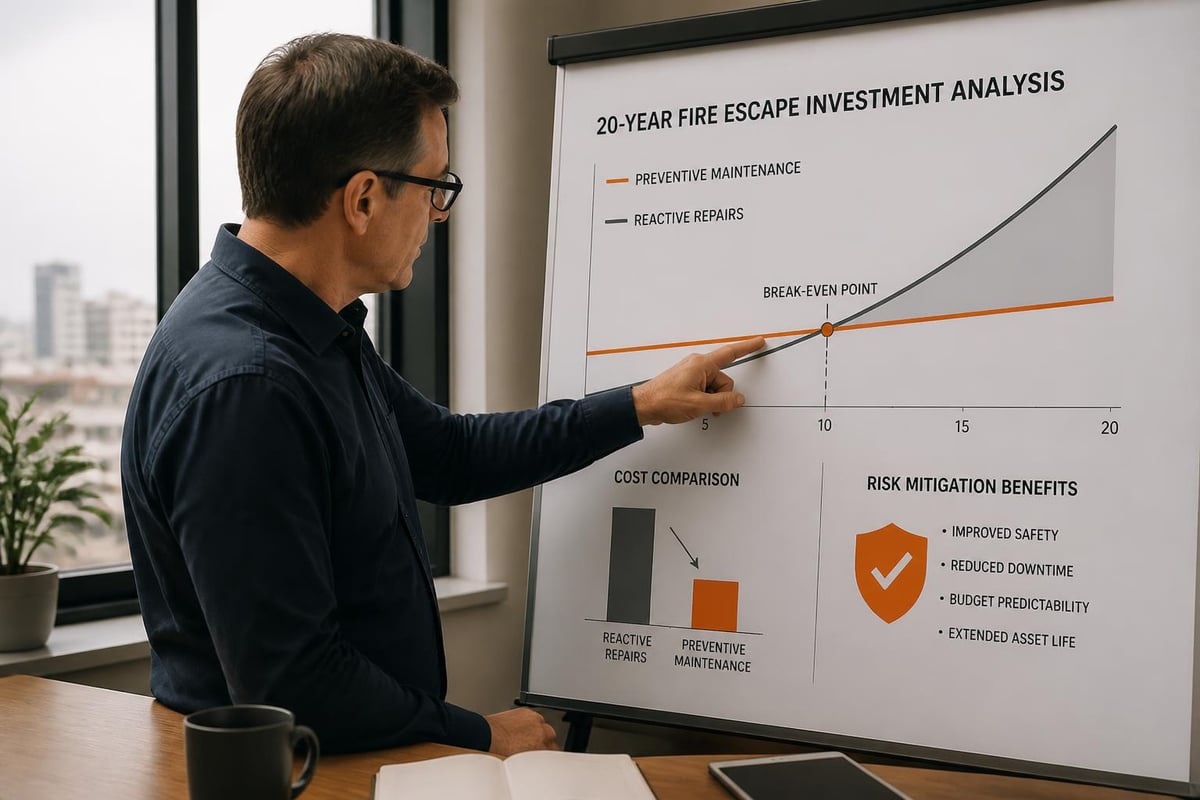
Deferred maintenance frequently escalates long-term costs, as minor corrosion or structural issues progress into major rehabilitation projects. Establishing preventive maintenance schedules reduces lifetime costs whilst maintaining continuous compliance and safety performance.
Return on Investment Considerations
Whilst fire escapes represent ongoing expense obligations, they provide measurable value through risk mitigation and regulatory compliance. Properties with well-maintained egress systems command premium valuations and reduced insurance premiums compared to those with deferred safety maintenance.
Investment in fire escape improvements often qualifies for insurance premium reductions when documented through professional certification. Additionally, properties demonstrating proactive safety management attract quality tenants willing to pay premium rates for secure, compliant facilities.
Professional Service Requirements
Maintaining fire escapes to appropriate standards requires engagement with qualified professionals possessing relevant expertise and certification. Fire and security engineers bring specialised knowledge of structural requirements, regulatory compliance, and integration with broader safety systems.
Service providers should demonstrate relevant qualifications including structural engineering credentials, familiarity with current building regulations, and experience with commercial property safety systems. Requesting case studies and client references helps verify provider capabilities before committing to service agreements.
Regular service agreements typically prove more cost-effective than ad-hoc engagements, providing predictable budgeting whilst ensuring consistent attention to maintenance requirements. Service level agreements should specify inspection frequencies, response times for emergency repairs, and documentation deliverables.
Multi-Disciplinary Coordination
Comprehensive building safety management requires coordination among various specialist trades and service providers. Fire escape maintenance intersects with structural engineering, fire safety consulting, facilities management, and regulatory compliance functions.
Establishing clear communication protocols and coordination mechanisms ensures that interdependent systems receive appropriate attention. For example, fire alarm testing procedures should incorporate verification that escape route access doors function properly when alarms activate, whilst evacuation alert systems must account for occupant routing through available egress paths.
Training and Emergency Preparedness
Physical infrastructure represents only one component of effective evacuation capabilities. Occupant familiarity with escape routes and proper usage procedures significantly impacts emergency outcomes. Regular training programmes ensure that building users can locate and utilise fire escapes efficiently during actual emergencies.
Training programmes should address specific aspects of fire escape usage including access point locations throughout facilities, proper descent techniques on external stairways, assembly point procedures after evacuation, and special considerations for assisting occupants with mobility limitations.
Essential training elements include:
- Quarterly evacuation drills utilising fire escape routes
- Orientation programmes for new building occupants
- Refresher training addressing procedural updates
- Scenario-based exercises simulating various emergency conditions
- Documentation of participation and competency verification
Building managers should coordinate fire escape training with broader emergency response procedures, ensuring consistency across alarm systems activation, communication protocols, and accountability measures. Integration with security management systems enables verification that all occupants have evacuated successfully.
Accessibility Compliance
Modern fire safety planning must accommodate occupants with diverse mobility capabilities. Traditional fire escapes present challenges for wheelchair users and others with physical limitations, necessitating alternative provisions within comprehensive evacuation strategies.
Solutions include designated refuge areas where mobility-impaired occupants can await assisted evacuation, evacuation chairs enabling descent via stairs, and coordination with emergency services ensuring prompt assistance for those unable to self-evacuate. These provisions require integration with building access control systems and communication networks enabling occupants to request assistance.
Future Trends and Technological Integration
Emerging technologies offer opportunities to enhance fire escape monitoring and management capabilities. Sensor networks can provide real-time status information about escape route conditions, whilst predictive maintenance algorithms identify potential failures before they compromise safety.
Internet of Things (IoT) devices installed along fire escape routes monitor structural movements, temperature variations, and access door status. This continuous monitoring complements periodic manual inspections, providing early warning of developing issues requiring attention. Integration with commercial security systems creates comprehensive building management platforms consolidating safety-related information.
Augmented reality applications assist maintenance personnel by overlaying structural information and historical repair data onto visual inspections. These tools improve inspection thoroughness whilst reducing time requirements, enhancing cost-effectiveness of maintenance programmes. Advanced fire detection systems increasingly incorporate escape route monitoring as integral safety features rather than separate systems.
Fire escapes continue serving essential functions in commercial building safety, requiring dedicated attention to maintenance, regulatory compliance, and integration with broader protection systems. Businesses managing properties with these critical egress routes benefit from partnering with experienced specialists who understand the technical requirements and regulatory obligations involved. Logic Fire and Security provides comprehensive fire safety solutions for commercial properties across the UK, delivering expert guidance on escape route assessment, system integration, and compliance management to ensure your facilities maintain the highest safety standards for occupants and operations.