

Proper smoke alarm placement can mean the difference between early fire detection and catastrophic loss in commercial environments. Understanding where should i put smoke alarms is crucial for business owners, facilities managers, and safety officers responsible for protecting employees, customers, and valuable assets. This comprehensive guide examines the strategic placement of smoke detection devices across various commercial settings, ensuring your organisation meets regulatory requirements whilst maximising protection.
Essential Smoke Alarm Placement Guidelines for Commercial Premises
The question of where should i put smoke alarms in commercial buildings requires careful consideration of building layout, occupancy patterns, and fire safety regulations. British Standards BS 5839-1:2017 provides the framework for fire detection and alarm systems in non-domestic premises throughout the UK.
Every commercial property requires smoke alarms positioned to detect fire at the earliest possible stage. The fundamental principle involves creating overlapping zones of detection that eliminate blind spots whilst accounting for air movement patterns, ceiling heights, and potential fire load areas.
Core Placement Requirements
Commercial smoke alarm installation differs significantly from residential applications due to larger floor areas, complex layouts, and varied occupancy types. Key placement zones include:
- Every floor level within the building, including basements and plant rooms
- All corridors and hallways that serve as escape routes
- Stairwells and vertical shafts where smoke naturally rises
- Storage areas containing combustible materials
- Spaces above suspended ceilings where fires can develop undetected
- Plant rooms housing mechanical and electrical equipment
First Alert’s placement guidelines emphasise avoiding dead air spaces near corners and ensuring adequate coverage across each level.

Smoke Alarm Positioning for Different Commercial Spaces
Understanding where should i put smoke alarms requires adapting placement strategies to specific business environments. Each commercial setting presents unique challenges and regulatory considerations.
Office Environments and Administrative Spaces
Open-plan offices demand strategic smoke alarm distribution across the ceiling space. Position detectors:
- At maximum 7.5-metre intervals for ceiling-mounted optical smoke detectors
- Away from air conditioning vents by at least one metre to prevent false alarms
- Within 500mm of walls where ceiling meets perimeter
- In enclosed meeting rooms and private offices
Modern office layouts with flexible workspaces require additional consideration for temporary partitions and evolving floor plans. Installing commercial fire detection systems with addressable technology allows for easier reconfiguration as your workspace evolves.
Retail and Public-Facing Premises
Retail environments combine customer areas, back-of-house storage, and often accommodation spaces. Critical placement includes:
| Location Type | Detector Placement | Special Considerations |
|---|---|---|
| Sales Floor | Every 100m² maximum | High ceilings may require beam detectors |
| Stockrooms | Above and within racked storage | Consider heat detectors near loading bays |
| Changing Rooms | Individual cubicles if enclosed | Privacy concerns balanced with safety |
| Staff Areas | Break rooms, offices, kitchens | Heat detectors in kitchen environments |
The Honolulu Fire Department’s guidelines stress the importance of smoke alarm placement in all occupied spaces, which translates to comprehensive coverage in commercial retail settings.
Manufacturing and Industrial Facilities
Industrial environments present complex challenges when determining where should i put smoke alarms. Manufacturing spaces often contain processes that generate dust, fumes, or steam that can trigger false alarms.
Strategic approaches include:
- Using aspirating smoke detection systems in dusty environments
- Installing beam detectors across large open manufacturing floors
- Positioning heat detectors near welding or hot work areas
- Placing optical smoke detectors in clean areas and corridors
- Implementing multi-sensor devices that combine smoke and heat detection
Production facilities must balance operational requirements with fire safety. Understanding system fire protection principles helps optimise detector selection and placement for industrial applications.
Height and Mounting Considerations
Ceiling height significantly impacts where should i put smoke alarms in commercial buildings. Standard smoke detectors perform optimally in spaces with ceiling heights between 3 and 10.5 metres.
Standard Ceiling Heights (3-7.5 metres)
For typical commercial spaces, mount smoke alarms:
- On the ceiling at least 300mm from walls and light fittings
- On walls 150-300mm below the ceiling if ceiling mounting proves impractical
- In the centre of corridors and hallways under 3 metres wide
- Alternating sides in corridors exceeding 3 metres width
Avoid mounting near ceiling fans, air handling units, or areas with strong airflow patterns that could divert smoke away from detectors.
High Ceiling Applications
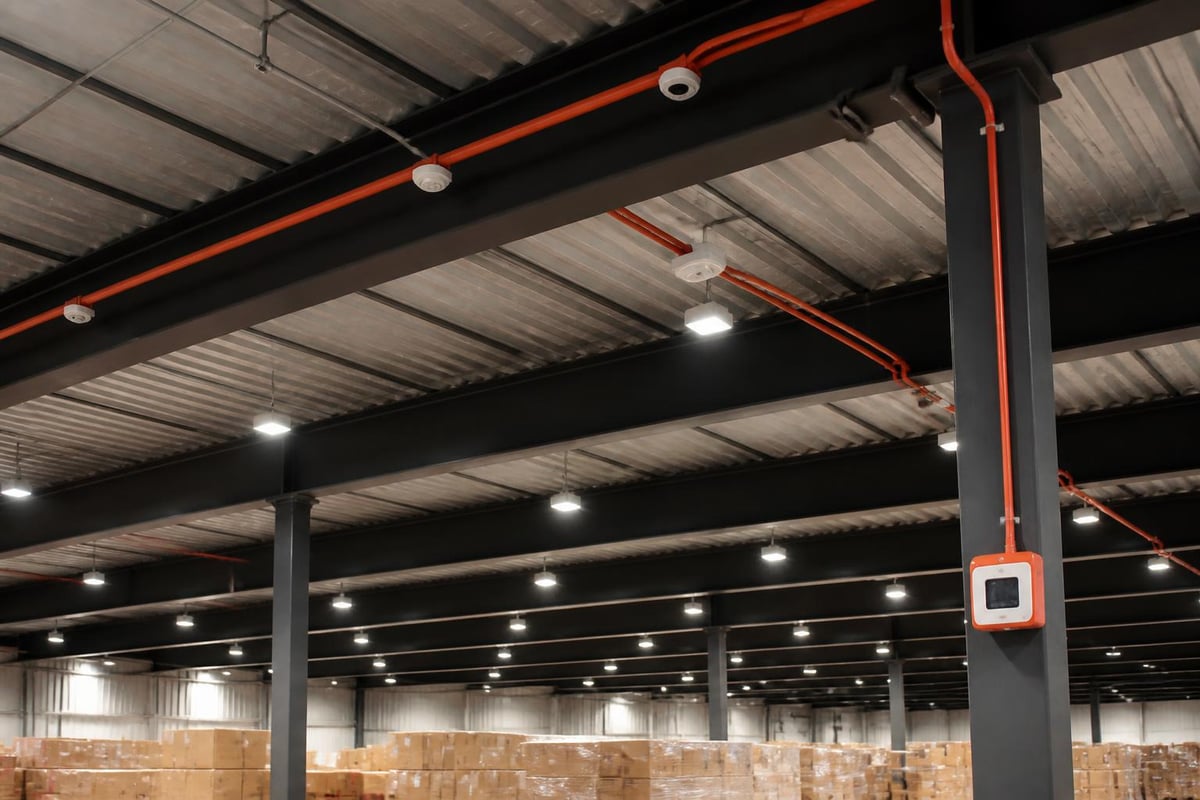
Warehouses, atriums, and industrial units with high ceilings require specialised detection solutions. Options include:
- Beam detectors for spaces 7.5-25 metres high
- Aspirating systems that actively sample air at ceiling level
- Projected beam smoke detectors across large open areas
- Multi-level detection with detectors at various heights
Sleeping Accommodation in Commercial Properties
Hotels, hospitals, care facilities, and other commercial premises with sleeping accommodation require enhanced smoke alarm coverage. Where should i put smoke alarms in these sensitive environments demands particular attention to life safety.
Hotels and Guest Accommodation
Every guest room requires:
Individual room protection:
- Smoke alarm within each sleeping room
- Connection to a monitored fire alarm system
- Sufficient audibility to wake sleeping occupants
- Regular testing and maintenance schedules
Common area coverage:
- Smoke detectors throughout corridors on each floor
- Stairwell protection on every level
- Coverage in lounges, dining areas, and function rooms
- Kitchen protection using heat detectors
The Texas Department of Insurance recommendations emphasise placement in sleeping areas, which applies equally to commercial accommodation settings.
Healthcare and Care Facilities
Medical facilities require comprehensive smoke detection integrated with fire safety and protection systems. Position alarms:
- In every patient room and ward area
- Throughout corridors with maximum 15-metre spacing
- In treatment rooms and consulting spaces
- Within storage areas for medical supplies and pharmaceuticals
- Throughout administrative and staff areas
Healthcare environments often operate 24/7, requiring smoke detection systems that minimise disruption whilst maintaining vigilance.
Areas Requiring Special Consideration
Certain commercial spaces present unique challenges when determining where should i put smoke alarms. These environments require tailored detection strategies.
Kitchen and Food Preparation Areas
Commercial kitchens generate heat, steam, and cooking particles that can cause false alarms. Implement:
- Heat detectors rather than smoke detectors directly above cooking appliances
- Optical smoke detectors in adjacent serving and dining areas
- Rate-of-rise heat detectors in kitchen extraction systems
- Aspirating detection in large commercial kitchen facilities
Understanding kitchen suppression systems helps integrate smoke detection with fire suppression technology.
Plant Rooms and Service Areas
Mechanical, electrical, and telecommunications equipment rooms require smoke detection despite limited occupancy:
- Position detectors to cover entire floor area
- Install additional detection within electrical cabinets and server racks
- Consider aspirating systems for early warning in critical infrastructure spaces
- Ensure detectors remain accessible for maintenance
Void Spaces and Concealed Areas
Fires often develop undetected in ceiling voids, floor voids, and service ducts. Address these hidden risks by installing:
| Void Type | Detection Strategy | Spacing Requirements |
|---|---|---|
| Ceiling Voids | Detectors throughout void space | Every 10.5m maximum |
| Riser Shafts | Each floor penetration | Every level |
| Cable Ducts | Within duct if large volume | Based on duct dimensions |
| Below Raised Floors | Throughout underfloor space | Every 10.5m maximum |
Regulatory Compliance and British Standards
Understanding where should i put smoke alarms involves compliance with UK fire safety legislation. The Regulatory Reform (Fire Safety) Order 2005 places responsibility on the ‘responsible person’ to conduct fire risk assessments and implement appropriate fire safety measures.
Key Regulatory Requirements
BS 5839-1:2017 specifies smoke alarm placement for different fire alarm system categories:
- Category L1 (full coverage): Smoke detectors throughout all areas
- Category L2 (partial coverage): Detection in specified areas plus escape routes
- Category L3: Coverage of escape routes only
- Category L4: Detection in areas where automatic fire alarm system activation is required
- Category L5: Localized smoke detection to specific risks
Most commercial premises require Category L2 or L3 systems as a minimum. High-risk environments or premises with sleeping accommodation typically need L1 coverage.
Professional fire risk assessment determines the appropriate category and specific smoke alarm placement requirements for your building.
System Design and Professional Installation
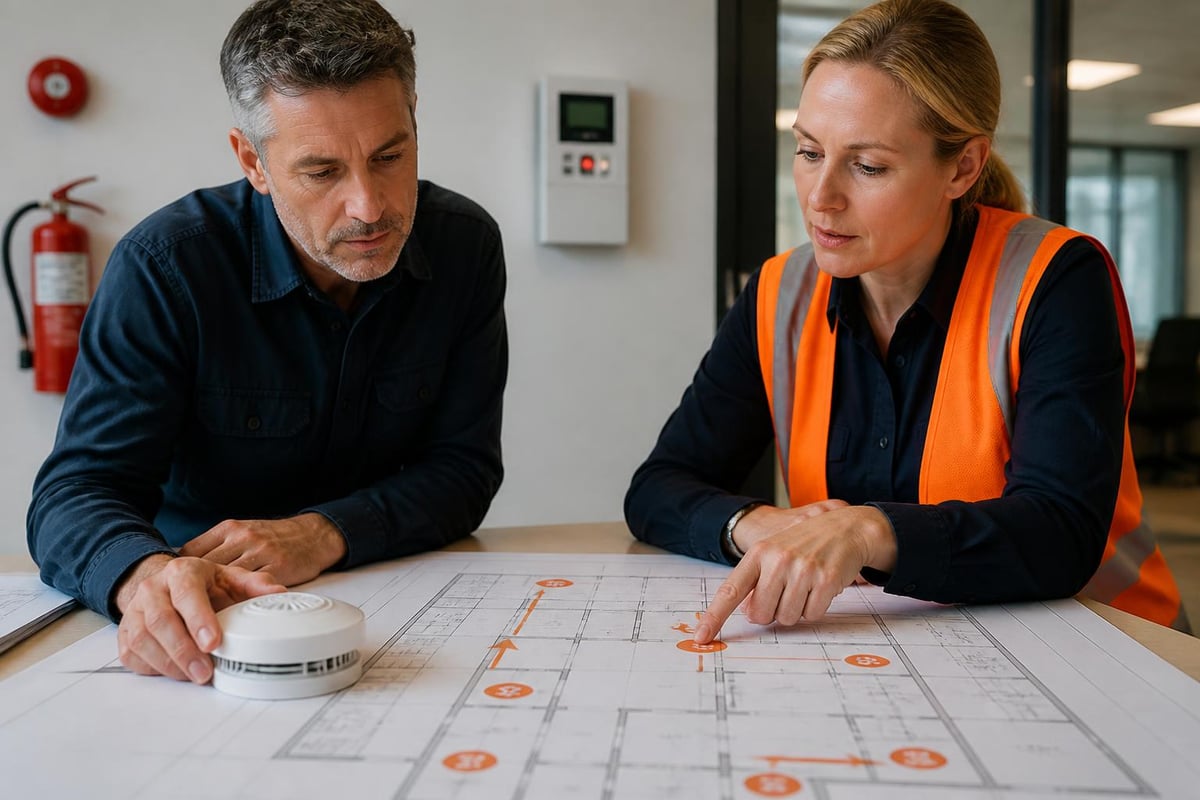
Answering where should i put smoke alarms correctly requires professional fire safety expertise. Qualified fire alarm designers consider:
- Building layout and construction including compartmentation
- Occupancy type and patterns throughout 24-hour periods
- Fire load and risk areas within the premises
- Existing fire protection measures such as sprinklers or suppression systems
- Evacuation strategy including phased or simultaneous evacuation
Engaging specialists like Logic Fire and Security ensures your smoke alarm system meets all regulatory requirements whilst providing optimal protection tailored to your specific premises.
Maintenance Access and Practical Considerations
Determining where should i put smoke alarms must account for ongoing maintenance requirements. Detectors positioned in inaccessible locations create compliance risks and operational challenges.
Accessibility Requirements
Position smoke alarms considering:
- Safe access for routine testing and maintenance
- Adequate working space around each detector
- Equipment access for scissor lifts or access platforms in high spaces
- Minimum disruption to business operations during servicing
Regular fire alarm testing ensures continued reliability. Plan detector locations that facilitate weekly, monthly, and annual maintenance activities.
Environmental Factors
External conditions impact where should i put smoke alarms effectively:
- Temperature extremes: Standard detectors operate between -10°C and 55°C
- Humidity levels: Moisture can affect detector sensitivity
- Dust and contamination: Industrial environments may require protective covers
- Electromagnetic interference: Position away from strong electrical equipment
Modern commercial fire alarm systems incorporate sophisticated technology that compensates for environmental variations, but placement remains critical.
Integration with Building Management Systems
Contemporary commercial fire safety extends beyond asking where should i put smoke alarms to encompass intelligent building integration. Modern smoke detection systems interface with:
Building automation platforms:
- HVAC systems for smoke control and fresh air supply
- Access control systems for controlled egress during emergencies
- Emergency lighting activation across escape routes
- Voice alarm and public address systems
Remote monitoring capabilities:
- Real-time alarm notification to designated personnel
- Off-site monitoring through approved alarm receiving centres
- Mobile application alerts for facilities managers
- Integration with security and CCTV systems
Understanding protection systems helps optimise detector placement within broader building safety architecture.
Wireless and Addressable Detection Technologies
Advances in fire detection technology influence where should i put smoke alarms by offering flexible installation options. These modern systems provide advantages for complex commercial environments.
Wireless Fire Detection Systems
Wireless fire alarms offer practical solutions for:
- Listed buildings where cable installation damages historic fabric
- Temporary installations during construction or refurbishment
- Retrofit applications in occupied premises
- Sites where cabling proves impractical or excessively expensive
Wireless technology maintains the same placement principles as wired systems but eliminates infrastructure constraints.
Addressable System Benefits
Addressable fire alarm systems assign each detector a unique identifier, enabling:
- Precise location identification when alarms activate
- Individual device monitoring for faults and contamination
- Reduced false alarms through multi-sensor correlation
- Flexible zoning adapted to building changes
These intelligent systems influence where should i put smoke alarms by allowing more sophisticated detection strategies across large or complex commercial sites.
Detector Spacing and Coverage Calculations
Professional smoke alarm placement requires precise coverage calculations. British Standards specify maximum spacing based on detector type and ceiling characteristics.
Standard Spacing Requirements
| Detector Type | Maximum Ceiling Height | Maximum Floor Area Coverage | Maximum Distance Between Detectors |
|---|---|---|---|
| Optical Smoke | 10.5m | 100m² | 7.5m |
| Ionisation Smoke | 10.5m | 85m² | 7.5m |
| Multi-Sensor | 10.5m | 100m² | 7.5m |
| Heat Detector | 9m | 50m² | 5.3m |
These figures represent maximums under ideal conditions. Real-world applications often require closer spacing based on:
- Ceiling slope and configuration
- Beam and joist arrangements
- Air movement patterns
- Specific fire risks present
Corridor and Stairwell Spacing
Linear spaces follow different placement rules. The Country Fire Authority installation guidance principles apply to commercial settings:
- Maximum 15-metre spacing along corridors
- Detectors at corridor intersections and direction changes
- Within 7.5 metres of corridor dead ends
- Every floor level in stairwells and vertical escape routes
False Alarm Prevention Through Proper Placement
Understanding where should i put smoke alarms includes avoiding locations prone to false activations. Nuisance alarms undermine confidence in fire safety systems and create operational disruption.
Avoid positioning smoke detectors:
- Within one metre of air conditioning diffusers or extract grilles
- Near doorways where drafts concentrate
- Above or adjacent to steam-producing equipment
- In dusty environments without appropriate detector types
- Close to areas with regular smoking activity (where permitted)
Proper placement significantly reduces false alarms whilst maintaining effective fire detection. Consider smoke detector locations carefully to balance sensitivity with reliability.
Alternative detector technologies suit challenging environments:
- Multi-sensor detectors combining smoke and heat in one device
- Aspirating systems with sophisticated smoke particle analysis
- Heat detectors in areas where smoke detection proves impractical
- Beam detectors for wide-area coverage with minimal false alarm risk
Documentation and Ongoing Compliance
Answering where should i put smoke alarms requires comprehensive documentation. Maintain records including:
System design documentation:
- Detailed drawings showing all detector locations
- Coverage calculations and spacing justifications
- Equipment specifications and manufacturer data sheets
- Commissioning certificates and test results
Maintenance records:
- Weekly test logs confirming system functionality
- Monthly inspection reports documenting detector condition
- Annual service records from competent technicians
- Battery replacement schedules for backup power supplies
The City of Tallahassee’s guidelines emphasise proper mounting alongside maintenance documentation, principles that extend to commercial applications.
These records demonstrate compliance during inspections and provide valuable information for system modifications or extensions.
Effective smoke alarm placement in commercial buildings requires careful planning that balances regulatory requirements, building characteristics, and operational needs. Strategic positioning across all floor levels, corridors, sleeping areas, and high-risk zones creates comprehensive fire detection coverage that protects people, property, and business continuity. Logic Fire and Security brings extensive expertise in designing, installing, and maintaining commercial fire detection systems tailored to your specific premises, ensuring compliance with British Standards whilst delivering reliable protection for your organisation.