

Proper smoke detector locations can mean the difference between early warning and catastrophic loss. In 2026, building regulations and fire safety standards continue to evolve, placing greater emphasis on strategic detection placement throughout commercial and residential properties. Understanding where to position these life-saving devices requires knowledge of building layouts, airflow patterns, regulatory requirements, and the specific fire risks associated with different environments. This comprehensive guide examines the critical considerations that influence optimal smoke detector locations, helping property managers, business owners, and safety professionals make informed decisions about their fire detection systems.
Understanding Regulatory Requirements for Smoke Detector Locations
British Standards and building regulations provide specific guidance on smoke detector locations to ensure adequate coverage throughout occupied buildings. BS 5839-6:2019 establishes the benchmark for residential fire detection systems, whilst BS 5839-1:2017 governs commercial installations.
These standards define protection grades based on building use and risk assessment. Grade A systems, typically found in commercial environments, require professionally designed and installed equipment with devices positioned according to detailed floor plans. The comprehensive fire detection systems used in these applications demand careful planning.
Key Regulatory Specifications
Building Regulations Approved Document B mandates smoke detection in specific areas, with requirements varying by property type and construction date. New builds face more stringent requirements than existing structures, though retrofitting obligations continue to expand.
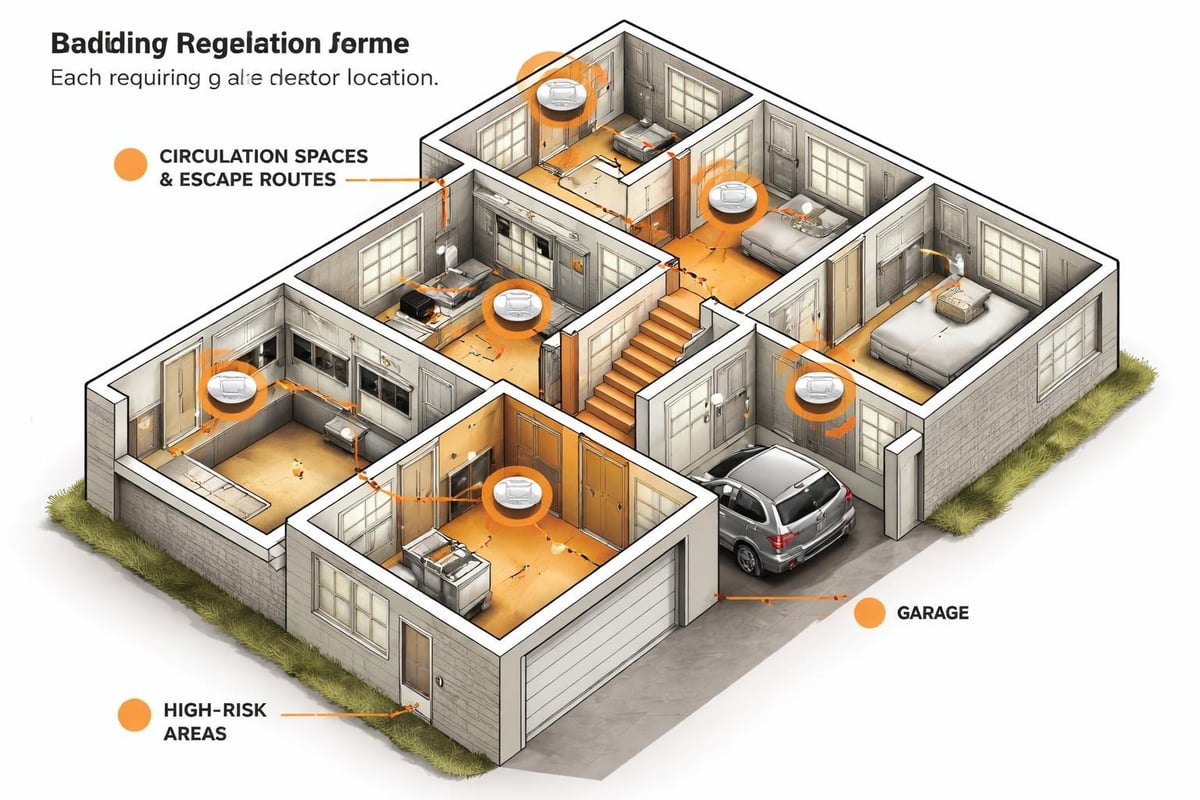
- Escape routes: All corridors and stairways forming part of evacuation paths require detection
- Living accommodation: Smoke detectors must be installed in circulation spaces between sleeping areas and exits
- High-risk zones: Areas with significant fire loading need enhanced coverage
- Interconnection: Multiple devices throughout a property must communicate to provide whole-building alerting
Federal regulations in other jurisdictions, such as federal housing standards, offer additional perspectives on comprehensive smoke alarm placement strategies that influence best practices globally.
Optimal Smoke Detector Locations in Commercial Buildings
Commercial properties present unique challenges for smoke detector locations due to complex layouts, varied ceiling heights, and diverse occupancy patterns. Strategic placement must account for business operations whilst maintaining regulatory compliance.
Open Plan Offices and Workspaces
Large open areas require systematic coverage based on ceiling height and detector specifications. Most point-type smoke detectors provide coverage of 50-100 square metres depending on ceiling height and environmental conditions.
| Ceiling Height | Maximum Coverage Area | Typical Spacing |
|---|---|---|
| Up to 3.5m | 100 m² | 10m intervals |
| 3.5m to 6m | 80 m² | 9m intervals |
| 6m to 7.5m | 60 m² | 7.5m intervals |
Position detectors to avoid dead air spaces near walls whilst ensuring adequate coverage in areas where staff congregate. Equipment rooms, server facilities, and storage areas require dedicated detection regardless of their size, as these spaces often contain high-value assets or critical infrastructure.
Corridors and Circulation Spaces
Hallways and passages demand specific smoke detector locations to ensure early detection in escape routes. Place devices at regular intervals not exceeding 15 metres, with additional units positioned within 7.5 metres of corridor ends and immediately outside rooms presenting particular fire risks.
Consider airflow patterns created by HVAC systems, as strong air currents can delay smoke reaching detection devices. Commercial fire alarm systems integrate detection with building management systems to coordinate response across multiple zones.
Stairwells and Vertical Shafts
These areas require smoke detector locations at every level, typically at the highest point to capture rising smoke. Install detectors on stairwell ceilings at each floor landing, ensuring they're positioned to detect smoke before it obscures escape routes. Vertical shafts such as lift wells and service risers need detection at the top of the shaft and at alternate floor levels for tall buildings.
Residential Smoke Detector Locations
Homes and residential accommodation require carefully considered smoke detector locations to protect occupants during their most vulnerable hours. The majority of fire fatalities occur at night when residents are sleeping, making bedroom-adjacent detection crucial.
Essential Placement Areas
Every home needs smoke detectors in specific locations to meet minimum safety standards:
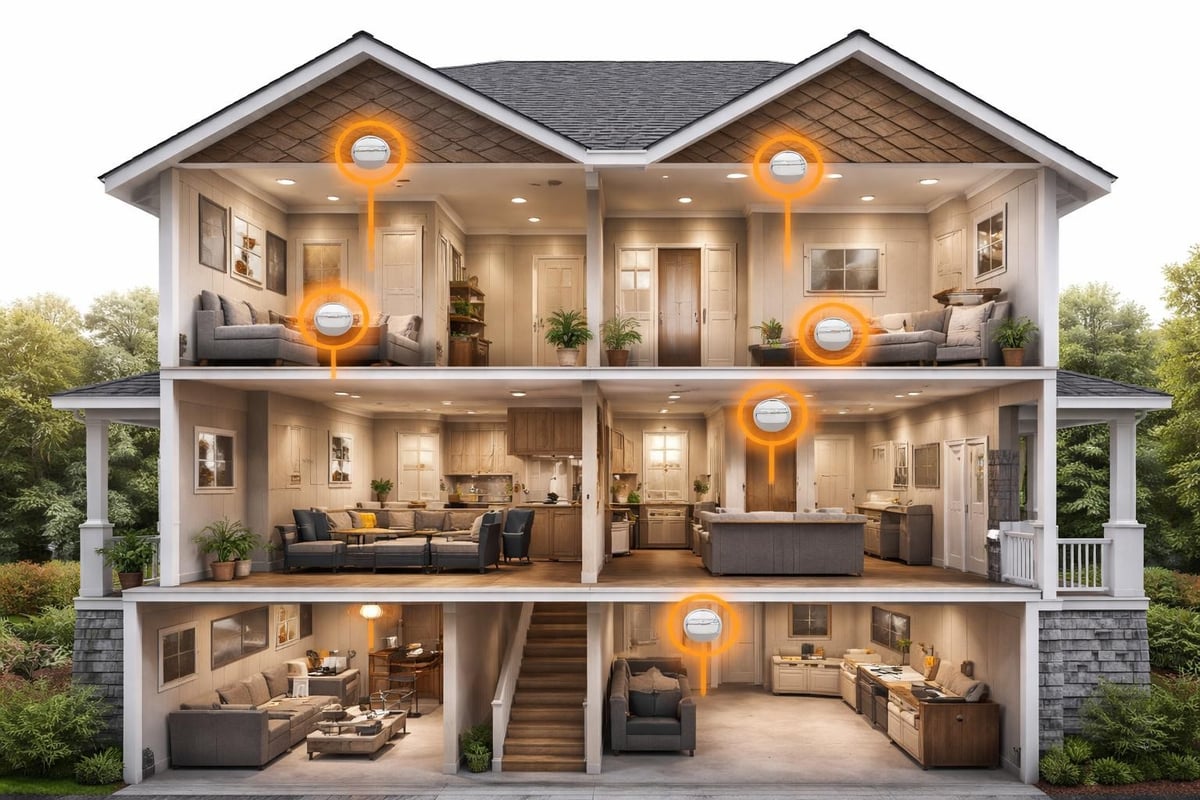
- Hallways and landings: Install detectors in circulation spaces between bedrooms and exits
- Each floor level: Every storey requires at least one smoke detector, including basements and loft conversions
- Living rooms: The primary living space needs detection, particularly if used for relaxation and sleeping
- Kitchen approaches: Position devices between the kitchen and living areas, avoiding direct kitchen placement to reduce false alarms
The NFPA installation guide provides detailed recommendations for residential smoke alarm installation, emphasising the importance of testing and maintenance alongside proper placement.
Bedroom Considerations
Whilst detectors inside bedrooms aren't always mandatory, they provide additional protection for vulnerable occupants and those sleeping with doors closed. Children, elderly residents, and individuals with mobility challenges benefit significantly from in-room detection.
Mount detectors centrally on bedroom ceilings, at least 300mm from walls and light fittings. Wall-mounted units should sit 150-300mm below the ceiling to remain within the smoke layer whilst avoiding dead air spaces.
Technical Considerations for Smoke Detector Locations
Beyond regulatory compliance, several technical factors influence effective smoke detector locations. Understanding these elements ensures devices function optimally whilst minimising nuisance alarms that undermine system credibility.
Ceiling Height and Smoke Stratification
Smoke behaviour changes dramatically with ceiling height. In spaces below 3.5 metres, smoke typically rises directly to the ceiling, making standard detector placement straightforward. Higher ceilings create thermal layering effects where smoke may plateau below the ceiling surface.
Addressing tall spaces requires careful analysis:
- Install beam detectors for ceilings above 10 metres
- Use multi-sensor devices combining smoke and heat detection in challenging environments
- Consider air sampling systems for very early warning in critical facilities
- Position spot detectors on walls at appropriate heights when ceiling mounting proves impractical
The Consumer Product Safety Commission report examines detector performance across various installation scenarios, highlighting the importance of proper placement for effective fire detection.
Airflow and Environmental Factors
HVAC systems, natural ventilation, and building design create airflow patterns that affect smoke detector locations. Strong air currents can carry smoke away from detectors or prevent it from entering sensing chambers, delaying alarm activation.
Position devices away from:
- Air supply diffusers (minimum 1.5 metres)
- Return air grilles (minimum 1 metre)
- Ceiling fans and extract ventilators
- Windows and doors creating cross-draughts
- Areas subject to condensation or excessive moisture
Manufacturing facilities, warehouses, and industrial premises require specialised assessment to determine smoke detector locations that account for processes generating dust, fumes, or steam. Fire risk assessment companies provide professional evaluation of these complex environments.
Locations to Avoid for Smoke Detectors
Certain positions create problems for smoke detector locations, generating false alarms or preventing proper detection. Avoiding these areas ensures reliable system performance and maintains occupant confidence in fire protection measures.
High False Alarm Risk Areas
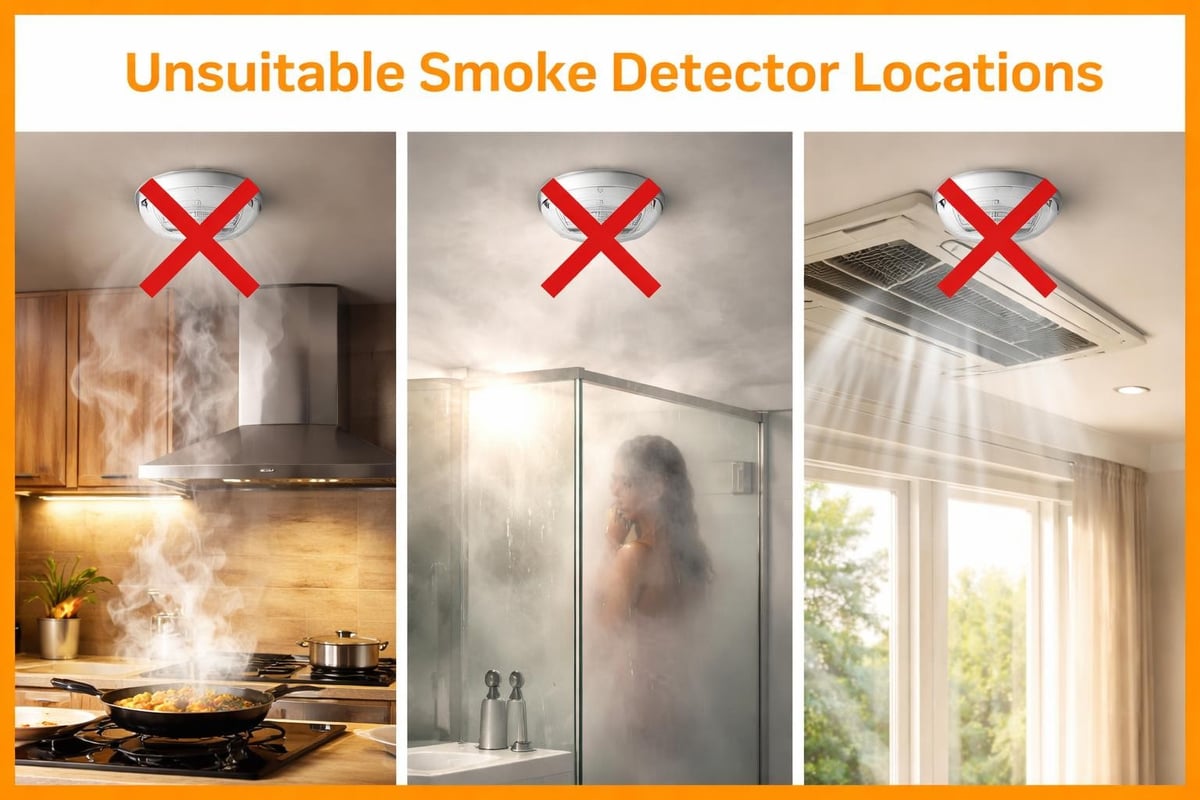
Never install smoke detectors directly in kitchens where cooking activities generate smoke and steam. Position devices at least 3 metres from cooking appliances, or use heat detectors in kitchen areas instead. Similarly, bathrooms generate steam that triggers smoke alarms, making them unsuitable locations.
| Area Type | Issue | Recommended Alternative |
|---|---|---|
| Kitchens | Cooking fumes | Heat detector or optical detector 3m+ away |
| Bathrooms | Steam and moisture | Heat detector only |
| Garages | Vehicle exhaust | Heat or CO detector |
| Boiler rooms | Combustion products | Heat detector or flame detector |
The Hopkins, MN guidance on smoke alarms emphasizes areas to avoid, helping homeowners prevent nuisance activations whilst maintaining adequate protection.
Environmental Extremes
Smoke detector locations must avoid areas experiencing temperature extremes, excessive dust accumulation, or corrosive atmospheres. Devices rated for standard environmental conditions fail prematurely in harsh settings.
Freezing temperatures, excessive heat above 38°C, and high humidity all degrade detector performance. Dusty environments clog sensing chambers, whilst corrosive chemicals damage electronic components. These locations require either environmental protection measures or alternative detection technologies suited to challenging conditions.
Specialized Buildings and Unique Smoke Detector Locations
Certain property types demand specialized approaches to smoke detector locations based on their unique characteristics and occupancy patterns. Heritage buildings, healthcare facilities, educational institutions, and hospitality venues each present distinct challenges.
Healthcare and Care Facilities
Hospitals, care homes, and medical facilities require enhanced smoke detector locations that provide early warning whilst accommodating patients unable to self-evacuate. Progressive horizontal evacuation strategies influence detection placement, with devices positioned to identify fire development in its earliest stages.
Patient rooms, treatment areas, and sleeping accommodation all need individual detection. Corridors forming fire compartment boundaries require detection on both sides of fire doors. Operating theatres, laboratories, and areas using flammable materials demand specialized detection appropriate to the specific risks present.
Educational Establishments
Schools, colleges, and universities need smoke detector locations throughout teaching spaces, accommodation blocks, and assembly areas. Large halls and sports facilities present challenges due to high ceilings and complex airflow patterns created by ventilation systems.
Sleeping accommodation in boarding schools and university halls requires detection consistent with residential guidance, whilst teaching spaces follow commercial standards. Science laboratories and workshops using hazardous materials need advanced fire alarm systems capable of distinguishing genuine fires from process-generated smoke or fumes.
Heritage and Listed Buildings
Historic properties present unique challenges for smoke detector locations, balancing preservation requirements with life safety obligations. Wireless detection systems minimize installation impact, whilst careful device selection ensures equipment remains discreet within sensitive interiors.
Listed building consent may restrict certain smoke detector locations or mounting methods. Professional fire safety consultants work with conservation officers to identify solutions protecting both the building and its occupants. Fire alarm design for heritage properties requires specialist expertise combining regulatory knowledge with conservation principles.
Integration with Complete Fire Safety Systems
Smoke detector locations form one component of comprehensive fire protection strategies. Effective detection systems integrate with alarm sounders, emergency lighting, evacuation alert systems, and building management platforms to coordinate complete emergency response.
Multi-Sensor Detection Strategies
Modern installations combine smoke detectors with heat sensors, CO detectors, and flame detection devices. This multi-sensor approach enhances reliability whilst reducing false alarms. Position each detector type according to the specific hazard it monitors, creating overlapping coverage that ensures rapid fire identification.
Heat detectors supplement smoke detector locations in areas prone to nuisance alarms:
- Kitchens and cooking areas
- Boiler rooms and plant spaces
- Dusty workshops and manufacturing zones
- Garages and vehicle maintenance facilities
Combining detection technologies creates robust systems suitable for complex commercial environments where single-technology approaches prove inadequate.
Monitoring and Maintenance Access
Smoke detector locations must remain accessible for routine maintenance, testing, and battery replacement. Fire alarm system inspections require technicians to reach every device safely, making extremely high or awkward positions problematic for ongoing servicing.
Plan detector placement considering:
- Safe access for testing and cleaning
- Replacement part availability
- Detector lifespan and replacement schedules
- Remote monitoring capabilities for critical facilities
Professional installation companies incorporate maintenance requirements into system design, ensuring smoke detector locations remain practical throughout the system's operational life. Businesses requiring commercial fire alarm monitoring benefit from systems designed for long-term serviceability.
Zone Planning and Detector Density
Effective smoke detector locations require systematic zone planning that divides buildings into manageable detection areas. Each zone provides specific information about fire location, enabling targeted response and efficient evacuation procedures.
Calculating Detector Requirements
Determine the number of devices needed by dividing total floor area by maximum coverage per detector, then adjust for specific room layouts and compartmentation. Small rooms require individual detection regardless of coverage calculations, whilst large open areas might need additional devices beyond mathematical minimums to ensure adequate response times.
British Standards provide detailed calculation methods accounting for ceiling height, detector type, and building characteristics. Professional designers use specialized software to model smoke movement and optimize detector placement, particularly in complex commercial environments.
| Building Type | Typical Detector Density | Special Considerations |
|---|---|---|
| Offices | 1 per 80-100 m² | Meeting rooms need individual coverage |
| Retail | 1 per 70-90 m² | Storage areas require enhanced detection |
| Industrial | 1 per 50-80 m² | Process areas may need specialist devices |
| Residential | 1 per floor minimum | Each circulation space needs coverage |
Zoning for Effective Response
Divide buildings into detection zones that align with fire compartments and evacuation strategies. Each zone should enable responders to quickly locate fire origin whilst providing occupants with specific guidance about threat location.
Large buildings require multiple zones, typically limiting each zone to 2,000 square metres or a single fire compartment. Tall buildings use vertical zoning with each floor or pair of floors forming separate zones. This approach provides evacuation alarms with precise location information, enabling phased evacuation procedures in large occupancies.
Smoke Detector Locations in Mixed-Use Developments
Properties combining residential, commercial, and retail uses need carefully planned smoke detector locations addressing each area's specific requirements whilst maintaining system integration. Mixed-use developments present unique challenges for fire safety design.
Compartmentation and Detection Boundaries
Fire compartment boundaries between different uses require detection on both sides of separating elements. This dual coverage ensures early detection regardless of which area fire originates. Smoke detector locations in these transitional zones provide critical early warning, potentially preventing fire spread between occupancies.
Commercial areas typically require more comprehensive detection than residential spaces, creating different device densities within the same building. Coordinate smoke detector locations with compartment walls, fire doors, and smoke control systems to create cohesive protection strategies.
System Architecture Considerations
Decide whether mixed-use buildings employ single integrated systems or separate systems for different occupancies. Integrated approaches provide economies of scale and centralized monitoring but must accommodate different alarm strategies for various occupancy types. Residential areas often require simultaneous evacuation, whilst commercial spaces might use phased or progressive approaches.
The strategic placement recommendations from fire service professionals emphasize considering occupant behavior and building use patterns when determining detector locations in complex properties.
Future-Proofing Smoke Detector Locations
Building modifications, use changes, and technology evolution affect smoke detector locations throughout a property's lifespan. Design systems with flexibility to accommodate future adjustments without requiring complete reinstallation.
Adaptable Detection Infrastructure
Wireless detection technologies enable repositioning without extensive rewiring, making them ideal for buildings anticipating layout changes. However, addressable wired systems provide superior reliability and monitoring capabilities for permanent installations.
Consider future expansion when planning smoke detector locations, ensuring detection zones can be subdivided and panel capacity allows additional devices. Office refurbishments, retail reconfigurations, and residential conversions all impact detection requirements, making adaptable infrastructure valuable for long-term cost management.
Emerging Detection Technologies
Advanced technologies including video smoke detection, multi-criteria sensing, and artificial intelligence analytics improve detection accuracy whilst reducing false alarms. These systems learn environmental conditions and adapt sensitivity to match specific smoke detector locations, optimizing performance over time.
Cloud-connected systems enable remote monitoring, automatic fault notification, and predictive maintenance scheduling. Specify smoke detector locations considering both current technology and future upgrade paths, ensuring infrastructure remains relevant as detection capabilities advance.
Businesses exploring fire life safety systems should consider scalable solutions that evolve with organizational needs and technological developments.
Strategic smoke detector locations form the foundation of effective fire protection, requiring careful consideration of building design, occupancy patterns, and regulatory requirements. Professional fire safety specialists assess these complex factors to create detection systems that protect life and property whilst maintaining operational efficiency. Logic Fire and Security brings extensive experience designing, installing, and maintaining advanced fire detection systems for commercial and public sector clients throughout the UK, ensuring optimal smoke detector locations that meet regulatory standards and provide reliable early warning capabilities. Contact their team to discuss comprehensive fire safety solutions tailored to your specific premises and operational requirements.