

Modern fire protection demands solutions that balance effectiveness with minimal collateral damage. A water mist system represents one of the most innovative approaches to fire suppression available to commercial enterprises today. Unlike traditional sprinkler systems that discharge large volumes of water, these advanced systems use fine water droplets to control and extinguish fires whilst reducing water damage, making them particularly valuable for businesses with sensitive equipment, heritage buildings, or water-sensitive operations.
Understanding Water Mist Technology
A water mist system operates on a fundamentally different principle compared to conventional sprinkler installations. The technology generates extremely fine water droplets, typically less than 1,000 microns in diameter, which create a mist that rapidly absorbs heat and displaces oxygen around the fire source.
The science behind these systems centres on surface area maximisation. When water is atomised into millions of tiny droplets, the collective surface area increases exponentially compared to conventional spray patterns. This enhanced surface area allows for faster heat absorption, more efficient cooling, and superior fire suppression with significantly less water consumption.
Fire Suppression Mechanisms
Water mist systems employ three primary mechanisms to combat fires:
- Cooling effect: Fine droplets evaporate rapidly, absorbing substantial heat energy from the fire
- Oxygen displacement: Steam generation creates a barrier that reduces oxygen concentration around the flames
- Radiant heat attenuation: The mist barrier blocks radiant heat transfer, preventing fire spread
- Smoke reduction: Enhanced visibility during evacuation by controlling smoke production
- Wetting capability: Droplets penetrate into materials, preventing re-ignition
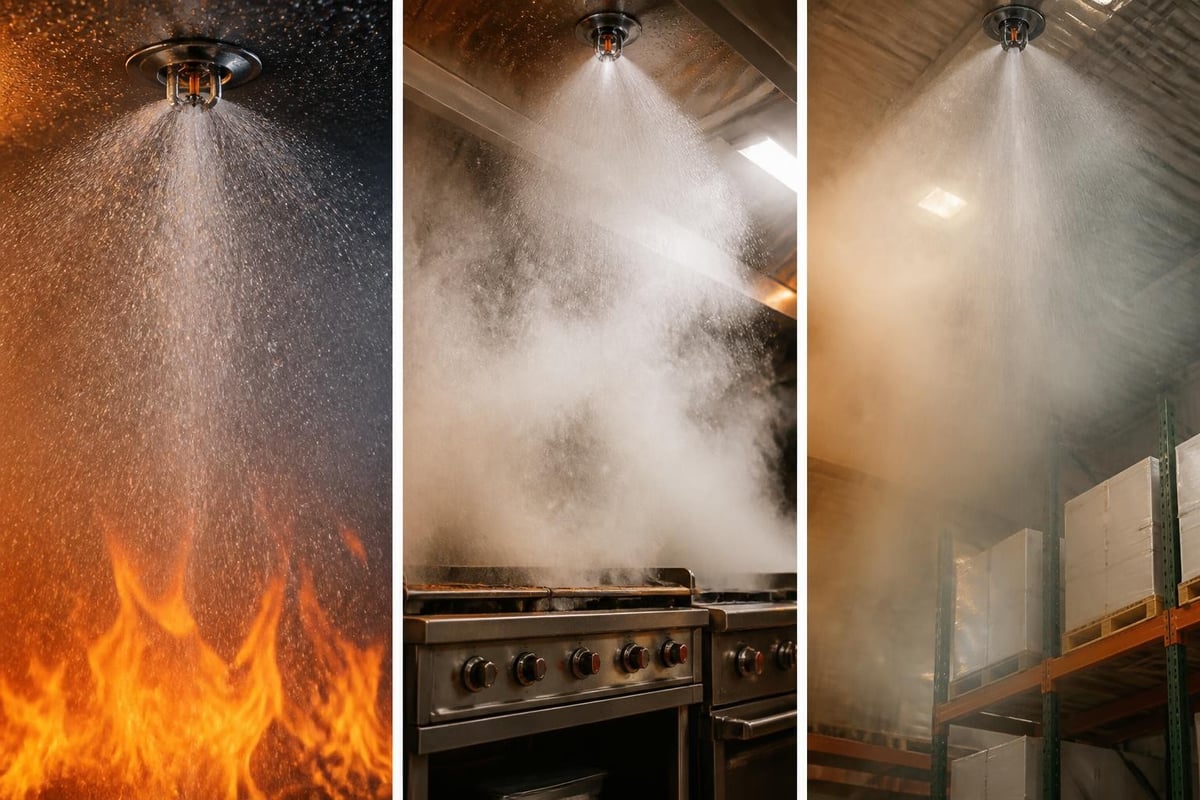
These combined mechanisms make water mist systems exceptionally effective across various fire classifications. The water mist system design and review process requires careful consideration of room geometry, fire load, and ventilation characteristics to optimise performance.
Applications in Commercial Environments
The versatility of a water mist system makes it suitable for diverse commercial applications where traditional sprinklers prove impractical or undesirable.
| Application Type | Primary Benefits | Typical Industries |
|---|---|---|
| Data Centres | Minimal equipment damage, rapid heat absorption | Technology, finance, telecommunications |
| Heritage Buildings | Reduced water damage, preserves artefacts | Museums, historic properties, libraries |
| Marine Vessels | Compact design, efficient water use | Shipping, offshore platforms, naval |
| Industrial Facilities | Chemical fire suppression, clean agent alternative | Manufacturing, processing, chemical |
| Transport Infrastructure | Space-efficient installation, quick response | Railways, airports, tunnels |
High-Value Asset Protection
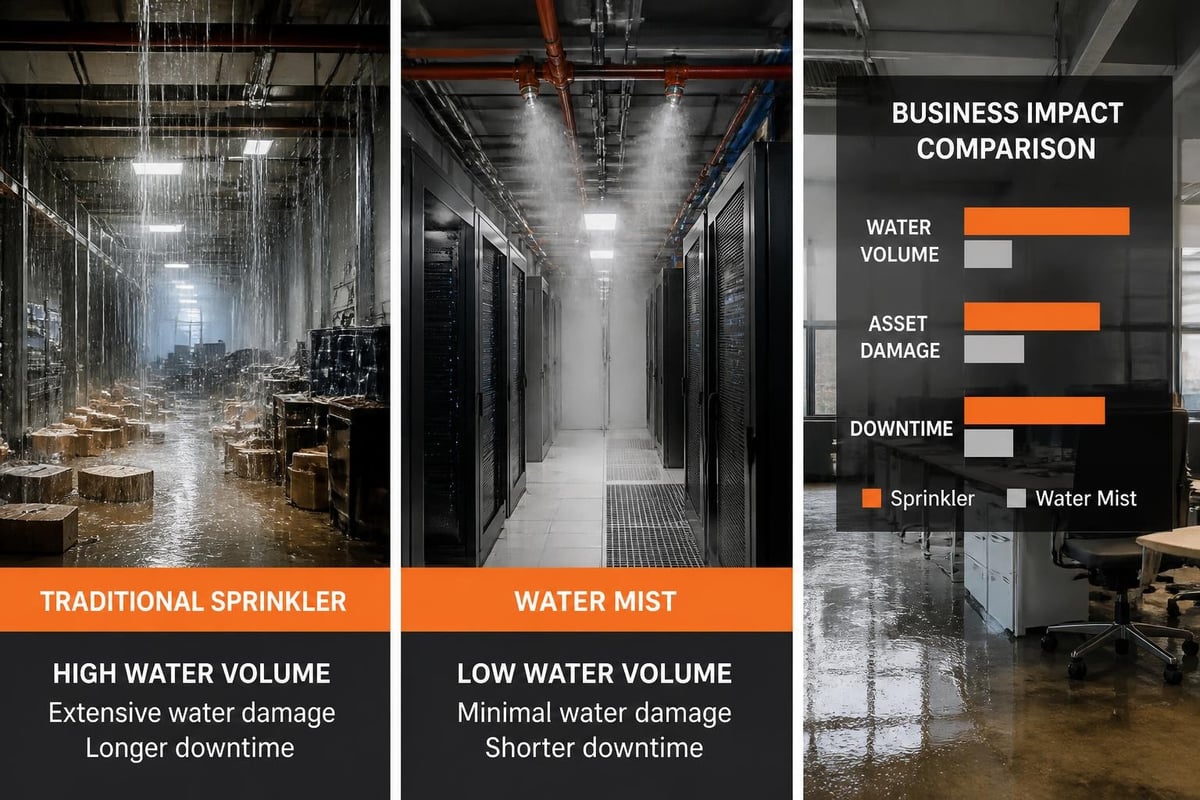
Businesses housing sensitive equipment or irreplaceable materials find particular value in water mist technology. Server rooms, telecommunications facilities, and archive storage areas all benefit from the reduced water discharge volumes. A properly designed water mist system can suppress a fire using up to 90% less water than traditional sprinklers, dramatically reducing the risk of water-related asset damage.
The pharmaceutical and electronics manufacturing sectors increasingly specify these systems where product contamination or equipment damage from excessive water would result in substantial financial losses. Understanding commercial fire detection systems integration helps businesses create comprehensive protection strategies.
Design Standards and Compliance
Implementing a water mist system requires adherence to rigorous standards that ensure reliability and effectiveness. The water mist system standards framework encompasses both international and regional requirements that govern design, installation, and maintenance protocols.
Regulatory Framework
In the UK, water mist installations must comply with British Standards and relevant building regulations. The primary standards include:
- BS 8489: Fixed fire protection systems encompassing water mist system specifications
- NFPA 750: International standard for water mist fire protection systems
- EN 14972: European standard for fixed firefighting systems using water mist
- FM 5560: Factory Mutual approval standard for specific applications
- IMO regulations: For marine and offshore installations
Professional installation by accredited contractors ensures compliance with these frameworks. Organisations should verify that their installer maintains appropriate quality and accreditations for water mist system design and implementation.
System Components and Architecture
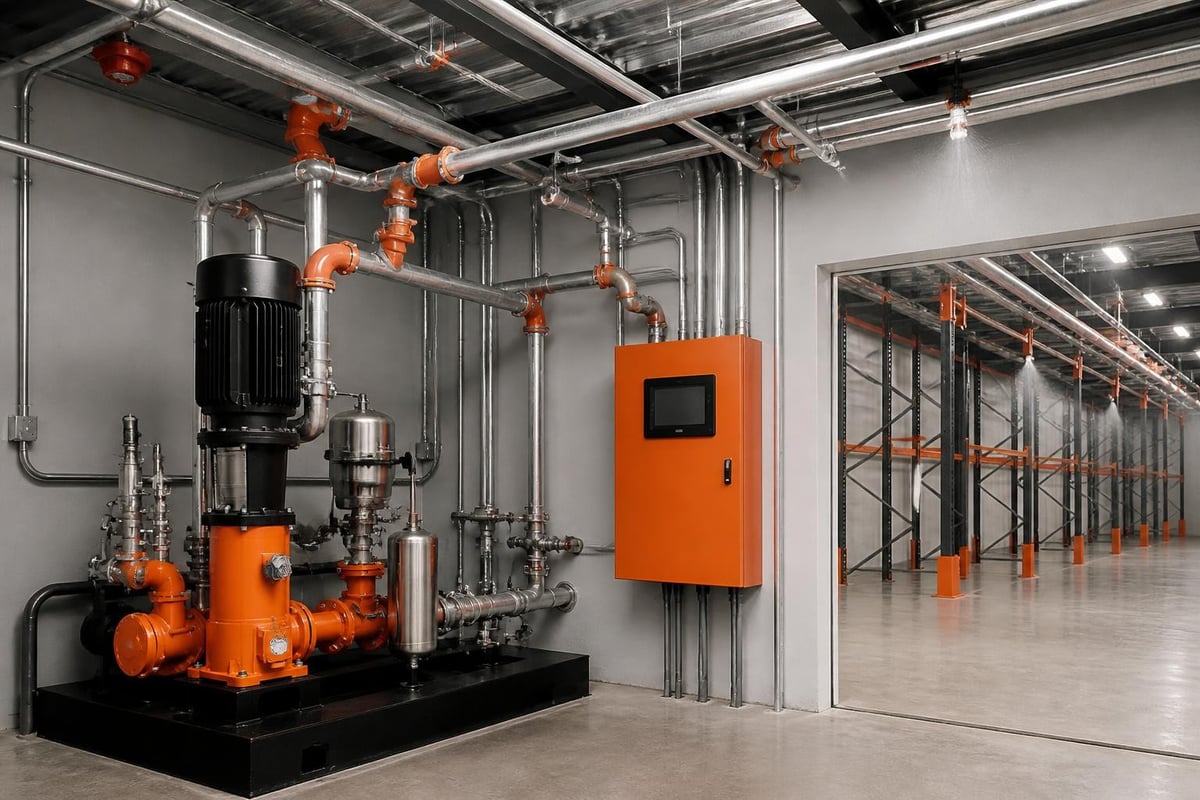
A water mist system comprises several critical components working in harmony to deliver effective fire suppression. Understanding these elements helps facility managers appreciate the technology’s sophistication and maintenance requirements.
Pumping Units: High-pressure pumps generate the necessary pressure to create fine water droplets. These units typically operate between 50 and 200 bar, depending on the nozzle design and application requirements. Twin-pump configurations provide redundancy for mission-critical installations.
Nozzle Technology: Specialised nozzles represent the heart of the system, atomising water into the characteristic fine mist. Single-fluid nozzles use water pressure alone, whilst twin-fluid designs incorporate compressed air or nitrogen to enhance droplet formation.
Distribution Network: Stainless steel or copper piping distributes pressurised water throughout the protected area. Pipe sizing calculations must account for pressure drop, ensuring adequate flow and pressure at each nozzle location.
Control and Detection Integration
Modern water mist installations integrate seamlessly with building management systems and system fire protection infrastructure. Advanced control panels monitor system status, perform automated testing sequences, and coordinate with fire detection devices to ensure rapid activation when required.
Detection technologies paired with water mist systems include:
- Smoke detection for early warning in enclosed spaces
- Heat detection for high-temperature environments
- Flame detection in high-risk industrial settings
- Multi-sensor detectors combining heat and smoke sensing
- Manual call points for human-initiated activation
Installation Considerations for Businesses
Deploying a water mist system in commercial premises requires thorough planning and professional expertise. Several factors influence system design and implementation success.
Space and Infrastructure Requirements
Water mist systems typically require less space than traditional sprinkler installations, making them ideal for retrofit projects and space-constrained environments. The reduced pipe diameters and compact pump units facilitate installation in buildings where extensive pipework would prove impractical.
Electrical supply must accommodate pump starting currents and control panel requirements. Three-phase power supplies typically serve larger installations, whilst single-phase connections suffice for smaller protected areas. Backup power provisions ensure system availability during mains failures.
| Consideration | Water Mist System | Traditional Sprinkler |
|---|---|---|
| Water Supply | 200-2000 litres | 5000-50000 litres |
| Pipe Diameter | 15-50mm | 25-150mm |
| Operating Pressure | 50-200 bar | 1-5 bar |
| Installation Complexity | Moderate-High | Low-Moderate |
| Collateral Damage | Minimal | Moderate-High |
Understanding the relationship between fire safety and protection systems helps businesses make informed decisions about their fire suppression strategy.
Maintenance and Lifecycle Management
Ensuring long-term reliability of a water mist system demands structured maintenance programmes aligned with manufacturer specifications and regulatory requirements. Regular servicing prevents component degradation and maintains system readiness.
Inspection Schedules
Weekly visual inspections verify pump unit status, control panel indications, and water supply availability. Monthly testing includes pump operation verification, pressure gauge readings, and valve position confirmation.
Quarterly maintenance activities encompass:
- Nozzle inspection and cleaning to prevent blockages
- Filter element replacement or cleaning
- Pressure relief valve testing
- Battery backup system verification
- Full system pressure testing
Annual comprehensive servicing involves detailed component examination, full discharge testing in designated areas, and compliance certification. Businesses should maintain detailed service records demonstrating regulatory compliance, particularly important for insurance purposes and building certification.
Professional maintenance contracts with experienced providers ensure expertise in the specific water mist technology installed. Fire extinguisher servicing often forms part of comprehensive fire protection maintenance programmes.
Performance Benefits for Commercial Operations
The adoption of a water mist system delivers multiple advantages beyond fire suppression capability. These benefits contribute to improved operational efficiency, reduced risk exposure, and enhanced asset protection.
Operational Continuity
Fire incidents traditionally result in extensive water damage that can halt operations for weeks or months. Water mist systems dramatically reduce this collateral damage, enabling faster recovery and minimising business interruption. This proves particularly valuable for continuous process industries, data centres, and facilities operating under strict uptime requirements.
Insurance providers increasingly recognise the risk mitigation value of water mist installations. Businesses may negotiate favourable premium adjustments when implementing these advanced suppression systems, particularly for high-value or heritage properties.
Environmental Advantages: Reduced water consumption aligns with corporate sustainability objectives whilst maintaining effective fire protection. The minimal environmental impact during discharge makes water mist systems suitable for facilities housing environmentally sensitive materials or operations.
Technology Advancements and Future Developments
The water mist sector continues evolving with technological innovations enhancing performance, reliability, and application versatility. Recent developments focus on intelligent control systems, improved nozzle designs, and hybrid suppression approaches.
Smart building integration represents a significant advancement area. Modern water mist installations communicate with building management platforms, providing real-time status updates, predictive maintenance alerts, and comprehensive event logging. This connectivity supports proactive facility management and regulatory compliance documentation.
Emerging Applications
Research into local water mist systems explores targeted protection for specific equipment or processes. These localised installations provide focused suppression without protecting entire rooms, reducing installation costs whilst maintaining effectiveness for critical assets.
The maritime sector drives innovation in compact, high-efficiency designs suitable for confined spaces. These developments transfer across to land-based applications, benefiting industries requiring space-efficient fire protection solutions.
Selecting the Right Water Mist Solution
Choosing an appropriate water mist system requires careful assessment of business requirements, risk profiles, and operational constraints. Professional fire safety consultants evaluate multiple factors to recommend optimal solutions.
Assessment Criteria
Fire Risk Analysis: Understanding the specific fire hazards present determines system requirements. Different fuel types, ignition sources, and fire growth rates influence design parameters. Comprehensive commercial fire risk assessment identifies protection priorities.
Building Characteristics: Ceiling heights, room volumes, ventilation rates, and structural features all impact water mist system effectiveness. Detailed site surveys capture these parameters for accurate design calculations.
Operational Requirements: Business continuity needs, asset values, and environmental considerations shape system selection. High-value operations typically justify investment in advanced water mist technology over conventional alternatives.
The IWMA Water Mist Guide provides valuable information for understanding system classifications and application suitability. Professional guidance ensures alignment between system capabilities and protection objectives.
Integration with Comprehensive Fire Strategies
A water mist system functions most effectively as part of a holistic fire protection strategy. Combining active suppression with detection, containment, and evacuation systems creates robust defence-in-depth protection.
Compartmentation through properly maintained fire doors prevents fire spread beyond the immediate area of origin. Understanding fire door installation requirements ensures compartment integrity that allows water mist systems adequate time to suppress fires before they propagate.
Layered Protection Approach
Effective fire safety strategies employ multiple protective layers:
- Early warning through advanced detection systems
- Automatic suppression via water mist activation
- Passive protection using fire-resistant construction
- Emergency evacuation procedures and systems
- Manual firefighting equipment for initial response
This integrated approach maximises occupant safety whilst minimising property damage and business disruption. Professional fire safety providers design these comprehensive solutions tailored to specific business requirements and risk profiles.
Investment Considerations and Cost Factors
Implementing a water mist system represents a significant capital investment requiring careful financial planning. Understanding cost components helps businesses develop realistic budgets and evaluate return on investment.
Initial installation costs typically exceed traditional sprinkler systems due to specialised components and installation expertise requirements. However, lifecycle cost analysis often demonstrates favourable economics when considering reduced water damage, lower insurance premiums, and minimal asset impact during activation.
| Cost Component | Approximate Range | Notes |
|---|---|---|
| Equipment Supply | £50,000-£500,000+ | Varies with protected area size |
| Installation Labour | £30,000-£200,000+ | Dependent on building complexity |
| Commissioning | £5,000-£20,000 | Testing and certification |
| Annual Maintenance | £2,000-£15,000 | Depends on system size |
| Water Supply Infrastructure | £10,000-£50,000 | If upgrades required |
Businesses should factor in potential insurance savings, reduced business interruption risk, and asset protection value when evaluating overall investment returns. Professional fire risk assessment companies can quantify these benefits during project planning phases.
Training and Operational Preparedness
Maximising the effectiveness of a water mist system requires properly trained personnel who understand system operation, limitations, and emergency procedures. Comprehensive training programmes ensure staff competence in normal operations and emergency situations.
Building managers and facilities teams should receive instruction covering system components, control panel operation, manual activation procedures, and troubleshooting basic issues. This knowledge enables informed decision-making during incidents and facilitates effective communication with emergency services.
Emergency responders benefit from familiarisation with water mist installations in their response areas. Pre-incident planning sessions help fire brigades understand system capabilities, water supply arrangements, and optimal tactical approaches for buildings protected by this technology.
Regular drills incorporating water mist system activation procedures reinforce training and identify improvement opportunities. Documentation of training activities demonstrates regulatory compliance and supports continuous improvement in fire safety management.
Water mist systems offer exceptional fire suppression capabilities for commercial environments where traditional sprinklers pose unacceptable risks to operations, assets, or heritage features. By combining cutting-edge technology with proven fire science principles, these systems deliver effective protection whilst minimising collateral damage and supporting business continuity objectives. Logic Fire and Security provides expert guidance on water mist system design, installation, and maintenance, helping businesses across the UK implement fire protection solutions tailored to their unique requirements and operational environments.