

Smoke alarm detectors sense the products of combustion and sound a warning before a fire spreads. The main types are optical, ionisation, multi-sensor and heat, and the right choice depends on the room, the likely fire and whether the building needs a stand-alone alarm or a connected fire alarm system. For a Responsible Person managing commercial, public or multi-occupied residential premises, the decision is rarely about a single device. It is about matching detection to risk across every space.
This guide takes you from the basics to confident specification: how detectors work, which type suits which area, where to position them and how to keep them compliant.
How do smoke alarm detectors work?
Smoke alarm detectors work by monitoring the air for particles, heat or gas created by a fire and triggering a sounder when readings cross a set threshold. The sensing method differs by type, and that difference determines how quickly each one responds to different kinds of fire.
In a stand-alone alarm, the sensor, battery or mains supply and sounder all sit in one unit. In an addressable or conventional system, detector heads are wired or wirelessly linked to a control panel, which identifies the exact device in alarm and can trigger evacuation sounders, door release and remote signalling.
Every detector has a limited sensor life. Manufacturers specify a replacement interval for their units, and the date of manufacture is printed on the casing. Building records should capture that date at installation.
What are the main types of detector?
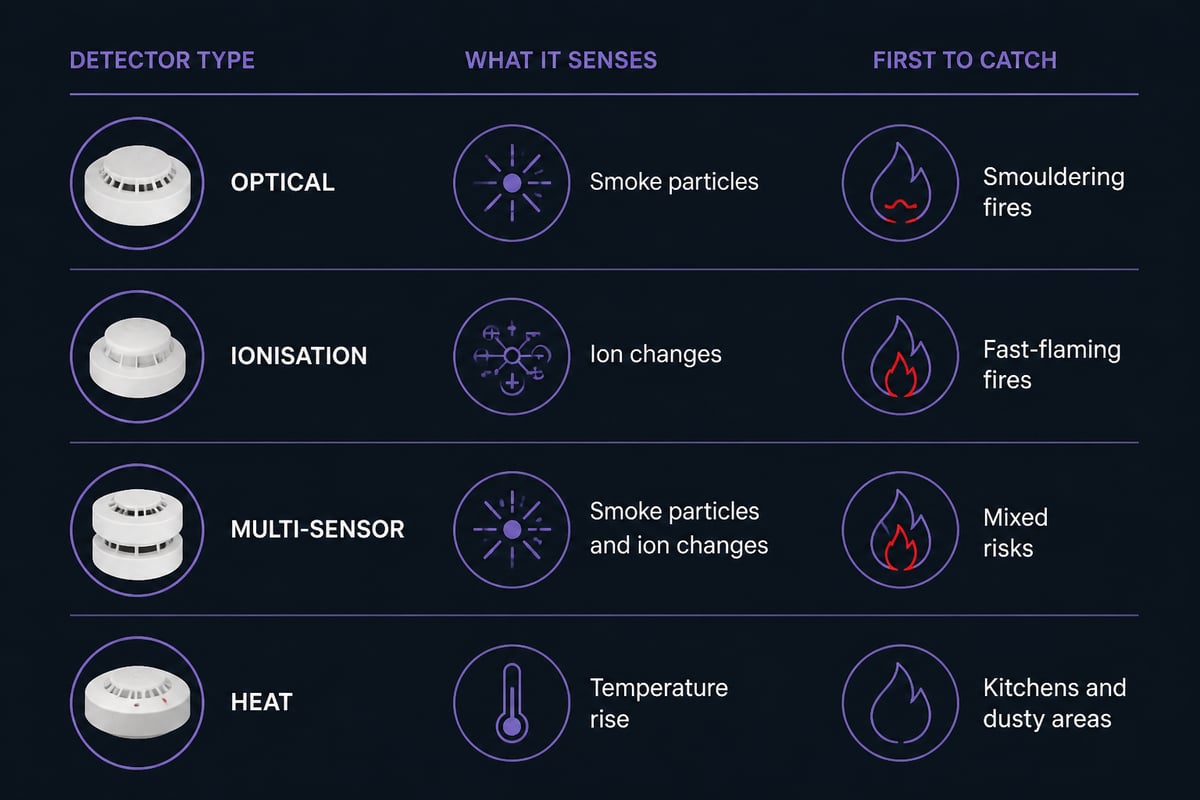
There are four main types of detector: optical, ionisation, multi-sensor and heat. Each responds to a different fire signature, which is why one type seldom suits an entire building.
| Detector type | Senses | Responds fastest to | Typical weakness |
|---|---|---|---|
| Optical (photoelectric) | Smoke particles scattering light | Smouldering fires, such as overheated cabling or upholstery | Steam, dust and cooking fumes can trigger it |
| Ionisation | Disturbance in an electrical current | Fast-flaming fires | More prone to nuisance alarms near cooking |
| Multi-sensor | Smoke plus heat, sometimes carbon monoxide | A wide range of fire types | Higher unit cost |
| Heat | Temperature rise or fixed temperature | Fires in areas where smoke detection is unsuitable | Slower to react than smoke detection |
The U.S. Fire Administration notes that ionisation alarms generally respond faster to flaming fires, while photoelectric alarms generally respond faster to smouldering ones. It recommends either both technologies together or dual-sensor units. Its position statement on ionisation and photoelectric alarms sets out the reasoning in more detail.
Optical detectors
Optical detectors are a common choice for smoke detection in commercial buildings, particularly in escape routes and sleeping accommodation. They detect the slow, smoky burn that often precedes open flame, which gives occupants more time to leave. They are the sensible default for corridors, stairwells, offices and bedrooms in hotels, care homes and student blocks.
Ionisation detectors
Ionisation detectors react quickly to the small particles produced by fast-flaming fires. They are less common in new commercial installations, where optical technology is often preferred. You may still encounter them in older buildings, where they should be reviewed during any system upgrade.
Multi-sensor detectors
Multi-sensor detectors combine optical and heat sensing, and some add carbon monoxide detection. The device compares signals and reacts to the pattern, which can reduce false alarms while retaining sensitivity. They suit areas where a single sensor would either miss a fire or trigger too often, such as open-plan areas with mixed activity.
When is a heat detector the better choice?
A heat detector is the better choice wherever smoke, steam or dust would cause repeated false alarms: kitchens, boiler rooms, garages, laundries and some plant spaces. It responds to temperature rather than particles, so it stays quiet when a toaster, a shower or a workshop generates airborne matter.
Heat detectors come in two forms. Fixed-temperature devices activate at a set threshold, while rate-of-rise devices activate when temperature climbs quickly. Both are slower than smoke detection, so they should never replace smoke detectors in escape routes or sleeping areas. They are a targeted solution for spaces where smoke detection is impractical.
A well-designed system will often use heat detection in the commercial kitchen and optical detection in the adjoining corridor, so the kitchen does not trigger repeated evacuations while the escape route stays protected.
Where should smoke alarm detectors be fitted?
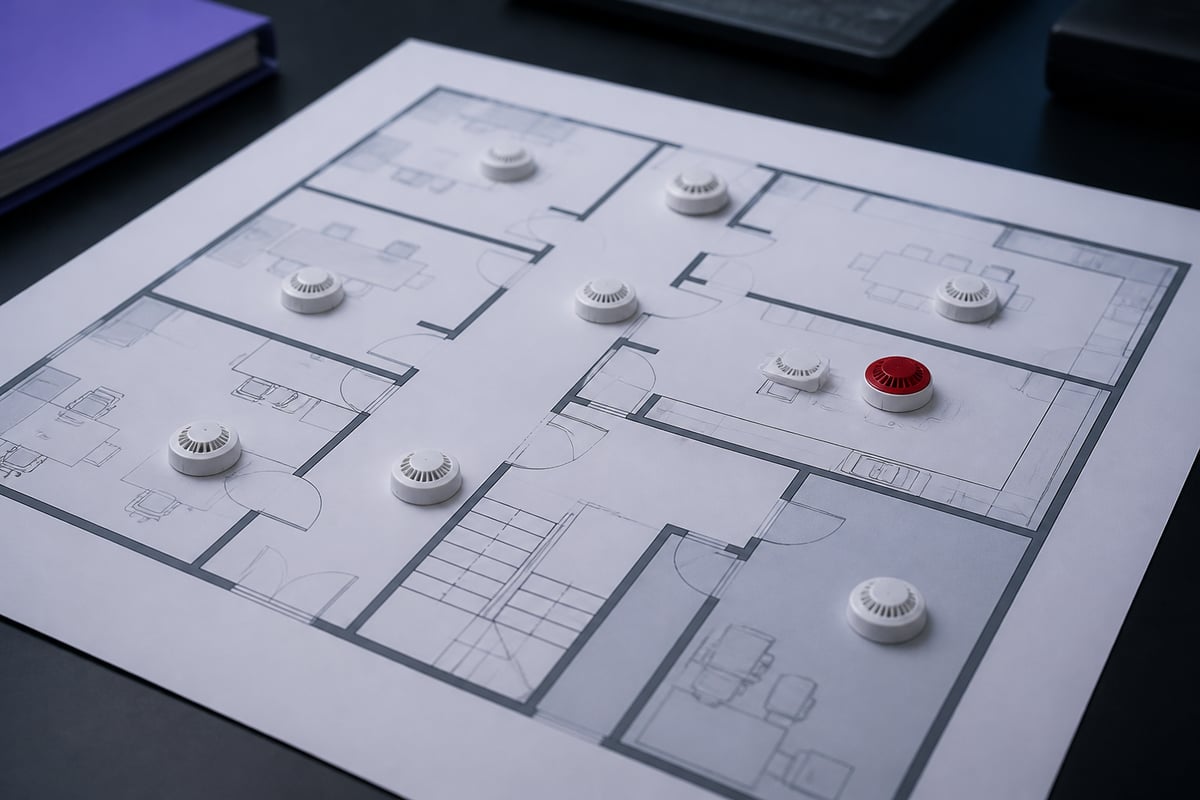
Smoke alarm detectors should be fitted on every level of a building, in escape routes, in rooms where people sleep and in areas that present a fire risk, with the exact positions set by a fire risk assessment and the relevant British Standard. The U.S. Fire Administration advises installing alarms inside every bedroom, outside each separate sleeping area and on every level, which is a useful principle for sleeping accommodation in any setting.
For commercial and multi-occupied premises, coverage typically needs to include:
- Escape routes, including corridors, landings and stairwells
- Sleeping accommodation in hotels, hostels, student halls and care settings
- Communal areas and lobbies in blocks of flats
- Plant rooms, electrical intake cupboards and risers
- Storage rooms and voids where fires can develop unseen
- Open-plan offices, retail floors and warehouses
Detector spacing, ceiling height and obstructions all affect coverage. A beam, a partition or a high ceiling can delay smoke reaching the head. For a closer look at positioning principles, see Logic Fire and Security's guides on where to put smoke alarms and smoke detector locations.
Positions to avoid
Avoid mounting detectors close to cooking equipment, shower areas, air vents, fans or doorways that admit drafts. The National Fire Protection Association recommends placing smoke alarms at least 3 metres (10 feet) from cooking appliances to reduce nuisance activations, and the same logic applies to staff kitchens and canteens. Where a space cannot be kept clear of steam or fumes, a heat detector is the right answer, not a smoke detector with its sensitivity reduced.
Stand-alone alarms or a connected system?
Stand-alone alarms suit very small, low-risk premises, while a connected fire alarm system is the appropriate standard for most commercial, public and multi-occupied buildings. The reason is simple: a stand-alone unit only warns people within earshot, whereas a connected system alerts the whole building and can notify a monitoring centre.
A connected system offers several practical advantages for a Responsible Person:
- Whole-building warning. Every sounder activates, so occupants in remote areas hear the alarm.
- Fault reporting. The control panel flags a failed detector, a tampered device or a wiring fault.
- Zone and address identification. Responders can see where the fire has been detected.
- Remote monitoring. Signals can be passed to an alarm receiving centre around the clock.
- Integration. Door holders, ventilation shutdown and lift recall can be linked to the alarm.
Wireless systems can suit buildings where cabling is difficult, such as listed properties or occupied premises where disruption must be minimal. Logic Fire and Security covers the trade-offs in its article on wireless fire alarms, and explains how detectors fit within a wider scheme in its piece on the smoke detector and fire alarm system.
How do you choose the right detector for each area?
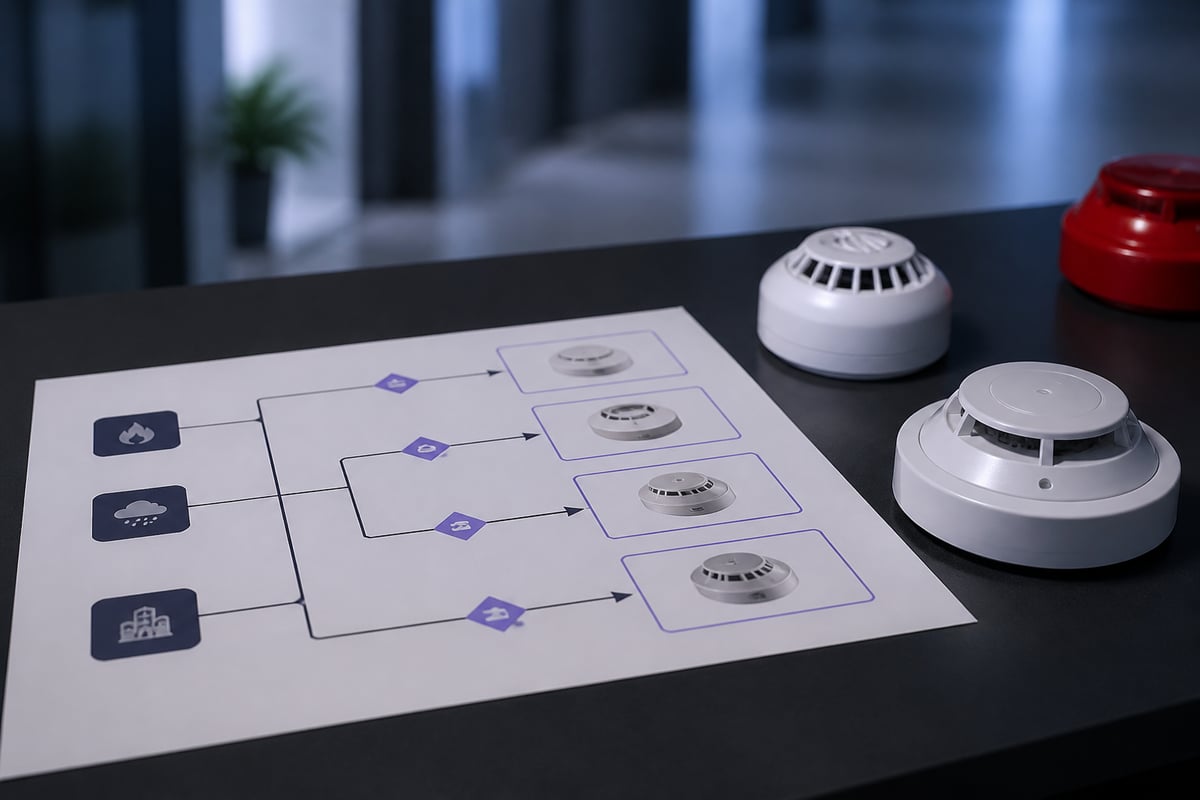
Choose the detector by asking what is likely to burn, what normally occupies the air in that room and who needs to be warned. A simple decision sequence helps:
- Identify the likely fire. Smouldering cables and soft furnishings favour optical. Fast-flaming solvents or fuels may justify multi-sensor or heat detection.
- Identify the environment. Steam, cooking fumes, dust and aerosols point towards heat or multi-sensor devices.
- Identify the occupants. Sleeping risk, vulnerable people and lone workers raise the priority for early smoke detection.
- Check the category of system. The fire risk assessment and the design standard determine the level of coverage required.
- Check for compatibility. Detector heads must suit the control panel and protocol in use.
Specifying detectors without a design brief is how buildings end up with kitchens that trigger weekly evacuations or stairwells with the wrong sensor. Logic Fire and Security's overview of fire alarm design explains how the process can work from survey to final layout.
What causes false alarms and how can you reduce them?
False alarms are usually caused by cooking fumes, steam, dust, construction work, insects or incorrect detector selection, and most can be reduced through correct specification and housekeeping. They matter commercially because every unwanted evacuation disrupts operations, wears down occupant trust in the alarm and can lead to a delayed response when a real fire occurs.
Practical measures include:
- Using heat or multi-sensor detectors near kitchens and washrooms
- Fitting temporary detector covers during building work, then removing them promptly
- Cleaning or replacing heads in dusty environments on a planned schedule
- Keeping detectors clear of air handling outlets
- Investigating every false alarm and recording the cause
Covers deserve particular care. A cover left in place after works leaves an area unprotected, so a documented process for fitting and removal is essential. Fire safety guidance from the Charlotte Fire Department is also consistent with the placement advice above.
How often should detectors be tested and maintained?
Detectors should be tested on a regular, documented schedule, with the fire alarm system serviced by a competent engineer at intervals set by the relevant standard, typically at least every six months for commercial systems. A weekly user test of a manual call point, rotated through the building, is also normal practice, with the result logged in the fire logbook.
Maintenance covers more than pressing a test button. A competent engineer will check each detector's condition, confirm fault monitoring is working, inspect batteries and standby power, and verify that sounders reach the required level throughout the building. Heads reaching the end of their service life are flagged for replacement before they fail.
Keep records of every test, fault, false alarm and service visit. In an inspection or after an incident, these records are the evidence that you have discharged your duties as the Responsible Person.
What should a Responsible Person check before specifying detectors?
Before specifying detectors, a Responsible Person should confirm that the fire risk assessment is current, the building use has not changed and the proposed design has been prepared by a competent, accredited contractor. Detectors are one component of a system that must also be commissioned, handed over with documentation and maintained.
A short pre-specification checklist:
- Is the fire risk assessment up to date, and does it reflect current occupancy?
- Has any layout change, such as new partitions or a change of use, altered the detection needs?
- Does the design identify the correct detector type for each room?
- Will the installer commission the system and provide a certificate and as-fitted drawings?
- Is there a plan for monitoring, servicing and replacement of ageing heads?
Third-party accreditation is a reasonable filter when choosing a contractor. Look for bodies such as NICEIC, BAFE and NSI Gold, which assess installers against recognised standards.
Can Logic Fire and Security supply and maintain the detection?
Logic Fire and Security designs, supplies, installs, commissions and maintains commercial detection throughout the UK, including fire alarm systems that bring the right smoke alarm detectors, heat detectors and sounders together under one monitored panel. The company works with Blue Chip businesses and public agencies on buildings of every scale. For a specific premises, the product and contact pages are the right place to confirm scope and arrangements.
Start by pulling out your current fire risk assessment and walking each floor to note the detector type fitted in every room, its manufacture date and any areas with repeated false alarms. That list gives you a clear brief for a survey, whether you are upgrading an ageing system or specifying a new one. Logic Fire and Security can take that brief forward, so call 0800 8445 999 or email [email protected] to arrange a survey of your premises.