

Operating a CCTV system in commercial premises requires more than simply installing cameras and recording footage. UK businesses must navigate a complex framework of legislation designed to balance security needs with individual privacy rights. Understanding CCTV laws UK businesses face is essential to ensure legal compliance, protect your organisation from penalties, and maintain public trust. From retail environments to industrial facilities, organisations across all sectors must adhere to strict regulations governing surveillance camera usage, data protection, and retention policies.
Understanding the Legal Framework Governing Business CCTV
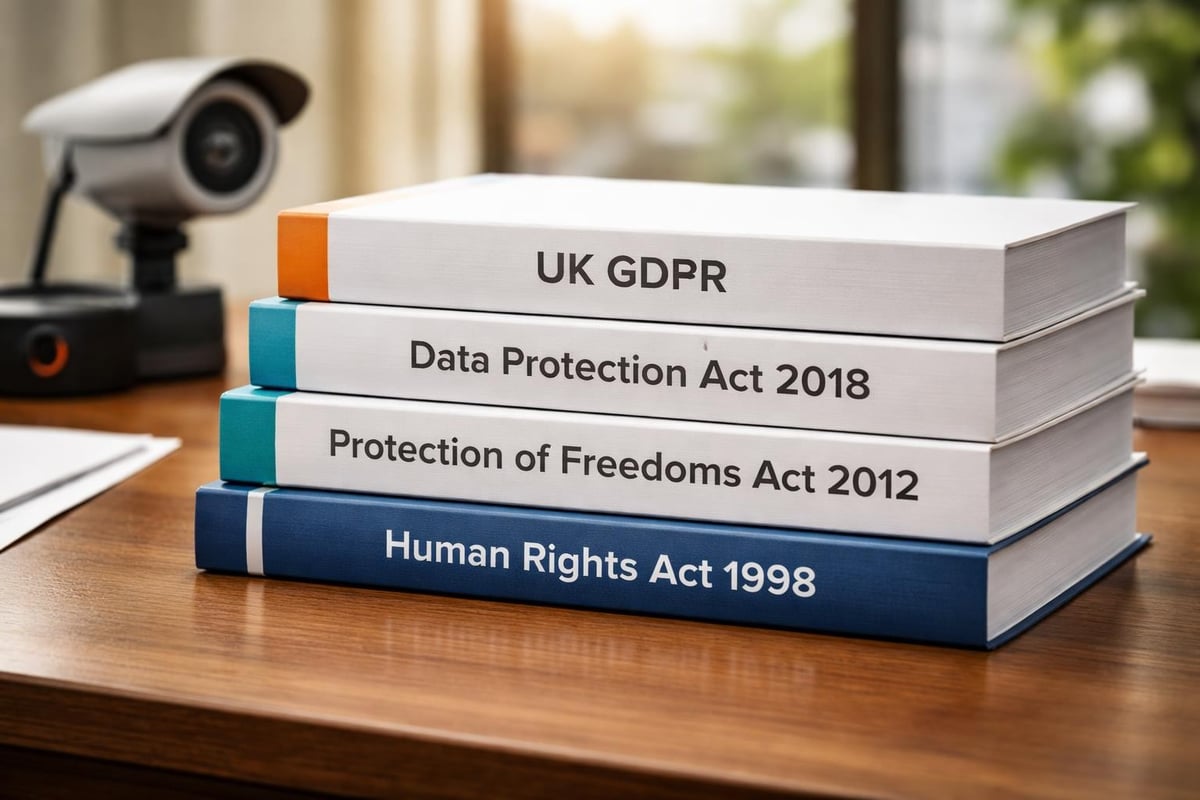
The regulatory landscape surrounding commercial CCTV systems comprises several key pieces of legislation that work together to protect individual privacy whilst enabling legitimate security operations. UK GDPR forms the cornerstone of data protection requirements, whilst the Data Protection Act 2018 provides the domestic framework for processing personal data captured through surveillance systems.
Primary Legislation Affecting Commercial Surveillance
Businesses must comply with multiple legislative requirements when deploying CCTV systems:
- UK General Data Protection Regulation (UK GDPR) – Governs how personal data captured on CCTV must be processed, stored, and protected
- Data Protection Act 2018 – Supplements UK GDPR with specific provisions for law enforcement and national security
- Protection of Freedoms Act 2012 – Establishes the Surveillance Camera Code of Practice for public authorities
- Human Rights Act 1998 – Protects the right to privacy under Article 8, requiring proportionate surveillance measures
The Protection of Freedoms Act 2012 introduced additional oversight for certain organisations, particularly those operating in publicly accessible spaces. Whilst primarily targeting public authorities, many principles apply to private sector operations where cameras monitor areas accessible to the general public.
Commercial organisations must demonstrate legitimate interest or another lawful basis for processing visual data. This requirement extends beyond simple installation to encompass every aspect of camera operation, from initial capture through to eventual deletion.
Data Protection Principles for Commercial CCTV Systems
The Information Commissioner’s Office provides comprehensive guidance on implementing CCTV systems in compliance with data protection law. Understanding CCTV laws UK regulations require means grasping the fundamental principles that govern data processing activities.
The Six Lawful Bases for CCTV Processing
Every business must identify at least one lawful basis before operating surveillance cameras:
| Lawful Basis | Application to CCTV | Example Scenarios |
|---|---|---|
| Legitimate interests | Most common for business CCTV | Crime prevention, staff safety, protecting assets |
| Legal obligation | Required by law or regulation | Insurance requirements, licensing conditions |
| Public task | Public authorities only | Regulatory enforcement, public safety monitoring |
| Consent | Rarely practical for CCTV | Specific research projects, controlled access areas |
Legitimate interests represent the most frequently used lawful basis for commercial CCTV operations. However, businesses must conduct a legitimate interests assessment (LIA) demonstrating that surveillance is necessary, proportionate, and that individual privacy rights have been considered.
Proportionality and Purpose Limitation
CCTV systems must be proportionate to the identified security risks. Installing high-resolution cameras covering every square metre of your premises would likely fail proportionality tests if the actual risk is minimal. Similarly, purpose limitation requires that footage is only used for the stated purpose.
Processing visual data for purposes beyond those communicated to data subjects constitutes a breach of CCTV laws UK businesses must observe. A system installed for security purposes cannot later be repurposed for performance monitoring without proper legal basis and transparency.
Transparency Requirements and Signage Obligations
Clear communication about CCTV operations forms a fundamental requirement under data protection law. Businesses must inform individuals that surveillance is taking place before they enter monitored areas.
Mandatory Information for CCTV Notices
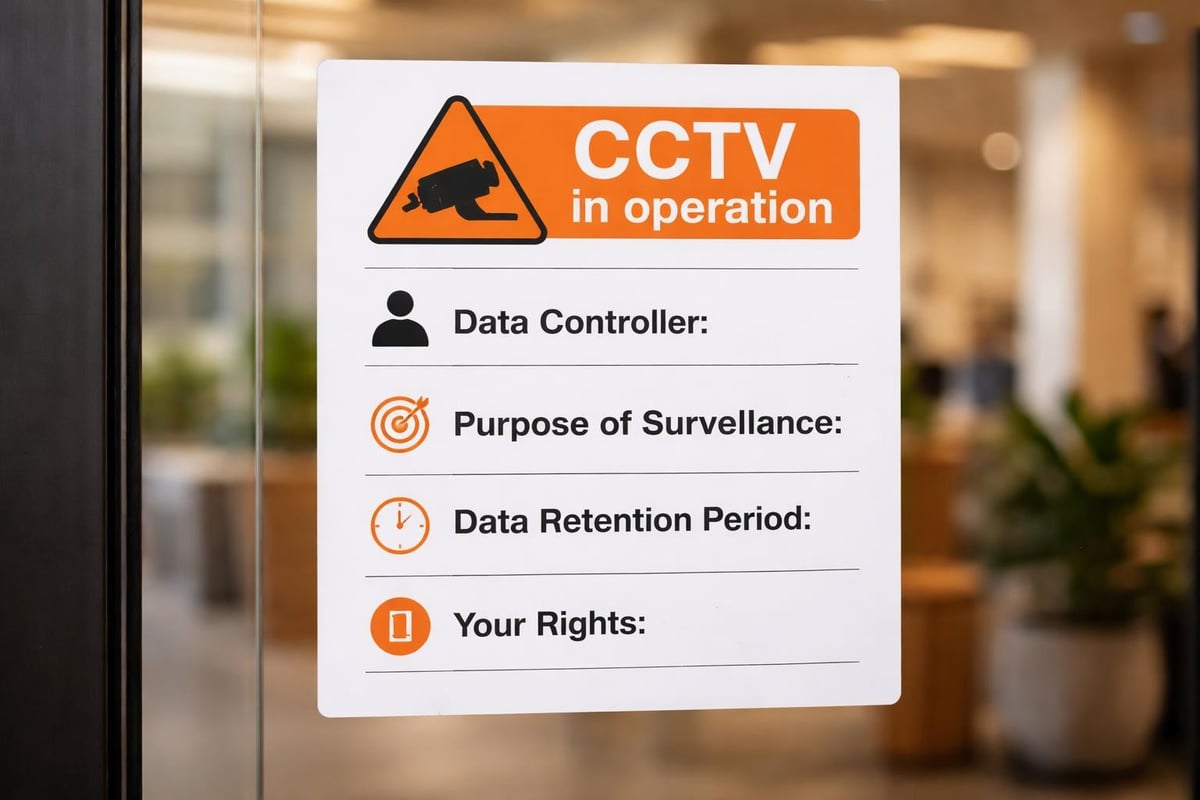
Effective signage must include specific details:
- Identity and contact details of the data controller (your organisation)
- Purpose of the surveillance (e.g., crime prevention, staff safety)
- Legal basis for processing
- How long footage will be retained
- Whether images will be disclosed to third parties
- Information about individual rights and how to exercise them
- Contact details for your Data Protection Officer (if appointed)
Signs should be positioned at entry points before individuals enter the monitored area. Simply placing a notice inside the premises fails to meet transparency obligations under CCTV laws UK standards require.
For commercial access control systems integrated with CCTV, additional considerations apply regarding employee monitoring and workplace surveillance.
Data Retention Policies and Storage Requirements
Retaining CCTV footage longer than necessary represents a common compliance failure. Understanding CCTV laws UK regulations stipulate around retention is crucial for maintaining legal operations.
Establishing Appropriate Retention Periods
No single prescribed retention period applies to all situations. Instead, businesses must determine appropriate timescales based on the specific purpose:
- General security monitoring: 31 days is commonly considered reasonable for most commercial premises
- Specific incident investigation: Footage may be retained longer where it relates to an active investigation
- Legal proceedings: Retention may extend while litigation is ongoing or anticipated
- Insurance claims: Insurers may require specific retention periods in policy terms
Whatever retention period you establish, it must be documented in your CCTV policy and communicated through signage. Automated deletion systems help ensure compliance by removing footage once the retention period expires.
Secure Storage and Access Controls
Data security principles require that CCTV footage is protected against unauthorised access, accidental loss, or deliberate destruction. Physical and technical measures should include:
- Encrypted storage for digital recordings
- Access restricted to authorised personnel only
- Audit trails recording who accessed footage and when
- Secure backup procedures for business continuity
- Clear protocols for responding to data breaches
Many organisations integrate their CCTV systems with broader commercial security systems to create layered protection that addresses both physical security and data security simultaneously.
Subject Access Requests and Disclosure Obligations
Individuals captured on CCTV footage possess the right to request copies of their personal data under UK GDPR. Managing these subject access requests (SARs) whilst protecting others' privacy presents practical challenges for businesses.
Processing CCTV Subject Access Requests
When an individual submits a SAR seeking CCTV footage:
- Verify identity – Confirm the requester's identity before disclosing any footage
- Locate relevant footage – Search recordings for images of the individual, typically requiring specific dates and locations
- Redact third parties – Blur or obscure other individuals to protect their privacy
- Respond within one month – Provide footage (or explain why it cannot be provided) within the statutory timeframe
- No charge in most cases – SAR responses must typically be provided free of charge
Redaction represents a particular challenge when multiple individuals appear in footage. While you cannot refuse a SAR simply because redaction is time-consuming, manifestly unfounded or excessive requests may be declined.
Disclosure to Third Parties
Sharing CCTV footage with third parties requires careful consideration of CCTV laws UK standards impose. Common scenarios include:
- Law enforcement: Generally permissible when assisting with crime prevention or detection
- Insurance companies: May be appropriate when supporting legitimate claims
- Legal representatives: Disclosure may be necessary for litigation purposes
- Other businesses: Usually requires consent or another lawful basis
Creating clear protocols for disclosure requests helps ensure consistent, compliant decision-making. These protocols should be documented and staff trained accordingly.
Special Considerations for Different Business Sectors
CCTV laws UK regulations establish apply differently across various commercial contexts. Sector-specific considerations influence how surveillance systems should be designed and operated.
Retail and Public-Facing Premises
Retail environments present unique challenges due to high customer throughput and public accessibility. Systems must balance security needs with customer privacy expectations:
- Position cameras to avoid capturing neighbouring properties or public highways
- Ensure changing rooms and toilets are not monitored
- Consider privacy impact assessments for facial recognition technology
- Integrate CCTV with business security monitoring services for rapid incident response
Industrial and Manufacturing Facilities
Industrial sites often require extensive coverage for health and safety compliance alongside security purposes. Multiple lawful bases may apply simultaneously in these environments.
Health and safety monitoring may constitute a legal obligation, providing additional justification for workplace surveillance. However, purpose limitation still applies, preventing footage from being used inappropriately for performance management.
Office Environments and Workplace Monitoring
Monitoring employees raises heightened privacy concerns. Covert surveillance is almost never permissible in workplace contexts, with limited exceptions for investigating serious wrongdoing.
Transparency about workplace CCTV is essential:
- Clearly communicate monitoring to all staff members
- Consult with employee representatives or trade unions where appropriate
- Avoid monitoring private areas such as toilets or changing facilities
- Document legitimate reasons for workplace surveillance in your CCTV policy
The balance between employer interests and employee privacy rights requires careful assessment. Surveillance security systems designed for commercial premises should incorporate these considerations from the outset.
Implementing Compliant CCTV Systems
Achieving compliance with CCTV laws UK businesses face requires more than understanding legislation. Practical implementation determines whether your system meets legal standards in operation.
Conducting Data Protection Impact Assessments
A Data Protection Impact Assessment (DPIA) is mandatory for surveillance likely to result in high risk to individual rights. This typically includes:
- Extensive monitoring of publicly accessible areas
- Systematic monitoring on a large scale
- Use of innovative technology such as facial recognition
- Processing of sensitive personal data
The DPIA process systematically identifies and mitigates privacy risks before system deployment. Key steps include:
- Describing the processing operations and purposes
- Assessing necessity and proportionality
- Identifying risks to individuals
- Implementing measures to address those risks
- Documenting the assessment and decisions made
Where high risks remain after mitigation, consultation with the Information Commissioner's Office may be required before proceeding.
Developing Comprehensive CCTV Policies
Written policies ensure consistent, compliant operations across your organisation. Essential policy elements include:
| Policy Section | Required Content |
|---|---|
| Purpose and scope | Why CCTV is deployed and which areas are covered |
| Legal basis | Lawful basis for processing and supporting LIA |
| Retention schedule | How long footage is kept and deletion procedures |
| Access controls | Who can view footage and under what circumstances |
| SAR procedures | How subject access requests are processed |
| Incident response | Protocols for data breaches and security incidents |
Regular policy reviews ensure alignment with evolving CCTV laws UK standards and operational changes within your business.
Staff Training and Awareness
Employees who operate or have access to CCTV systems require appropriate training covering:
- Data protection principles and legal obligations
- Proper system operation and access controls
- Responding to subject access requests
- Identifying and reporting security incidents
- Confidentiality and appropriate use of footage
Creating a culture of compliance protects your organisation from inadvertent breaches whilst ensuring systems are operated as intended.
Enforcement and Penalties for Non-Compliance
Understanding the consequences of failing to comply with CCTV laws UK authorities enforce provides additional motivation for robust compliance programmes.
Information Commissioner's Office Enforcement Powers
The ICO possesses extensive powers to investigate and sanction non-compliant organisations:
- Information notices requiring organisations to provide specific information
- Assessment notices permitting ICO inspection of data processing operations
- Enforcement notices mandating specific actions to achieve compliance
- Administrative fines up to £17.5 million or 4% of annual global turnover (whichever is higher)
- Criminal prosecution for serious offences under the Data Protection Act 2018
Recent enforcement actions demonstrate the ICO's willingness to use these powers. Organisations have received significant fines for failures including inadequate security, excessive retention, and lack of transparency.
Civil Claims and Compensation
Beyond regulatory enforcement, individuals can pursue civil claims for damages resulting from data protection breaches. Courts have awarded compensation for distress caused by unlawful surveillance, even where no financial loss occurred.
Reputational damage often exceeds financial penalties. Media coverage of compliance failures can undermine customer trust and damage business relationships, particularly for organisations serving sensitive sectors.
Emerging Technologies and Future Developments
CCTV laws UK frameworks must continue evolving to address technological advancement. Several developments merit particular attention from businesses planning or upgrading surveillance systems.
Artificial Intelligence and Automated Decision-Making
AI-enabled features such as facial recognition, behavioural analysis, and automated alerting raise additional legal considerations:
- Biometric data processing – Facial recognition processes special category data requiring additional safeguards
- Automated decision-making – Systems making decisions without human involvement trigger specific rights
- Algorithmic transparency – Organisations must be able to explain how AI systems reach decisions
- Bias and discrimination – AI systems must not perpetuate or amplify discriminatory practices
The amended Surveillance Camera Code of Practice includes guidance on emerging technologies, though further evolution is anticipated as capabilities develop.
Cloud Storage and International Data Transfers
Many modern CCTV systems utilise cloud storage, introducing considerations around international data transfers where providers operate servers outside the UK. Post-Brexit, businesses must ensure appropriate safeguards exist for any transfers to countries without adequacy decisions.
Integration with other security systems presents both opportunities and challenges. Protection systems combining CCTV with access control, intruder detection, and fire safety systems offer enhanced security but require careful consideration of data flows and processing purposes.
Privacy-Enhancing Technologies
Technological solutions can help achieve security objectives whilst minimising privacy impact:
- Privacy masking – Automatically obscuring specific areas or objects in the field of view
- Edge processing – Analysing footage locally rather than storing it centrally
- Encryption – Protecting footage both in transit and at rest
- Anonymisation – Removing identifying features where full visual data isn't required
Incorporating these technologies demonstrates commitment to privacy by design principles, a core requirement of UK GDPR.
Common Compliance Mistakes and How to Avoid Them
Even organisations with good intentions frequently make avoidable errors when implementing CCTV systems. Awareness of common pitfalls supports better compliance outcomes.
Installation and Operational Errors
Frequent mistakes include:
- Inadequate signage – Failing to provide required information or positioning signs ineffectively
- Excessive retention – Keeping footage indefinitely "just in case" rather than applying appropriate schedules
- Poor access controls – Allowing too many staff members unrestricted access to footage
- Capturing beyond boundaries – Recording areas outside your property or control
- Missing documentation – Failing to maintain policies, assessments, and processing records
Simple procedural improvements address most of these issues. Regular compliance audits identify problems before they become enforcement matters.
Responding to Incidents Appropriately
When incidents occur, proper response procedures are essential:
- Contain the breach and prevent further unauthorised access
- Assess what data has been compromised and who is affected
- Notify the ICO within 72 hours if required under breach notification rules
- Inform affected individuals where high risk to their rights exists
- Document the incident, response, and preventative measures
Working with specialists in fire and security systems ensures your CCTV installation meets both security objectives and legal compliance requirements from the outset.
Navigating CCTV laws UK businesses must comply with requires balancing legitimate security needs against individual privacy rights through careful system design, clear policies, and ongoing compliance monitoring. Understanding your legal obligations under UK GDPR and supporting legislation protects your organisation from enforcement action whilst maintaining stakeholder trust. Logic Fire and Security provides comprehensive guidance on implementing surveillance systems that meet both your security requirements and legal compliance obligations. Logic Fire and Security works with businesses across all sectors to design, install, and maintain compliant CCTV systems that protect your premises whilst respecting privacy rights.