

Fire detection is the process of identifying a fire in its earliest stages, using devices that sense smoke, heat, flame or gas and raise an alarm automatically. In a commercial or public building, a fire detection system links those sensors to a control panel that alerts occupants and, where monitored, the emergency services. For a Responsible Person under the Regulatory Reform (Fire Safety) Order 2005, it is the front line of both life safety and legal compliance.
This guide explains how a system is built, how it identifies a fire, which detector types suit which spaces, and how to keep it reliable once it is installed.
What is fire detection?
Fire detection is the combination of devices, wiring and software that recognises the physical signs of combustion and converts them into a warning. Those signs include smoke particles, a rapid rise in temperature, infrared or ultraviolet radiation from flames, and gases such as carbon monoxide.
A system can be manual, relying on a person to break a call point glass, or automatic, where sensors trigger the alarm without human input. Most commercial buildings use both. Automatic detectors catch fires that nobody has noticed, while manual call points let occupants raise the alarm the moment they see a problem.
The purpose is time. The sooner a fire is identified, the sooner people can leave, the sooner the fire service can attend and the smaller the damage to property and business continuity.
The value of working alarms is well documented. In the United States, NFPA research indicates that working smoke alarms cut the risk of dying in a home fire by about 60 percent, and that roughly three in five home fire deaths occur where alarms are absent or not working. Those figures relate to homes, but the principle carries straight into commercial premises: an alarm only protects people if it is present, maintained and working.
How does a fire detection system work?
A fire detection system works by sensing a fire signature, sending a signal to a control panel, and triggering an alarm response, usually within seconds.
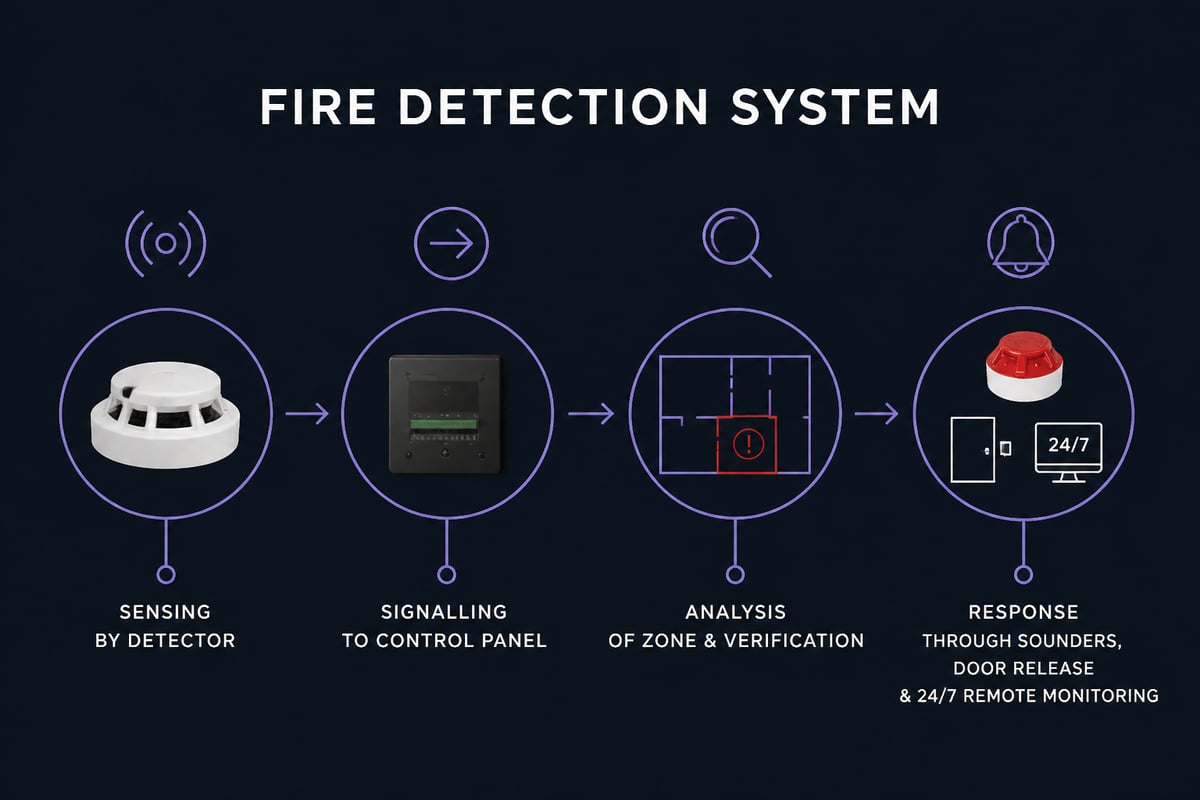
The sequence runs in four stages:
- Sensing. A detector continuously samples its environment for smoke, heat, flame or gas.
- Signalling. When a reading crosses a set threshold, the detector sends a signal along the system wiring or by radio to the control panel.
- Analysis. The panel identifies which device has activated, and which zone it sits in. Some systems apply verification logic, such as requiring two detectors to agree before a full evacuation alarm sounds.
- Response. The panel activates sounders and beacons, can release door-holding magnets, shut down air handling, and pass a signal to a monitoring centre.
Modern addressable systems give each device a unique identity, so the panel reports the exact location of a fault or fire. This matters in large buildings such as hospitals, office towers and campuses, where pinpointing a detector on a particular floor saves valuable minutes. Older conventional systems group detectors into zones and tell you only which zone has triggered.
What are the main components of a fire detection system?
A fire detection system consists of a control panel, detectors, manual call points, sounders and beacons, and the cabling or wireless network that connects them.
- Control panel: the brain of the system. It monitors every device, displays alarms and faults, and controls outputs.
- Automatic detectors: smoke, heat, flame and multi-sensor devices placed according to the building layout and risk.
- Manual call points: break-glass units at exits and along escape routes.
- Sounders, beacons and voice alarm devices: the means of alerting occupants, including visual alerts for those who cannot hear an alarm.
- Power supply: mains with battery standby, so the system works during a power cut.
- Interfaces and monitoring: connections to door holders, ventilation, lifts and a remote alarm receiving centre.
Wireless systems have become a practical option for listed buildings or sites where running cable is disruptive. Logic Fire and Security covers the topic in its piece on wireless fire alarms.
Which types of fire detector are there?
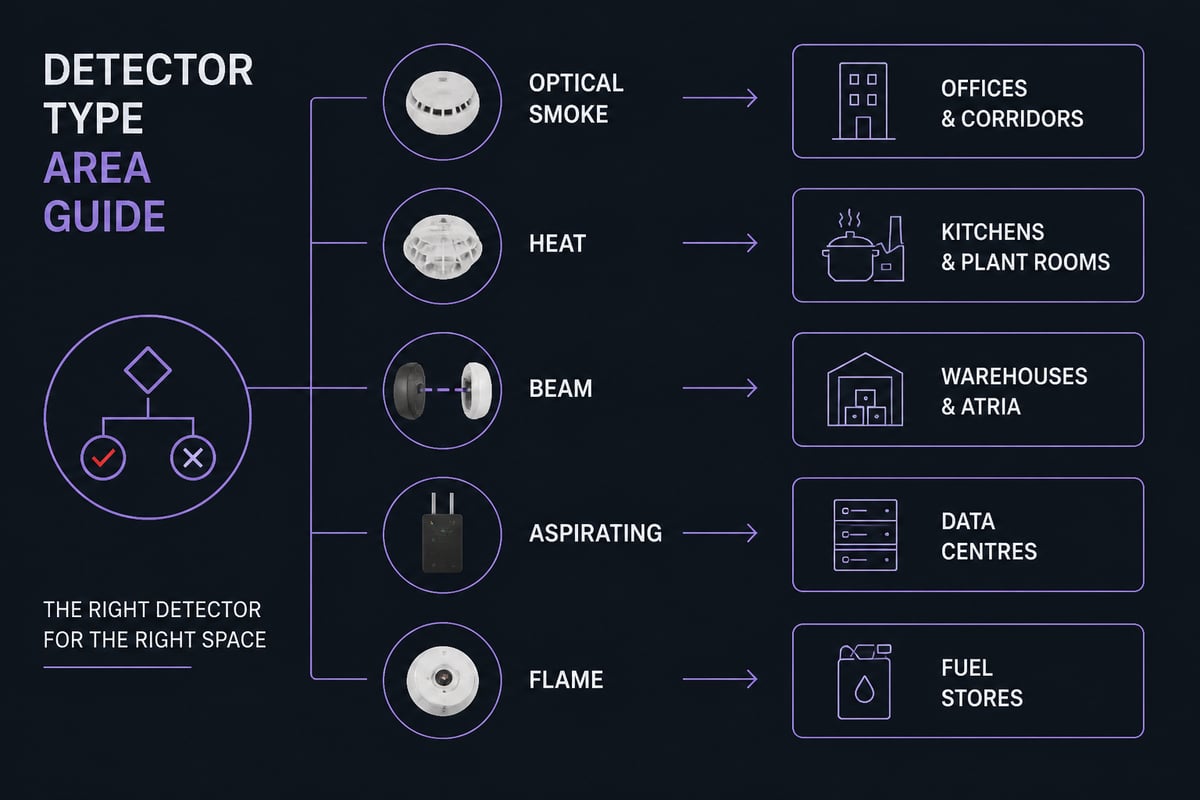
The main detector types are optical smoke, ionisation smoke, heat, multi-sensor, flame, beam and aspirating detectors, each suited to different environments.
| Detector type | What it senses | Typical use |
|---|---|---|
| Optical smoke | Light scattered by smoke particles | Offices, corridors, hotel rooms, general areas |
| Heat | Fixed temperature or rapid rise | Kitchens, plant rooms, car parks |
| Multi-sensor | Smoke, heat and sometimes carbon monoxide combined | Areas prone to nuisance alarms |
| Flame | Infrared or ultraviolet radiation | Fuel stores, industrial plant |
| Beam | Smoke obscuring an infrared beam | Warehouses, atria, high ceilings |
| Aspirating | Air drawn through pipes to a sensitive analyser | Data centres, clean rooms, heritage buildings |
Smoke detectors
Optical detectors respond well to the slow, smouldering fires typical of overheated cables or upholstery. Ionisation types are more sensitive to fast-flaming fires but are now far less common in new installations.
Heat detectors
Heat detectors are less sensitive than smoke detectors by design. That makes them the right choice where steam, dust or cooking fumes would otherwise cause repeated false alarms.
Aspirating systems
Aspirating detection draws air continuously through a network of sampling pipes to a central unit. It can identify a fire at a very early stage, which is why it is used for data rooms and other environments where even a small incident would be costly.
Video and CCTV-based detection
Camera analytics can spot smoke or flame in large open spaces. Logic Fire and Security explains how this overlaps with surveillance in its article on smoke detector CCTV cameras.
Where should detectors be placed?
Detectors should be placed so that smoke or heat reaches them quickly, in line with the system design category, the building's use and the fire risk assessment.
Category L1 covers automatic detection throughout a building and is typically specified where life safety is the priority, such as sleeping accommodation. L2 covers defined areas of high risk plus escape routes, and L3 protects escape routes only. P categories focus on property protection. The right category is established through a fire risk assessment and designed by a competent contractor, not guessed.
Placement points that affect performance:
- Keep detectors clear of air supply vents and fans that dilute smoke.
- Allow for ceiling height, beams and partitions that change how smoke travels.
- Cover voids, such as ceiling and floor cavities, where fire can spread unseen.
- Position heat detectors, not smoke detectors, close to cooking appliances.
For guidance aimed at home settings, NFPA recommends alarms inside every bedroom, outside each sleeping area and on every level. The same logic of covering where people sleep and where they escape informs the design of commercial sleeping risk, from hotels to residential blocks.
Is fire detection a legal requirement in the UK?
For most non-domestic premises, yes: the Regulatory Reform (Fire Safety) Order 2005 requires the Responsible Person to carry out a fire risk assessment and provide appropriate fire detection and warning measures based on its findings.
The order does not prescribe a single design. Instead, the risk assessment determines what is proportionate, and British Standard BS 5839-1 is the recognised code of practice for the design, installation, commissioning and maintenance of fire detection and alarm systems in non-domestic buildings. Building Regulations add requirements for new construction and major alterations.
Landlords and managing agents of multi-occupied and high-rise residential buildings carry duties for communal areas, and increasingly for the wider building safety regime. Failing to maintain suitable detection can lead to enforcement notices, unlimited fines and, in serious cases, prosecution.
Many other countries publish equivalent rules. The International Fire Code chapter on fire protection and life-safety systems, for example, sets out installation, testing and smoke-detector sensitivity checks, which shows how widely periodic testing is treated as a core obligation.
How do you reduce false alarms?
You reduce false alarms by choosing the right detector for each space, keeping devices clean and tested, and investigating every activation to find its cause.
Unwanted alarms disrupt operations, erode trust in the system and can lead occupants to ignore a real warning. The usual causes are:
- Steam, cooking fumes or aerosols reaching a smoke detector
- Dust and dirt from building works, including contamination of detector heads
- Detectors that have drifted from their calibration or reached end of life
- Poor siting close to kitchens, shower rooms or loading bays
- Deliberate or accidental activation of call points
Practical measures include swapping a smoke detector for a heat or multi-sensor device where conditions warrant, fitting protective covers during construction, and using verification delays where the design permits. Maintaining a log of every alarm event helps reveal patterns. Self-testing technology also cuts routine faults; Logic Fire and Security has written about its self-test detection range.
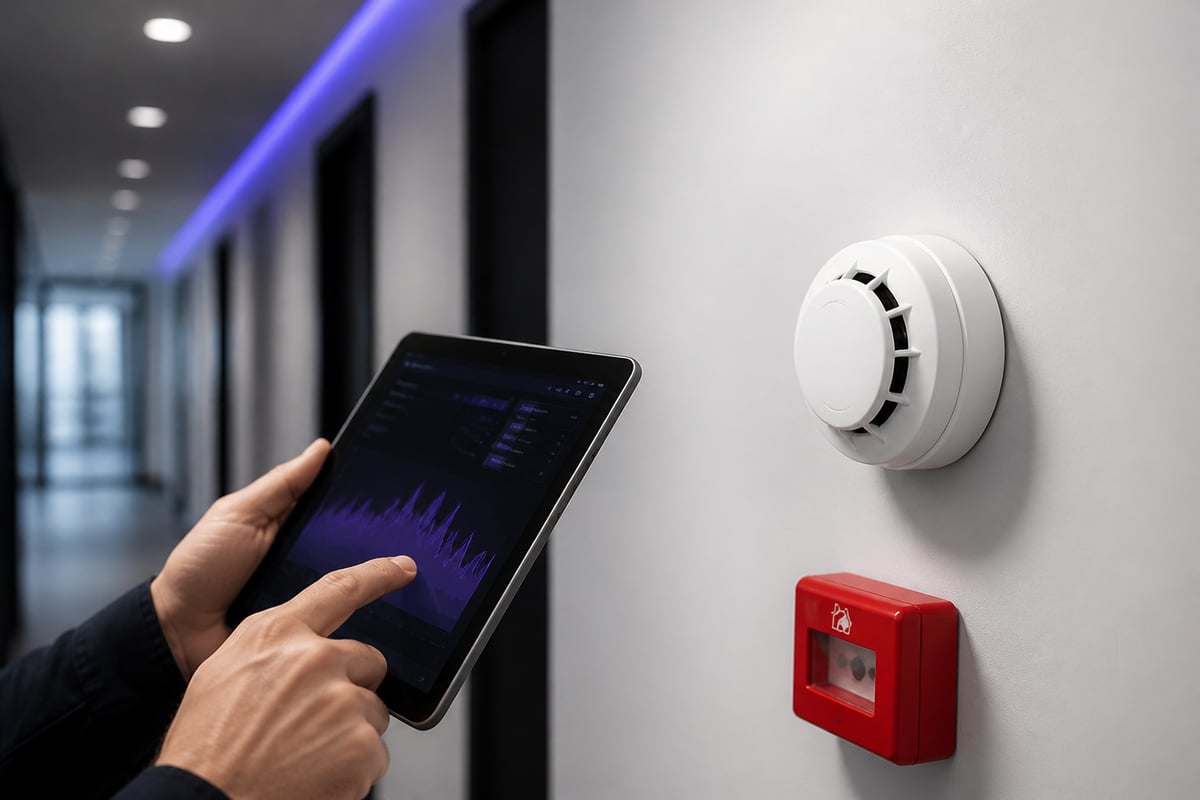
How often should a fire detection system be maintained?
Fire detection systems should be serviced regularly by a competent engineer, with BS 5839-1 recommending regular inspection and servicing, alongside a weekly user test.
A typical routine looks like this:
- Weekly: operate a different manual call point each week, confirm the panel and sounders respond, and record the result in the logbook.
- Periodic service: an engineer tests detectors, batteries, cabling integrity and panel functions, and checks that the system still matches how the building is used.
- After changes: any refurbishment, partitioning or change of use should prompt a review of detector coverage.
- After every alarm or fault: record the cause and the action taken.
A point worth building into your process is the logbook itself. A well-kept record of tests, faults, false alarms and engineer visits is often the first thing an enforcing authority or insurer asks to see, and it demonstrates that you have discharged your duties as Responsible Person.
Detection data is also useful beyond compliance. Trends in nuisance alarms, for instance, can point to a failing detector batch or a part of the building that has changed use.
Why does remote monitoring matter?
Remote monitoring matters because a building is not always occupied, and an alarm that nobody hears cannot protect anyone.
A monitored system transmits fire and fault signals to an alarm receiving centre, which can call the fire and rescue service and your keyholders at any hour. This is particularly valuable for sites that are empty at night and weekends, such as offices, schools, warehouses and retail units, where a fire could otherwise burn unnoticed. Faults can also be flagged remotely, so that a failing detector or a lost power supply is dealt with before it becomes a gap in protection.
Government data shows that even in homes, upkeep is the weak link: in England, 93% of households reported a working smoke alarm in the year ending March 2025, yet only a minority reported testing it at least monthly. The lesson for commercial premises is that installation alone is not enough. Routine testing, servicing and monitoring are what keep detection reliable, and a managed contract removes the reliance on individuals remembering to do it.
Logic Fire and Security's monitoring and support service provides 24/7 fire alarm monitoring, and its overview of commercial alarm monitoring explains how signals reach the right people.
How do you choose a fire detection provider?
Choose a provider that holds recognised third-party approvals, designs to BS 5839-1 and can support the system across its whole life, from design to ongoing maintenance.
Look for:
- Certification: recognised third-party approvals such as NICEIC, BAFE or NSI show that a contractor's work and management systems have been independently assessed.
- Competent engineers: trained staff with proven fire safety experience.
- End-to-end capability: design, supply, installation, commissioning and maintenance under one contract avoids gaps in responsibility.
- Monitoring: a route from the panel to an alarm receiving centre.
A well-specified system is built around your building and your risk assessment. Logic Fire and Security designs, supplies, installs, commissions and maintains commercial fire alarm systems that detect fire or smoke and alert occupants and emergency services, backed by recognised third-party approvals. For a wider view of the field, its guide to commercial fire detection systems is a useful companion.
Related terms
- Fire alarm system: the wider system, including sounders and call points, that warns occupants once detection has occurred.
- Fire risk assessment: the legal process that determines what detection and warning is needed.
- Addressable system: a system in which each device reports its own location to the panel.
- BS 5839-1: the British Standard code of practice for non-domestic fire detection and alarm systems.
- Responsible Person: the individual or organisation legally accountable for fire safety in a non-domestic building.
- Alarm receiving centre: the monitoring station that relays fire signals to the emergency services.
Your next step is to pull out your latest fire risk assessment and compare its recommendations with the detectors, call points and logbook entries you actually have on site. If gaps appear, or you want an independent view of your system's age and coverage, Logic Fire and Security can help, and its Fire Alarm System service covers design, installation and maintenance for commercial and public buildings across the UK. Call 0800 8445 999 or email [email protected] to speak with an approved team about your premises.