

Green emergency lights serve a critical function in commercial building safety systems, representing both a regulatory requirement and an evolving technology that balances environmental responsibility with life safety provisions. For business facilities across the UK, understanding the multifaceted applications of green emergency lights-from egress path marking to sustainable emergency illumination-has become increasingly important as regulations tighten and sustainability expectations rise. Modern commercial buildings require sophisticated emergency lighting strategies that comply with British Standards whilst addressing environmental concerns and operational efficiency demands.
Understanding Green Emergency Lights in Commercial Settings
The term “green emergency lights” encompasses two distinct but equally important applications within commercial fire safety and security systems. The first relates to the physical colour of emergency exit signage and wayfinding illumination, where green has become the international standard for indicating safe egress routes. The second interpretation involves environmentally sustainable emergency lighting solutions that reduce energy consumption and carbon footprint whilst maintaining compliance with safety regulations.
Regulatory Framework for Emergency Exit Lighting
In the UK, emergency lighting regulations mandate specific requirements for commercial premises to ensure occupants can safely evacuate during power failures or emergency situations. Green emergency lights marking exit routes must comply with BS 5266-1:2016 and BS EN 1838:2013, which establish illumination levels, colour specifications, and positioning requirements. These standards ensure consistency across commercial facilities, enabling occupants to recognise emergency exits regardless of building type.
Key regulatory requirements include:
- Minimum illumination levels of 1 lux along escape routes
- Duration requirements of at least three hours for non-residential premises
- Specific colour coordinates for green exit signage
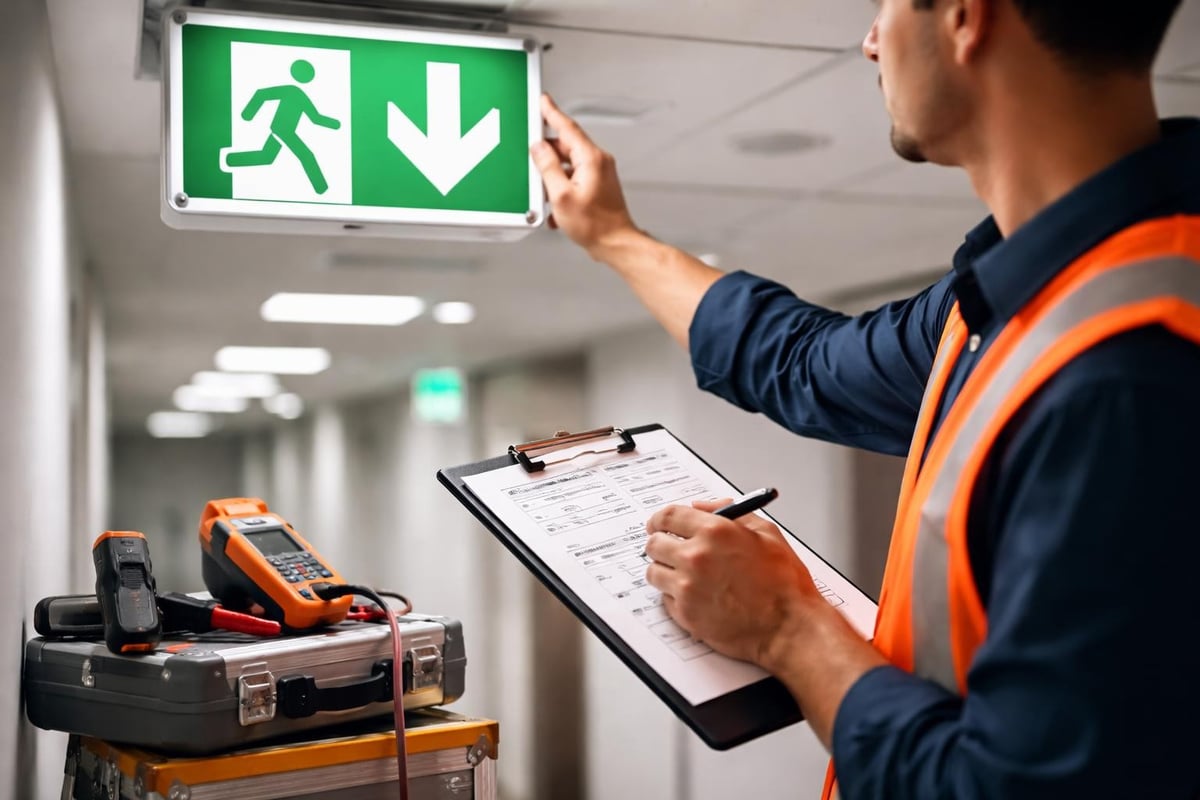
- Regular testing and maintenance schedules
Commercial property owners must maintain detailed records of emergency lighting tests and inspections, with emergency lighting systems requiring monthly functional tests and annual duration tests. Non-compliance can result in significant penalties and insurance complications, particularly for businesses operating in high-risk sectors or hosting public events.
Sustainable Green Emergency Lighting Technologies
The evolution towards environmentally responsible building systems has transformed how businesses approach emergency illumination. Modern green emergency lights utilise LED technology, which offers substantially longer service life and reduced energy consumption compared to traditional fluorescent or incandescent systems. According to industry research on green emergency lighting, LED-based emergency lights can reduce energy consumption by up to 75% whilst providing superior light output and reliability.
Advantages of LED Emergency Lighting Systems
| Feature | Traditional Systems | LED Green Emergency Lights |
|---|---|---|
| Average Lifespan | 2,000-5,000 hours | 50,000-100,000 hours |
| Energy Consumption | High | 75% lower |
| Maintenance Frequency | Annual replacement | 5-10 year replacement |
| Environmental Impact | Higher carbon footprint | Reduced emissions |
| Light Quality | Variable degradation | Consistent output |
Businesses investing in sustainable emergency lighting infrastructure benefit from reduced operational costs and enhanced corporate social responsibility credentials. For organisations committed to carbon reduction targets, transitioning to energy-efficient green emergency lights represents a measurable improvement in environmental performance whilst maintaining full regulatory compliance.
The integration of self-testing capabilities within modern emergency lighting systems further enhances efficiency. These intelligent systems automatically conduct functional tests, maintain digital records, and alert facilities managers to potential failures, reducing labour costs associated with manual testing whilst improving reliability. For commercial facilities managed by comprehensive fire and security solutions providers, such automation represents a significant advancement in building management efficiency.
Design Considerations for Commercial Emergency Lighting
Implementing effective green emergency lights requires careful consideration of building layout, occupancy patterns, and specific regulatory requirements. Commercial facilities must assess multiple factors when designing emergency lighting schemes, including ceiling heights, architectural features, and potential obstructions that might affect light distribution.
Strategic Placement and Coverage
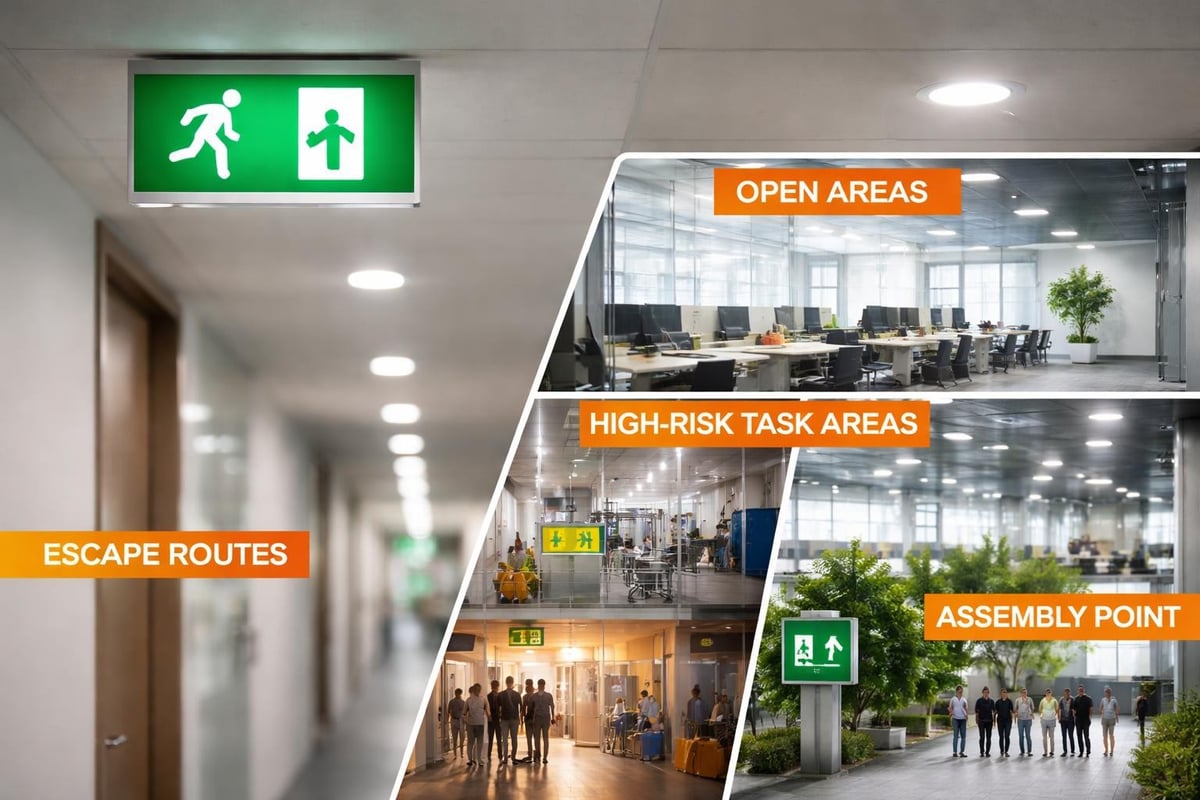
Emergency lighting design begins with thorough risk assessment and egress route mapping. Green emergency lights must illuminate all escape routes, stairwells, corridor intersections, changes in floor level, and final exit points. The positioning must account for shadows, glare, and potential visual obstructions that could compromise wayfinding during emergency evacuations.
Critical placement locations include:
- All final exit doors and emergency exit routes
- Stairwells and changes in elevation
- Corridor intersections and directional changes
- Open areas exceeding 60 square metres
- Equipment locations requiring emergency shutdown
- First aid stations and assembly points
For businesses operating in complex facilities such as manufacturing plants, warehouses, or multi-storey office buildings, the design process requires collaboration between fire safety specialists and electrical engineers to ensure comprehensive coverage. Computer modelling software enables designers to simulate emergency conditions and verify adequate illumination levels before installation.
Integration with Fire Detection and Alarm Systems
Green emergency lights function as part of an integrated fire safety ecosystem within commercial buildings. Modern systems connect emergency lighting with fire alarm systems through addressable networks, enabling intelligent responses to different emergency scenarios. This integration allows buildings to implement dynamic emergency lighting strategies that adapt to specific incident locations and evacuation requirements.
Intelligent Emergency Lighting Networks
Advanced commercial facilities increasingly deploy networked emergency lighting systems that communicate with building management platforms. These systems provide real-time status monitoring, predictive maintenance alerts, and detailed compliance reporting. When integrated with fire alarm monitoring services, facilities managers receive immediate notification of any emergency lighting failures or test anomalies.
The integration extends beyond fire safety to encompass broader security functions. In facilities with access control entry systems, emergency lighting can automatically unlock designated egress doors during fire alarm activation, facilitating rapid evacuation whilst maintaining security protocols during normal operations.
Maintenance and Testing Requirements
Regulatory compliance for green emergency lights demands rigorous maintenance schedules and documentation. British Standards require monthly functional tests to verify lamp illumination and annual duration tests to confirm battery capacity meets minimum requirements. For commercial premises, these obligations represent ongoing operational responsibilities that require systematic management.
Compliance Testing Protocols
| Test Type | Frequency | Duration | Documentation Required |
|---|---|---|---|
| Functional Test | Monthly | Brief illumination check | Date, results, signature |
| Duration Test | Annually | Full three-hour discharge | Comprehensive report |
| Visual Inspection | Monthly | Component condition check | Defect log maintained |
| Battery Replacement | 4-6 years | As per manufacturer specs | Replacement records |
Professional maintenance services ensure businesses maintain continuous compliance whilst minimising disruption to operations. Specialist providers conducting fire suppression system servicing typically offer comprehensive emergency lighting maintenance as part of integrated fire safety programmes, streamlining contractor management and ensuring coordinated system performance.
Businesses must retain testing records for inspection by regulatory authorities and insurance assessors. Digital record-keeping systems have become standard practice, enabling facilities managers to demonstrate compliance history and track performance trends across multiple sites. According to guidance on facility emergency exit lighting, maintaining comprehensive documentation proves essential during regulatory audits and insurance renewals.
Special Applications and Sector-Specific Requirements
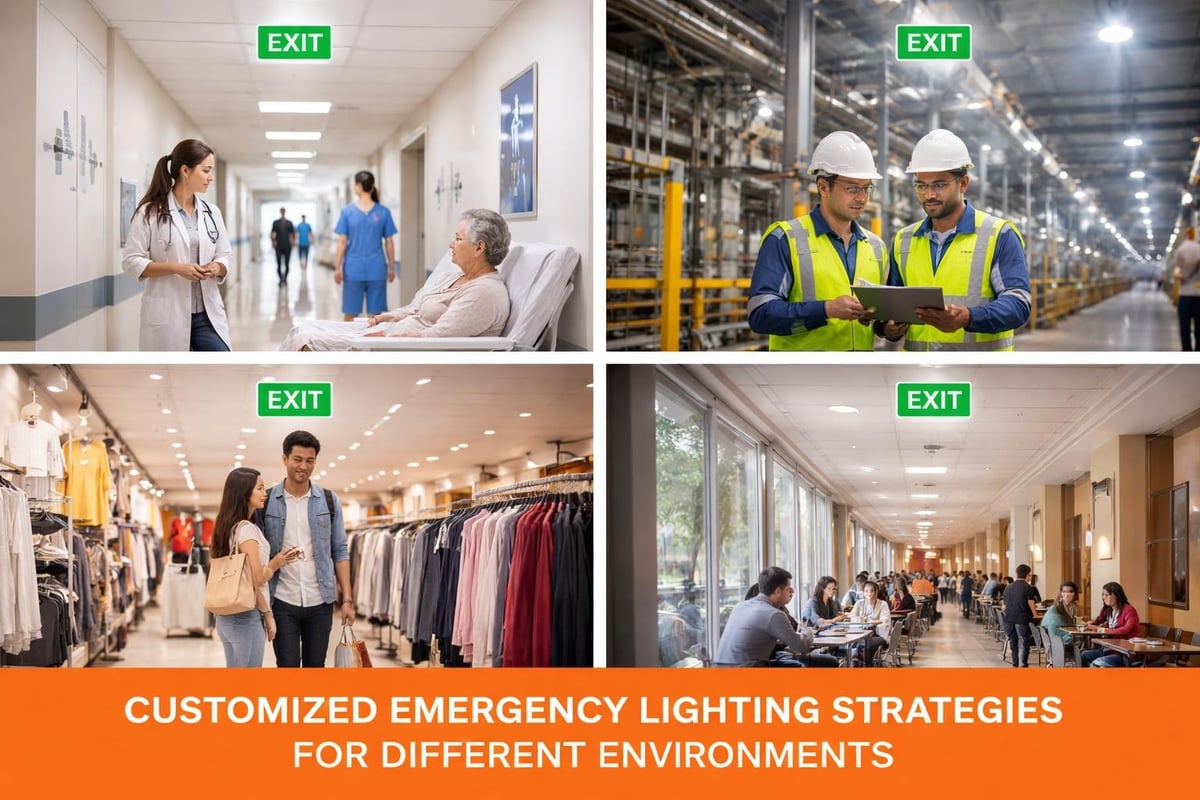
Different commercial sectors face unique challenges regarding green emergency lights implementation. Healthcare facilities, educational institutions, industrial plants, and hospitality venues each require tailored approaches that address specific occupancy characteristics, risk profiles, and operational constraints.
Healthcare and High-Dependency Environments
Hospitals and care facilities demand enhanced emergency lighting provisions due to vulnerable occupant populations and complex evacuation procedures. These environments typically require higher illumination levels, extended duration capabilities, and integration with disabled refuge communication systems. Green emergency lights in healthcare settings must maintain operation during extended power outages whilst supporting progressive horizontal evacuation strategies.
Industrial facilities present distinct challenges related to hazardous environments, large open spaces, and specialised equipment requirements. Emergency lighting in manufacturing plants must withstand harsh conditions including dust, moisture, and vibration whilst providing adequate illumination for safe equipment shutdown procedures. Explosion-proof emergency lighting fixtures become necessary in environments containing flammable materials or atmospheres.
Sector-specific considerations include:
- Retail environments: High-density occupancy and unfamiliar layouts requiring enhanced wayfinding
- Educational facilities: Large student populations with varying mobility and awareness levels
- Entertainment venues: Complex layouts with multiple levels and restricted visibility conditions
- Transport hubs: Extensive coverage areas with diverse user populations and accessibility requirements
Emerging Technologies and Future Developments
The landscape of green emergency lights continues evolving with technological advancements and changing regulatory expectations. Wireless emergency lighting systems eliminate traditional wiring constraints, enabling more flexible installation in heritage buildings and retrofit applications. Battery technology improvements extend operational duration whilst reducing physical size and maintenance requirements.
Smart Building Integration
Modern commercial buildings increasingly incorporate emergency lighting within comprehensive building management systems. This integration enables centralised monitoring across multiple sites, automated compliance reporting, and predictive maintenance scheduling. Cloud-based platforms allow facilities managers to access emergency lighting status remotely, responding promptly to failures and optimising maintenance resource allocation.
Sustainability drivers continue influencing emergency lighting development. Solar-powered emergency lighting systems with battery backup offer completely independent operation suitable for remote facilities or buildings with limited electrical infrastructure. Energy harvesting technologies that capture ambient light or kinetic energy represent emerging solutions for ultra-low-power emergency indicators.
The regulatory landscape continues adapting to technological capabilities and environmental imperatives. Future standards may mandate enhanced energy efficiency thresholds, longer operational durations, or integration with evacuation management systems. Businesses planning emergency lighting investments should consider emerging requirements to ensure system longevity and avoid premature obsolescence.
Cost Considerations and Return on Investment
Implementing comprehensive green emergency lights systems represents a significant capital investment for commercial property owners. However, lifecycle cost analysis typically demonstrates favourable returns through reduced energy consumption, decreased maintenance requirements, and extended component service life. LED-based emergency lighting systems, despite higher initial costs, deliver substantial savings over operational lifetimes extending twenty years or more.
Financial Analysis Framework
| Cost Factor | Traditional Systems | LED Green Emergency Lights |
|---|---|---|
| Initial Installation | £80-150 per fixture | £120-200 per fixture |
| Annual Energy Cost | £25-40 per fixture | £6-10 per fixture |
| Maintenance Cost (10 years) | £400-600 per fixture | £100-150 per fixture |
| Component Replacement | Every 2-3 years | Every 8-10 years |
| Total Lifetime Cost (20 years) | £1,200-1,800 | £600-900 |
Beyond direct financial returns, modern emergency lighting systems contribute to enhanced property valuations, improved insurance premiums, and stronger corporate sustainability credentials. For businesses pursuing green building certifications such as BREEAM or LEED, energy-efficient emergency lighting installations contribute towards environmental performance scores.
Investment in self-testing emergency lighting systems generates additional operational savings by reducing labour requirements for compliance testing. Facilities with hundreds of emergency fixtures can achieve thousands of pounds in annual savings through automated testing capabilities, whilst simultaneously improving compliance reliability through consistent digital documentation.
Compliance Challenges and Solutions
Maintaining continuous compliance with emergency lighting regulations presents ongoing challenges for commercial property managers, particularly those overseeing multiple facilities or complex building portfolios. Common compliance failures include inadequate testing documentation, insufficient illumination levels in modified spaces, and battery failures in older installations.
Proactive Compliance Management
Successful compliance strategies employ systematic approaches combining regular professional inspections, automated monitoring technologies, and comprehensive maintenance programmes. Businesses partnering with specialist fire safety and protection providers benefit from expert guidance on regulatory interpretation, system design optimisation, and compliance documentation.
Critical compliance elements include:
- Documented testing schedules with defined responsibilities
- Regular professional inspections by qualified technicians
- Prompt rectification of identified deficiencies
- Comprehensive record retention systems
- Staff training on emergency lighting systems and procedures
For organisations operating across multiple jurisdictions, understanding regional variations in emergency lighting requirements becomes essential. Whilst UK standards provide the primary framework, specific local authorities may impose additional requirements or interpretation variations affecting design and maintenance obligations.
Selecting Professional Installation and Maintenance Partners
The complexity of modern emergency lighting systems necessitates engagement with qualified professional contractors possessing relevant certifications and demonstrable expertise. Businesses should verify contractor credentials including relevant industry accreditations, insurance coverage, and proven experience with similar facility types and scales.
Quality installation directly impacts system performance, reliability, and compliance outcomes. Professional installers understand nuanced requirements including correct cable specifications, battery charging parameters, and integration protocols with existing building systems. Engaging contractors offering comprehensive services spanning design, installation, commissioning, and ongoing maintenance streamlines project delivery and establishes clear accountability.
When evaluating potential partners, businesses should assess technical capabilities, response times for emergency repairs, geographic coverage for multi-site portfolios, and digital reporting capabilities. Contractors offering 24/7 protection and monitoring services provide additional assurance for mission-critical facilities requiring continuous operational integrity.
Implementing effective green emergency lights requires balancing regulatory compliance, operational efficiency, and environmental responsibility within commercial facilities. Professional guidance ensures businesses achieve optimal outcomes whilst maintaining focus on core operations. Logic Fire and Security delivers comprehensive emergency lighting solutions tailored to commercial requirements, combining expert design, quality installation, and reliable maintenance services that keep businesses compliant and protected across the UK.