


When power failures occur in commercial premises, the consequences extend far beyond inconvenience. Without proper illumination, building occupants face genuine hazards whilst attempting to evacuate, whilst businesses expose themselves to significant legal liability. Emergency lighting systems serve as a critical safeguard, ensuring safe egress during power outages and maintaining compliance with stringent UK building regulations. For organisations operating warehouses, offices, healthcare facilities, or retail spaces, understanding the intricacies of emergency lighting installation represents an essential aspect of comprehensive fire safety and protection strategies.
Understanding Emergency Lighting Systems and Legal Requirements
Emergency lighting installation encompasses far more than simply mounting battery-powered lights throughout a building. These sophisticated systems must integrate seamlessly with existing electrical infrastructure whilst meeting exacting standards set forth by British and European regulations. The fundamental purpose remains constant: providing adequate illumination for safe evacuation when primary power sources fail.
Regulatory Framework for Commercial Properties
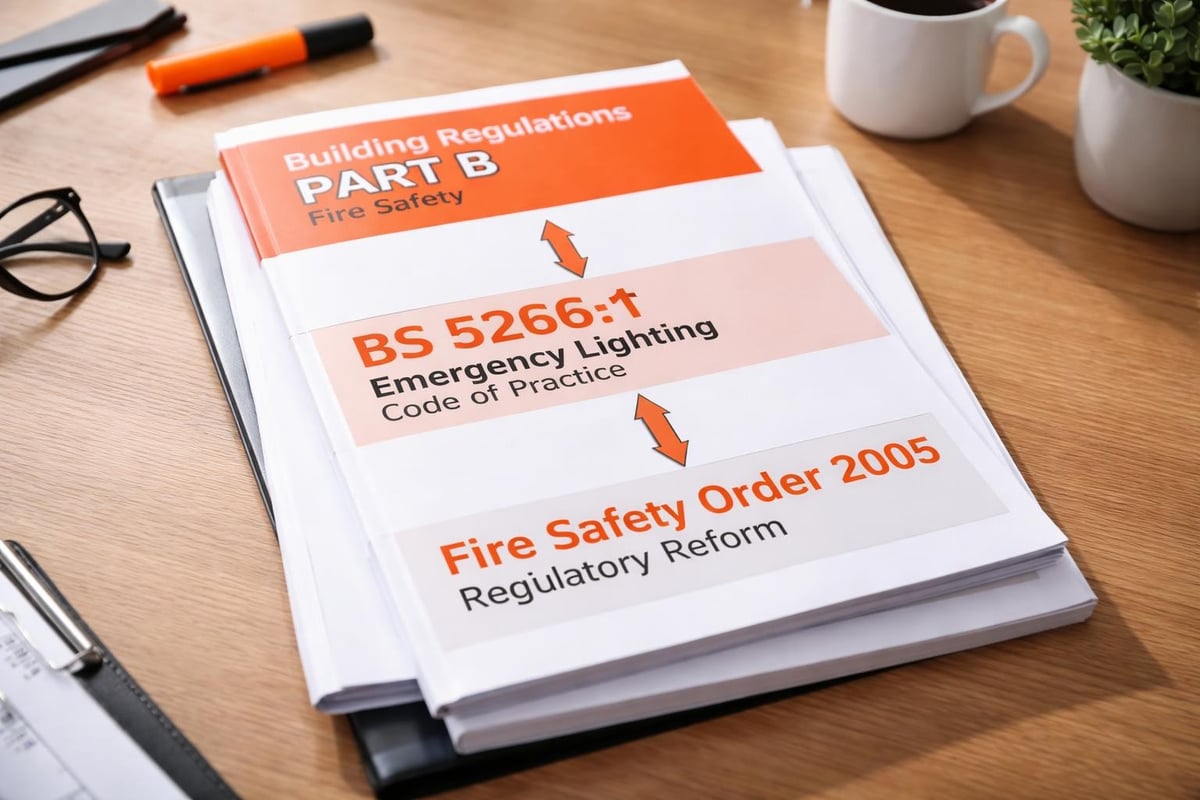
UK businesses must comply with the Regulatory Reform (Fire Safety) Order 2005, which mandates appropriate emergency lighting in virtually all non-domestic premises. This legislation places responsibility squarely on the "responsible person" – typically building owners or managers – to ensure adequate provision exists. The NFPA 101 Life Safety Code provides additional guidance that many UK organisations adopt, particularly those with international operations or parent companies.
Building regulations Part B (Fire Safety) establishes minimum standards for escape lighting, whilst BS 5266-1:2016 offers comprehensive technical specifications for emergency lighting systems in premises other than cinemas and residential properties. These standards address critical parameters including illumination levels, duration requirements, and positioning criteria that directly impact installation design.
Key compliance elements include:
- Minimum illumination of 1 lux along escape routes
- Three-hour duration for systems in premises used for public assembly
- One-hour duration for most other commercial applications
- Regular testing intervals (monthly and annually)
- Comprehensive maintenance records
Types of Emergency Lighting Systems
Emergency lighting installation projects typically involve one of three primary system architectures, each offering distinct advantages depending on building characteristics and operational requirements. Understanding these options enables informed decision-making during the specification phase.
| System Type | Power Source | Best Applications | Key Advantages |
|---|---|---|---|
| Self-contained | Individual batteries per luminaire | Small to medium premises | Lower installation costs, simplified maintenance |
| Central battery | Dedicated battery bank | Large commercial buildings | Centralised monitoring, extended battery life |
| Generator-backed | Standby generator | Critical facilities | Extended duration capability, full lighting restoration |
Self-contained systems represent the most common approach for emergency lighting installation in standard commercial environments. Each luminaire contains its own battery pack and charging circuitry, eliminating the need for specialist wiring beyond standard mains supply. This architecture offers considerable flexibility during installation and simplifies future modifications.
Central battery systems consolidate emergency power provision into a single location, with dedicated emergency lighting circuits radiating throughout the building. Whilst requiring more substantial initial investment, these installations deliver superior monitoring capabilities and reduced long-term maintenance requirements. Commercial fire detection systems often integrate with central battery emergency lighting for comprehensive safety coordination.
Planning Your Emergency Lighting Installation Project
Successful emergency lighting installation begins with thorough planning and assessment. Rushed implementations frequently result in compliance failures, operational inefficiencies, and unnecessary expenditure. A structured approach ensures systems meet both regulatory requirements and genuine operational needs.
Conducting a Comprehensive Risk Assessment
Before specifying equipment or engaging contractors, organisations must complete a detailed commercial fire risk assessment that specifically addresses emergency egress requirements. This assessment identifies escape routes, assembly points, and areas requiring specific attention such as high-risk zones or locations serving vulnerable populations.
The assessment should document:
- All primary and secondary escape routes
- Locations of firefighting equipment requiring illumination
- Areas with changing floor levels or directional complexity
- Zones where occupants may be unfamiliar with premises layout
- Special provisions for disabled access routes
This information forms the foundation for system design, ensuring emergency lighting installation addresses actual building characteristics rather than applying generic templates. According to codes and standards governing emergency lighting, proper assessment reduces both under-provision and wasteful over-specification.
System Design Considerations
Professional emergency lighting installation requires careful attention to luminaire positioning, circuit architecture, and integration with existing building systems. Designers must balance regulatory compliance, operational practicality, and budget constraints whilst ensuring systems remain maintainable throughout their operational lifespan.
Critical design parameters include:
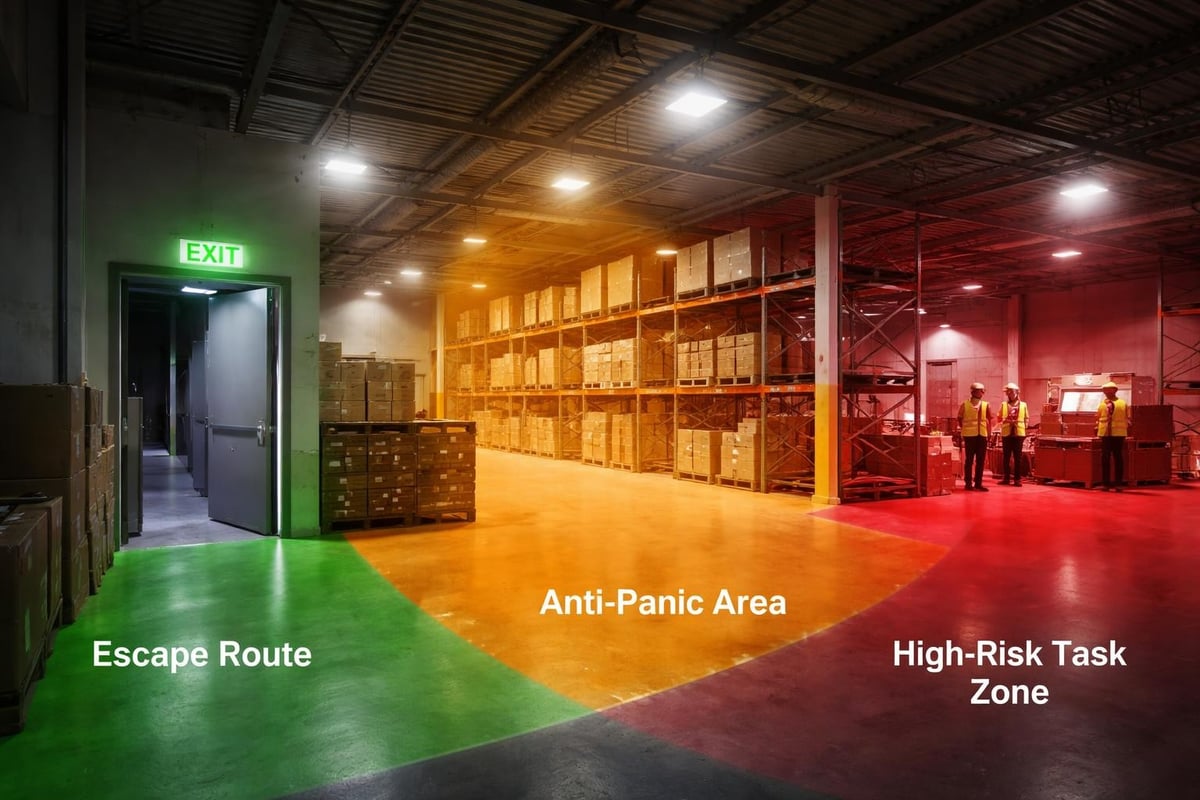
- Escape route coverage: Luminaires positioned to maintain minimum 1 lux horizontal illumination along the centre line of escape routes
- High-risk task area lighting: Enhanced illumination (minimum 10% of normal lighting levels) for locations where operations continue during evacuation
- Anti-panic areas: Open areas exceeding 60m² require specific emergency lighting provision to prevent disorientation
- Signage illumination: Exit signs must remain visible under all conditions, either through internal illumination or external lighting
Mounting heights significantly impact performance and maintenance accessibility. Whilst higher mounting reduces vandalism risk and physical damage, it complicates testing procedures and lamp replacement. Most commercial emergency lighting installation projects adopt mounting heights between 2.5 and 3.5 metres, balancing these competing considerations.
Installation Process and Technical Requirements
Professional emergency lighting installation demands both electrical expertise and detailed knowledge of fire safety standards. The process extends beyond simple luminaire mounting, encompassing circuit design, testing infrastructure, and documentation systems that support ongoing compliance.
Electrical Infrastructure and Wiring
Emergency lighting circuits require dedicated provision to ensure reliability during fault conditions. Standard practice separates emergency lighting from general lighting circuits, preventing common-mode failures that could compromise safety systems. The National Electrical Manufacturers Association provides technical guidance on proper electrical configuration for emergency lighting systems.
Self-contained systems utilise standard final circuits, with each luminaire drawing minimal current during normal charging operation. Installation complexity remains relatively low, though attention to cable routing ensures charging circuits remain energised under all normal operating conditions. Requirements for emergency lighting design emphasise the importance of proper cable selection and protection.
Central battery installations demand more sophisticated electrical design. Sub-circuits radiating from the central battery location must incorporate appropriate switching arrangements, allowing luminaires to operate from mains supply during normal conditions whilst automatically transferring to battery power during failures. This switching logic requires careful specification to ensure rapid, reliable changeover.
Luminaire Selection and Positioning
Modern emergency lighting installation projects benefit from significant technological advancement in luminaire design. LED technology has revolutionised the sector, delivering superior energy efficiency, extended operational life, and reduced maintenance requirements compared to traditional fluorescent systems.
Luminaire selection must address:
- Environmental conditions: Temperature extremes, moisture exposure, and physical impact risk
- Aesthetic considerations: Integration with architectural design and corporate identity
- Maintenance accessibility: Ease of testing, battery replacement, and cleaning
- Optical performance: Beam patterns suited to mounting heights and coverage requirements
- Durability expectations: Expected service life and component availability
Standard emergency luminaires typically provide 3-watt to 8-watt output during emergency mode, with higher-power units reserved for areas requiring enhanced illumination. Exit signs incorporate integral emergency lighting or require separate illumination depending on sign type and regulatory requirements.
Testing and Commissioning Procedures
Upon completion of installation work, comprehensive commissioning ensures systems perform as designed. This process validates both technical compliance and operational effectiveness, identifying any deficiencies before buildings enter regular occupation.
| Test Category | Procedure | Acceptance Criteria | Documentation Required |
|---|---|---|---|
| Duration test | Full discharge under load | Maintains minimum illumination for required period | Battery performance certificates |
| Illumination survey | Lux meter measurements | Meets minimum levels at all specified points | Surveyed floor plans with readings |
| Functional operation | Mains failure simulation | All luminaires activate within 5 seconds | Activation log for each unit |
| Integration testing | Fire alarm interface verification | Emergency lighting responds to fire signals | System integration schedule |
Professional contractors conducting emergency lighting installation provide detailed commissioning documentation that serves as the baseline for ongoing maintenance activities. This documentation proves invaluable during regulatory inspections and insurance assessments.
Maintenance Requirements and Ongoing Compliance
Emergency lighting installation represents the beginning rather than the conclusion of a long-term commitment to system reliability. UK regulations mandate specific testing and maintenance regimes that building operators must implement without exception. Failure to maintain adequate records exposes organisations to prosecution following incidents.
Monthly and Annual Testing Protocols
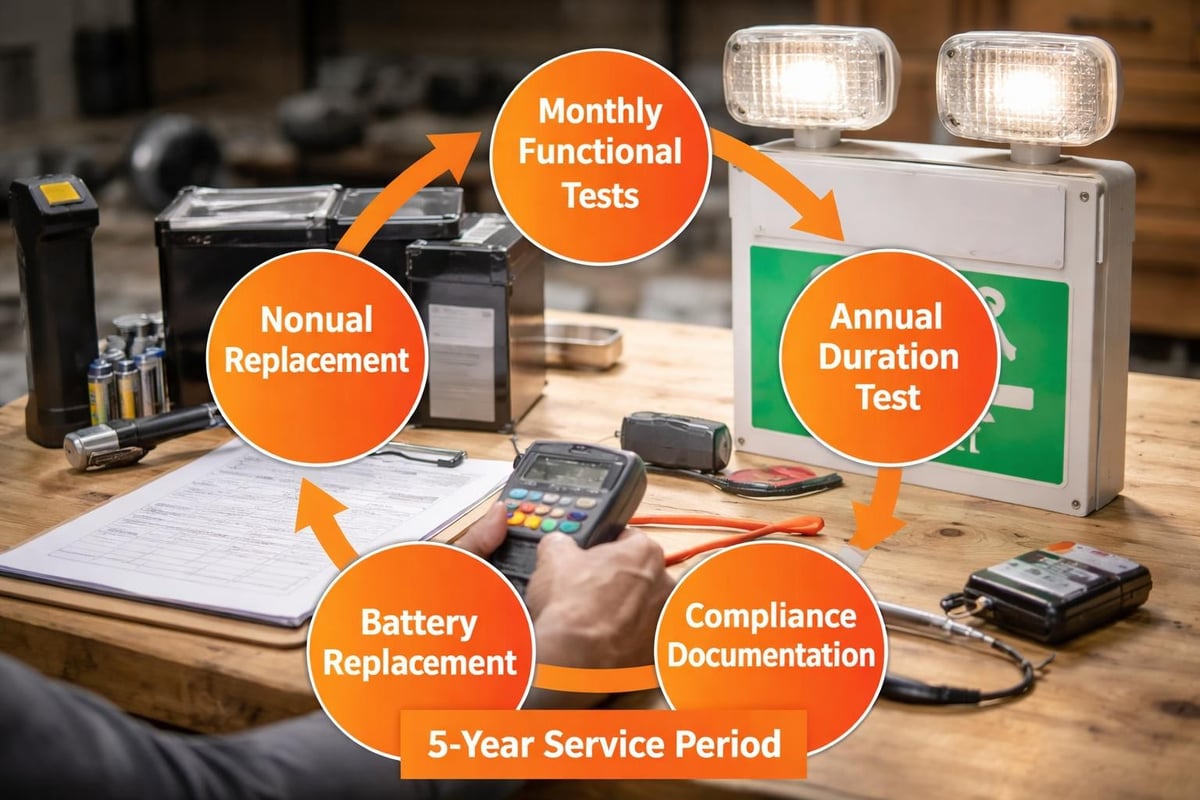
The Regulatory Reform (Fire Safety) Order 2005 requires regular testing of emergency lighting systems, with specific intervals established by BS 5266-1. Monthly tests verify basic functionality, whilst annual duration tests confirm batteries maintain adequate capacity throughout their rated discharge period.
Monthly testing involves:
- Simulating mains failure for each luminaire
- Verifying illumination for minimum 30 seconds
- Checking indicator lamps show charging status
- Recording results in the emergency lighting logbook
Annual duration tests require systems to operate for their full rated period – typically one or three hours depending on premises classification. This comprehensive assessment identifies batteries approaching end-of-life before they compromise safety. Modern fire emergency lighting systems increasingly incorporate automatic testing functionality, reducing manual intervention requirements whilst improving compliance documentation.
Battery Replacement and Component Lifecycle
Emergency lighting batteries degrade predictably over time, regardless of usage patterns. Most manufacturers specify replacement intervals between three and five years, though actual service life depends on environmental conditions and charge/discharge cycling. Proactive replacement programmes prevent unexpected failures and maintain consistent system performance.
Battery technology selection impacts both initial costs and long-term operational expenses. Nickel-cadmium batteries offer exceptional durability and tolerance to deep discharge cycles, making them ideal for demanding applications. Lithium-ion alternatives provide superior energy density and reduced environmental impact, though at premium pricing. Sealed lead-acid batteries represent the economical choice for standard applications with moderate performance requirements.
System component obsolescence presents challenges for emergency lighting installation projects involving proprietary technologies. Selecting luminaires from established manufacturers with demonstrated long-term market presence reduces the risk of unavailable replacement parts forcing premature system replacement.
Advanced Emergency Lighting Technologies and Integration
Contemporary emergency lighting installation increasingly leverages intelligent technologies that enhance both performance and manageability. Self-testing systems, wireless networking, and building management integration represent significant advances beyond traditional standalone luminaires.
Self-Testing and Automated Compliance
Self-testing emergency lighting systems conduct scheduled tests automatically, eliminating manual intervention whilst maintaining comprehensive test records. Microprocessor-controlled luminaires perform monthly and annual tests according to programmed schedules, documenting results electronically for remote access.
These intelligent systems offer substantial advantages:
- Reduced labour costs: Elimination of manual testing throughout large premises
- Improved compliance: Automated scheduling prevents missed tests
- Enhanced visibility: Centralised monitoring identifies failures immediately
- Detailed reporting: Electronic records simplify regulatory demonstrations
Whilst self-testing emergency lighting installation commands premium pricing compared to conventional systems, organisations with extensive premises or distributed portfolios frequently achieve rapid return on investment through reduced maintenance expenditure and improved operational efficiency.
Integration with Fire Detection and Building Systems
Modern emergency lighting installation projects increasingly incorporate integration with broader building safety systems. Connection to commercial fire detection systems enables coordinated response during emergencies, with emergency lighting activation reinforcing fire alarm signals and supporting evacuation procedures.
Building Management Systems (BMS) provide centralised oversight of emergency lighting alongside HVAC, access control, and other infrastructure. This holistic approach delivers operational benefits including predictive maintenance scheduling, energy consumption monitoring, and unified fault reporting. European standards such as EN 50172 and EN 1838 address integration requirements for emergency lighting within broader building systems.
Integration considerations include:
- Communication protocols: Ensuring compatibility between emergency lighting and existing systems
- Network architecture: Wired versus wireless connectivity options
- Data management: Storage and access arrangements for test records and fault logs
- Cybersecurity: Protecting safety-critical systems from unauthorised access
Selecting Professional Installation Partners
Emergency lighting installation demands specialist knowledge spanning electrical engineering, fire safety regulations, and building systems integration. Organisations seeking to implement or upgrade emergency lighting systems must carefully evaluate potential contractors to ensure competent execution and ongoing support.
Essential Contractor Qualifications
Professional emergency lighting installation contractors should demonstrate relevant industry accreditations and technical competencies. NICEIC or ECA registration confirms electrical competence, whilst additional fire safety qualifications indicate broader expertise. Experience with similar building types and system scales provides valuable assurance of capability.
Evaluation criteria should include:
- Demonstrable experience with commercial emergency lighting projects
- Comprehensive insurance coverage including professional indemnancy
- Access to manufacturer technical support and training
- Quality assurance processes and ISO certification
- Post-installation support and maintenance capabilities
Organisations should request detailed proposals addressing system design rationale, equipment specifications, installation methodology, and commissioning procedures. Vague quotations lacking technical detail frequently indicate contractors inadequately qualified for professional emergency lighting installation projects.
Importance of Ongoing Support Relationships
Emergency lighting installation creates long-term service requirements extending decades beyond initial commissioning. Selecting contractors offering comprehensive maintenance programmes ensures systems remain compliant and operational throughout their design life. Fire security service providers often bundle emergency lighting maintenance with broader fire safety support, delivering operational efficiencies and simplified vendor management.
Maintenance agreements should specify response times for emergency callouts, scheduled testing frequencies, and battery replacement provisions. Transparent pricing structures prevent unexpected costs, whilst guaranteed parts availability protects against obsolescence challenges. Understanding essential emergency lighting requirements helps organisations evaluate whether proposed maintenance programmes adequately address regulatory obligations.
Cost Considerations and Return on Investment
Emergency lighting installation represents significant capital expenditure, with costs varying substantially based on system architecture, building characteristics, and technology choices. Understanding cost drivers enables realistic budget planning and informed decision-making regarding system specifications.
Initial Installation Expenses
Self-contained emergency lighting installation typically costs between £150 and £400 per luminaire including materials, labour, and commissioning. Large-scale projects benefit from economies of scale, whilst complex buildings with difficult access or heritage constraints command premium pricing. Central battery systems involve higher initial investment, with equipment costs ranging from £5,000 for small installations to £50,000+ for extensive commercial applications.
Major cost components include:
| Element | Typical Range (Self-Contained) | Typical Range (Central Battery) |
|---|---|---|
| Luminaires/equipment | £80-£200 each | £5,000-£50,000 total |
| Installation labour | £50-£150 per point | £3,000-£15,000 |
| Testing/commissioning | £500-£2,000 | £1,500-£5,000 |
| Design fees | £1,000-£5,000 | £2,000-£10,000 |
Energy-efficient LED emergency lighting installation delivers long-term operational savings through reduced electricity consumption and extended maintenance intervals. Whilst LED luminaires command higher purchase prices than fluorescent alternatives, typical payback periods range from three to seven years depending on electricity rates and maintenance cost differentials.
Lifecycle Cost Analysis
Comprehensive cost evaluation extends beyond initial installation expenses to encompass ongoing operational requirements. Battery replacement, routine testing, and periodic system upgrades contribute substantially to total cost of ownership across typical 15-25 year system lifespans.
Annual maintenance costs for professional servicing typically range from £3 to £8 per luminaire for self-contained systems, with central battery installations requiring £1,500 to £5,000 annually depending on system complexity. Battery replacement cycles every 3-5 years add further expense, though central battery architectures concentrate replacement costs into less frequent interventions.
Organisations should evaluate emergency lighting installation proposals using lifecycle cost models that account for all anticipated expenditure over realistic operational periods. Systems offering lower initial costs frequently prove more expensive over their service life due to higher maintenance requirements or premature replacement needs.
Professional emergency lighting installation forms an indispensable element of comprehensive building safety provision, protecting occupants whilst ensuring regulatory compliance across diverse commercial environments. Organisations implementing new systems or upgrading existing installations benefit from engaging specialist contractors who understand the technical complexities and regulatory nuances governing emergency lighting provision. Logic Fire and Security delivers expert emergency lighting installation services throughout the UK, combining technical excellence with deep regulatory knowledge to protect businesses and their occupants. Contact our experienced team to discuss your emergency lighting requirements and ensure your premises meet all safety obligations.