

CCTV surveillance cameras for UK businesses fall into seven main types: dome, bullet, PTZ, turret, fisheye, thermal and ANPR, each suited to a different site layout, lighting condition and risk. The right choice depends on what you need to see (identification, detection or general observation), how far away it is, and what UK data protection law expects of you as the operator.
This guide sets out each type by specification, approximate price and best use, then covers the legal duties that follow installation. It is written for Responsible Persons and facilities managers who must specify, approve or review a system for a commercial or public building. Prices are approximate hardware figures and exclude installation, cabling and recording.
How to choose among CCTV surveillance cameras
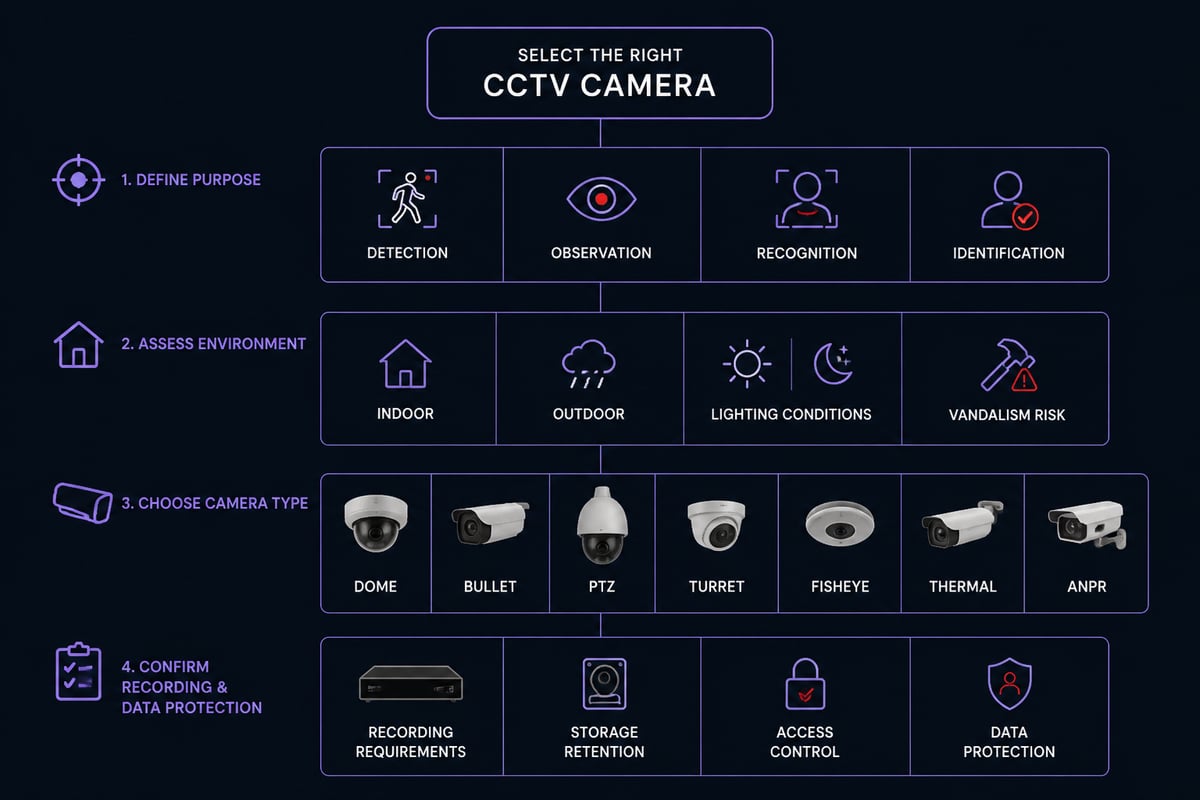
Start with the job each camera must do, because the purpose determines the type, lens and resolution far more than the brand. The standard way to define this is by operational requirement:
- Identification: a face or vehicle registration must be recognisable, which usually means a narrow lens and high resolution at close range.
- Recognition: you need to know whether a person is familiar, which allows a slightly wider view.
- Observation: you need to see activity and its general nature, such as movement across a car park.
- Detection: you need to know that something has happened, such as a person entering a perimeter.
Next, weigh the environment. External cameras need a suitable ingress protection rating (IP66 or above is common for exposed positions), low-light performance and, where vandalism is a risk, an impact rating such as IK10. Power and cabling matter too: most modern commercial cameras use Power over Ethernet (PoE), which carries data and power on one cable, simplifying installation and allowing the system to run from a protected supply.
1. Dome cameras
A dome camera is a compact, ceiling- or wall-mounted unit housed in a rounded cover, and it is the most common choice for indoor commercial areas.
- Key specs: typically 4 to 8 megapixel, varifocal lens, infrared range around 30 metres, IK10 vandal-resistant housing on many models, IP66 on outdoor versions.
- Approximate price: typically a few hundred pounds per camera.
- Suits: reception areas, corridors, stairwells, offices and retail floors where a discreet, tamper-resistant unit is needed and the view is moderate in range.
The cover hides the lens direction, which deters tampering and avoids drawing attention to what is being watched. The trade-off is that the dome can cause infrared reflections at night if installed too close to a wall or ceiling.
Verdict: the dependable default for internal coverage across most commercial buildings.
2. Bullet cameras
A bullet camera is a cylindrical, externally mounted unit whose visible shape makes it a clear deterrent.
- Key specs: 4 to 12 megapixel, fixed or motorised varifocal lens, infrared range often 40 to 80 metres, IP67 weatherproofing common.
- Approximate price: typically a few hundred pounds per camera.
- Suits: building perimeters, car park entrances, loading bays and long, narrow views such as fence lines or service yards.
Bullets are simple to install and aim, and their longer infrared reach suits external areas. They are more exposed than domes, so mounting height and bracket quality matter where vandalism is possible.
Verdict: the practical choice for external perimeters and long sightlines.
3. PTZ cameras
A PTZ (pan, tilt, zoom) camera uses motorised movement and optical zoom to cover a wide area and follow activity, and it is the most capable type for live monitoring.
- Key specs: 20x to 40x optical zoom, 360-degree pan, preset tours, auto-tracking on many models, 2 to 8 megapixel.
- Approximate price: typically several hundred pounds or more per camera.
- Suits: large yards, retail car parks, distribution sites and campuses where a monitoring operator can direct the camera or where one unit replaces several fixed ones.
The limitation is that a PTZ views only one area at a time. If nobody is controlling it and no patrol preset is configured, it can look away at the moment an incident occurs. For that reason many sites pair PTZ units with fixed cameras and with remote CCTV monitoring so a trained operator can respond to alerts.
Verdict: worth the cost for large open areas that are actively monitored.
4. Turret cameras
A turret camera, sometimes called an eyeball camera, is a ball-and-socket unit that mounts flat to a ceiling or wall and avoids the infrared glare problem of a dome.
- Key specs: 4 to 8 megapixel, fixed or varifocal lens, infrared range around 30 to 40 metres, IP67 on many models.
- Approximate price: typically a few hundred pounds per camera.
- Suits: soffit mounting at building entrances, covered walkways, shopfronts and anywhere a dome would reflect light back into the lens.
The open design reflects less infrared back into the lens, which gives cleaner night images under canopies and in porches. It is less vandal-resistant than a dome, so it is better in sheltered or higher positions.
Verdict: a sensible alternative to a dome where night glare is a problem.
5. Fisheye and multi-sensor cameras
A fisheye camera captures a full 180- or 360-degree view from one lens, and a multi-sensor camera joins several sensors into one panoramic image.
- Key specs: 6 to 20 megapixel total, dewarping in software, single cable run, ceiling or wall mounting.
- Approximate price: typically several hundred pounds or more per camera.
- Suits: open-plan offices, warehouses, atriums, foyers and retail floors where one device should cover a whole room with no blind spots.
Detail falls towards the edges of a fisheye image, so it is better for overview than for identification. Many sites combine one for room coverage with fixed cameras at doors for face-level detail.
Verdict: the efficient option for wide open interiors, best used alongside identification cameras at entrances.
6. Thermal cameras
A thermal camera detects heat rather than visible light, so it works in complete darkness, fog and glare and can detect people or vehicles well beyond the range of standard cameras.
- Key specs: uncooled sensor, typically 320 x 256 or 640 x 512 resolution, detection ranges from tens of metres to several hundred, built-in analytics for intrusion alerts.
- Approximate price: typically a substantial premium over standard cameras.
- Suits: high-risk perimeters, utilities, storage compounds, solar farms and other large sites where a false alarm is costly and lighting is poor.
Thermal images detect presence rather than identity, so they are used to trigger an alert, with a conventional or PTZ camera confirming and recording the detail. Their analytics also reduce false alerts from animals, rain and moving foliage.
Verdict: the strongest detection tool for large or unlit perimeters, at a clear premium.
7. ANPR cameras
An ANPR (automatic number plate recognition) camera reads vehicle registration plates and logs them against a database, and it is a specialist type rather than a general one.
- Key specs: high-speed shutter, infrared illumination, plate-reading software, narrow field of view, typically 2 to 5 megapixel.
- Approximate price: typically several hundred pounds or more per camera, plus software licences.
- Suits: site entrances, barrier-controlled car parks, logistics yards and any location where vehicle access must be logged or controlled.
ANPR processes personal data, since registrations can be linked to individuals, so it carries a stricter justification and documentation burden. The ICO’s guidance on video surveillance covers ANPR alongside other technologies and is worth reading before specifying it.
Verdict: valuable for controlled vehicle access, provided the lawful basis is documented first.
8. Commercial CCTV from Logic Fire and Security
Commercial CCTV from Logic Fire and Security is a service covering high-definition CCTV surveillance systems with 24/7 monitoring and evidence for investigations, rather than a single camera model.
- Key specs: the camera mix, resolution and recording are specified after a site survey; details are on the product page rather than listed here.
- Approximate price: quoted per project, so contact Logic Fire and Security for a figure.
- Suits: multi-site or complex commercial and public buildings where the types above need to be selected, designed, installed, commissioned and maintained as one system by an approved contractor.
Logic Fire and Security provides 24/7 monitoring, which matters where footage must support an investigation or a claim. If your CCTV is part of a wider package with intruder alarms and access control, the Commercial Security Systems service covers survey, design, installation and maintenance together.
Verdict: a sound route when you want a specified, installed and maintained system rather than a set of separate products.
Comparison of CCTV camera types
| Camera type | Typical resolution | Approx. price (as of November 2026) | Best suited to |
|---|---|---|---|
| Dome | 4 to 8 MP | Typically a few hundred pounds | Indoor corridors, reception, offices |
| Bullet | 4 to 12 MP | Typically a few hundred pounds | Perimeters, long sightlines |
| PTZ | 2 to 8 MP | Typically several hundred pounds or more | Large monitored yards and car parks |
| Turret | 4 to 8 MP | Typically a few hundred pounds | Entrances, canopies, night glare areas |
| Fisheye / multi-sensor | 6 to 20 MP | Typically several hundred pounds or more | Open-plan interiors, warehouses |
| Thermal | 320 x 256 to 640 x 512 | Substantial premium over standard cameras | Large or unlit high-risk perimeters |
| ANPR | 2 to 5 MP | Typically several hundred pounds or more, plus software | Vehicle access control and logging |
| Logic Fire and Security Commercial CCTV | Specified per site | Quoted per project | Designed, installed and maintained systems |
Is it legal to have CCTV outside your premises?
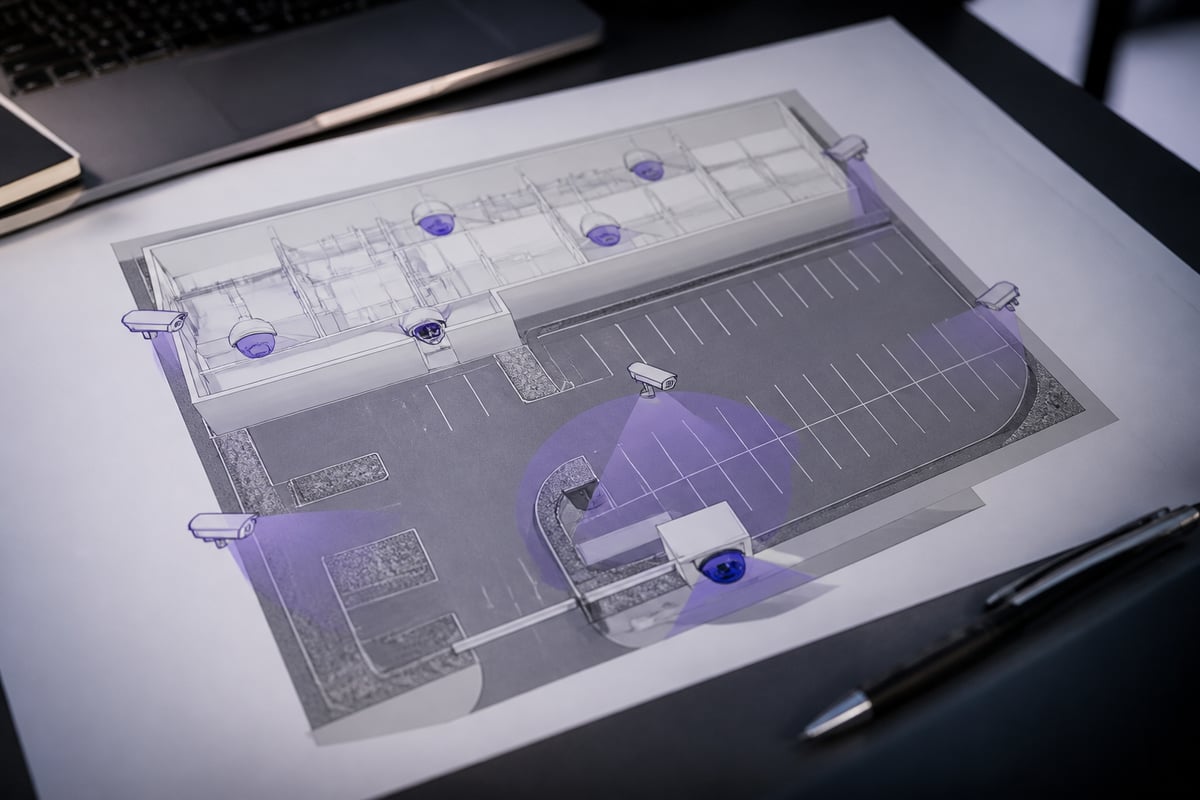
Yes, it is legal for a business to have CCTV outside its premises, provided its use is lawful, fair and proportionate under UK data protection law. Cameras that capture public space, neighbouring land or people who have not been told about them need extra care, because the footage is personal data.
The ICO sets out the duties for organisations using CCTV, including paying the data protection fee where required, according to the ICO’s CCTV guidance for organisations. Practical steps include:
- Record a clear purpose for each camera, such as theft prevention or staff safety.
- Place visible signs stating that CCTV is in use and who operates it.
- Position cameras so they capture only what the purpose requires, using privacy masking where public or neighbouring areas fall in view.
- Restrict who can view and export footage, and log access.
For a wider legal summary, Logic Fire and Security's article on CCTV laws in the UK is a useful companion.
Recording, retention and access requests
A system is only as useful as its recorded evidence, and UK law adds duties on how long footage is kept and who may request it.
The ICO says businesses should set and document how long CCTV footage is kept, then delete footage when it is no longer needed, as set out in its guidance for organisations. It also expects the system to let you retrieve stored footage to respond to people's requests for their personal data, and third-party data may need to be redacted or removed. Under GOV.UK guidance on using CCTV, people can usually request footage containing their personal data, and businesses usually must provide it free within one calendar month.
This has a direct bearing on hardware choice:
- Storage capacity: higher resolution and frame rates shorten the retention period for a given disk size, so size the recorder against your documented retention period.
- Export and redaction: choose recorders and software that can export clips with timestamps and blur or mask other people.
- Cyber security: change default passwords, segment the camera network and keep firmware current, because an exposed recorder is a data breach risk.
- Maintenance: failed disks and misaligned cameras often go unnoticed until footage is needed, so a planned inspection regime is worth having. Logic Fire and Security's overview of CCTV maintenance explains what such a regime involves.
Smoke and fire detection alongside CCTV
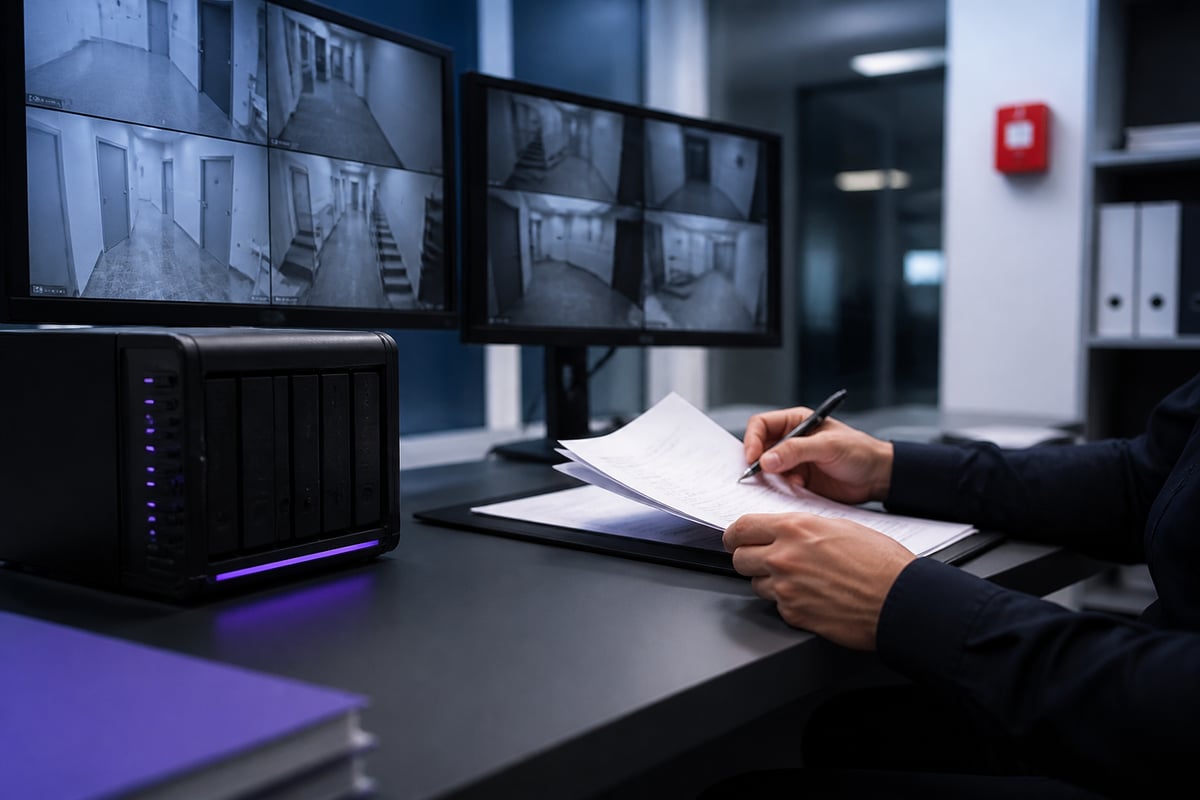
CCTV and fire detection are separate systems with separate standards, but they work well together on the same site. Cameras can give a control room visual confirmation of an alarm activation, shorten the time taken to decide whether to call the fire and rescue service and record the evacuation for later review. Logic Fire and Security's note on smoke detector CCTV cameras covers this crossover.
Cameras do not replace a compliant fire detection and alarm system, and they must never be positioned so as to obstruct detectors, sounders or signage. For a Responsible Person, the practical point is to treat both systems in one risk assessment so that coverage, power resilience and monitoring are planned together.
FAQ
What is the difference between a surveillance camera and CCTV?
CCTV (closed-circuit television) traditionally means cameras sending video to a limited set of recorders and monitors over a private link. "Surveillance camera" is the broader term and includes IP cameras, cloud-connected units and body-worn devices. In practice, the two terms are used interchangeably for commercial systems, and both fall under the same UK data protection rules.
What are the best CCTV cameras to buy for a business?
There is no single best camera, because the right one depends on whether you need detection, observation or identification. Domes suit indoor areas, bullets suit perimeters, PTZ suits large monitored yards and ANPR suits vehicle access. A site survey by an approved installer will match types to your risks and lighting conditions.
Do CCTV surveillance cameras need a data protection fee?
Most organisations that process personal data, including through CCTV, must pay the ICO data protection fee unless an exemption applies. Check whether you must pay and what the current fee is on the ICO website before installing.
Your next step is to walk your site with a list of your risks, noting where you need detection, observation or identification, and then ask a surveyor to match camera types to each point. Logic Fire and Security designs, supplies, installs, commissions and maintains CCTV and fire detection systems across the UK, with 24/7 monitoring behind them. To discuss a system built around your premises, start with the Commercial CCTV service, then call 0800 8445 999 or email info@logicfireandsecurity.com to arrange a survey.