

Security companies in the UK are businesses that protect premises, people and assets through manned guarding, electronic security systems, monitoring or a combination of all three. For a Responsible Person managing a commercial or public building, the right provider depends on what needs protecting, which accreditations the provider holds and how the service is delivered day to day.
The market is broad. Some firms supply licensed guards by the hour, others design and install alarm, CCTV and access control equipment, and a smaller group combine electronic security with fire detection under one contract. This article sets out the main types of provider, what each costs, and the checks that separate a dependable supplier from a risky one.
1. What does "security firm" actually mean?
A security firm is a business that sells protection services or systems to protect property, staff and assets, and the term covers very different operations. Some employ licensed guards and patrol officers. Others are electronic specialists that survey, design, install and maintain alarms, cameras and entry systems. Many do both.
For a facilities manager, the distinction matters because the two models carry different risks and obligations. Manned services are regulated by the Security Industry Authority (SIA), while electronic installers are assessed through industry bodies such as the NSI and NICEIC. A single site often needs both, so it helps to know which part of the market you are buying from.
2. The main types of security companies
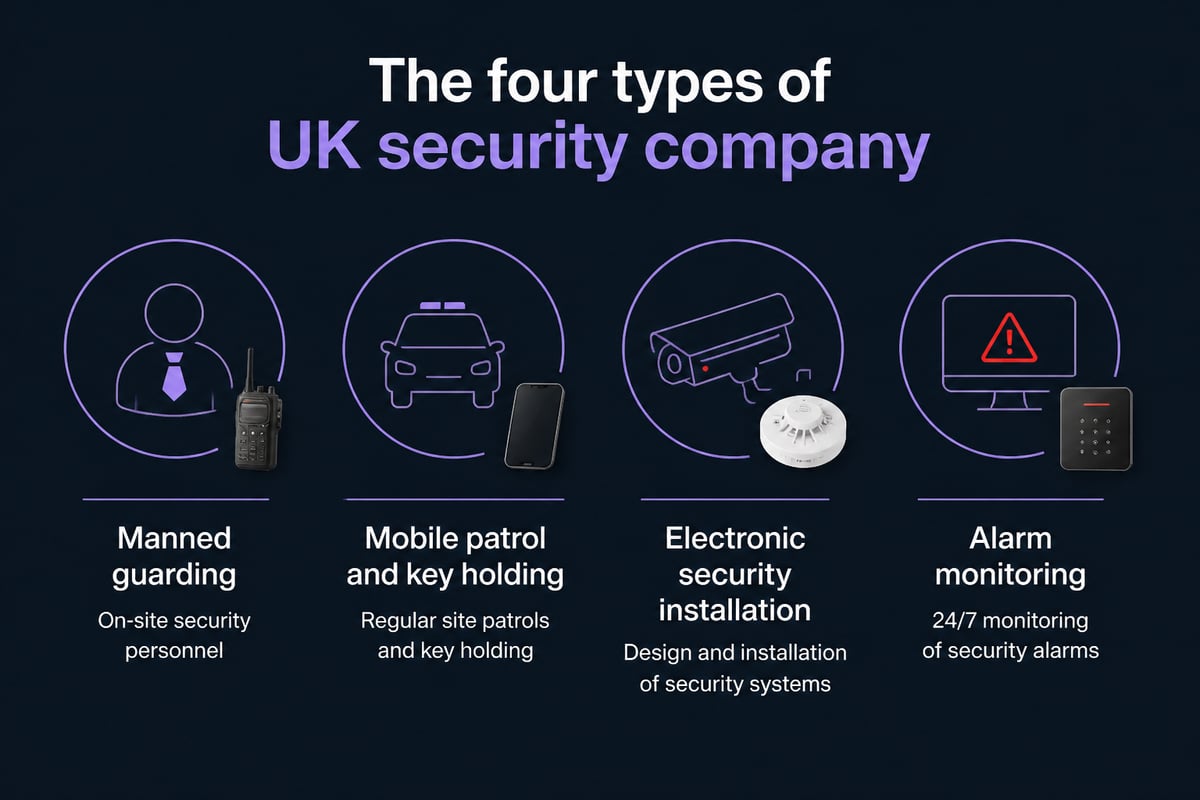
Security companies fall into four broad groups, and most commercial sites will use more than one.
- Manned guarding firms supply static guards, concierge staff, event security and door supervisors.
- Mobile patrol and key holding providers visit sites at intervals and respond to alarm activations.
- Electronic security installers design and fit intruder alarms, CCTV, access control and related systems.
- Monitoring providers run alarm receiving centres that handle signals from alarms and cameras around the clock.
The Security Industry Authority licenses security guarding, door supervision, close protection, public-space CCTV surveillance, key holding and cash-and-valuables-in-transit work. If a provider supplies any of those activities, its staff need the relevant licence.
3. How much do security companies cost in the UK?
Costs vary by service type, and manned guarding is priced by the hour while electronic systems are priced by project plus ongoing maintenance and monitoring. A 2025 UK security cost guide from Leon Guarding gives indicative hourly rates of £18 to £25 or more for static guarding, £20 to £30 or more for mobile patrols, £20 to £28 or more for event security, and £25 to £40 or more for specialist or high-risk work.
Those figures are indicative and change with region, shift pattern and contract length. Rates are likely to be at or above those ranges, so treat them as a starting point for budgeting rather than a quote.
Electronic security works differently. Costs depend on site size, the number of cameras or entry points, the cabling involved and the monitoring contract chosen. A fixed installation can cost less over several years than round-the-clock guarding, which is one reason many sites move from guards to systems with monitored response. For a figure tied to your own building, a site survey is the only reliable route.
4. What to check before you appoint a provider
Verify accreditations, insurance and licensing before comparing price, because a cheap quote from an unaccredited supplier can leave you non-compliant.
- Accreditation. Look for NSI, SSAIB or equivalent approval for alarms and CCTV, NICEIC for electrical work and BAFE for fire systems.
- SIA licences. For guards, patrols or key holding, ask to see current licences for the people who will attend your site.
- Insurance. Confirm public liability and employer's liability cover at levels that suit your premises.
- References. Ask for named clients in comparable sectors, such as education, healthcare or logistics.
- Response and escalation. Find out who answers an alarm, how fast, and who contacts key holders or the police.
- Contract terms. Check minimum terms, notice periods and what is included in maintenance visits.
Accreditation is also the practical route to insurer acceptance. Many insurers require alarms to be installed and maintained by an approved contractor, and monitored to a recognised standard, before they recognise the system. Ask any supplier for evidence of its accreditations.
5. Why integrated fire and security matters
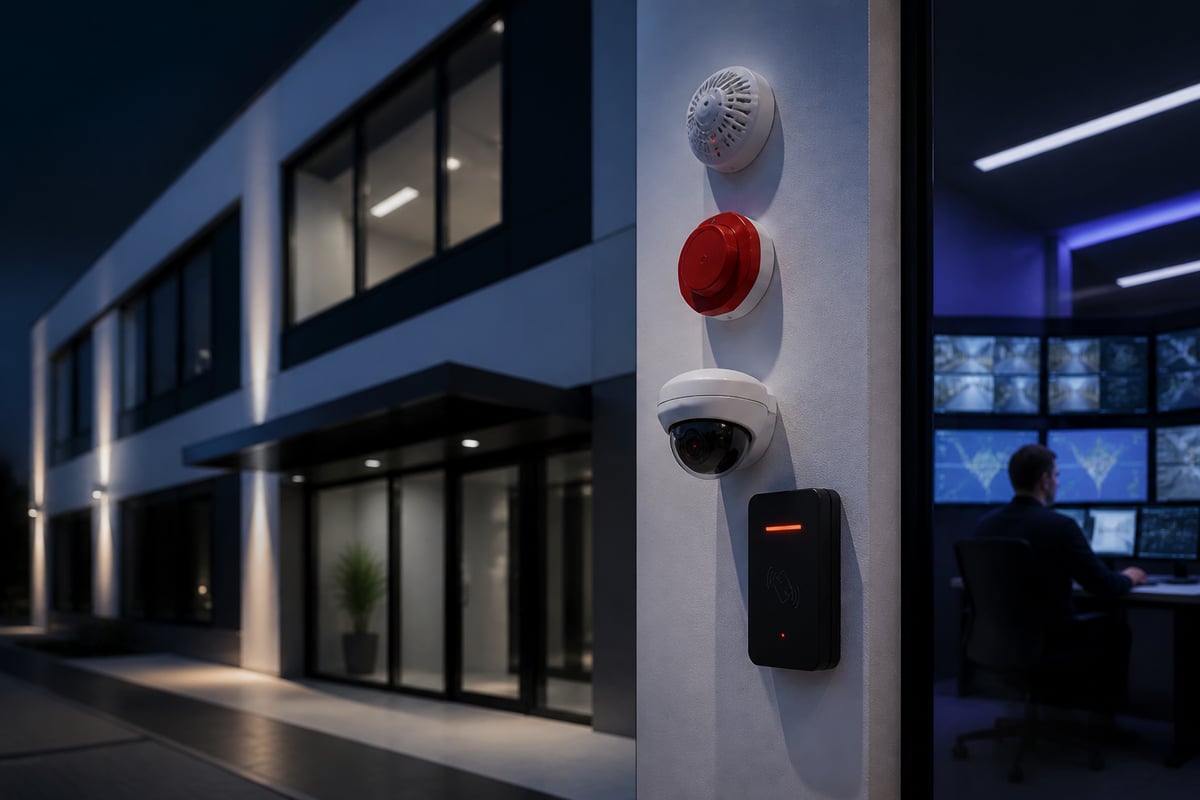
Treating fire detection and security as separate purchases can create gaps, duplicated visits and conflicting contractors. Fire alarms, intruder alarms, CCTV and access control often share cabling, power and a monitoring path. They also interact: an access control system, for example, must release doors on a fire alarm signal so people can leave safely.
Using one competent contractor for design and maintenance reduces the risk of those systems working against each other. It also gives the Responsible Person a single point of contact for service records, which helps when demonstrating compliance after an inspection or incident. Where the supplier also designs the system, you can ask directly how fire alarm design decisions affect the security layout and vice versa.
6. Monitoring and response: what happens after the alarm sounds
An alarm only protects a site if someone acts on the signal, so the monitoring arrangement deserves as much scrutiny as the equipment. A good alarm receiving centre verifies the activation, contacts key holders and, where the alarm qualifies, requests an emergency response. The accreditation of that centre matters, because police response policy depends on the alarm meeting recognised standards.
Ask any provider where signals are received, whether the centre is NSI Gold accredited, and how fire and intruder signals are handled differently. Fire alarm monitoring in particular should run continuously, since a fire does not wait for office hours. Logic Fire and Security offers fire alarm monitoring on a 24/7 basis, and round-the-clock monitoring is the standard to expect from any serious supplier.

7. Examples of providers to compare
Security companies range from national guarding groups to specialist electronic installers, and the right shortlist depends on whether you need people on site, systems on the wall or both. The list below covers well-known routes to market rather than a ranking, ordered by how broadly they apply to a typical commercial site.
G4S
G4S is a large international security group with a UK manned guarding business, alongside electronic systems and facilities services. It suits organisations that need guarding across many locations under one agreement. Verdict: a scale option for large, multi-site manned guarding.
Securitas
Securitas is another international group with a UK presence covering guarding, mobile patrols, remote video monitoring and fire and safety services. It sells to retail, logistics, public sector and corporate clients, with bespoke pricing. It suits sites wanting guarding combined with technology-led monitoring. Verdict: a broad provider for mixed guarding and technology needs.
Mitie
Mitie provides security services alongside wider facilities management, which can simplify contracts for organisations outsourcing several building services at once. Pricing is contract-based. It suits large public sector and corporate sites that prefer a single facilities partner. Verdict: sensible where security sits within a bundled facilities contract.
ADT Commercial
ADT Commercial focuses on electronic security: intruder alarms, CCTV, access control and monitoring for business premises. It suits sites that want a national installer with monitoring capability and no manned guarding element. Pricing follows a survey. Verdict: a recognised electronic security specialist for commercial sites.
Commercial Security Systems from Logic Fire and Security
Commercial Security Systems from Logic Fire and Security is an integrated service covering intruder alarms, CCTV, access control and monitoring, from survey and design through installation and maintenance. Logic Fire and Security is an NICEIC, BAFE and NSI Gold approved contractor, with fully trained engineers who bring over two decades of fire safety experience. It suits commercial and public buildings that want electronic security and fire detection handled by one accredited team across the UK. Pricing is not listed, so request a survey for a quote. Verdict: a strong fit for sites wanting fire and security under one accredited contractor.
Intruder Alarm Monitoring from Logic Fire and Security
Intruder Alarm Monitoring routes alarm signals through an NSI Gold accredited Alarm Receiving Centre, which contacts key holders and emergency services when an alarm is triggered. It suits businesses that already have an alarm and need reliable, accredited monitoring behind it, or that are installing a new system and want the monitoring arranged at the same time. Pricing is not listed, so contact the team for terms. Verdict: a focused monitoring service where accreditation of the receiving centre matters.
8. Comparison of the options
| Provider | Core service | Best suited to | Pricing basis |
|---|---|---|---|
| G4S | Manned guarding, electronic systems | Large multi-site estates | Contract-based |
| Securitas | Guarding, remote monitoring | Mixed guarding and technology | Bespoke contract |
| Mitie | Security within facilities management | Bundled facilities contracts | Contract-based |
| ADT Commercial | Alarms, CCTV, access control | Electronic-only installations | Survey-based |
| Commercial Security Systems (Logic Fire and Security) | Integrated alarms, CCTV, access control, maintenance | Sites wanting fire and security together | Survey-based, not listed |
| Intruder Alarm Monitoring (Logic Fire and Security) | NSI Gold accredited alarm monitoring | Sites needing accredited monitoring | Not listed |
9. How to run a fair comparison
Request like-for-like quotes by giving every provider the same written brief. Include the site address, opening hours, number of entry points, existing equipment and the level of response you expect. Without that, prices cannot be compared meaningfully.
Ask each supplier for their approach to maintenance as well as installation, since a system that is not serviced loses its value and may fall outside insurer requirements. A realistic commercial intruder alarm system proposal should state the equipment grade, the monitoring arrangement and the service schedule in plain terms.
If you are weighing several suppliers at once, a useful companion read is Logic Fire and Security's overview of commercial security alarm companies, which sets out what separates one installer from another.
FAQ
What are the top security companies in the UK?
The largest names by scale include G4S, Securitas and Mitie for manned services, and ADT Commercial for electronic systems. The best choice for you depends on your site, not size alone, so shortlist providers that hold the right accreditations for the service you need.
Do security companies need to be licensed in the UK?
Companies supplying security guarding, door supervision, close protection, public-space CCTV surveillance, key holding or cash-and-valuables-in-transit work must ensure their staff hold SIA licences. Electronic installers are not licensed in the same way but are usually assessed by bodies such as the NSI and NICEIC.
Is it cheaper to use guards or electronic security?
Guards are charged by the hour, so round-the-clock cover accumulates quickly, while electronic systems involve an upfront installation cost plus maintenance and monitoring. Many commercial sites find a monitored system cheaper over several years, but a survey of your own premises is the only way to confirm that.
Start by writing a one-page brief of your site, its entry points and your insurer's requirements, then ask two or three accredited providers to quote against it. If you want fire detection and electronic security handled by one team, Logic Fire and Security designs, installs, monitors and maintains both for businesses and public bodies across the UK, and its Commercial Security Systems service is a good place to see how a survey-led approach works. To discuss your premises, call 0800 8445 999 or email [email protected] and the team will help you scope the right solution.