

A smoke sensor alarm detects particles in the air and gives the earliest warning in most rooms, while a heat alarm responds only to a rise in temperature and suits kitchens, boiler rooms and other places where smoke or steam would cause false alarms. Most commercial premises benefit from both, each in the right location. This comparison sets out how the two technologies differ so that a Responsible Person can specify the correct device for each area.
Smoke Sensor vs Heat Sensor Alarms at a Glance
The table below summarises the practical differences between the two device types and the multi-sensor option that combines them.
| Criterion | Smoke sensor alarm (optical) | Heat alarm | Multi-sensor alarm |
|---|---|---|---|
| What it detects | Smoke particles | Rising or high temperature | Smoke and heat, sometimes carbon monoxide |
| Speed of warning | Fastest in most rooms | Slower, as heat must reach the device | Fast, with a second trigger as a cross-check |
| False-alarm risk | Higher near cooking, steam and dust | Low | Lower than smoke-only in marginal areas |
| Typical locations | Offices, corridors, stairwells, storage | Kitchens, plant rooms, garages | Areas with mixed risks |
| Detects smouldering fires | Yes | Poorly | Yes |
| Life-safety role | Early warning | Fire confirmation where smoke is unsuitable | Early warning with fewer nuisance alarms |
The choice is rarely one or the other. The right question is which technology belongs in which room.
How a Smoke Sensor Alarm Works
A smoke sensor alarm contains a chamber that senses combustion particles and sounds the alarm when their concentration passes a set threshold. The two main sensing methods behave differently, and that difference affects where each should go.
Optical (photoelectric) sensors shine a light beam inside the chamber. Smoke scatters the light onto a sensor and triggers the alarm. Optical devices respond well to slow, smouldering fires that produce visible smoke, such as burning upholstery or overheated wiring.
Ionisation sensors use a small radioactive source to create a current between two plates. Smoke particles disrupt the current. They tend to react faster to fast-flaming fires, but they are more prone to nuisance alarms from cooking.
Cornwall Fire and Rescue Service outlines the alarm types and where each may be appropriate. For general-purpose areas where a smouldering fire is a realistic risk, optical detection is the usual starting point.
How a Heat Alarm Works
A heat alarm does not sense smoke at all; it triggers when the surrounding temperature crosses a fixed threshold or rises at a defined rate. Because it ignores smoke, steam and cooking fumes, it will not sound for toast or a boiling kettle.
The trade-off is speed. Heat must travel from the fire to the device, so the warning arrives later than from a smoke sensor. A heat alarm is a confirmation device for difficult environments, not a replacement for early smoke detection across the wider building.
The UK government's fire safety in the home guidance covers alarm placement and the use of heat alarms in kitchens. The principle carries across to commercial catering areas, though commercial premises are governed by the Regulatory Reform (Fire Safety) Order 2005 and a fire risk assessment rather than domestic guidance.
Which Alarm Suits Which Area?
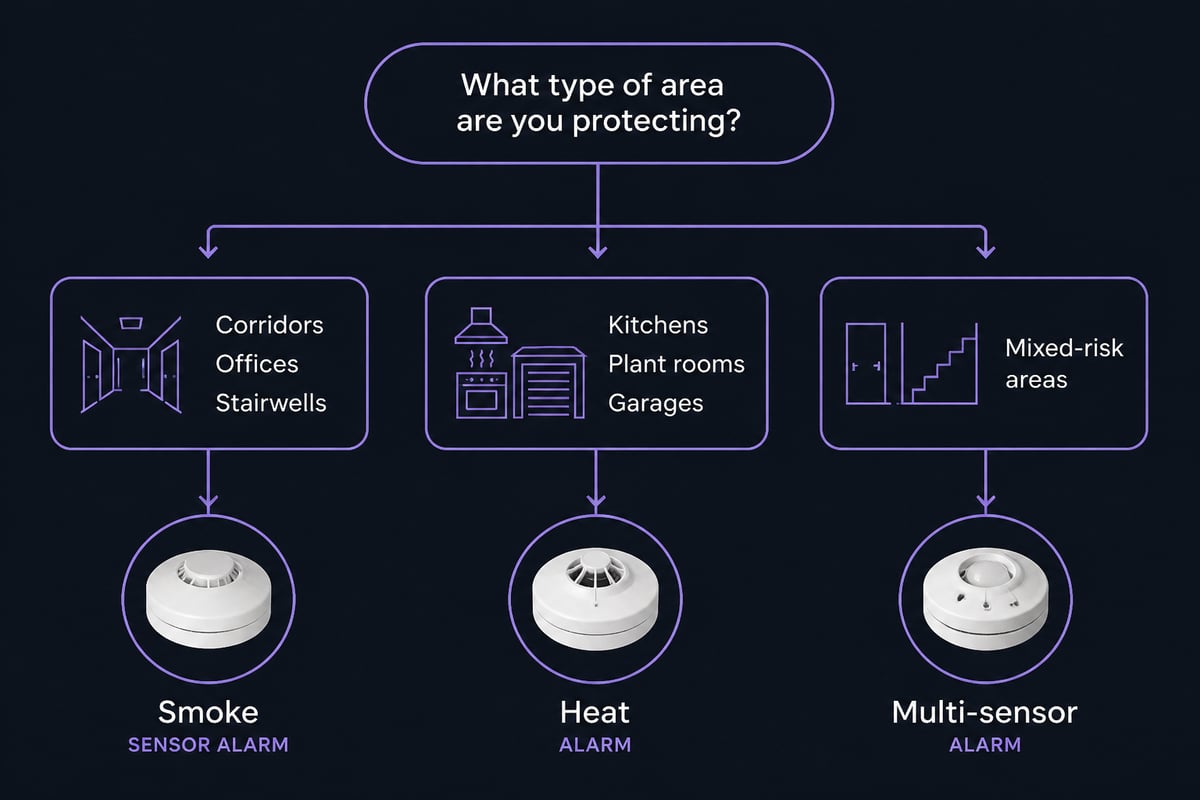
The right device depends on what normally happens in the room, not on the type of building. A short list of common commercial areas makes the pattern clear:
- Corridors, stairwells and escape routes: smoke detection, so occupants are warned before routes become impassable.
- Offices and meeting rooms: optical smoke detection.
- Staff kitchens and canteens: heat detection, or a multi-sensor device, to avoid nuisance alarms from cooking.
- Plant rooms, boiler rooms and garages: heat detection, as dust, fumes and exhaust gases can trigger smoke sensors.
- Server and comms rooms: typically smoke detection, often alongside a specialist suppression or aspirating system specified by a designer.
- Storage areas: smoke detection where dust is controlled; heat detection where it is not.
London Fire Brigade advises smoke alarms in rooms where a fire may start, except rooms with excess smoke or steam, and a heat alarm in the kitchen. That exclusion rule is the practical test: if the room regularly produces smoke, steam or fine dust, a smoke sensor alarm will cause repeated false alarms.
Comparing Specific Alarm Models
Four Aico models illustrate how the technologies are packaged. They are stand-alone mains or battery alarms of the type found in smaller premises and individual rooms; larger commercial buildings normally rely on an addressable system, covered later.
Aico Ei3014 Heat Alarm
The Ei3014 is a mains-powered heat alarm with a sealed backup battery and a 10-year guarantee. It can be interlinked with other alarms. It suits kitchens and other areas where cooking fumes would trigger a smoke alarm, because it responds to rising temperature instead.
Aico Ei146e Optical Smoke Alarm
The Ei146e uses an optical sensor and is mains powered with an included 9V backup battery. It interlinks with up to 12 other alarms and carries a 10-year alarm life. It is a sound choice for general rooms where an optical smoke alarm is suitable, especially where smouldering fires are the concern.
Aico Ei3024 Multi-Sensor Fire Alarm (Smoke)
The Ei3024 combines optical smoke and heat sensors in a battery-powered unit with a sealed 10-year battery. It can be interlinked wirelessly or by hardwiring. It suits areas that need a battery-powered, interlinkable alarm covering both smoke and heat.
Aico Ei3030 Multi-Sensor Fire and Carbon Monoxide Alarm
The Ei3030 detects smoke, heat and carbon monoxide, is mains powered with an included 9V backup battery, and interlinks with compatible Aico alarms. It carries a 10-year alarm life and warranty. It is available from retailers such as Electricpoint and Screwfix, where prices vary. It suits spaces where one interlinked unit should cover all three hazards, such as a room containing fuel-burning appliances.
Model comparison
| Model | Sensing | Power | Interlinking | Life |
|---|---|---|---|---|
| Aico Ei3014 | Heat | Mains, sealed backup battery | Yes | 10-year guarantee |
| Aico Ei146e | Optical smoke | Mains, 9V backup battery | Up to 12 other alarms | 10-year alarm life |
| Aico Ei3024 | Optical smoke and heat | Sealed 10-year battery | Wireless or hardwired | 10-year battery |
| Aico Ei3030 | Smoke, heat and carbon monoxide | Mains, 9V backup battery | Compatible Aico alarms | 10-year life and warranty |
Where Standalone Alarms End and a Fire Alarm System Begins
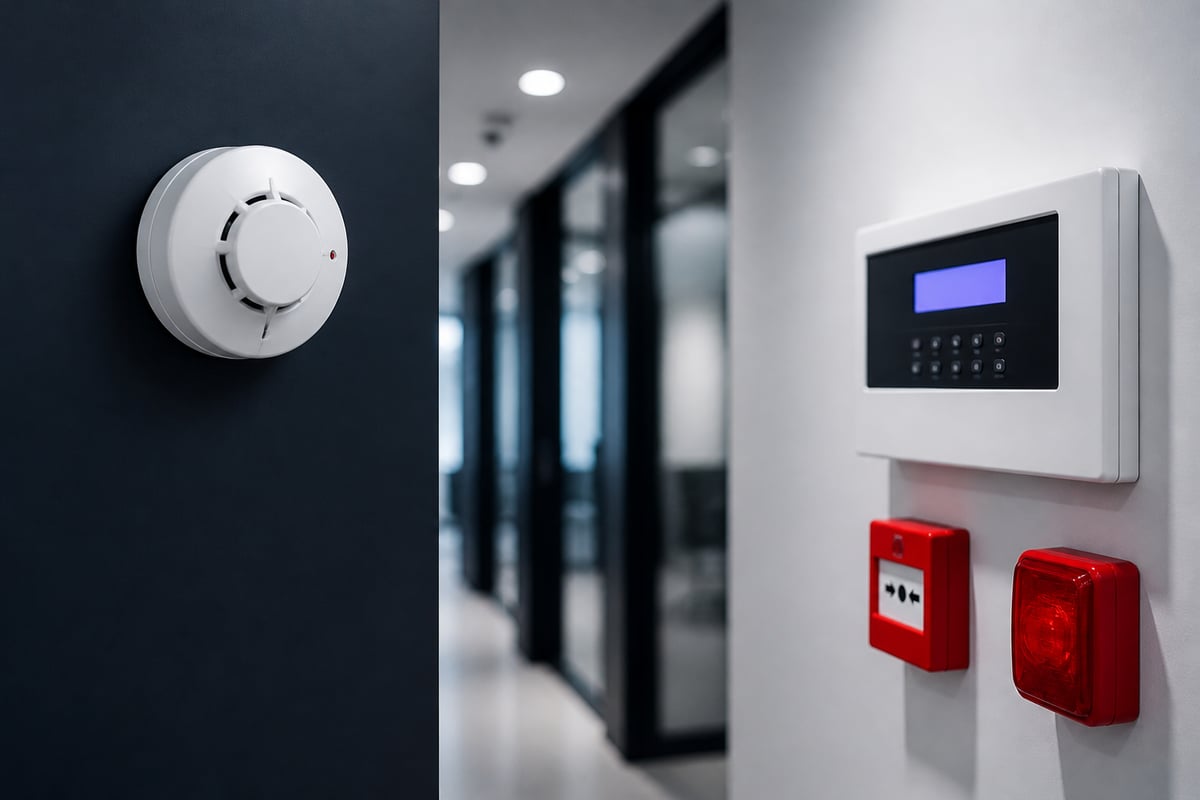
Standalone alarms are suitable for small, low-risk spaces, but most commercial and public buildings require a coordinated fire detection system designed to a recognised standard. In a system, smoke and heat detectors are wired to a central control panel. Each device reports its location, the panel drives sounders throughout the building, and the system can be monitored so that a signal reaches a response centre.
This is the central difference for a Responsible Person. A battery alarm sounds locally and relies on someone being present to act. A system provides zone identification for the fire service, supports a clear evacuation strategy, and can be tested and logged as evidence of compliance. Logic Fire and Security designs, supplies, installs, commissions and maintains commercial fire alarm systems that detect fire or smoke and alert occupants and emergency services, with 24/7 fire alarm monitoring available as a separate service. Its engineers work as approved contractors.
For a plain-English overview of how detectors and control equipment fit together, the Logic Fire and Security article on smoke detectors within a fire alarm system is a useful starting point.
Where Should Each Alarm Be Fitted?
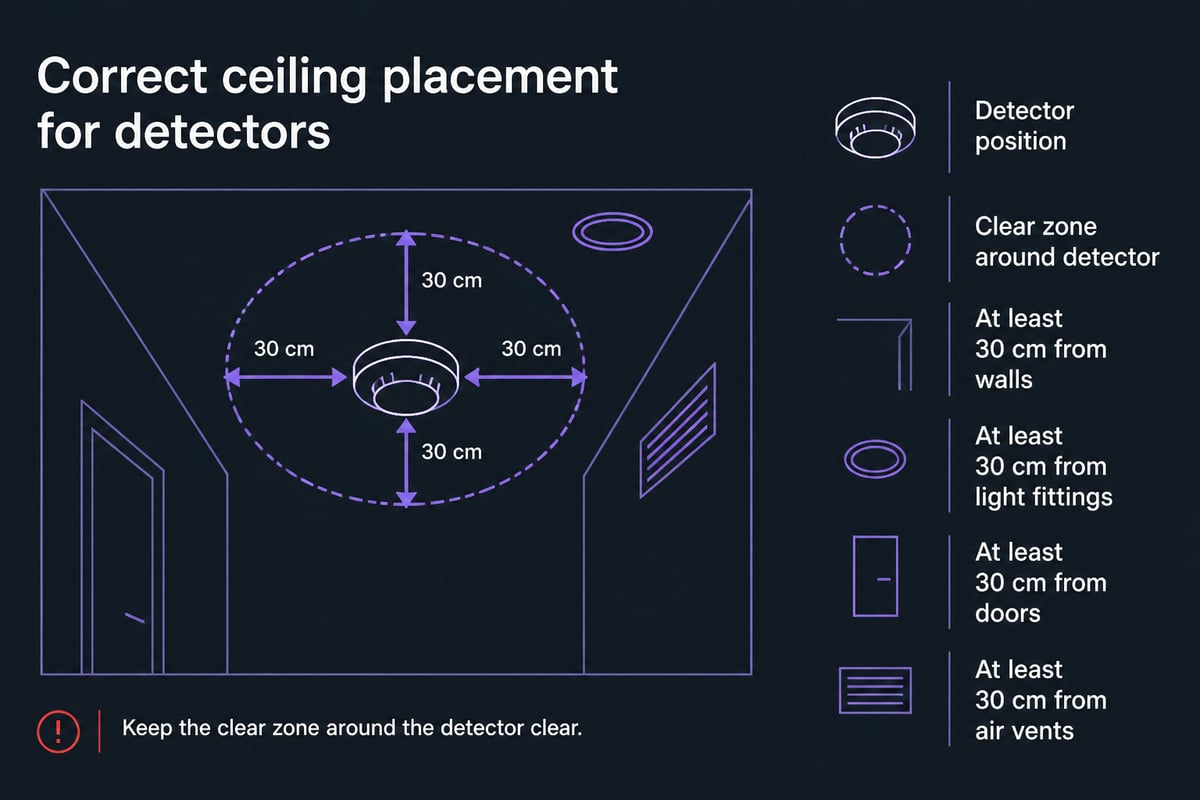
Mount alarms on the ceiling, away from walls, lights, doors and vents, so that air currents do not delay or distort detection. The Scottish Fire and Rescue Service advises mounting alarms on the ceiling at least 30 cm (12 inches) from walls, lights, doors, and heating or air-conditioning vents. The same service sets a domestic benchmark of one smoke alarm in the living room or most-used room, one in every hallway or landing, and one heat alarm in the kitchen, all interlinked.
In a commercial setting, spacing and coverage radius are set by the system design standard rather than a rule of thumb, and your fire risk assessment should drive the final layout. Logic Fire and Security's guidance on where to put smoke alarms and on smoke detector locations explains the principles behind positioning.
Power, Battery Life and Interlinking
Choose devices with a sealed long-life battery or mains power with a backup, and make sure every alarm in an area sounds when one is triggered. London Fire Brigade recommends smoke alarms with a 10-year or long-lasting sealed battery, which removes the risk of a flat or removed battery. Most of the Aico models above offer 10-year life or sealed power.
Interlinking matters because a fire in a closed room may not be heard elsewhere. Linked alarms can be hardwired or wireless; wireless links reduce disruption in occupied buildings and heritage premises where cabling is difficult. Logic Fire and Security covers the trade-offs in its article on wireless fire alarms.
What Do Smoke and Heat Detection Cost to Install and Maintain?
Cost depends on building size, number of zones, cabling route and monitoring, so there is no single figure that applies across premises. Device price is often a small part of the total; design, installation, commissioning and ongoing servicing can make up much of it. For a breakdown of the factors involved, Logic Fire and Security publishes guidance on commercial fire alarm installation cost. Pricing for a specific site is best confirmed through a survey.
How Do I Replace a Smoke Alarm in a Commercial Building?
Replace a detector by isolating it according to the system's procedure, fitting a compatible like-for-like unit, and testing it before the zone returns to service. In a conventional or addressable system, detectors are matched to the control panel, so an incompatible head can cause faults or fail to report. Competent engineers should carry out the work and record it in the fire alarm logbook.
Replace any alarm that has reached the end of its stated life, shows repeated faults, or has been exposed to paint, damage or contamination. Regular servicing catches these issues before they become compliance gaps; see Logic Fire and Security's notes on fire alarm testing and fire alarm servicing.
Verdict: Which Option Suits Which Reader?
Use this as a quick guide, then confirm against your fire risk assessment.
- Facilities managers of offices, schools and public buildings: specify optical smoke detection for general areas and escape routes, with heat detection in kitchens and plant rooms, all within a designed, monitored system.
- Operators of catering or kitchen-adjacent areas: use heat detection, or multi-sensor devices, where cooking and steam would otherwise cause repeated false alarms.
- Managers of small, low-risk spaces such as a single-room annex: a standalone interlinked alarm such as the Aico Ei146e (smoke) with an Ei3014 (heat) may be adequate, provided your risk assessment supports it.
- Managers of spaces with fuel-burning appliances: a multi-sensor device that also detects carbon monoxide, such as the Ei3030, covers more than one hazard.
- Anyone responsible for a large or multi-occupancy building: choose an addressable fire alarm system with monitoring rather than relying on standalone units.
The strongest set-ups do not choose between smoke and heat. They place each technology where it performs best.
FAQ
Where is the smoke sensor on a fire alarm?
The sensing chamber sits inside the detector housing, behind the vented cover on the ceiling-mounted head. Air carrying smoke enters through the slots and reaches the chamber. Keep the vents clear of paint, dust and covers so the device can respond.
Is there a smart smoke detector?
Yes, connected smoke alarms exist that send alerts to a phone or building system. In commercial premises, the equivalent is an addressable or monitored fire alarm system that reports the exact location of a trigger to a control panel and, where monitored, to a response centre.
How do I stop a smoke alarm from beeping in the UK?
A repeated chirp usually means a low battery, a fault or an end-of-life warning, not a fire. Check the device against the manufacturer's guidance, and in a commercial system report the fault to your maintenance provider rather than disabling the detector. Cheshire Fire and Rescue Service gives general advice on what to do when an alarm sounds.
Start by listing each area of your premises and noting whether it produces cooking fumes, steam, dust or exhaust gases, because that single check decides where smoke detection is suitable and where heat detection is needed. If you would like those decisions confirmed by a survey and built into a compliant design, Logic Fire and Security can help; its approved engineers design, install, commission, monitor and maintain fire detection for UK businesses and public bodies, including its fire alarm system service, so call 0800 8445 999 or email [email protected] to arrange a conversation with its team.