

Security for safety means using protective systems such as intruder alarms, CCTV, access control and fire detection to keep people, property and operations free from harm. For UK businesses, the two disciplines overlap far more than their separate budgets suggest, and the Responsible Person for a building is expected to manage both with a clear, documented plan.
This guide takes you from the basic definitions through to the systems, legal duties and maintenance habits that keep a commercial or multi-occupied building protected.
Are security and safety the same thing?
Security and safety are related but distinct: safety protects people from accidental harm, while security protects people and assets from deliberate harm.
A fire, a slip hazard or a blocked escape route are safety matters. A forced entry, theft or unauthorised access to a plant room are security matters. In practice, the two meet constantly. A door that is locked tightly for security can trap occupants during a fire. A fire exit left unsecured can invite intruders. Good design resolves that tension rather than choosing one side.
In simple words, safety means being free from danger or risk of harm. Security means being protected against threats that someone intends to carry out. A building needs both, and the systems that deliver them should be planned together.
What are the levels of safe security?
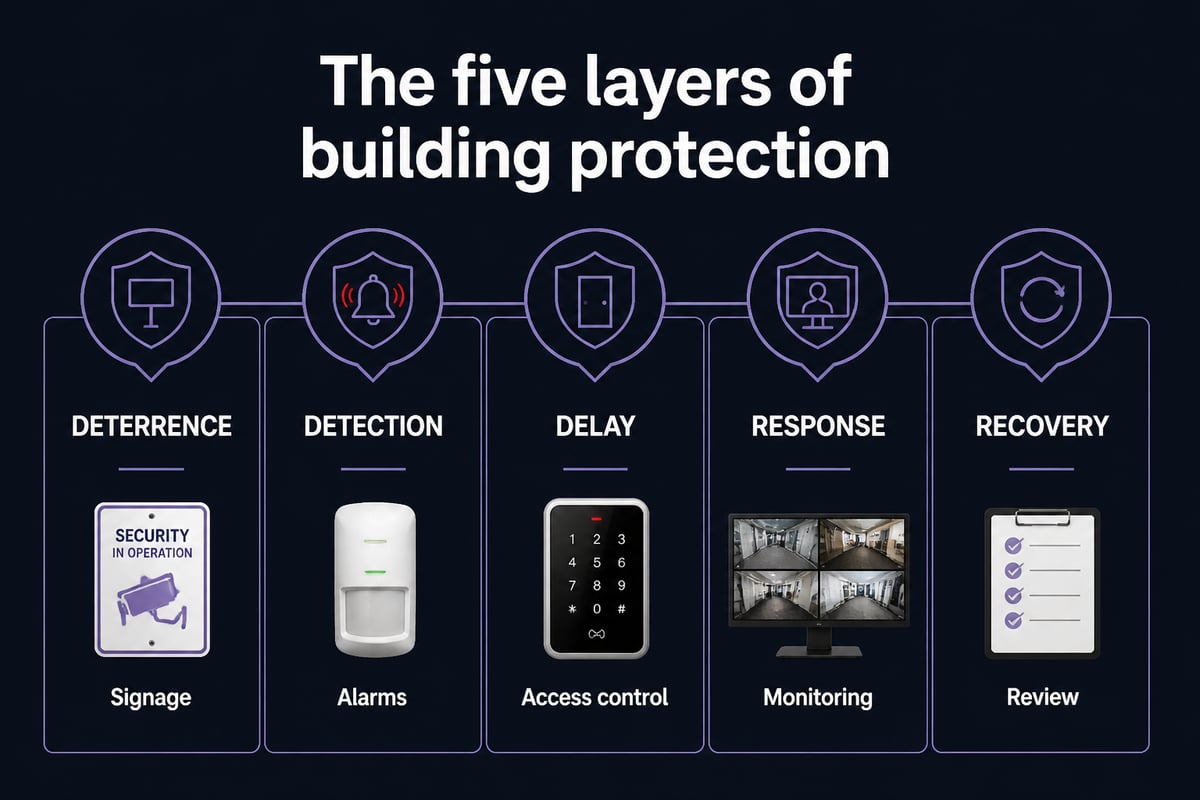
There is no single national scale called "levels of safe security", but UK practice commonly describes protection as a set of layers, each adding delay or detection before a threat reaches people or assets.
A practical layered model looks like this:
- Deterrence: visible signage, lighting, CCTV cameras and well-maintained perimeters discourage opportunistic activity.
- Detection: intruder alarms, door contacts, smoke and heat detectors and video analytics identify a problem early.
- Delay: locks, access control, shutters and compartmentation slow an intruder or a fire's spread.
- Response: monitoring, keyholders, emergency services and evacuation procedures limit the impact.
- Recovery: records, backups, insurance and review procedures restore operations and prevent a repeat.
Each layer supports the next. A camera that nobody monitors detects nothing in real time, and an alarm with no response plan simply makes noise. That is why monitoring and maintenance sit alongside hardware in any sound specification.
What threats should a UK business plan for?
A UK business should plan for fire, intrusion, theft, vandalism, unauthorised access and cyber attack, because all of them can interrupt operations and endanger occupants.
Physical risks are the most visible. Fire remains the most serious safety threat for most commercial premises, while burglary, criminal damage and tailgating through entrances affect security. Cyber risk now belongs in the same conversation, because networked alarms, cameras and door controllers can themselves be targeted.
The scale of digital exposure is significant. According to the Cyber Security Breaches Survey 2025 from DSIT and the Home Office, a large share of UK businesses reported a cyber breach or attack in the previous 12 months, and a considerable number were victims of at least one cyber crime. For a facilities manager, the lesson is practical: any device connected to your network needs the same care as the doors and windows it protects.
What legal duties apply to the Responsible Person?
The Responsible Person must assess fire risk, act on the findings and keep the arrangements under review, and this duty applies to most non-domestic premises and the common parts of multi-occupied residential buildings.
Under the Regulatory Reform (Fire Safety) Order 2005, the duty holder is usually the employer, owner, landlord or whoever controls the premises. GOV.UK guidance on fire risk assessments states that the responsible person must carry out and regularly review a fire risk assessment, keep a written record, and use it to identify prevention measures and actions that keep people safe. The HSE overview of workplace fire safety reinforces the requirement to choose appropriate measures to reduce the risk of injury or loss of life.
For a clearer reading of those obligations, the Logic Fire and Security explainer on the Regulatory Reform Order 2005 sets out what the order expects in practice.
Security carries fewer prescriptive statutory rules, but it still has legal edges. CCTV, for instance, falls under data protection law, which we cover below.
Which fire safety systems form the core of a safe building?
The core of a safe building is a fire detection and alarm system suited to its use, supported by emergency lighting, compartmentation, fire-fighting equipment and clear escape routes.
Detection is the foundation. An addressable fire alarm panel identifies the exact location of a fault or activation, which speeds up evacuation and response. Wireless systems suit heritage buildings and sites where cabling is disruptive, and you can compare approaches in this overview of wireless fire alarms. Where the risk justifies it, suppression systems such as sprinklers, water mist or gas suppression protect server rooms, archives and high-value plant without the water damage of conventional discharge.
Do not overlook those who cannot evacuate unaided. Disabled refuge systems provide two-way communication between a refuge point and the control panel, and they are a legitimate part of a compliant escape strategy in multi-storey buildings.
Typical elements of a well-specified fire installation include:
- Detectors matched to the environment, such as optical, heat or multi-sensor devices
- Manual call points on every escape route
- Sounders and visual alarm devices that all occupants can perceive
- Emergency lighting and signage
- Remote signalling to a monitoring centre
For a wider look at how these elements work together, see this guide to fire and life safety systems.
Which security systems protect people and property?
Intruder alarms, CCTV and access control are the three security systems that work together to protect people and property in commercial buildings.
Intruder alarms detect unauthorised entry and trigger a response. A well-designed system balances sensitivity with false alarm control, which matters because repeated false activations can reduce police response. Further background is available in this guide to burglar alarms for business.
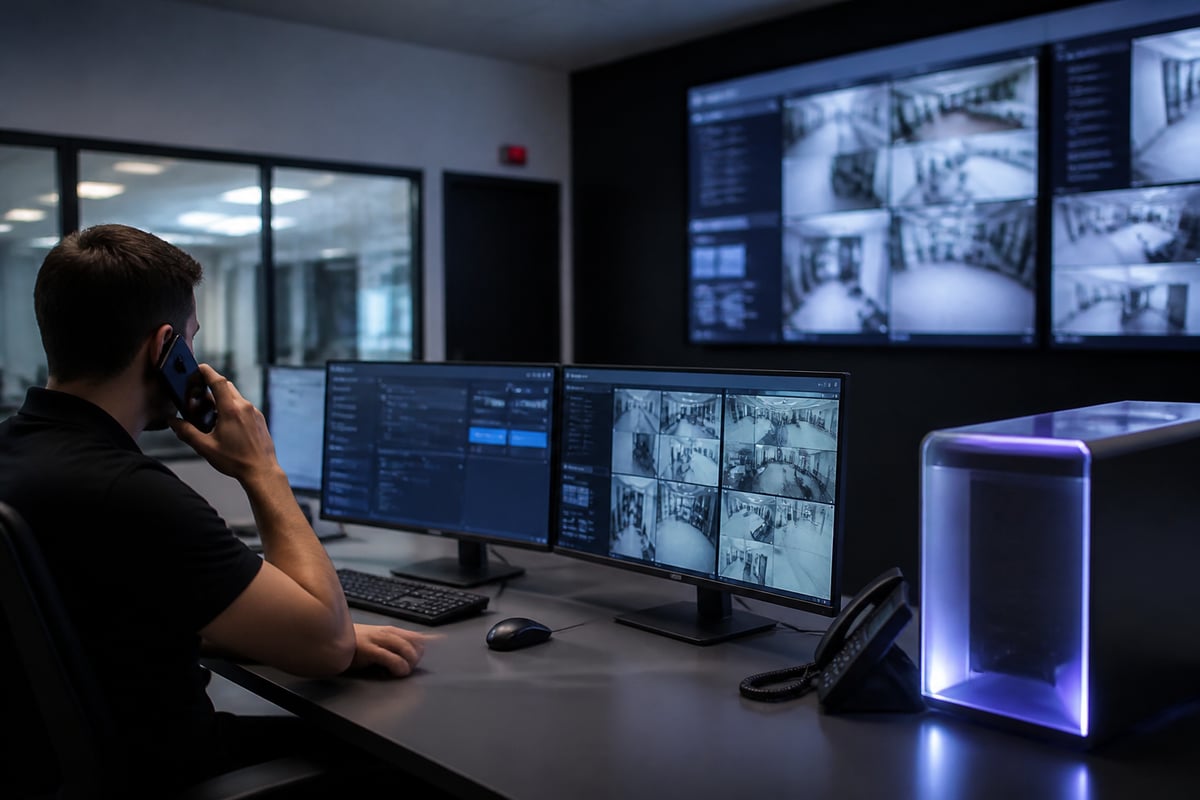
CCTV deters, records and verifies. Modern systems include remote viewing and analytics, and remote CCTV monitoring services allow trained operators to respond to events out of hours.
Access control manages who enters which area and when. It replaces keys with credentials that can be withdrawn instantly, and it produces an audit trail.
Logic Fire and Security's Commercial Security Systems service covers intruder alarms, CCTV, access control and monitoring, from survey and design through installation and maintenance, which suits organisations that want one accountable contractor rather than several.
How do fire and security systems work together?
Fire and security systems work together when they share information and respond to each other, so that a fire event unlocks escape routes while an intrusion event keeps them secured.
Integration is where security for safety delivers its greatest value. Consider the practical examples:
- Access control releases doors on fire alarm activation, so occupants are never trapped by a locked door.
- CCTV cameras record automatically when a detector activates, helping responders see what is happening before they arrive.
- Intruder alarm status prevents false entry into a building that is already under fire evacuation.
- A shared monitoring centre receives all signals, which avoids conflicting instructions.
Integration should be planned at the design stage. Retrofitting links between systems from different suppliers often leaves gaps in responsibility, and a fault on one system can silently undermine another. A single contractor with the right approvals can specify, commission and maintain the whole arrangement against one set of drawings.
What should you consider when buying a system?
Before buying, define your risks, check the contractor's approvals, and confirm who will monitor and maintain the system after installation.
A short checklist helps:
- Start from the risk assessment. Fire and security surveys should drive the specification, not the other way round.
- Check certification. Look for third-party approvals such as NICEIC, BAFE and NSI Gold, which demonstrate audited competence. Logic Fire and Security is an approved contractor under all three schemes.
- Ask about monitoring. An alarm only protects you if someone acts on the signal. Round-the-clock monitoring, such as the 24/7 fire alarm monitoring Logic Fire and Security provides, closes that gap.
- Plan for lifecycle cost. Servicing, replacement parts and software support belong in the budget from day one. Installation cost varies widely by building size and system type, so ask for a site-specific quote.
- Consider the building type. A warehouse, a school and a care home each carry different risks, as explained in resources on warehouse security alarm systems and alarm systems for schools.
How does data protection affect CCTV and access control?
Data protection law applies whenever your cameras or access systems record identifiable people, so you must be able to justify the use, tell people about it and control who sees the data.
The ICO's guidance for small organisations on CCTV covers signage, footage retention and when a data protection impact assessment may be needed. Larger or more complex deployments should consult the ICO's detailed video surveillance guidance under UK GDPR.
Sensible habits include placing cameras only where there is a clear purpose, restricting access to recordings, setting a defined retention period and keeping a record of who has viewed footage. Biometric access control raises further considerations, because fingerprint or facial data is sensitive. Document your reasoning before you install, not after a complaint arrives.
How do you keep systems reliable over time?
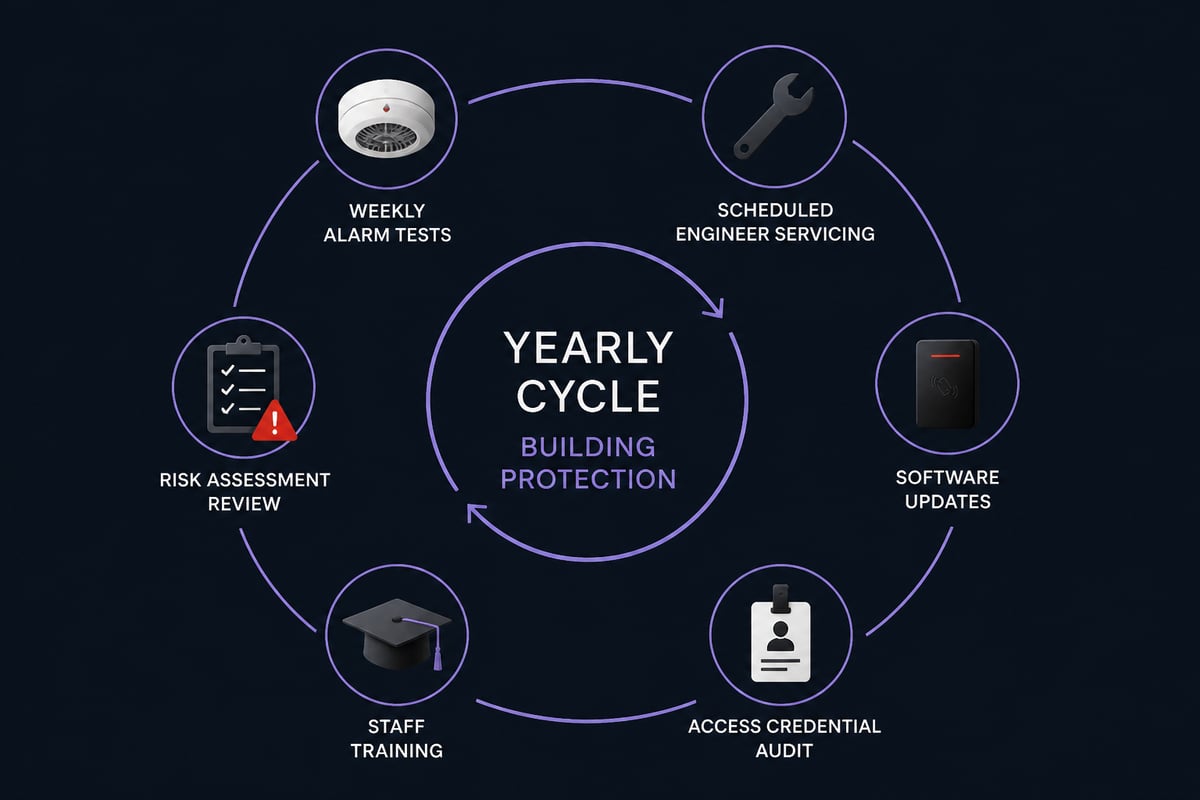
You keep systems reliable through scheduled servicing, prompt fault repair, periodic testing and regular review of the risk assessment.
Fire alarms should be serviced to the relevant British Standard, at intervals set by the system's category and your risk assessment, and manual call points should be tested regularly with the results logged.
Reliability also depends on the less obvious items:
- Software and firmware updates for networked cameras, panels and controllers
- Credential audits so leavers and contractors lose access promptly
- Change management, since a refit, new partition or change of use can leave detectors and cameras in the wrong place
- Training, so fire wardens and reception staff know how to respond to an alarm or a fault
Review the whole arrangement whenever the building, its occupancy or its risks change, and at least annually in any case. A system designed for last year's layout can quietly fall out of step with how the building is used today.
FAQ
What are the 7 basic safety rules?
There is no single official list of seven, but common workplace rules cover knowing your escape routes, keeping exits clear, reporting hazards, using equipment correctly, following instructions, knowing the alarm and assembly point, and never tampering with safety equipment. Each business should adapt these to its own risk assessment and induction process.
Do I need 24/7 monitoring for my alarms?
Monitoring is not mandatory for every premises, but it is strongly advised where a building is unoccupied for long periods or where an alarm must trigger an emergency response. Without monitoring, an activation depends on someone being present to hear it and act.
How often should a risk assessment be reviewed?
You should review it regularly and whenever something significant changes, such as building works, a new tenant, a change in occupancy or an incident. GOV.UK guidance requires the responsible person to keep the assessment under review and maintain a written record.
Start by reading your current fire risk assessment alongside your security arrangements and note where a locked door, a camera blind spot or an unmonitored alarm leaves a gap. From there, a joined-up survey will show what needs upgrading and in what order. Logic Fire and Security designs, installs, monitors and maintains fire detection and electronic security systems across the UK, and if you want to protect your people and premises with one accountable partner, call 0800 8445 999 or email [email protected] to arrange a conversation with its engineers.