

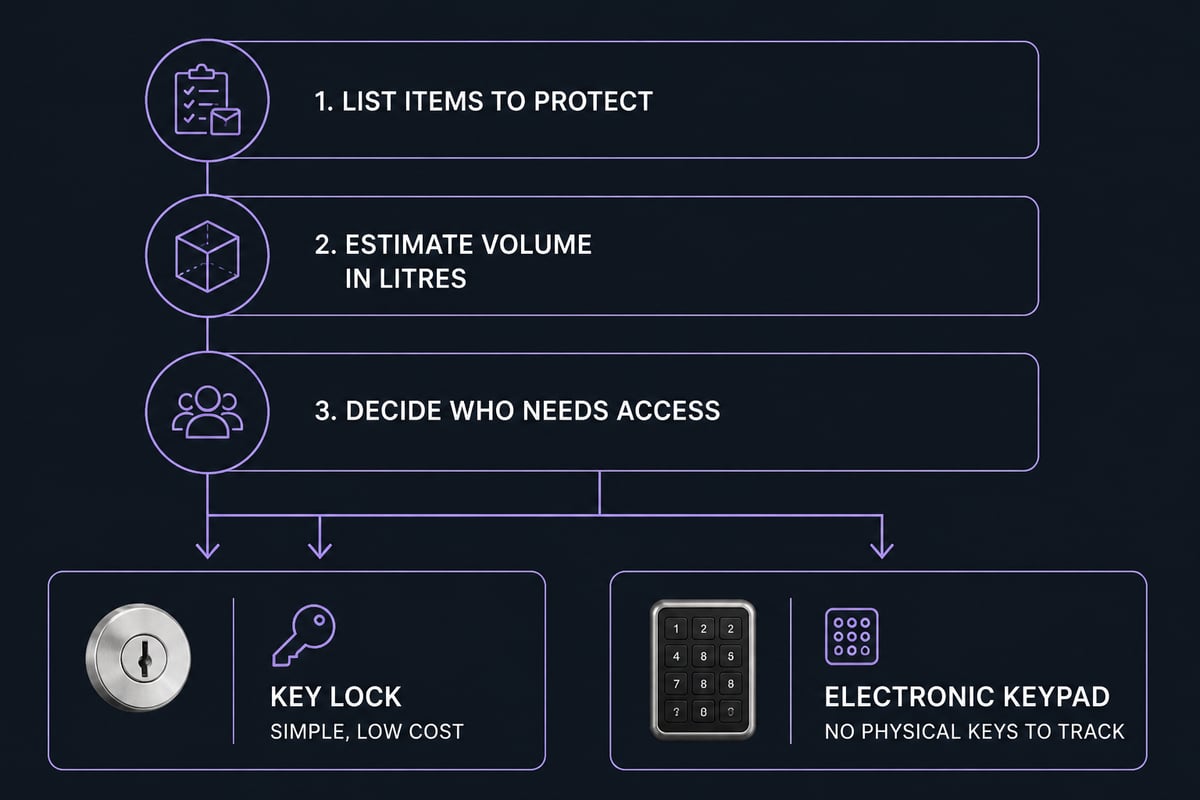
A safe for fire is a lockable container tested to keep its contents below a set temperature for a stated period, usually 30 or 60 minutes for paper, and it should be chosen by certified rating and internal capacity rather than by outward appearance. For a business, the useful questions are what you need to protect (paper records, data media or both), how much space that requires, and whether key or electronic access suits your staff.
This comparison covers seven Phoenix models, all priced between roughly £206 and £319 at the time of research, followed by a table, a short guide to reading fire ratings, and advice on where a fire safe sits within a wider fire strategy.
1. Phoenix Titan FS1281K
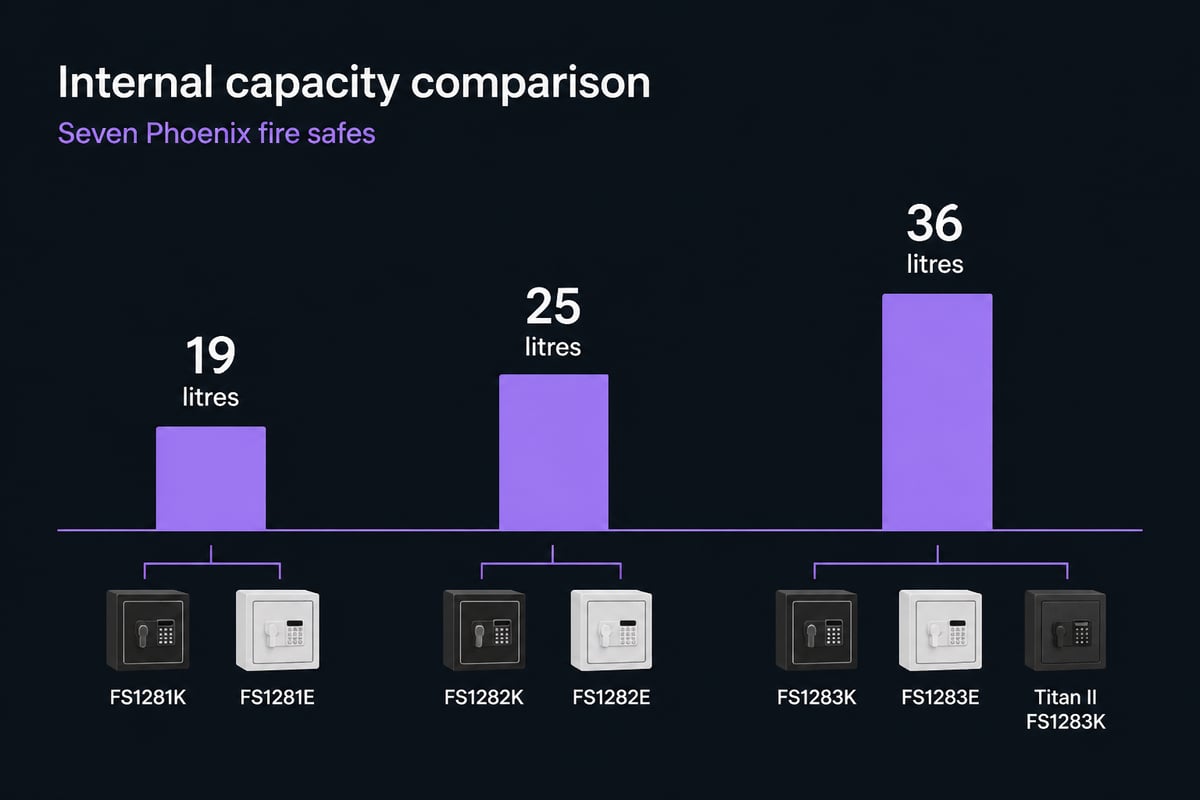
The Phoenix Titan FS1281K is a compact, key-operated fire safe offering 60-minute fire protection in a 19-litre interior. It suits a single office or reception area that needs to secure a limited set of contracts, insurance papers or backup media. At 360 × 412 × 363 mm externally, it can sit on a shelf or in a cupboard without dominating the space. Its 19-litre interior holds a modest stack of folders rather than full lever-arch files, so it is worth measuring your most important documents before committing.
- Capacity: 19 litres
- Fire protection: 60 minutes
- Lock: key
- External dimensions: 360 × 412 × 363 mm
- Approximate price: £206 (at the time of research)
Best for: a small workspace with modest storage needs and a preference for a simple key lock.
Verdict: the lowest-cost entry in this comparison and a sensible starting point for light document storage.
2. Phoenix Titan FS1283K
The Phoenix Titan FS1283K is a larger key-lock model that provides 36 litres of storage with certified fire protection. According to Simply Safes, it is certified to NT Fire 017 Level 60 Paper and to MTC-DIP120-60DM Grade B for data media, which matters if backup drives or tapes are stored alongside paperwork. The 515 × 400 × 440 mm body gives room for A4 files in quantity, and the 60-minute rating applies across the unit. The same retailer lists free UK mainland door-to-door delivery for this unit, which offsets some of the handling cost of a heavier unit.
- Capacity: 36 litres
- Fire protection: 60 minutes
- Lock: key
- External dimensions: 515 × 400 × 440 mm
- Approximate price: £292.70 (at the time of research)
Best for: small offices that need more volume and a data media rating in the same unit.
Verdict: the strongest value here for mixed paper and digital storage.
3. Phoenix Titan II FS1281E
The Phoenix Titan II FS1281E pairs a 19-litre compact body with an electronic lock and 60-minute paper fire protection. A keypad removes the need to track physical keys, which can simplify access control where several authorised staff share one safe. Its external size of 360 × 410 × 365 mm matches the key-operated 19-litre models, so it fits the same shelf or cupboard space. Because the rating is stated for paper, store backup drives elsewhere unless a data media certification is confirmed.
- Capacity: 19 litres
- Fire protection: 60 minutes (paper)
- Lock: electronic
- External dimensions: 360 × 410 × 365 mm
- Approximate price: £239 (at the time of research)
Best for: compact storage where keypad access is preferred over keys.
Verdict: a practical upgrade over the key version if codes are easier to manage than keys in your premises.
4. Phoenix Titan II FS1282K
The Phoenix Titan II FS1282K is a mid-size, cylinder key-lock safe with 25 litres of capacity, suited to paper records that outgrow the 19-litre models. It weighs 34 kg, which adds some resistance to removal before any anchoring is considered. Its 410 × 350 × 430 mm footprint is taller than it is wide, so it suits a low cabinet or floor position beside a desk. With keys, nominate a named custodian and keep a spare in a separate secure location.
- Capacity: 25 litres
- Lock: cylinder key
- Weight: 34 kg
- External dimensions: 410 × 350 × 430 mm
- Approximate price: £269 (at the time of research)
Best for: departments holding a moderate volume of paper records with controlled key custody.
Verdict: a balanced middle option when 19 litres is too tight and 36 litres is more than required.
5. Phoenix Titan II FS1282E
The Phoenix Titan II FS1282E offers the same 25-litre body as the FS1282K with an electronic lock. It is the mid-size choice for small offices that prefer a keypad and need space for files, contracts and personnel records. The shared 410 × 350 × 430 mm dimensions mean it can replace the key version without any change to its position. Electronic locks need a working power source, so fit fresh batteries at the point of installation and add a battery check to your routine maintenance.
- Capacity: 25 litres
- Lock: electronic
- Weight: 34 kg
- External dimensions: 410 × 350 × 430 mm
- Approximate price: £289 (at the time of research)
Best for: small offices needing keypad access with mid-size document storage.
Verdict: a sound pick where code-based access and moderate capacity are both priorities.
6. Phoenix Titan II FS1283E
The Phoenix Titan II FS1283E is the largest electronic-lock model in this group, with 36 litres of space and a 53 kg body. It is the most capable option here for an office that wants a keypad and room for substantial paper archives. At 515 × 400 × 440 mm externally, it needs a deliberate home, ideally a floor position against a solid wall where it can be fixed down. Its weight makes it hard to carry off, though anchoring remains the stronger deterrent.
- Capacity: 36 litres
- Lock: electronic
- Weight: 53 kg
- External dimensions: 515 × 400 × 440 mm
- Approximate price: £319 (at the time of research)
Best for: offices storing larger volumes of documents with keypad control.
Verdict: the highest price in the list, justified by capacity and weight rather than any extra feature.
7. Phoenix Titan II FS1283K
The Phoenix Titan II FS1283K is the key-operated counterpart to the FS1283E, offering 36 litres and a 53 kg body at a slightly lower price. Simply Safes lists it at £309, with external dimensions of 515 × 400 × 440 mm. The £10 difference from the keypad version suits a business that already runs a key register and does not need code management. A cylinder lock also has no battery to maintain, which suits a safe that may go long periods between openings.
- Capacity: 36 litres
- Lock: cylinder key
- Weight: 53 kg
- External dimensions: 515 × 400 × 440 mm
- Approximate price: £309 (as of November 2026)
Best for: larger paper archives where key custody is already a managed process.
Verdict: the better-value large model if you do not need a keypad.
Side-by-side comparison
The table below sets the seven models against the same attributes. Prices are approximate and were correct at the time of research.
| Model | Capacity | Lock | Weight | External size (mm) | Approx. price |
|---|---|---|---|---|---|
| Phoenix Titan FS1281K | 19 L | Key | Not listed | 360 × 412 × 363 | £206 |
| Phoenix Titan FS1283K | 36 L | Key | Not listed | 515 × 400 × 440 | £293 |
| Phoenix Titan II FS1281E | 19 L | Electronic | Not listed | 360 × 410 × 365 | £239 |
| Phoenix Titan II FS1282K | 25 L | Key | 34 kg | 410 × 350 × 430 | £269 |
| Phoenix Titan II FS1282E | 25 L | Electronic | 34 kg | 410 × 350 × 430 | £289 |
| Phoenix Titan II FS1283E | 36 L | Electronic | 53 kg | 515 × 400 × 440 | £319 |
| Phoenix Titan II FS1283K | 36 L | Key | 53 kg | 515 × 400 × 440 | £309 |
How to read the fire rating on a safe for fire
A fire rating states how long a safe keeps its interior below a damaging temperature under test conditions, and the figure only means something when it is tied to a named test standard and a named contents type. A "60-minute" claim for paper does not automatically apply to USB drives, hard disks or tapes, which are damaged at much lower temperatures.
Check three things before purchase:
- The contents class: paper, data media or both. The FS1283K, for example, carries separate certifications for paper and for data media.
- The test standard: look for a named certificate rather than a generic "fireproof" label.
- The internal volume: usable space is smaller than the external dimensions suggest, so compare litres, not millimetres.
For paper, a 60-minute rating gives considerably more margin than 30 minutes where the building's fire response may take time to reach a remote site. Where records are irreplaceable, an off-site or cloud backup remains the more reliable second layer.
Where a safe for fire sits in your wider fire strategy
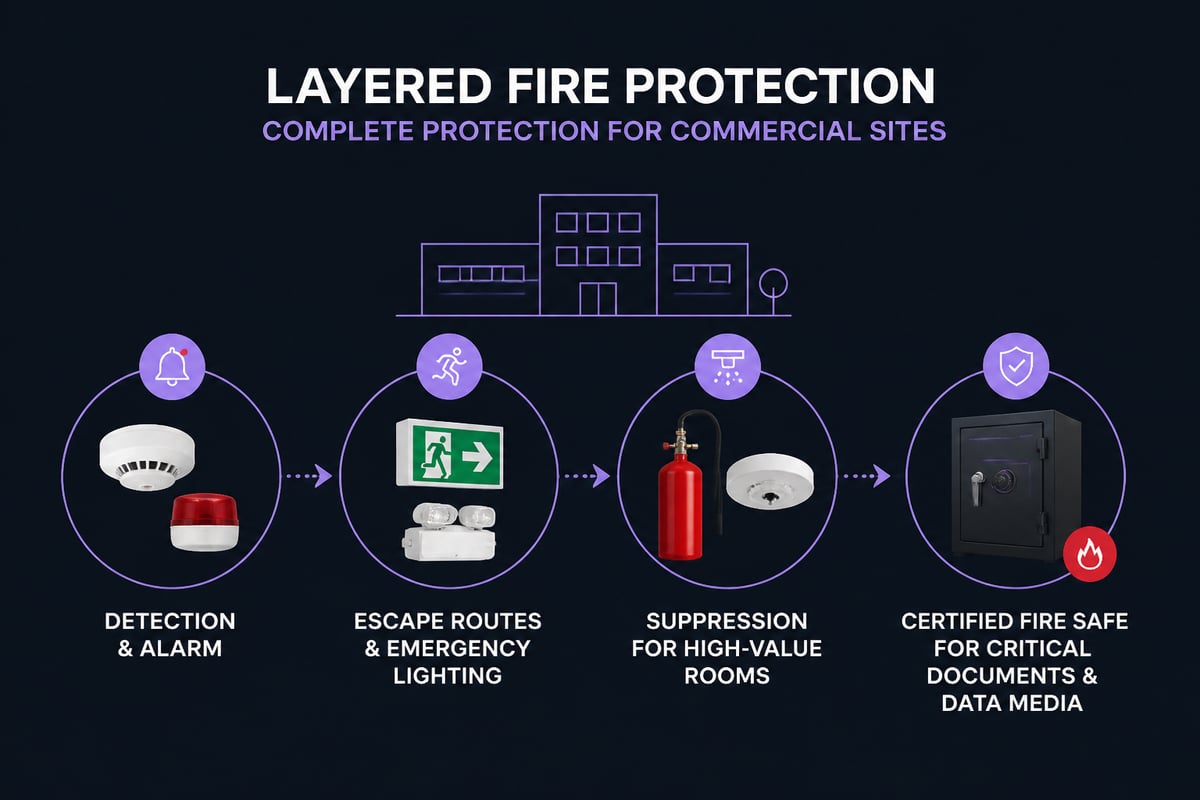
A fire safe protects documents and media after a fire has started; it does not detect, contain or extinguish one. For the Responsible Person under the Regulatory Reform (Fire Safety) Order 2005, a safe is a records-protection measure, not a substitute for a suitable fire risk assessment or for the life safety systems that protect occupants.
The order of priority is straightforward:
- Detect and warn: a properly designed and maintained fire alarm system gives occupants and responders the earliest possible notice.
- Protect people: escape routes, emergency lighting and evacuation provisions come ahead of asset protection. Logic Fire and Security's overview of fire safety and protection outlines how these layers fit together.
- Protect high-value areas: where a server room or archive holds critical assets, automatic suppression limits damage at source.
- Protect records: a certified safe for fire then secures the specific documents and media you cannot afford to lose.
Duties under the Order sit with the Responsible Person, and the fire risk assessment guidance explains how assessment findings should drive these choices rather than the reverse.
Practical points on placement, weight and delivery
Placement affects both fire performance and security. Heavier models such as the 53 kg units are harder to remove, but any safe is more secure when bolted to a solid floor or wall, and it should sit away from the most likely ignition points such as kitchens, plant rooms and electrical cupboards.
On cost, delivery and installation charges vary by retailer, so compare the free delivery, positioning and full-service installation options that Simply Safes offers for the FS1283K before ordering. Those figures are one retailer's terms and will differ elsewhere, so confirm delivery and installation charges before ordering.
Two further habits improve outcomes:
- Keep an index of what is inside and update it when contents change, so an insurer or auditor can verify losses.
- Record who holds keys or codes, and change keypad codes when staff leave.
Where a site also needs to control who can reach the room housing a safe, access control systems for business can add a recorded layer of entry control. For wider thinking on securing valuables on commercial premises, the article on safe solutions covers related options.
When a safe is not enough: protecting the room itself
A fire safe protects a defined volume of contents, but some premises hold assets that cannot be moved into a box, such as server equipment, plant and large archives. For those areas, a fire suppression system uses gas or water-based agents to control or extinguish a fire automatically in high-risk or high-value spaces, limiting damage before the fire reaches stored material.
Suppression is a design and installation matter rather than an off-the-shelf purchase, so it should follow a specification based on the room's use and risk. A safe for fire and a suppression system answer different problems and are often used together.
Start by listing the records and media you cannot replace, then match the volume and the paper or data media rating to a model from the table above. Once the safe is chosen, confirm that the detection, alarm and suppression around it meet the findings of your fire risk assessment. Logic Fire and Security, with NICEIC, BAFE and NSI Gold approved status and 24/7 fire alarm monitoring, designs, installs and maintains fire detection and security systems for businesses across the UK, including a commercial fire alarm system service. To discuss your premises, speak to Logic Fire and Security by calling 0800 8445 999 or emailing [email protected].