

PAVA spray is an incapacitant spray used by UK police forces and prison staff to temporarily disable a person who is violent or threatening violence. The name comes from its active ingredient, pelargonic acid vanillylamide, a synthetic compound related to the substance that makes chilli peppers hot. It causes intense eye pain, involuntary eye closure and breathing discomfort for a short period, giving officers a chance to control a situation without resorting to heavier force.
For business owners, facilities managers and Responsible Persons, PAVA matters for two reasons. It appears in news coverage of public safety, prisons and policing, and it raises practical questions about what happens if an irritant is discharged inside a building. This guide explains what PAVA is, how it works, who can lawfully use it and what the wider implications are for the premises you manage.
What does PAVA stand for?
PAVA stands for pelargonic acid vanillylamide, also known as nonivamide. It is a synthetic version of capsaicin, the compound that gives chilli peppers their heat. The synthetic form is preferred in incapacitant sprays because its strength can be standardised from one canister to the next, which is harder to guarantee with natural plant extracts.
The compound is dissolved in a solvent, usually an alcohol-based liquid, and held in a pressurised canister. When the nozzle is pressed, the solution leaves as a stream or fine spray aimed at the face of the person being subdued.
PAVA is sometimes grouped with CS spray, another incapacitant. The two work differently. CS is a chemical irritant, whereas PAVA is derived from the capsaicin family and acts mainly as an inflammatory agent on mucous membranes.
How does PAVA spray work?
PAVA spray works by irritating the eyes, nose, mouth and airways within seconds of contact, which forces the eyes shut and makes it hard for the person to continue an attack. The compound triggers pain receptors that normally respond to heat, so the body reacts as though it has been burned.
The sequence is fast and predictable:
- Discharge. The officer sprays towards the face, typically from a distance of around one to three metres.
- Contact. The liquid reaches the eyes, nose and mouth, and the capsaicin-like compound binds to pain receptors.
- Reflex response. The eyes close involuntarily, tears stream and the throat and chest tighten.
- Control window. The person is temporarily unable to see or fight effectively, allowing staff to restrain them.
- Recovery. Symptoms fade over the following minutes as the compound is washed away and the body recovers.
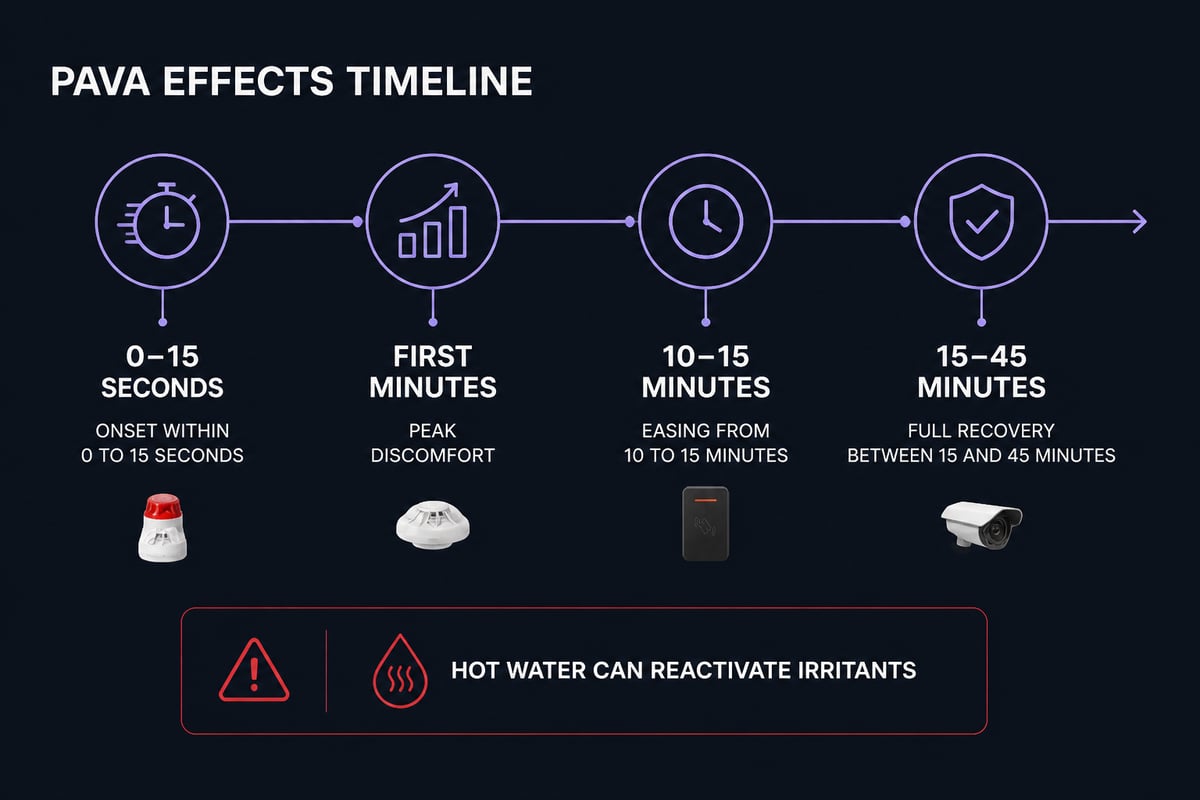
West Yorkshire Police guidance says eye discomfort generally takes effect within a few seconds, with effects beginning to subside within 10 to 15 minutes. The speed of onset is the main reason PAVA is valued as a tool, and the length of recovery is the main reason for aftercare rules.
What are the effects of PAVA spray?
The effects of PAVA spray are temporary but severe, centring on the eyes, airways and skin. A South Yorkshire NHS policy lists possible effects including intense eye pain and redness, excessive tearing, throat burning, chest constriction, coughing, retching, mucus production and skin irritation.
On timing, the same Rotherham Doncaster and South Humber NHS Foundation Trust policy says primary effects usually occur within 10 to 15 seconds. Symptoms commonly last between 15 minutes and one hour, and effects in the immediate environment can persist for up to 45 minutes.
Several factors can change how a person reacts:
- Pre-existing conditions. People with asthma or other respiratory conditions can experience more serious breathing difficulty.
- Intoxication or medication. Alcohol, drugs or certain medicines can alter the response and complicate medical assessment.
- Contact lenses. Lenses can trap the irritant against the eye and prolong discomfort.
- Enclosed spaces. In a closed room the vapour lingers, affecting bystanders and staff as well as the intended subject.
That final point is the one most relevant to building managers. Because the vapour can linger in the immediate environment, a discharge in a corridor, reception area or stairwell can affect people who were never involved in the incident.
What is the first aid for PAVA exposure?
The first aid for PAVA exposure is to move the person into fresh air and rinse the affected areas with plenty of cold water. The NHS policy advises moving to fresh air and rinsing the face and eyes with copious cold water, and it warns that hot water can reactivate the irritants.
A practical checklist for a workplace that has been contaminated:
- Move affected people to fresh air, away from the area of discharge.
- Rinse the eyes and face with cold running water, avoiding rubbing.
- Remove contact lenses if the person can do so safely.
- Take off contaminated clothing and bag it separately.
- Avoid hot showers, which can reopen pores and reactivate the compound.
- Seek medical attention for anyone with persistent breathing difficulty, chest pain or symptoms that fail to settle.
Ventilation matters as much as first aid. Opening doors and windows, and using extraction where available, helps clear the vapour from the affected area.
Is PAVA spray legal in the UK?
PAVA spray is legal only for authorised users in the UK, and it is illegal for members of the public to carry or use it. An incapacitant spray of this kind is classed as a prohibited weapon, so possession without lawful authority is a criminal offence. Authorised users include police officers and trained prison staff.
Use is governed by the same principle that applies to any force: it must be necessary, reasonable and proportionate in the circumstances. Police forces publish their own policies on its deployment, and staff must be trained before they are issued with it.
This means a business cannot lawfully equip security guards or reception staff with PAVA for self-defence. Door supervisors, stewards and in-house security teams are not authorised to carry it, and an employer who tolerated it could face serious consequences.
Why do police and prison staff use PAVA?
Police and prison staff use PAVA because it offers a way to stop violence from a distance, without the close physical contact that restraint holds require. When an officer can disable an aggressor at one to three metres, the risk of injury to both parties can fall compared with hand-to-hand struggle.
The arguments in favour are generally:
- Distance. It works before an assailant reaches the officer.
- Speed. Effects begin within seconds.
- Short duration. Symptoms are temporary and usually resolve without lasting injury.
- Escalation ladder. It sits between verbal de-escalation and more forceful options.
The arguments against are equally part of the public record. Campaign groups including the Howard League and the Prison Reform Trust have raised concerns about its use in custody, particularly around proportionality, its use on children and vulnerable people, and whether it is being used as an early response rather than a last resort. These debates are ongoing, and the evidence on injury and over-use continues to be examined.
PAVA spray compared with other incapacitants
PAVA spray differs from CS spray, pepper spray and other incapacitants mainly in its active chemical and its legal standing in Great Britain. The table summarises the main points of comparison.
| Feature | PAVA spray | CS spray | Pepper spray (OC) |
|---|---|---|---|
| Active agent | Pelargonic acid vanillylamide (synthetic capsaicin) | Chlorobenzylidene malononitrile | Oleoresin capsicum (natural extract) |
| Chemical family | Capsaicinoid | Synthetic irritant | Capsaicinoid |
| Strength consistency | High, as it is synthetic | High | Varies by batch |
| Typical UK users | Police and prison staff | Police, historically | Not authorised for the public |
| Legal status for the public | Prohibited weapon | Prohibited weapon | Prohibited weapon |
In practice, the three are all treated as prohibited for ordinary members of the public in Great Britain, so the choice between them is an operational one for authorised services rather than something a business would ever face.
What PAVA means for workplaces and Responsible Persons
PAVA matters for workplaces because a discharge inside a building creates an air-quality and evacuation problem, even though it is not a fire. Vapour can spread through corridors and enter ventilation, and the symptoms it causes, such as coughing and streaming eyes, can lead occupants to leave the area in a hurry or raise a false alarm.
If you are a facilities manager or Responsible Person, a few practical points follow:
- Incident planning. Emergency procedures should cover non-fire incidents such as chemical irritant release, with clear responsibilities for ventilation and first aid.
- Detector behaviour. Aerosols and vapours can occasionally trigger some smoke detectors, so it is worth understanding how your detection types respond. Our guide to the types of fire system explains the main options.
- Access to first aid. Eyewash provision and trained first aiders help in any irritant incident.
- Security design. Visible deterrents, controlled entry and good surveillance reduce the likelihood that violence occurs at all. A review of building access control systems is a sensible starting point for premises with public-facing areas.
Your fire risk assessment should also account for how people would be evacuated if a non-fire hazard made part of the building temporarily unusable. A Fire Risk Assessment carried out by a qualified assessor looks at escape routes, alarm coverage and management arrangements, all of which apply equally when an incident other than fire forces an evacuation.
Related terms worth knowing
Several terms appear alongside PAVA in policing and prison reporting, and knowing them helps when reading policy documents or news coverage.
- Incapacitant spray. The general category covering PAVA, CS and pepper spray.
- Capsaicin. The natural compound in chilli peppers that PAVA imitates synthetically.
- Nonivamide. Another name for pelargonic acid vanillylamide.
- CS spray. An older irritant spray used by some forces before PAVA became standard.
- Use of force. The legal framework requiring any force to be necessary, reasonable and proportionate.
- Prohibited weapon. The legal classification that makes private possession of these sprays an offence.
- Decontamination. The process of rinsing and ventilating after exposure.
FAQ
What is a PAVA in English?
In English usage, a PAVA is short for PAVA spray, a handheld canister of incapacitant used by authorised police and prison staff. It is named after its active ingredient, pelargonic acid vanillylamide. The word does not refer to anything else in this context.
How long do the effects of PAVA last?
Effects begin within seconds and usually start to ease within 10 to 15 minutes according to police guidance. Some NHS policy documents note that symptoms commonly last between 15 minutes and an hour. Cold water and fresh air speed recovery, while hot water can make symptoms return.
Can a business buy or carry PAVA spray for security staff?
No. In Great Britain, incapacitant sprays are prohibited weapons, and only authorised services such as police and trained prison staff may carry them. Businesses should rely on lawful measures such as trained staff, access control, CCTV and intruder detection instead.
Start by checking whether your emergency plans cover non-fire incidents, such as an irritant release or a violent disturbance, and whether your alarm, access control and surveillance arrangements support them. Logic Fire and Security designs, installs, monitors and maintains fire detection and electronic security systems for businesses and public bodies across the UK, with NICEIC, BAFE and NSI Gold approved status and 24/7 fire alarm monitoring. If you would like a qualified assessor to review your premises, begin with a Fire Risk Assessment, and call 0800 8445 999 or email [email protected] to speak to the team about the right fire and security arrangements for your building.