

A fire detection alarm is a system of detectors, call points, sounders and a control panel that identifies a fire early and warns everyone in a building so they can evacuate. For UK businesses, having one is usually a legal duty rather than a choice, and choosing the right type, category and maintenance routine decides whether it protects people or simply generates false alarms.
This guide takes the Responsible Person from the fundamentals through to confident, compliant use of the system.
What Is a Fire Detection and Alarm System?
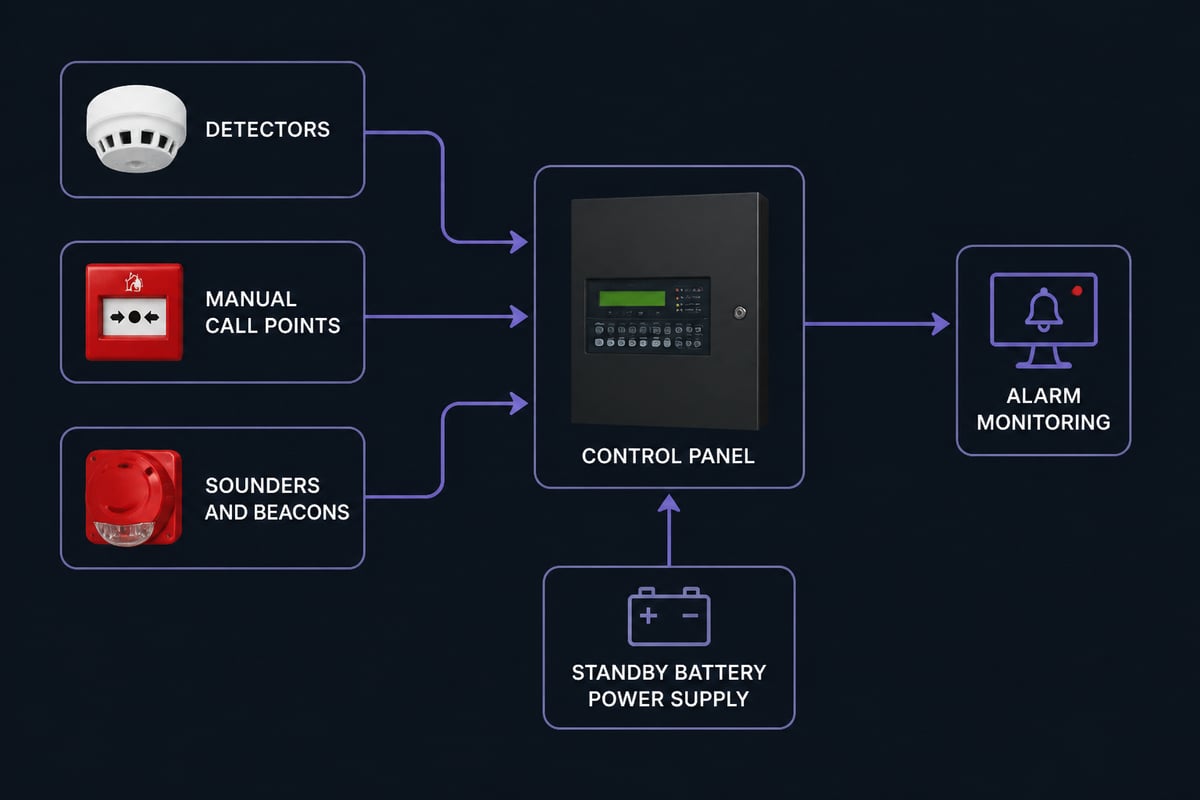
A fire detection and alarm system (FDAS) is an integrated network that senses fire, sounds a warning and, where specified, signals an alarm receiving centre. It consists of five core elements:
- Detectors that sense smoke, heat or flame
- Manual call points that let occupants raise the alarm by hand
- Sounders and beacons that give audible and visual warnings
- A control panel that receives signals, shows the location of the event and drives the outputs
- A power supply with standby batteries, so the system keeps working during a mains failure
Everything is tied together by the panel. When a device activates, the panel identifies the zone or individual device, triggers the sounders and can pass the signal to monitoring or other systems, such as door release or fan shutdown.
Why UK Businesses Need a Fire Detection Alarm
Under the Regulatory Reform (Fire Safety) Order 2005, the Responsible Person for non-domestic premises in England and Wales must carry out a fire risk assessment and put in place appropriate fire detection and warning measures. Scotland and Northern Ireland have equivalent legislation. The assessment determines how much detection your premises need.
Enforcement activity shows why this matters. In England, 49,835 fire-safety audits were recorded in the year ending March 2024, and only 29,018 (58%) had a satisfactory outcome, the lowest proportion since the year ending March 2011, according to GOV.UK fire prevention and protection statistics. A well-specified, properly maintained system is one of the most visible signs of compliance an auditor will look for.
Conventional or Addressable: Which System Type Do You Need?
Conventional systems divide a building into zones, while addressable systems identify each individual device by its own address, and the right choice depends mainly on the size and complexity of your premises.
| Feature | Conventional | Addressable |
|---|---|---|
| Location accuracy | Identifies the zone only | Identifies the exact device |
| Typical premises | Small to medium, simple layouts | Larger or multi-floor, complex sites |
| Wiring | Radial circuits per zone | Loop wiring, devices share a circuit |
| Fault finding | Slower, broader search | Faster, device-level information |
| Flexibility | Limited | Easier to expand and reprogram |
A small retail unit or single-floor office may be well served by a conventional panel. A multi-storey office, hospital, school or warehouse benefits from addressable technology, where staff and the fire service can see precisely which detector has activated. Wireless addressable systems are also an option where cabling would be disruptive or impractical, such as in listed buildings, and you can read more about wireless fire alarms before deciding.
Understanding Fire Alarm System Categories
Fire alarm systems are classified by category in BS 5839-1, the British Standard for commercial systems, and the category sets how much of the building is covered and what the system is meant to achieve.
Category M: Manual
Category M systems rely on people. They consist of manual call points and sounders but no automatic detection. They suit very low-risk premises where occupants are awake and alert.
Category P: Property Protection
Category P systems protect property through automatic detection. P1 covers the whole building, while P2 covers only defined areas of higher risk. Many insurers specify one or the other.
Category L: Life Protection
Category L systems protect lives and are subdivided by coverage:
- L1 covers all areas of the building
- L2 covers escape routes plus defined high-risk rooms
- L3 covers escape routes and rooms opening onto them
- L4 covers escape routes only
- L5 is bespoke, designed to meet a specific fire engineering objective
Your fire risk assessment, insurer requirements and any building control conditions together determine the category. A thorough fire alarm design stage matters because specifying the wrong category either leaves gaps in protection or adds unnecessary cost.
Which Types of Fire Detector Are Available?
The main detector types are optical smoke, heat, multisensor, and specialist devices, and each responds to a different fire signature.
- Optical (photoelectric) smoke detectors respond to visible smoke particles and are well suited to offices, corridors and sleeping risk areas.
- Heat detectors react to a fixed temperature or a rapid rise, which makes them appropriate for kitchens, boiler rooms and dusty areas where smoke detectors would trigger falsely.
- Multisensor detectors combine smoke and heat sensing, giving broader fire recognition with fewer unwanted activations.
- Aspirating systems draw air through sampling pipes to a central sensor and suit data centres, clean rooms and high ceilings.
- Beam and flame detectors cover large open spaces such as atria, warehouses and aircraft hangars.
Matching the detector to the environment is the single biggest lever for reducing nuisance alarms. For a closer look at how detection technologies differ, see this overview of commercial fire detection systems.
Where Should Detectors and Call Points Be Placed?
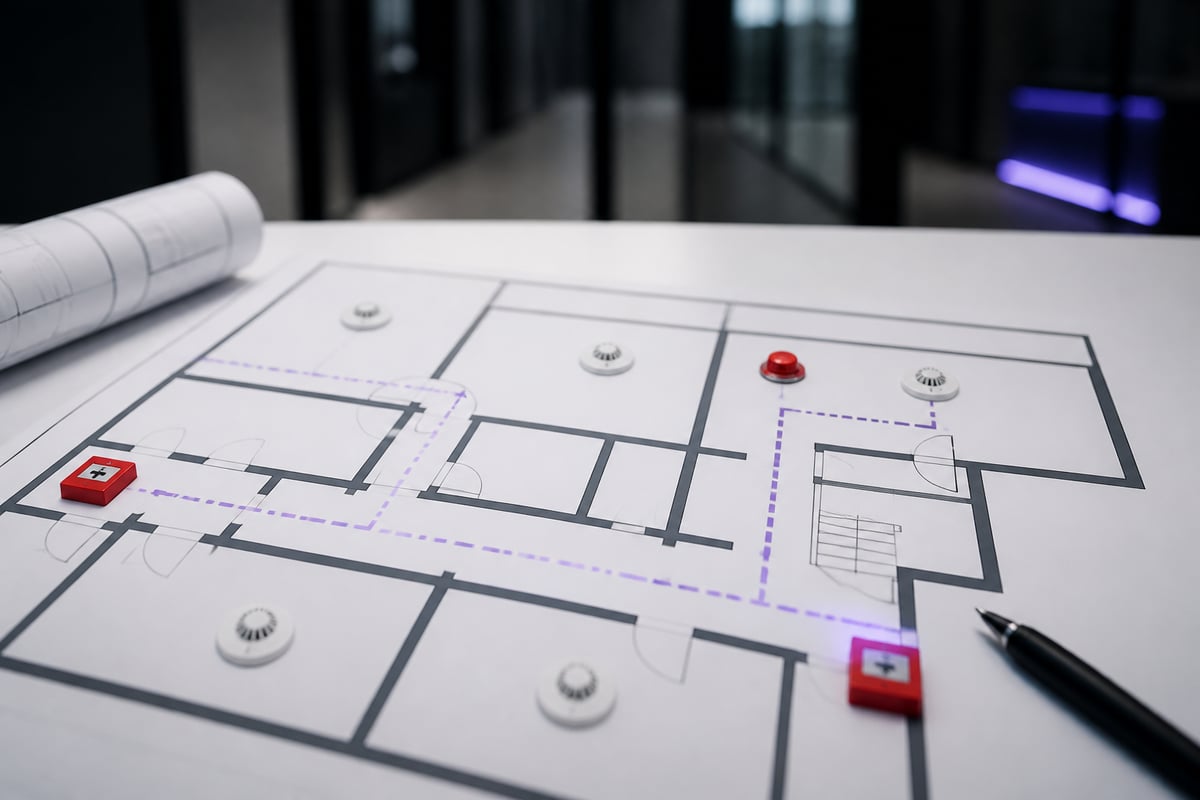
Detectors belong on ceilings in every area covered by your chosen category, with manual call points on escape routes at exits and on each floor landing, and the precise positions are set by BS 5839-1 and your design.
The standard sets out maximum coverage radii, minimum distances from walls and obstructions, and positioning rules for high ceilings, voids and beams. Manual call points are fitted at a set height above floor level and positioned along escape routes so that people can reach one easily. Sounders must be loud enough to be heard throughout the building, and BS 5839-1 sets the required sound levels for the area.
Placement is not a job for guesswork. A competent designer will survey the layout, consider airflow, heat sources and cooking or manufacturing processes, and produce a layout that the fire risk assessment can rely on.
How Does a Fire Detection Alarm Work in Practice?
When a detector senses smoke or heat, or someone operates a call point, it sends a signal to the control panel, which identifies the source, activates sounders and beacons, and can notify a monitoring centre.
The sequence is typically:
- A detector or call point activates.
- The panel displays the zone or device address.
- Sounders and visual alarm devices operate throughout the building.
- Occupants evacuate and the fire marshals check the panel display.
- If the system is monitored, a signal is passed to an alarm receiving centre, which alerts the fire and rescue service.
Remote fire alarm monitoring matters most when premises are unoccupied overnight, at weekends or over holidays. Without it, a fire might burn unnoticed until someone raises the alarm by phone.
How Do You Reduce False Alarms?
You reduce false alarms by choosing detectors suited to each space, maintaining them regularly and managing activities that produce smoke, steam or dust.
The scale of the problem is substantial. Fire and rescue services in England attended 600,185 incidents in the year ending December 2024, and fire false alarms accounted for 42% of them, according to GOV.UK fire and rescue incident statistics. False alarms reached their highest level in over a decade.
Practical measures include:
- Fitting heat or multisensor detectors near kitchens, shower rooms and loading bays
- Keeping detector heads clean and covering them only under a controlled permit during building work
- Investigating every unwanted activation and recording the cause
- Using a staged response, such as a delay for staff investigation, where the risk assessment permits
- Training staff on call point use so accidental operation is rare
Persistent false alarms also erode trust. When people expect a bell to be a nuisance, evacuation slows, which is a safety problem in its own right.
How Often Must a Fire Detection Alarm Be Tested and Serviced?
Under BS 5839-1, commercial systems should be serviced at regular intervals, with a routine user test carried out in-house by a nominated person.
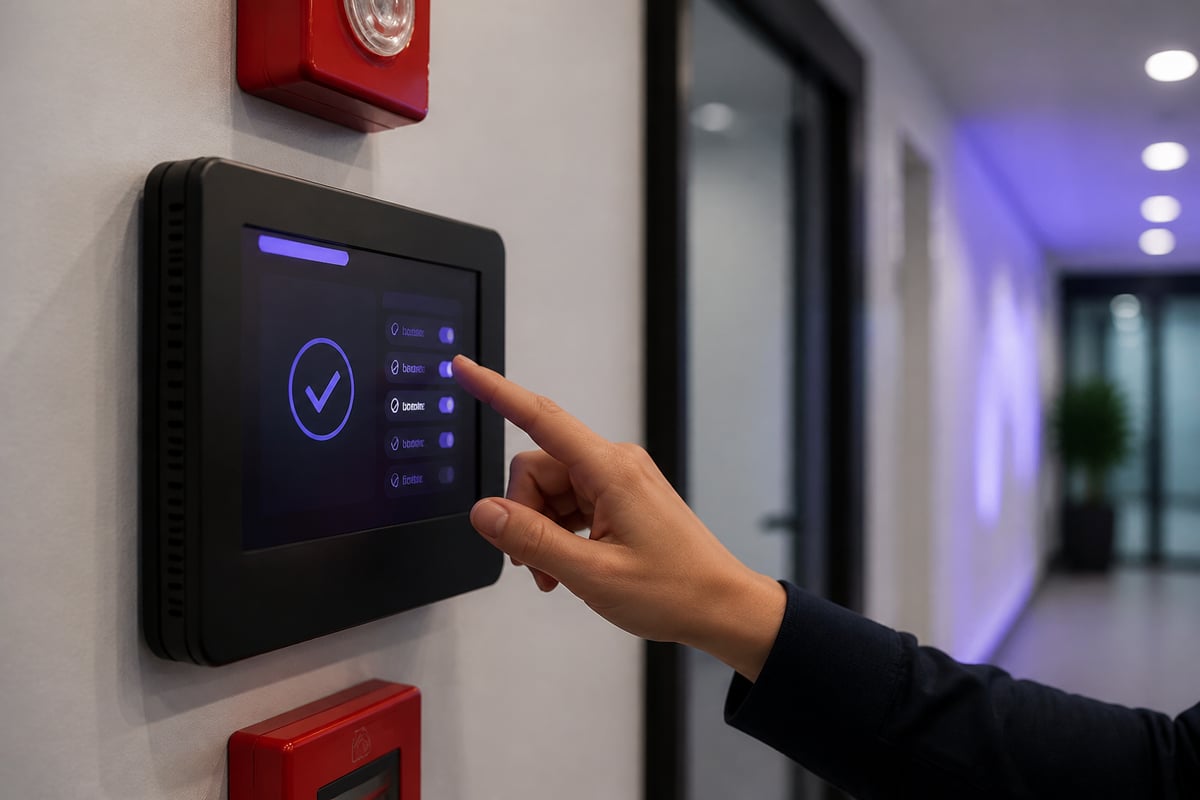
The routine test involves operating a manual call point, confirming that the panel and sounders respond, and recording the result in the fire logbook. Periodic servicing by a competent engineer covers detector sensitivity, battery condition, cabling integrity and the performance of all devices over a full cycle. Detailed guidance is available on fire alarm testing and on fire alarm servicing.
Records matter as much as the tests. The logbook, service certificates and any commissioning documentation form the evidence trail if a fire safety inspector asks you to demonstrate compliance. New installations should always be formally handed over after fire alarm commissioning.
How Much Does a Commercial Fire Alarm Cost?
Cost depends on the number of devices, building size, system type, cabling route and whether monitoring and maintenance contracts are included, so a fixed figure cannot be responsibly quoted without a site survey.
Larger premises with addressable loops, specialist detection or complex integration cost more than a compact conventional installation. Reviewing the factors in a guide to commercial fire alarm installation cost helps you prepare a realistic budget and compare quotations on a like-for-like basis. Remember to include lifetime costs: servicing, monitoring, battery replacement and any later expansion.
What Should You Look for in a Fire Alarm Contractor?
Look for a contractor with third-party certification, trained engineers and the capacity to support the system across its whole life, from design through to monitoring.
Check for independent certification such as BAFE, NICEIC approval for electrical competence and NSI Gold status where monitored systems and security are involved. These schemes show that a contractor is independently audited rather than self-declared. Ask who will carry out the work, how long their engineers have been working in fire safety, and whether design, installation, commissioning, monitoring and maintenance are provided by one accountable company.
Logic Fire and Security is a NICEIC, BAFE and NSI Gold approved contractor whose engineers have over two decades of fire safety experience, and it designs, supplies, installs, commissions and maintains commercial fire alarm systems across the UK. Some of the largest Blue Chip companies and public agencies rely on the company to design, install and maintain their fire safety systems.
How Do Fire Suppression Systems Relate to Detection?
Fire suppression systems act on a fire after it is detected, discharging water, gas, foam or powder to control or extinguish it, and they depend on a fire detection alarm to trigger them.
A detection system warns and evacuates; suppression fights the fire. In areas such as server rooms, archives or commercial kitchens, the detector signal can release a gaseous or wet-chemical agent automatically. Suppression is a separate design discipline and is not a replacement for detection and alarm, which remains the foundation of life safety.
FAQ
Do the fire brigade fit smoke alarms for businesses?
No. Fire and rescue services may offer home fire safety checks to residents in some areas, but commercial premises are the responsibility of the employer or Responsible Person. You must arrange a competent contractor to design, install and maintain your system.
Can a fire detection alarm be linked to other building systems?
Yes. Panels can be interfaced with door holders, access control, ventilation shutdown, lift recall and building management systems. These links must be specified at the design stage and tested during commissioning so that they work correctly in an emergency.
Who is the Responsible Person for fire safety?
The Responsible Person is usually the employer, or the owner or occupier in control of the premises. They must carry out a fire risk assessment, act on its findings and keep it under review, which includes ensuring the fire detection alarm remains compliant and working.
Start by pulling out your latest fire risk assessment and checking it against your system's category, last service certificate and fire logbook, noting any gaps or recurring false alarms. If you need help closing them, Logic Fire and Security designs, installs, monitors and maintains commercial detection systems and its Fire Alarm System service is a sensible place to start. To discuss your premises with a team that supports Blue Chip companies and public agencies, contact Logic Fire and Security by calling 0800 8445 999 or emailing [email protected].