

Understanding commercial fire alarm installation cost requires looking beyond headline figures. In 2026, a compliant system for a small office might start around £3,000, whilst a large warehouse with complex zoning can exceed £50,000. The variation stems from system category, building geometry, detection philosophy, and the degree of integration required. For facilities managers and responsible persons, the key is recognising what drives price and ensuring every pound spent delivers genuine fire safety and regulatory compliance rather than simply the lowest bid.
What a Commercial Fire Alarm Installation Includes
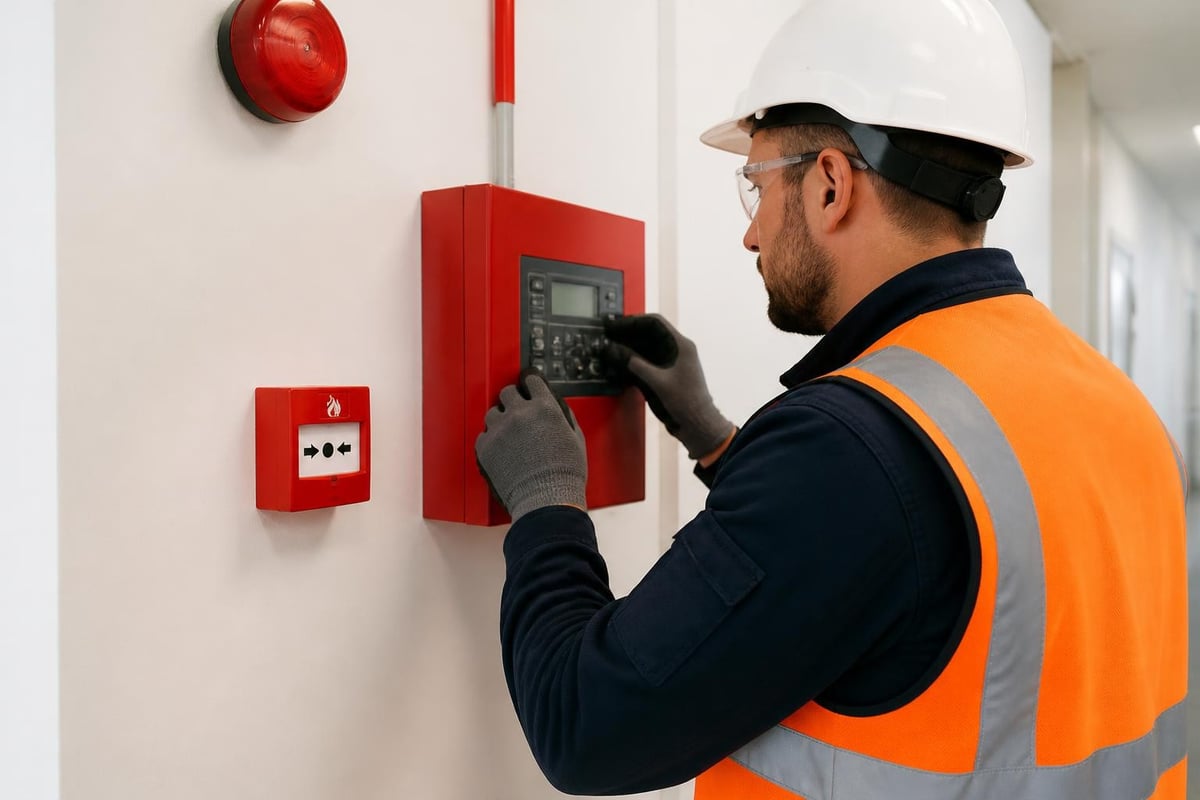
A complete commercial fire alarm system installation encompasses far more than mounting detectors and a control panel. The scope begins with a site survey and fire risk assessment to establish the appropriate BS 5839-1 system category. Designers then specify detection devices, manual call points, sounders, and panel capacity based on building use, occupancy, and escape routes.
Physical installation includes:
- Fire-resistant cabling runs from panel to all devices
- Power supply connections and battery backup
- Detector mounting at code-compliant heights and spacings
- Sounder placement to achieve minimum sound pressure levels
- Zone configuration and addressable device programming
- Integration with other building systems (HVAC shutdown, door release, suppression)
Testing and commissioning verify that every device triggers correctly, alarm sequences follow the cause-and-effect matrix, and the system meets BS 5839-1:2017 standards. Certification from BAFE SP203-1 accredited installers provides the evidence required for building control sign-off and insurer approval.
Documentation deliverables include as-built drawings, operation and maintenance manuals, device schedules, and commissioning certificates. Handover training ensures that building staff understand system operation, silence procedures, and routine testing obligations. The commercial fire alarm installation cost must account for this entire lifecycle, not merely the hardware.
Five Key Drivers of Fire Alarm System Cost
System Category Determines Device Density
BS 5839-1 defines categories L1 through L5, each mandating different coverage. L1 systems require detection in every room, corridor, and void, providing maximum life safety but driving up device counts and cabling. L2 systems cover escape routes and specified high-risk areas. L3 systems protect escape routes only. L4 and L5 variants offer further reductions in scope.
Category selection directly impacts commercial fire alarm installation cost because device count scales with coverage area. A 2,000 m² office might need 40 detectors under L1 but only 15 under L3. At £80–150 per detector installed, category choice creates a £2,000–5,250 swing before any other factors.
Addressable Versus Conventional Topology
Conventional systems divide the building into physical zones, each wired as a radial circuit. When a device activates, the panel indicates which zone triggered, but not the specific detector. Addressable systems assign a unique identifier to every device, providing precise location data and enabling sophisticated cause-and-effect programming.
| Feature | Conventional | Addressable |
|---|---|---|
| Device identification | Zone only | Individual device |
| Wiring topology | Radial circuits | Loop or network |
| Programming flexibility | Limited | Extensive |
| Fault diagnostics | Zone indication | Device-level detail |
| Typical cost (50-device system) | £4,500–8,000 | £8,000–15,000 |
For smaller, simpler buildings, conventional systems offer adequate protection at lower upfront cost. Larger or complex premises benefit from addressable technology's diagnostics and reduced false-alarm nuisance. The commercial fire alarm installation cost differential narrows as building size increases because addressable loop wiring can reduce cable runs compared to multiple conventional zones.
Cable Runs and Building Geometry
Fire alarm cabling must be fire-resistant (FP200, FP400, or mineral-insulated) to maintain circuit integrity during a fire event. Installation cost rises with:
- Total cable length: Detectors far from the panel require longer runs
- Routing difficulty: Concealed routes, containment through fire-rated construction, and penetration sealing add labour hours
- Vertical distribution: Multi-storey buildings necessitate risers and additional fire-stopping
- Containment type: Surface trunking is cheaper than conduit or above-ceiling basket tray
A single-storey, open-plan warehouse might require 200 metres of cable for 20 devices. A four-storey office with cellular rooms could need 800 metres for the same device count. Labour rates of £35–60 per hour mean cabling complexity can contribute £3,000–10,000 to total project cost.
Cause-and-Effect Programming Complexity
Modern systems don't just sound alarms. They trigger coordinated actions: shutting down air-handling units to prevent smoke spread, releasing magnetic door holders, activating evacuation alert systems, and signalling to fire alarm monitoring centres. Each integration point requires programming, interface modules, and testing.
A basic cause-and-effect matrix might specify: "Detector D1 triggers sounder circuit SC1 and signals panel." A complex scenario reads: "Detectors D1 or D2 in server room trigger gas suppression pre-alarm, sound local evacuation tone, send signal to 24/7 monitoring, lock down HVAC zone 3, release fire doors FD4-FD7, and delay discharge for 30 seconds."
Programming and commissioning this logic demands specialist expertise. According to RSMeans estimating guidance, commissioning can represent 15–25% of total installation labour, with complex integration driving costs toward the upper end. Every additional interface increases both commercial fire alarm installation cost and the time required for verification.
Commissioning and Certification Requirements
BAFE SP203-1 accredited installers follow rigorous commissioning procedures:
- Functional testing of every device to confirm activation and correct panel response
- Sound-level surveys to verify sounder coverage meets minimum 65 dB(A) at all points
- Loop integrity checks for addressable systems
- Battery autonomy tests to ensure 24-hour standby plus 30-minute alarm capacity
- Cause-and-effect verification for every programmed action
- Documentation review against design specifications
Commissioning cannot be rushed. A 100-device system may require two engineers working two days to complete testing, witnessing, and documentation. Cutting corners compromises compliance and invalidates insurance cover, a risk the Insurance Institute for Business & Home Safety research consistently highlights.
Typical Cost Ranges by Building Type
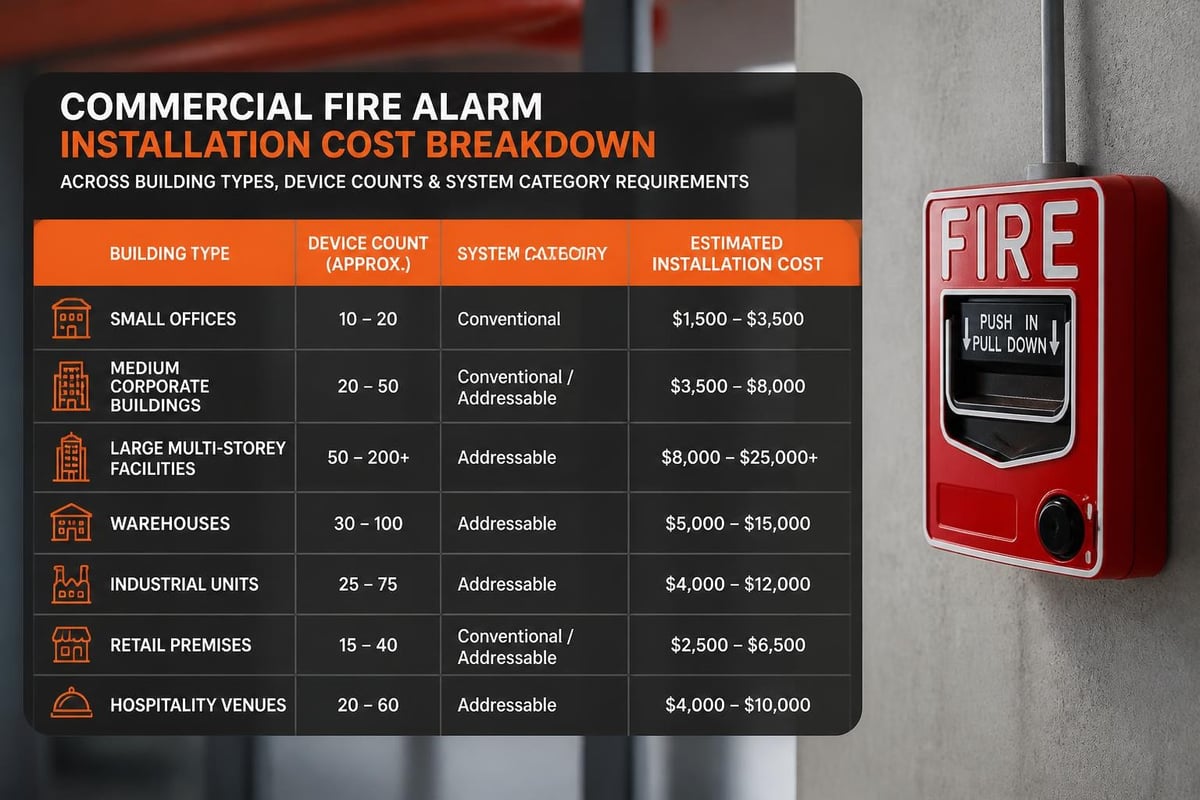
Commercial fire alarm installation cost varies substantially by sector and occupancy profile. The following ranges reflect 2026 UK market rates for BAFE-accredited installations meeting BS 5839-1 standards.
Offices and Commercial Buildings
Small office (100–500 m²): £3,000–8,000
Typical L3 or L2 system, 10–25 devices, conventional or small addressable panel. Single-storey or simple multi-floor layout.
Medium office (500–2,000 m²): £8,000–25,000
L2 system, 25–80 devices, addressable panel with cause-and-effect for HVAC and door release. Multiple floors, possible phased evacuation.
Large corporate building (2,000+ m²): £25,000–100,000+
L1 or L2 system, 100+ devices, networked addressable panels, extensive integration with building management systems, disabled refuge communication, and emergency lighting control.
Warehouses and Industrial Units
Small warehouse (500–1,500 m²): £5,000–12,000
L3 system optimised for high ceilings, beam detectors or heat detection in dust-prone areas, robust IP-rated devices.
Large warehouse (1,500–10,000 m²): £12,000–60,000
L2 system, specialist detection (VESDA aspirating systems for early warning), integration with fire suppression systems, zoning for phased response.
Retail and Hospitality
Retail unit (200–1,000 m²): £4,000–15,000
L2 or L3 system balancing public safety with minimal disruption, integration with security systems and CCTV monitoring.
Hotel or restaurant: £8,000–50,000+
L1 system in sleeping accommodation areas, specialist heat detection in kitchens, cause-and-effect for fire door release and staged evacuation, possible integration with nurse call or guest alert systems.
These ranges assume standard construction. Listed buildings requiring minimal visual impact, premises with asbestos requiring specialist precautions, or sites demanding out-of-hours installation incur additional costs.
Where Low-Cost Quotes Hide Future Expenses
Budget quotations often appear attractive until post-installation realities emerge. Facilities managers should scrutinise proposals for these common cost omissions.
Inadequate Device Specification
Cheaper detectors may lack multi-sensor capability or drift compensation, leading to false alarms and premature replacement. A £40 optical detector versus a £90 multi-criteria device might save £2,000 on a 40-device system, but frequent false alarms cost far more in disruption and callout fees. The U.S. Fire Administration data on non-residential fires underscores the importance of appropriate detection technology matched to risk profile.
Minimal Cable Fire Rating
Standard cabling is not fire-resistant. Some installers specify FP200 only where visibly required, using cheaper PVC elsewhere. When inspectors or insurers audit the installation, non-compliant cable must be replaced entirely. Savings of £800–1,500 become liabilities of £5,000+.
Excluded Integration
Quotations may price the fire panel and devices but exclude:
- Interface modules for BMS, HVAC, or access control
- Programming time for cause-and-effect logic
- Monitoring contracts or ARC connection
- Commissioning witness by third-party certifiers
A "complete system" at £12,000 might require another £4,000 to achieve actual operational readiness.
Deferred Maintenance Provision
Commercial fire alarm systems require quarterly, six-monthly, and annual servicing under BS 5839-1. Initial contracts bundling installation and three-year maintenance provide cost certainty. Pay-as-you-go arrangements expose businesses to annual price increases and potential service lapses risking non-compliance.
Unaccredited Installers
BAFE SP203-1 and NSI Gold accreditation signal competence and insurance backing. Unaccredited installers may offer 20–30% lower prices but cannot provide certificates accepted by building control or insurers. Retrospective certification by accredited firms costs more than correct installation initially.
Comparing Two Fire Alarm Installation Quotations
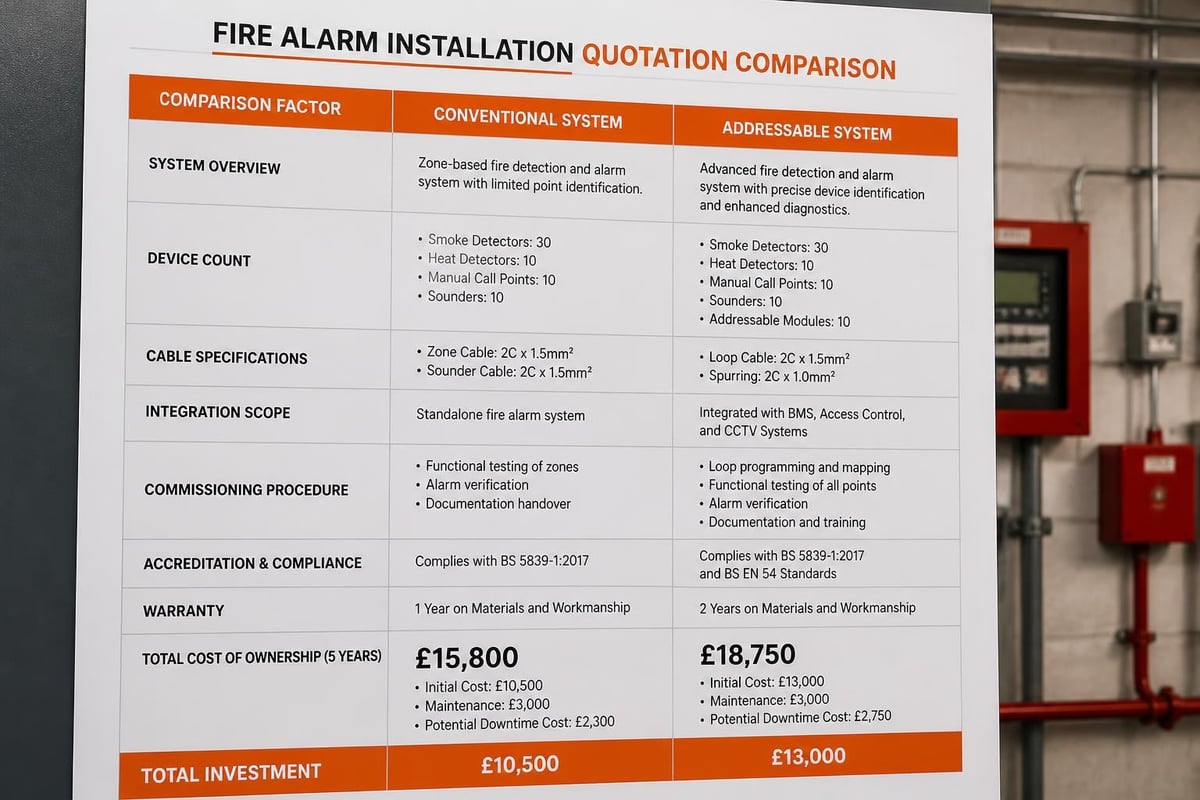
When evaluating proposals, commercial fire alarm installation cost must be assessed in context of what each quotation delivers. Consider this comparison for a 1,200 m² three-storey office building.
| Element | Quotation A | Quotation B |
|---|---|---|
| System type | Conventional, 8 zones | Addressable, loop topology |
| Detection category | BS 5839-1 L3 | BS 5839-1 L2 |
| Device count | 22 devices | 45 devices |
| Cable specification | FP200 fire-resistant | FP400 enhanced integrity |
| Panel capacity | 8 zones, non-expandable | 2-loop panel, expandable to 4 loops |
| Integration | None | HVAC shutdown, door release, monitoring |
| Commissioning | Basic functional test | Full witness commissioning + certificate |
| Accreditation | Local contractor, no BAFE | BAFE SP203-1, NSI Gold |
| Warranty | 12 months parts | 24 months parts and labour |
| Maintenance | Quoted separately | Included, Year 1 |
| Total price | £9,800 | £18,500 |
Quotation A meets minimum legal requirements for a low-risk office but offers no expansion path, no integration, and limited documentation. When the business grows or insurers mandate L2 coverage, the system requires wholesale replacement.
Quotation B provides future-proof infrastructure, precise fault location reducing maintenance costs, and integration that automates emergency response. The 89% higher commercial fire alarm installation cost spreads over a system lifecycle that NIST fire risk reduction research demonstrates provides superior long-term value through reduced losses and improved resilience.
For responsible persons balancing budgets against duty-of-care obligations, the question isn't which quotation costs less initially but which delivers compliant, reliable protection over 10–15 years of service life. Professional advice from experienced providers like Logic Fire and Security helps navigate these trade-offs.
Preparing Your Building for Cost-Effective Installation
Facilities managers can influence commercial fire alarm installation cost through thoughtful preparation and realistic specification.
Conduct a Compliant Fire Risk Assessment
A thorough fire risk assessment identifies hazards, escape route adequacy, and appropriate system category. This becomes the foundation for accurate quotations. Without it, installers must assume worst-case scenarios or risk under-specifying, both of which inflate costs.
Provide Accurate Building Information
As-built drawings, ceiling void access details, and existing services routes enable precise cable run estimation. Site surveys take time. Buildings with good documentation receive tighter quotations because estimators face less uncertainty.
Coordinate with Other Works
Installing fire alarms during refurbishment or alongside access control and CCTV systems reduces mobilisation costs and allows shared containment routes. A project installing fire, security, and data cabling together achieves economies of 15–25% compared to three separate contracts.
Clarify Integration Requirements Upfront
List every system requiring interface:
- Building Management System (BMS) for HVAC control
- Access control for door release
- Disabled refuge systems
- Suppression systems (gas suppression, sprinklers, mist)
- Monitoring and alarm receiving centres
Each integration requires specific interface modules and programming. Discovering these mid-project generates variation orders inflating costs by 20–40%.
Plan for Ongoing Monitoring and Maintenance
Commercial fire alarm installation cost represents the capital expenditure. Operational expenses include:
- Quarterly inspections: £150–300 per visit
- Annual servicing: £500–2,000 depending on system size
- Monitoring contracts: £200–600 annually for ARC connection
- Device replacement: Detectors typically require replacement at 10 years
Bundled contracts offering installation plus multi-year maintenance provide cost certainty and ensure compliance continuity. Separately procured maintenance often costs 30–50% more over the same period.
Verify Installer Credentials and References
Request evidence of:
- BAFE SP203-1 or equivalent accreditation
- NSI Gold or SSAIB certification
- Professional indemnity and public liability insurance
- References from similar building types and sectors
- Membership of recognised industry partnerships
Accredited installers may charge 10–20% more than unaccredited firms, but the assurance of compliant installation and accepted certification justifies the premium. Building control authorities and insurers routinely reject systems installed without proper accreditation, forcing expensive remedial work.
Understanding Value Beyond Initial Price
Commercial fire alarm installation cost should be evaluated against the consequences of inadequate protection. The NFPA 72 code provides the technical foundation for life-safety systems, emphasising that detection and notification form the first line of defence against fire losses.
A well-designed system protects:
- Lives: Early warning enables safe evacuation before untenable conditions develop
- Property: Prompt detection limits fire spread and reduces damage
- Business continuity: Faster emergency response minimises downtime and recovery costs
- Legal compliance: Meeting Regulatory Reform (Fire Safety) Order 2005 obligations avoids prosecution
- Insurance validity: Non-compliant or poorly maintained systems void cover, exposing businesses to uninsured losses
The cheapest compliant system that meets duty-of-care obligations represents better value than a cut-price installation requiring remedial work or failing during audit. Responsible persons must balance budgets against the reality that fire safety investments protect both people and business viability.
For facilities managers seeking transparent advice on commercial fire alarm installation cost, professional consultation with accredited providers ensures specifications match risk profiles and budgets reflect genuine scope. Systems designed and installed to BS 5839-1 by BAFE-accredited specialists deliver reliable protection and long-term value.
Understanding commercial fire alarm installation cost requires looking beyond initial quotations to consider system category, device topology, integration scope, and long-term maintenance obligations. Properly specified and installed systems provide life safety, regulatory compliance, and business protection that far outweigh capital expenditure. Logic Fire and Security brings decades of expertise designing and installing fire detection systems for businesses across the UK, delivering transparent quotations, BAFE-accredited installations, and ongoing support that ensures your investment protects what matters most. Contact the team today to discuss your fire safety requirements and receive a detailed proposal tailored to your building and budget.