

Proper commercial cctv camera placement determines whether your video surveillance system delivers prosecution-quality evidence or merely records blurry shapes. The difference between identifying a perpetrator and watching an incident unfold without useful detail comes down to strategic positioning, appropriate mounting height, correct lens selection, and compliance with UK data protection requirements. Before specifying a single camera location, facility managers and responsible persons must define the incidents they need to evidence and work backwards to the technical parameters that deliver courtroom-standard footage.
Start From the Incident You Must Evidence, Not the Camera
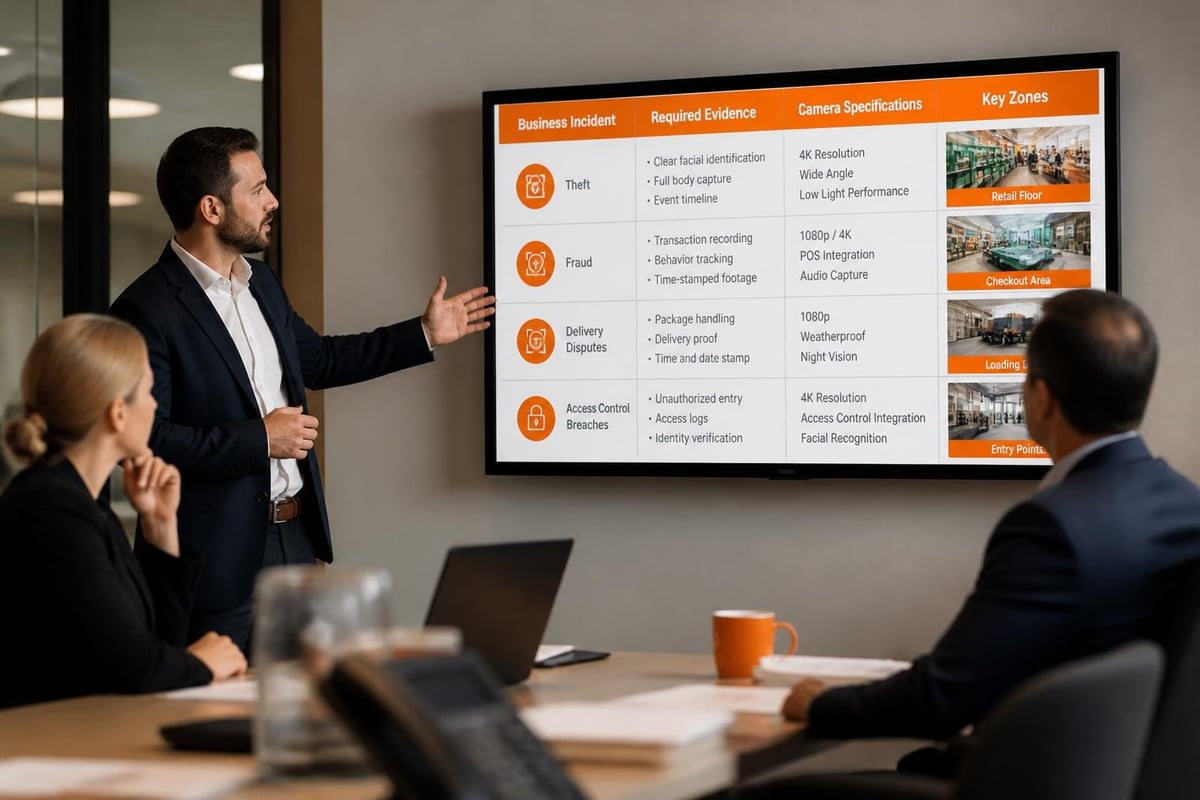
Most commercial CCTV specifications fail because they begin with camera counts and budgets rather than the business risks they must mitigate. Effective commercial cctv camera placement starts by cataloguing the incidents your organisation needs to prove or disprove: employee theft, fraudulent injury claims, shoplifting, unauthorised access, delivery disputes, or vandalism.
Each incident type demands specific image quality standards. A theft investigation requires facial identification, which the Amended Surveillance Camera Code of Practice defines as 250 pixels per metre (px/m) at the target distance. General monitoring to detect movement requires only 62.5 px/m. Observation (determining activity) needs 125 px/m.
Map Incidents to Critical Business Zones
Create a risk matrix that identifies where incidents occur, their frequency, and the evidence standard required for resolution:
| Incident Type | Location | Required Standard | Pixel Density |
|---|---|---|---|
| Till fraud | Point of sale | Identification | 250 px/m |
| Stock theft | Warehouse aisles | Recognition (suspect known) | 125 px/m |
| Delivery disputes | Loading bay | Observation (package condition) | 125 px/m |
| Unauthorised access | Fire exits | Detection (movement only) | 62.5 px/m |
This matrix drives every placement decision. A camera positioned to "cover the warehouse" achieves nothing unless it delivers sufficient pixel density at the high-value stock locations where theft occurs. Working with experienced commercial security alarm companies ensures your system design addresses documented business risks rather than generic surveillance coverage.
Five Placements That Pay: Entrances, Till and Cash, Stock, Loading Bays, Perimeter
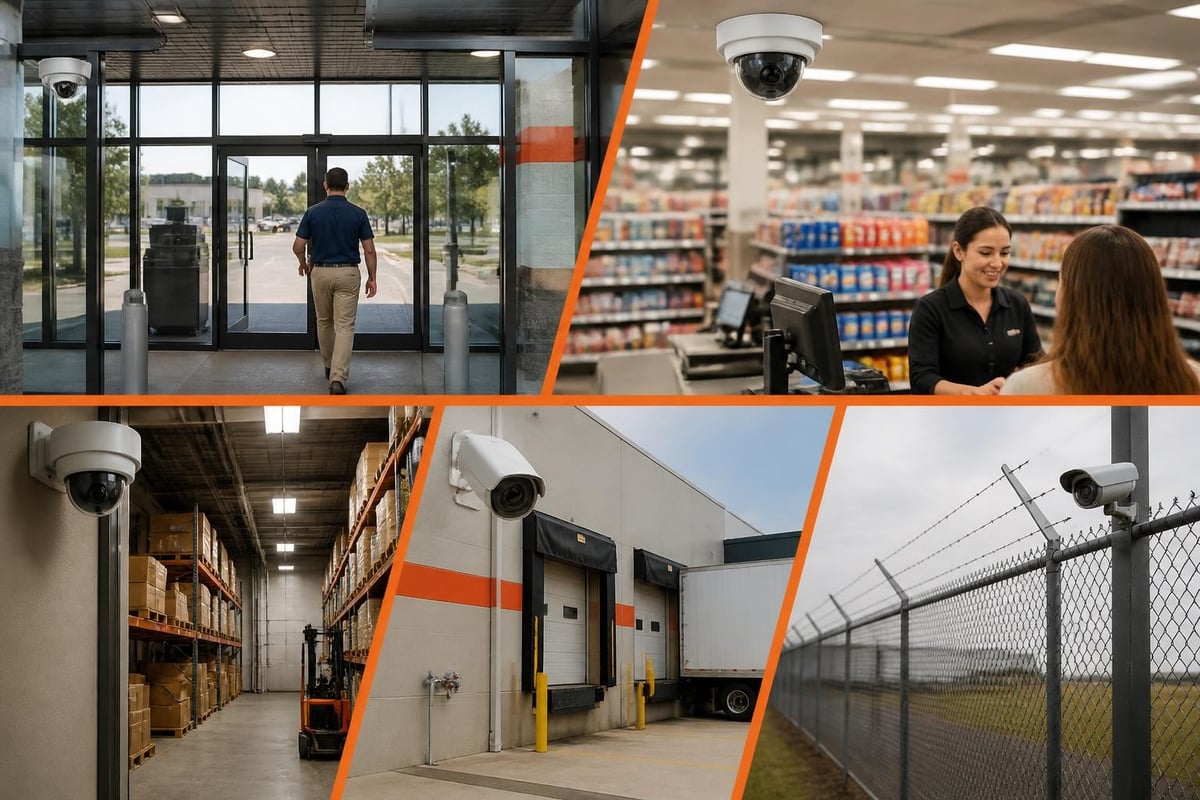
Certain zones in every commercial facility demand priority coverage because they represent the highest frequency of incidents and the greatest evidential value per camera.
Entrance and Exit Points
All personnel and visitor entry/exit points require cameras positioned to capture frontal facial images. Mount cameras above and slightly forward of the doorway, angled downward at 10-15 degrees to avoid capturing the top of heads. Target height: 2.5-3 metres for standard commercial doorways.
Place a second camera behind the threshold looking outward to capture faces of departing individuals and provide context for vehicles or accomplices. This dual-angle approach satisfies the observation standard in the DHS Video Security Systems handbook, which recommends overlapping coverage at critical chokepoints.
Reception areas benefit from three-camera coverage: wide-angle for situational awareness, medium view for face capture at the desk, and tight view for credential or document verification.
Till Points and Cash Handling Areas
Commercial cctv camera placement at point-of-sale stations must capture the till operator's actions, customer faces, and the transaction itself. Position cameras directly above the till at 2-2.5 metres, angled to include:
- Cash drawer opening and closing
- Card reader interactions
- Receipt printer output
- Operator hand movements
- Customer face (three-quarter view minimum)
Retailers handling significant cash require a separate cash office camera covering the safe, counting table, and preparation area. Mount at ceiling height in the corner farthest from the safe to maximise coverage without blind spots behind operators.
Stock and High-Value Inventory Zones
Warehouse and stockroom coverage demands careful consideration of aisle width, ceiling height, and lighting. Standard practice positions cameras at aisle intersections, providing overlapping coverage down each corridor.
Calculate your pixel density before specifying lenses. A warehouse with 15-metre-deep aisles and 6-metre ceiling height requires varifocal lenses (typically 2.8-12mm) to deliver 125 px/m at the far end. Fixed-lens cameras lack the flexibility to adjust field of view after installation.
Critical areas include:
- Goods-in staging areas
- High-value product cages
- Waste and disposal zones (common theft exit points)
- Staff-only storage
Reference video surveillance systems for business implementation guides to understand how modern IP systems integrate inventory management data with video analytics to flag unusual access patterns.
Loading Bays and Goods Receiving
Loading bays generate frequent disputes over delivery condition, quantities, and driver behaviour. Effective commercial cctv camera placement requires:
- Wide-angle cameras (2.8-4mm) covering the entire bay door and approach area
- PTZ or varifocal cameras positioned to read vehicle registration plates and capture driver faces
- Detail cameras (8-12mm) focused on the handover point where goods transfer between vehicles and facility
Mount cameras under canopies or soffits where available to protect from direct weather exposure. Ensure night-time infrared coverage extends to the furthest point of the loading area, typically 20-30 metres from the building.
Perimeter and External Boundaries
External commercial cctv camera placement serves two purposes: detecting intrusion attempts and evidencing criminal damage or unauthorised access. The BSI EN IEC 62676 standard recommends overlapping coverage with no gaps exceeding 2 metres at ground level.
Position cameras at 3.5-4.5 metres to prevent tampering whilst maintaining adequate ground-level pixel density. Integrate with intruder detection systems to trigger recording and alerts when motion is detected in specified zones after hours.
Height, Angle, Lens: A Face at Four Metres is Useless
The physics of camera placement matter more than camera count. A £5,000 camera positioned incorrectly delivers worse results than a £500 unit placed according to optical principles.
Mounting Height and Angle
Height determines pixel density. Every metre of distance between camera and subject halves the available pixels, assuming fixed lens focal length. A camera 2 metres from a subject captures four times the facial detail of the same camera at 4 metres.
Standard commercial mounting heights by zone:
- Corridors and aisles: 2.5-3 metres (head-height faces, minimal foreshortening)
- Open retail floors: 3-3.5 metres (balance coverage area vs detail)
- Warehouses: 3.5-4.5 metres (determined by racking height and aisle width)
- External perimeter: 4-5 metres (anti-tamper height whilst maintaining ground detail)
- Car parks: 4-6 metres (balance vehicle plate capture and pedestrian identification)
Angle affects recognition. Cameras angled more than 30 degrees from horizontal create severe foreshortening that distorts faces and makes identification unreliable. The Washington State facility design guidelines specify maximum 20-degree downward angle for facial identification purposes.
Lens Selection and Field of View
Three lens categories serve distinct commercial applications:
| Lens Type | Focal Length | Use Case | Coverage at 3m Height |
|---|---|---|---|
| Wide angle | 2.8-4mm | General awareness, small rooms | 8-12 metre width |
| Standard | 6-8mm | Corridors, medium rooms, till points | 4-6 metre width |
| Telephoto | 12mm+ | Long corridors, vehicle plates, perimeter | 2-3 metre width |
Varifocal lenses (adjustable focal length) cost 30-40% more than fixed lenses but eliminate the risk of incorrect field-of-view specifications during installation. For projects requiring more than ten cameras, varifocal units significantly reduce commissioning time and rework costs.
Calculate before you buy. Online field-of-view calculators (available from major manufacturers) require three inputs: sensor size, lens focal length, and distance to subject. These tools reveal whether your specification achieves the required pixel density before equipment purchase.
UK Winter Low Light and Weather Considerations
British weather conditions expose poor commercial cctv camera placement decisions. Systems that perform adequately in summer daylight fail completely during winter months unless specified correctly from the outset.
Low-Light Performance
December through February presents challenging conditions: extended darkness, heavy cloud cover, and reliance on artificial lighting. Cameras require minimum illumination ratings below 0.01 lux for acceptable performance in car parks, perimeters, and loading areas during early morning hours.
Infrared (IR) illumination extends usable range in complete darkness but introduces three complications:
- IR reflection from glass, shiny surfaces, and rain creates unusable glare
- IR absorption by dark clothing and vehicles reduces effective range
- Insect attraction to IR emitters creates motion-detection false alarms
Position IR cameras to avoid pointing directly at windows, wet surfaces, or highly reflective signage. Where IR proves impractical, consider white-light illuminators that provide colour images at night and serve as visual deterrents.
Environmental Protection Standards
External cameras require IP66 or IP67 ratings (dust-tight, protected against heavy seas or powerful jets). Internal cameras in dusty warehouses or food preparation areas need minimum IP54 (limited dust ingress protection).
Condensation kills more cameras than physical damage. Cameras experiencing temperature cycling (cold nights, warm days) or installed in high-humidity environments require integrated heaters and IP67-rated cable glands. Budget £30-60 per camera for environmental housings on external installations.
Coastal locations and areas with high atmospheric salt content (within 10 miles of the coast across much of the UK) demand stainless steel or corrosion-resistant housings for external cameras. Standard powder-coated aluminium housings corrode within 3-5 years in marine environments.
Pixel Density Decides Identify or Just Show
The single most important technical specification for commercial cctv camera placement is pixel density at the point of interest. Every other parameter (camera count, recording duration, storage capacity) derives from this fundamental requirement.
Calculating Required Megapixels
Pixel density (px/m) depends on three variables:
- Sensor resolution (total megapixels)
- Lens focal length
- Distance to subject
Worked example: A 2-megapixel camera (1920 × 1080 pixels) with 4mm lens positioned 5 metres from a doorway delivers approximately 90 px/m. This meets the observation standard (125 px/m) but fails identification requirements (250 px/m).
To achieve identification standard at 5 metres, the same installation requires either:
- A 5-megapixel sensor (2560 × 1920 pixels) with 4mm lens, or
- A 2-megapixel sensor with 8mm lens (narrower field of view)
Recent research on optimal camera placement algorithms demonstrates that strategic positioning reduces required camera counts by 40-60% compared to conventional uniform coverage approaches whilst improving evidential quality.
Multi-Imager and Panoramic Solutions
Single high-resolution panoramic cameras (12-20 megapixels) or multi-imager units (four sensors in one housing) offer alternatives to multiple individual cameras in open areas. These units provide 180-360 degree coverage with digital zoom capability for incident investigation.
Advantages: Reduced installation labour, fewer network switch ports, simplified cabling.
Limitations: Higher per-unit cost (£800-2,500), greater bandwidth requirements, single point of failure covers large area.
Panoramic cameras suit reception areas, retail floors, and car parks where situational awareness matters more than identification-quality close-ups.
Privacy Masking and Signage First
Legal compliance governs commercial cctv camera placement as much as technical capability. UK organisations operating surveillance systems face obligations under GDPR, Data Protection Act 2018, and sector-specific regulations.
Privacy Impact Assessment
Before deploying cameras, the responsible person must complete a Privacy Impact Assessment (PIA) documenting:
- Legitimate business purposes for surveillance
- Proportionality (least intrusive means of achieving objectives)
- Privacy risks to employees, visitors, and neighbouring properties
- Mitigation measures including privacy masking
Camera views must exclude areas where individuals have reasonable expectation of privacy: toilets, changing rooms, medical facilities, private offices (unless consent obtained), and neighbouring properties. Modern IP cameras include software privacy masking that blacks out specified zones whilst recording the remainder of the field of view.
The ICO CCTV Code of Practice requires organisations to demonstrate that surveillance is necessary, proportionate, and cannot be achieved through less intrusive means.
Signage and Notification Requirements
Prominent signage must appear at all entrances to surveilled areas, stating:
- That CCTV is in operation
- The identity of the data controller (your organisation)
- Contact details for data protection enquiries
- The legal basis for processing (legitimate interests, typically)
Signs should appear before individuals enter the camera coverage area, giving opportunity to avoid the surveilled zone if desired. The Epping Forest CCTV Code of Practice provides exemplar signage templates applicable to commercial installations.
Data Retention and Access Controls
Commercial installations typically retain footage for 30 days unless specific incidents require extended preservation. Longer retention periods increase storage costs and heighten data protection risks without corresponding security benefits.
Access controls must restrict footage viewing to authorised personnel only. Modern systems integrate with security and access control platforms to audit who viewed footage, when, and for what purpose. This audit trail proves essential when responding to subject access requests or defending employment tribunal claims.
Network Security for IP Camera Systems
IP-based surveillance systems require the same cybersecurity rigour as other networked devices. The NIST Guide to Operational Technology Security recommends segregating camera networks from corporate IT infrastructure using VLANs or physically separate switches.
Minimum security measures include:
- Changing default passwords on all cameras and NVRs
- Disabling unused network services (UPnP, Telnet)
- Implementing certificate-based encryption for video streams
- Regular firmware updates from manufacturers
- Network intrusion detection monitoring camera network segments
Compromised camera systems provide attackers with visual reconnaissance of facilities and potential pivot points into broader networks. Organisations with remote CCTV monitoring services must ensure third-party monitoring centres maintain equivalent security standards.
System Integration and Ongoing Verification
Effective commercial cctv camera placement delivers sustained value only when integrated with broader security infrastructure and regularly verified against original specifications.
Integration With Access Control and Alarms
Camera systems should trigger recording when integrated systems detect events:
- Door controllers initiate recording when specific doors open outside normal hours
- Intruder alarms direct cameras to affected zones and increase frame rates
- Fire alarm systems capture evacuation footage and preserve evidence of fire origin
This event-driven approach reduces storage requirements whilst ensuring high-quality footage captures significant incidents. Integration also enables guard tour verification, where warehouse security alarm systems confirm that patrols occurred at specified times by cross-referencing alarm acknowledgements with camera footage.
Video Analytics and Intelligent Monitoring
Modern IP cameras include analytics capabilities that automate incident detection:
- Line crossing: Triggers when individuals cross virtual boundaries (perimeter fences, restricted areas)
- Loitering detection: Alerts when persons remain in defined zones beyond set durations
- Object removal: Flags when items disappear from protected areas
- Crowd density: Monitors occupancy levels in public areas
Analytics reduce dependence on continuous human monitoring but require careful configuration to minimise false alarms. Accuracy improves with strategic camera placement: analytics perform best with clear, unobstructed views and consistent lighting.
Quarterly Performance Verification
Camera systems degrade over time through:
- Lens contamination (dust, moisture, insect debris)
- Bracket creep (mounting hardware loosening)
- Vegetation growth obscuring fields of view
- Lighting changes (failed lamps, seasonal shadows)
Quarterly inspections should verify each camera against original field-of-view diagrams, check recording quality, and test night-time performance. Many organisations discover failed cameras only when footage is required to investigate incidents weeks after the failure occurred.
Maintenance contracts with qualified providers ensure systematic verification and rapid fault response. Systems protecting critical infrastructure or high-value assets justify monthly verification schedules.
Strategic commercial cctv camera placement transforms surveillance from a recording exercise into an evidential asset that supports prosecution, resolves disputes, and demonstrates duty-of-care compliance. Successful implementations prioritise incident-driven specifications, evidence-quality pixel density, UK weather resilience, and data protection compliance from the initial design stage. Logic Fire and Security brings over two decades of experience designing, installing, and maintaining commercial surveillance systems for Blue Chip companies and public agencies across the UK, ensuring your cameras deliver prosecution-standard evidence when it matters most.