


Protecting commercial premises from unauthorised entry requires sophisticated security infrastructure that goes far beyond basic door locks. Modern commercial burglar alarm systems have evolved into comprehensive networks that integrate multiple detection technologies, intelligent control panels, and round-the-clock monitoring capabilities. For businesses across the UK, selecting and implementing the right intrusion detection solution represents a critical investment in asset protection, regulatory compliance, and operational continuity. Understanding the components, standards, and strategic considerations behind these systems enables organisations to make informed decisions that align with their specific security requirements and risk profiles.
Understanding Commercial Burglar Alarm System Architecture
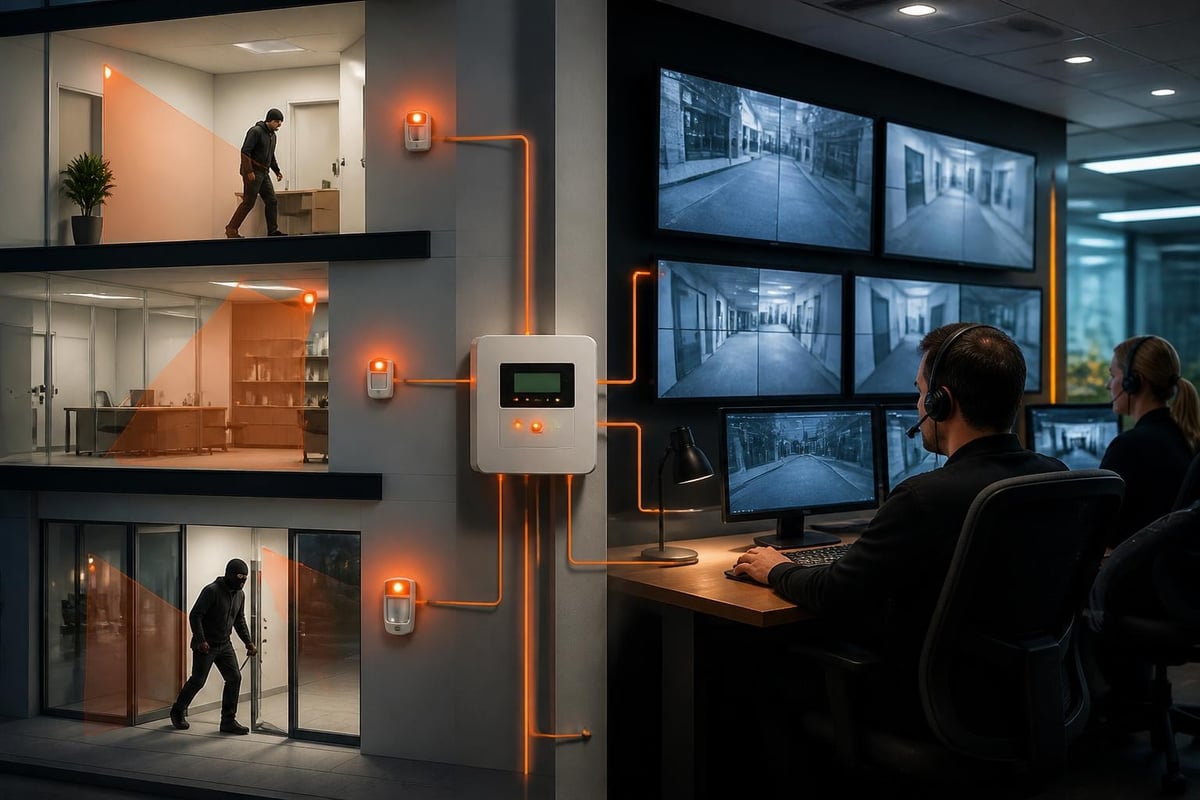
Commercial burglar alarm systems comprise several interconnected layers, each serving a distinct function within the overall security ecosystem. The architecture typically includes detection devices, control panels, communication pathways, and response mechanisms that work together to identify, verify, and respond to potential intrusions.
Core System Components
At the foundation level, detection devices form the first line of defence. These include passive infrared sensors that detect heat signatures from human movement, magnetic door contacts that trigger when entry points open, glass break detectors that identify the acoustic signature of shattering windows, and motion sensors using microwave or dual-technology approaches. Each sensor type addresses specific vulnerabilities within the protected space.
The control panel serves as the central intelligence hub, processing signals from all connected devices and executing programmed responses. Modern panels offer sophisticated features including:
- Zone-based programming for targeted response protocols
- User access management with individual codes and permissions
- Event logging and audit trails for compliance documentation
- Integration capabilities with building access control systems and video surveillance
- Remote configuration and diagnostics
Communication pathways transmit alarm signals to monitoring centres or designated personnel. Contemporary systems employ redundant communication methods-typically combining broadband internet, cellular networks, and traditional telephone lines-to ensure signal transmission even if primary pathways are compromised. This redundancy proves essential for meeting insurance requirements and regulatory standards.
Regulatory Compliance and Industry Standards
Commercial burglar alarm systems must adhere to rigorous standards that govern their design, installation, and ongoing performance. The UL Standard 2610 consolidates legacy requirements into a comprehensive framework covering construction, performance, operation, and maintenance for burglar alarm systems in commercial settings, with the latest December 2025 update introducing enhanced cybersecurity provisions and network resilience requirements.
Key Compliance Frameworks
| Standard | Focus Area | Application |
|---|---|---|
| UL 2610 | System construction and performance | All commercial installations |
| NFPA 730 | Premises security guidance | Design and risk assessment |
| BS 8243 | Installation and configuration | UK market requirements |
| EN 50131 | European intrusion alarm specifications | Cross-border compliance |
Beyond product certification, installation practices must meet exacting standards. Professional installers follow documented procedures for device placement, wire routing, tamper protection, and system testing. The NFPA 730 Guide for Premises Security provides comprehensive guidance on intrusion detection placement, physical security integration, and vulnerability assessment methodologies that inform optimal system design.
Compliance extends throughout the system lifecycle. Regular maintenance, testing protocols, and documentation practices ensure continued conformance with insurance stipulations and regulatory obligations. Many organisations partner with certified providers who deliver security monitoring services alongside installation and maintenance to maintain comprehensive compliance coverage.
Technology Selection for Different Commercial Environments
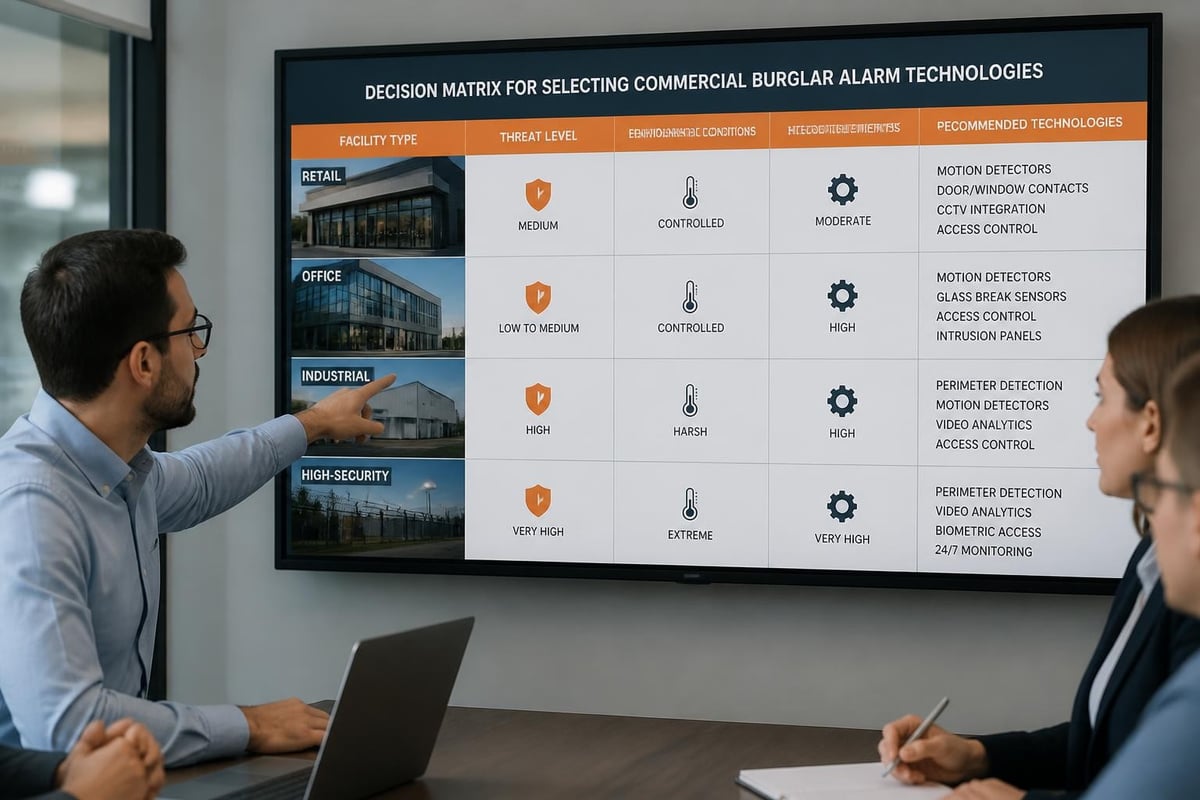
Selecting appropriate technology depends heavily on the specific operational environment, asset values, threat profiles, and existing infrastructure. Different commercial sectors present unique requirements that inform system specification.
Retail Environments
Retail premises face distinct challenges including high customer traffic, multiple entry points, and after-hours vulnerability. Effective systems for retail typically incorporate:
- Perimeter protection on all doors, windows, and loading bays
- Motion detection in stockrooms and cash handling areas
- Sequential arming capabilities for staged closing procedures
- Integration with CCTV for visual verification of alarms
- Panic buttons at point-of-sale locations
The system design must balance security effectiveness with operational flexibility, allowing staff to move freely during business hours whilst providing comprehensive coverage after closing.
Office and Corporate Facilities
Professional office environments require systems that accommodate varying access patterns, protect sensitive information, and integrate with broader building management infrastructure. Key considerations include:
- Zoned coverage allowing different areas to be armed independently
- Credential-based disarming linked to access control databases
- Protection for server rooms and data storage areas
- Integration with environmental monitoring and fire systems
- Audit capabilities for compliance documentation
Many corporate facilities benefit from commercial intruder alarm systems that connect seamlessly with enterprise security management platforms, enabling centralised oversight across multi-site portfolios.
Industrial and Warehouse Facilities
Large-scale industrial premises present coverage challenges due to expansive floor areas, environmental conditions, and complex operational patterns. Warehouse security alarm systems often employ:
- Long-range motion detection suitable for open areas
- Environmental-rated devices for harsh conditions
- Beam detectors for perimeter monitoring
- Integration with loading dock control systems
- Vehicle detection for after-hours movement
The market for commercial burglar alarm systems continues expanding, with global industry analysis projecting substantial growth driven by increasing security awareness and technological advancement across commercial sectors.
Advanced Features and Integration Capabilities
Contemporary commercial burglar alarm systems extend far beyond simple intrusion detection, incorporating sophisticated capabilities that enhance security effectiveness and operational efficiency.
Intelligent Verification Technologies
False alarms represent a significant challenge, generating unnecessary response costs and potentially diminishing emergency service prioritisation. Advanced verification features help distinguish genuine threats from benign triggers:
- Video verification linking alarm events to camera footage
- Audio verification enabling monitoring operators to listen to protected premises
- Sequential confirmation requiring multiple sensor triggers before dispatch
- Environmental correlation cross-referencing with temperature, humidity, and other data
Research on false alarm patterns demonstrates that commercial premises generate disproportionate false alarm volumes, making verification capabilities essential for maintaining efficient emergency response relationships and avoiding municipal penalties.
Network Integration and Smart Building Connectivity
Modern commercial facilities increasingly operate as integrated ecosystems where security, environmental, access, and operational systems communicate through common networks. This integration offers powerful capabilities but also introduces cybersecurity considerations documented in building automation system security research, highlighting protocol vulnerabilities and field-level risks that must be addressed through proper network segmentation, encryption, and access controls.
Integration opportunities include:
- Coordinated response with commercial fire alarm installation systems for comprehensive emergency protocols
- Access control synchronisation for enhanced threat detection
- HVAC integration for environmental manipulation during security events
- Lighting system coordination for deterrence and investigation support
- Building management dashboards providing unified security oversight
Some facilities even coordinate security systems with custom installations like home cinema setups from specialists such as ANR media, ensuring comprehensive protection across all building systems and high-value assets.
Implementation Planning and Professional Installation
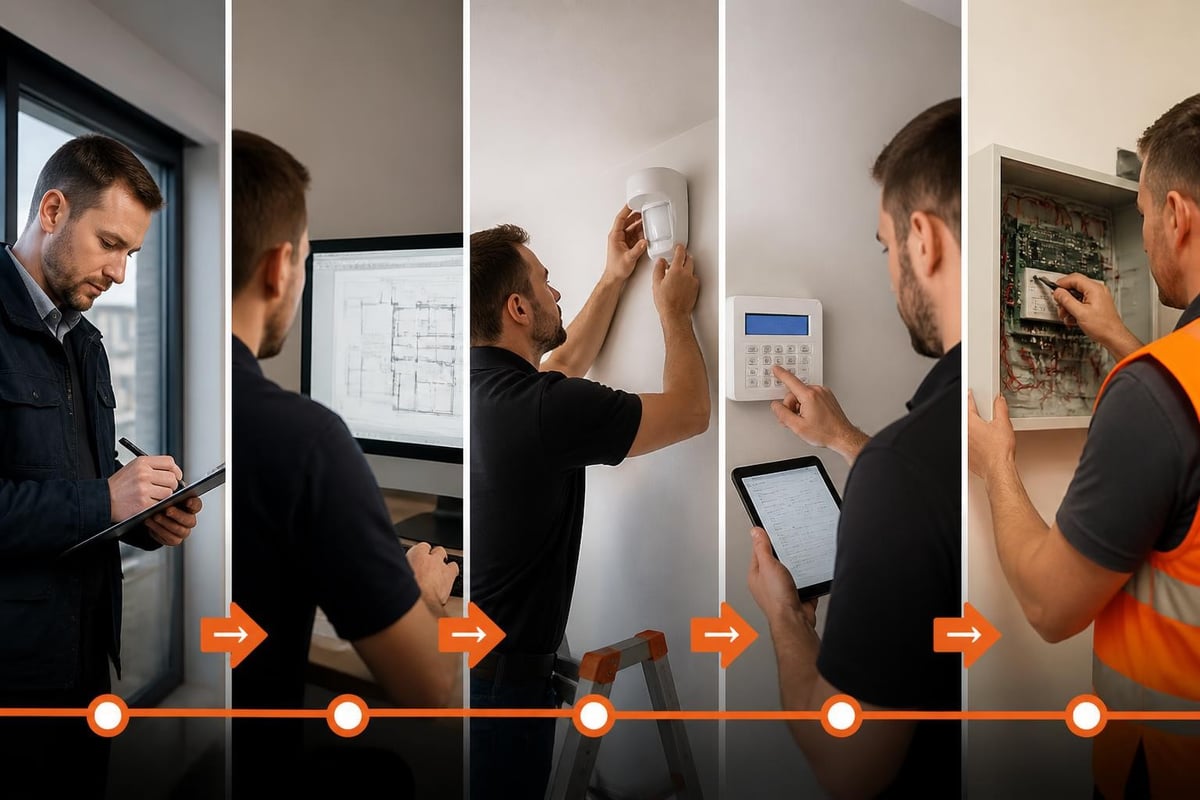
Successful commercial burglar alarm system deployment requires systematic planning that addresses technical, operational, and regulatory dimensions. The implementation process typically follows a structured pathway from initial assessment through commissioning and ongoing optimisation.
Security Risk Assessment
Professional implementation begins with comprehensive site evaluation examining:
- Asset inventory and valuation
- Threat analysis specific to location and sector
- Vulnerability identification across physical and operational domains
- Regulatory and insurance requirements
- Integration opportunities with existing infrastructure
This assessment informs system specification, ensuring solutions address actual risks rather than implementing generic approaches that may leave gaps or create unnecessary complexity.
Design and Engineering
System design translates security requirements into detailed technical specifications covering device selection, placement, wiring pathways, control panel configuration, and communication architecture. Professional designers consider factors including:
- Detection coverage patterns and sensor overlap
- Tamper protection for all system components
- Backup power provisioning for extended operation
- Environmental conditions affecting device performance
- Future expansion capacity and upgrade pathways
The design phase should produce comprehensive documentation including floor plans with device locations, wiring schedules, zone assignments, and programming specifications that guide installation and provide ongoing reference for maintenance and modifications.
Professional Installation Standards
Quality installation proves critical to system reliability and performance. Commercial alarm system installers should demonstrate relevant certifications, insurance coverage, and documented installation procedures aligned with applicable standards.
Installation best practices include:
- Concealed or protected wiring to prevent tampering
- Secure mounting preventing device removal or repositioning
- Proper termination and testing of all connections
- Comprehensive system documentation and labelling
- Thorough commissioning testing across all scenarios
For high-risk verticals including finance, healthcare, and government facilities, control panel compliance takes on heightened importance, with specific requirements detailed in compliance roadmaps for high-risk sectors addressing UL 2610 consolidated standards.
Testing Protocols and Performance Validation
Rigorous testing ensures commercial burglar alarm systems perform reliably when needed. Testing encompasses multiple dimensions from initial commissioning through ongoing operational validation.
Commissioning Testing Requirements
Upon installation completion, comprehensive testing verifies all system functions operate correctly. Testing protocols include:
- Individual device testing confirming proper detection and signalling
- Zone verification ensuring correct assignment and panel response
- Communication pathway testing across all redundant channels
- Power failure simulation validating backup operation
- User interface testing confirming access codes and controls function properly
- Integration testing verifying coordination with connected systems
Academic research demonstrates that NFPA 72-compliant cause-and-effect testing significantly reduces false alarm frequency and response latency in high-occupancy commercial complexes, establishing evidence-based improvement methodologies applicable to burglar alarm systems.
Ongoing Testing and Maintenance
| Test Type | Frequency | Purpose |
|---|---|---|
| Walk tests | Weekly | Verify sensor detection patterns |
| Full system test | Monthly | Confirm all devices operational |
| Communication test | Monthly | Validate signal transmission |
| Battery testing | Quarterly | Ensure backup power capacity |
| Professional inspection | Annual | Comprehensive system evaluation |
Regular testing identifies developing issues before they compromise security effectiveness. Documentation of all testing activities creates audit trails satisfying insurance and regulatory requirements whilst informing predictive maintenance strategies.
Monitoring Services and Response Protocols
Commercial burglar alarm systems deliver maximum value when connected to professional monitoring services that provide round-the-clock oversight and coordinated emergency response.
Central Station Monitoring
Professional monitoring centres receive alarm signals, verify authenticity, and initiate appropriate responses according to predetermined protocols. Central station operators follow structured procedures:
- Initial signal reception and system identification
- Multi-method verification using audio, video, or sequential confirmation
- Contact with designated keyholders or on-site personnel
- Emergency service dispatch when intrusion is confirmed
- Documentation of all events and actions taken
Monitoring services typically operate under contracts specifying response timeframes, escalation procedures, and communication protocols. Many organisations maintain relationships with multiple monitoring stations for redundancy.
Response Coordination
Effective response protocols balance rapid intervention against false alarm minimisation. Typical escalation procedures include:
- Immediate verification attempt using available technologies
- Primary keyholder contact with specified response timeframe
- Secondary keyholder contact if primary unavailable
- Emergency service dispatch upon confirmation or timeout
- Post-event reporting and system reset coordination
For businesses operating security systems for small business environments through to enterprise-scale operations, response protocols must align with operational patterns, staffing availability, and local emergency service relationships.
Cost Considerations and Return on Investment
Commercial burglar alarm systems represent significant capital investments with ongoing operational costs. Understanding the complete financial picture enables informed decision-making and appropriate budget allocation.
Initial Investment Components
System costs vary substantially based on facility size, complexity, and technology selection. Primary cost drivers include:
- Equipment costs for panels, sensors, communication devices, and peripherals
- Installation labour reflecting system complexity and site conditions
- Engineering and design services for custom solutions
- Permits and inspection fees as required by local authorities
- Integration expenses when connecting with existing systems
Whilst initial costs may appear substantial, they should be evaluated against potential loss values, insurance premium reductions, and regulatory compliance requirements.
Ongoing Operational Expenses
Beyond initial deployment, commercial burglar alarm systems incur recurring costs:
- Monthly monitoring service fees
- Regular maintenance and testing
- Battery replacement at specified intervals
- System updates and technology refreshes
- False alarm fines where applicable
Many organisations find comprehensive service agreements from providers like commercial security alarm companies deliver cost predictability and ensure professional maintenance throughout the system lifecycle.
Quantifying Return on Investment
ROI calculations should consider both tangible and intangible benefits:
- Direct loss prevention from deterred or interrupted intrusions
- Insurance premium reductions for monitored systems
- Reduced security staffing requirements
- Compliance maintenance avoiding regulatory penalties
- Business continuity protection preserving operational capacity
- Reputation protection from security incident prevention
For many organisations, the peace of mind and risk mitigation justify investment even before quantifying direct financial returns.
Sector-Specific Applications and Requirements
Different commercial sectors present unique security challenges requiring tailored approaches to burglar alarm system design and deployment.
Educational Institutions
Schools and universities balance security requirements with accessibility needs, creating complex operational environments. Schools security systems must accommodate:
- Multiple building footprints with varied access patterns
- High daytime occupancy with minimal after-hours presence
- Integration with lockdown and emergency notification systems
- Protection for high-value equipment in laboratories and technology centres
- Compliance with safeguarding and data protection regulations
Educational facilities often implement zoned systems allowing selective arming of specific areas whilst maintaining access to others during extended hours.
Healthcare Facilities
Medical premises require security solutions that protect patients, staff, pharmaceuticals, and sensitive equipment without impeding emergency access or clinical operations. Considerations include:
- 24-hour operational patterns requiring sophisticated zone management
- Protection for pharmaceutical storage against controlled substance theft
- Integration with nurse call and emergency systems
- Privacy protection for patient areas
- Compliance with healthcare-specific regulations
Healthcare burglar alarm systems frequently coordinate with comprehensive alarm systems for business applications addressing multiple security dimensions simultaneously.
Financial Institutions
Banks and financial services firms face heightened security requirements driven by asset values, regulatory mandates, and elevated threat profiles. Systems typically include:
- Multi-layer detection with redundant coverage
- Holdup alarm capabilities for staff under duress
- Time-delay features for vault and safe access
- Integration with physical barriers and access control
- Enhanced monitoring with guaranteed response times
- Rigorous compliance documentation and testing protocols
Technical requirements for financial sector installations often reference specialised standards and undergo regular third-party audits verifying continued compliance.
Future Trends and Emerging Technologies
Commercial burglar alarm systems continue evolving, incorporating new technologies and capabilities that enhance effectiveness whilst addressing emerging threats and operational requirements.
Artificial Intelligence and Machine Learning
AI-powered analytics are transforming alarm systems from reactive detection tools to predictive security platforms. Emerging capabilities include:
- Behavioural analysis identifying unusual patterns before incidents occur
- Intelligent video analytics distinguishing genuine threats from benign activity
- Predictive maintenance identifying device degradation before failure
- Automated tuning reducing false alarms through adaptive learning
These technologies promise substantial reductions in false alarm rates whilst improving genuine threat detection, addressing longstanding challenges documented in municipal false alarm reporting.
Cloud-Based Management Platforms
Cloud infrastructure enables sophisticated management capabilities previously available only to enterprise-scale deployments. Benefits include:
- Multi-site oversight from unified dashboards
- Remote configuration and diagnostics reducing service visit requirements
- Automated software updates maintaining current security patches
- Scalable storage for event logs and compliance documentation
- Integration with business intelligence platforms
Cloud migration introduces cybersecurity considerations requiring proper authentication, encryption, and access management aligned with broader IT security policies.
Wireless and Low-Power Technologies
Advances in wireless communication and battery technology are reducing installation complexity whilst maintaining reliability. Modern wireless systems offer:
- Reduced installation costs eliminating extensive cable runs
- Simplified retrofits in heritage or complex buildings
- Encrypted communication preventing signal interception
- Extended battery life minimising maintenance requirements
- Mesh networking providing signal redundancy
Professional installers increasingly specify hybrid architectures combining wired infrastructure for critical devices with wireless technology for supplementary coverage and flexibility.
Implementing effective commercial burglar alarm systems requires balancing technical capability, regulatory compliance, operational requirements, and financial considerations across diverse commercial environments. Modern systems integrate sophisticated detection technologies, intelligent verification, and professional monitoring to deliver comprehensive intrusion protection whilst minimising false alarms and operational disruption. For organisations seeking expert guidance on designing, installing, and maintaining commercial burglar alarm systems tailored to their specific security requirements, Logic Fire and Security brings extensive experience serving Blue Chip companies and public agencies across the UK, delivering integrated fire and security solutions that ensure compliance, protect assets, and provide peace of mind.