

CCTV and security cameras for UK businesses fall into nine main types: dome, bullet, PTZ, fixed IP network, ANPR, thermal, multi-sensor, smart battery or solar, and analogue HD cameras. The right choice depends on what each camera must see, how far, in what light and for how long the footage must be kept. This guide sets out what each type does, typical specifications and prices as of November 2026, and where it suits a commercial or multi-occupied building.
Prices below are approximate and exclude installation, cabling and recording equipment unless stated.
1. Dome cameras: the standard choice for indoor and covered areas
A dome camera is a compact, ceiling or wall-mounted unit housed in a rounded shell that hides the direction of the lens. Typical specifications include 4MP to 8MP resolution, infrared night vision and a vandal-resistant casing. Individual cameras cost roughly £80 to £250.
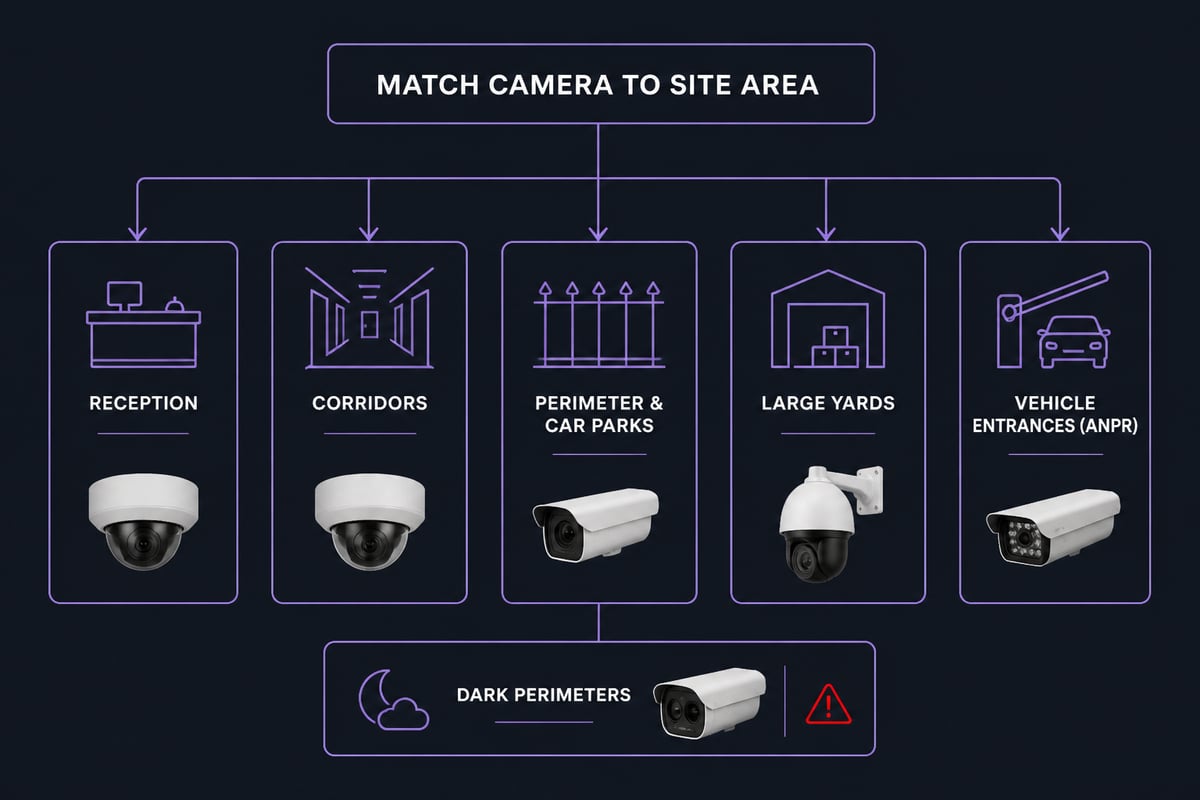
Best use: reception areas, corridors, stairwells, lifts and retail floors where discreet, tamper-resistant coverage is needed.
Verdict: the dependable default for internal coverage, though the fixed lens limits its reach outdoors.
2. Bullet cameras: long-range fixed views of perimeters and car parks
A bullet camera is a cylindrical, wall-mounted unit that points in an obvious direction, which acts as a visible deterrent. Expect 4MP to 8MP resolution, weatherproof housings and infrared night vision. Prices sit at roughly £90 to £300 per camera.
Best use: building perimeters, loading bays, fence lines and car parks where a narrow, long view is more useful than wide coverage.
Verdict: strong for outdoor distance, but it is easier to tamper with than a dome if mounted low.
3. PTZ cameras: one unit covering a large open area
A PTZ (pan, tilt, zoom) camera rotates and zooms, either under operator control or on pre-set patrol routes. Typical models offer 4MP to 8MP resolution, optical zoom and auto-tracking of moving subjects. Prices range from about £400 to £1,800.
Best use: large yards, depots, campuses and open car parks where staff or a monitoring centre can follow an incident live.
Verdict: excellent for active monitoring, but it only records what it is pointed at, so it suits supervised sites better than unattended ones.
4. Fixed IP network cameras: the flexible backbone of modern systems
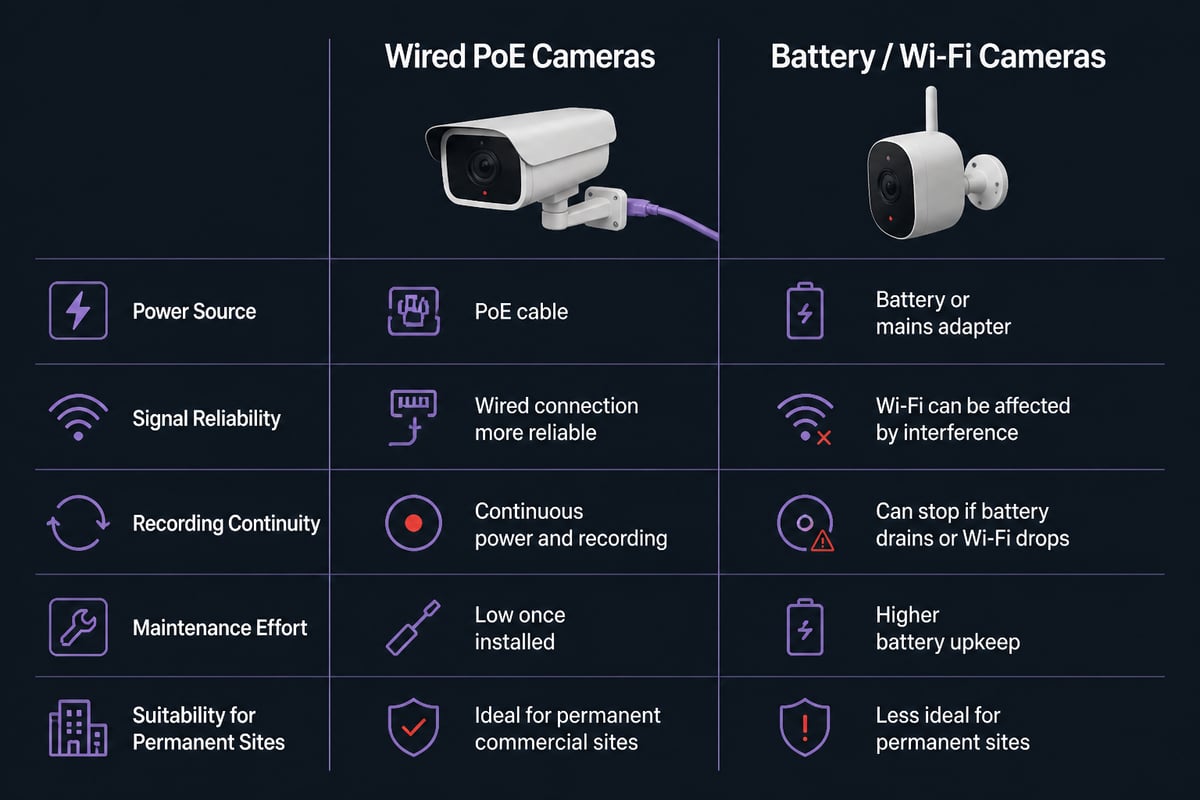
An IP network camera sends digital video over a standard network, usually powered through PoE (Power over Ethernet) with a single cable. Resolutions of 4MP to 12MP are common, with onboard video analytics such as line-crossing and loitering detection. Prices run from roughly £100 to £500.
Best use: multi-site estates and buildings with existing structured cabling, where cameras must be added or moved without rewiring.
Verdict: the most scalable option, provided the network is segmented and secured. Our overview of commercial CCTV systems explains how recording and storage fit around them.
5. ANPR cameras: reading number plates at vehicle entrances
An ANPR (automatic number plate recognition) camera is a specialist unit that captures and logs vehicle registrations using a tightly controlled shutter and infrared illumination. Models are designed to read plates across a single lane of moving traffic. Prices start at about £600 and commonly exceed £2,000 with software.
Best use: barrier-controlled car parks, gated yards and delivery entrances where a searchable log of vehicle movements is required.
Verdict: worth the cost where vehicle access matters, but it is a single-purpose camera and should sit alongside general coverage. Positioning is critical, as covered in the guide to commercial CCTV camera placement.
6. Thermal cameras: detecting people in total darkness
A thermal camera detects heat rather than light, so it works in complete darkness, fog and glare. Common specifications include a 640 x 512 sensor resolution, often paired with analytics to reduce false alarms. Prices typically range from £1,500 to £6,000.
Best use: large, unlit perimeters at utilities, storage compounds, solar sites and construction yards where infrared cameras produce too many false triggers.
Verdict: the most reliable detection in poor conditions, but it detects intruders rather than identifying them, so it is normally paired with a standard camera.
7. Multi-sensor panoramic cameras: wide coverage from one position
A multi-sensor camera combines several lenses in one housing to produce a 180 or 360-degree view, with a high combined resolution. This reduces the number of mounting points and cables needed. Prices usually sit between £700 and £2,500.
Best use: atria, open-plan offices, warehouses and large forecourts where gaps between separate cameras would otherwise appear.
Verdict: efficient for wide spaces, though storage and bandwidth demands are higher than for a standard camera.
8. Wireless, battery and solar cameras: temporary or hard-to-cable locations
These cameras run on rechargeable batteries or solar panels and connect over Wi-Fi or mobile networks. Retail kits illustrate the category: the Swann AdvancedX Super HD 4 Dome Camera CCTV Kit is listed with 5-megapixel cameras, a 1TB hard drive, an 8-channel NVR, motion and heat detection and colour night vision. Kits like this typically cost a few hundred pounds, and standalone battery cameras from around £100.
Best use: short-term sites, remote storage areas or outbuildings where running cable is impractical.
Verdict: quick to deploy, but batteries, signal strength and consumer-grade software make it a stopgap rather than a primary system for a building with legal safety duties.
9. Logic Fire and Security Commercial CCTV: a designed and maintained system
Commercial CCTV from Logic Fire and Security is a service rather than a single camera: high-definition surveillance systems providing 24/7 monitoring and evidence for investigations. The cameras are specified to suit the building, and the service covers design, supply, installation, commissioning and maintenance across the UK. Pricing depends on the survey and scope, so it is quoted on request.
Best use: commercial and public buildings, and managed residential blocks, where the Responsible Person needs a system that is surveyed, installed and maintained to a recognised standard. Logic Fire and Security is an approved contractor.
Verdict: the sensible route when several camera types must work together under one maintenance contract.
Comparison of CCTV and security cameras by type
| Camera type | Typical resolution | Approx. price per camera | Best location | Main limitation |
|---|---|---|---|---|
| Dome | 4MP to 8MP | £80 to £250 | Indoor areas, reception | Short outdoor reach |
| Bullet | 4MP to 8MP | £90 to £300 | Perimeter, car parks | Easier to tamper with |
| PTZ | 4MP to 8MP | £400 to £1,800 | Large open yards | Needs active control |
| Fixed IP network | 4MP to 12MP | £100 to £500 | Multi-site estates | Needs secure network |
| ANPR | 2MP to 4MP | £600 to £2,000+ | Vehicle entrances | Single purpose |
| Thermal | 640 x 512 sensor | £1,500 to £6,000 | Dark perimeters | Detects, does not identify |
| Multi-sensor | 20MP to 32MP | £700 to £2,500 | Atria, warehouses | High storage load |
| Battery or solar | 2MP to 5MP | £100 to £900 (kits) | Temporary or remote sites | Power and signal reliability |
| Logic Fire and Security Commercial CCTV | Specified per site | Quoted on request | Commercial and public buildings | Requires a site survey |
The price spread tells its own story. Dome, bullet and fixed IP cameras sit in a similar band of roughly £80 to £500, so the choice between them is driven by mounting position and tamper risk rather than cost. A bullet camera on a perimeter wall and a dome in a stairwell serve different purposes at almost the same price.
Costs climb sharply with specialisation. ANPR, thermal and multi-sensor units cost considerably more than standard cameras, so they are best reserved for the one or two points where a standard camera cannot do the job, such as a barrier-controlled entrance or a dark fence line. Resolution also has a hidden cost: a 12MP or multi-sensor camera produces far more data than a 4MP dome, which increases storage, bandwidth and the retention capacity you need to budget for.
Battery and solar kits look cheapest, but they depend on power and signal, which is why they rarely suit a permanent system. For a building with several zones, the practical comparison is the total installed cost of the mix, including cabling, recording and maintenance, rather than the price of any single camera.
What UK law requires of business CCTV
Any business operating cameras that capture identifiable people has data protection duties, regardless of camera type. The Information Commissioner's Office states that SMEs using CCTV that captures identifiable people may owe a data protection fee of £52 or £78 per year, reduced to £47 or £73 by direct debit, according to the ICO guidance on CCTV for your organisation.
The same guidance sets out practical steps:
- Check camera angles so they do not capture areas you have no reason to record.
- Put up clear signs informing people that surveillance is in operation.
- Keep footage only as long as needed, with the retention period recorded in your CCTV policy and privacy information.
Larger organisations should also read the ICO's broader video surveillance guidance, and the section on post-deployment governance covers disclosure controls, access requests and secure handling of footage. For a plain-English summary, see Logic Fire and Security's note on CCTV laws in the UK.
How to match cameras to your site
Start with the purpose of each camera, then choose the type. A useful sequence is:
- Define the objective for each zone: deterrence, detection, identification or evidence. A camera meant to deter can be a visible bullet unit on a wall. A camera meant to identify a face at a door needs a tighter field of view, adequate resolution and even lighting, which usually points to a dome or fixed IP camera mounted at a sensible height.
- Survey lighting and distance, since infrared range and lens choice depend on both. Walk the site after dark. A car park lit by sodium lamps behaves very differently from an unlit yard, and a camera facing a bright entrance in daylight may need a lens that copes with glare. Measure the distance from each mounting point to the area it must cover, then compare it with the stated infrared range of the camera.
- Check recording and storage: higher resolution and more cameras raise storage needs and cost. An 8-channel NVR with a 1TB drive, as in the Swann kit above, suits a small unit, whereas a site running many high-resolution or multi-sensor cameras needs far more capacity. The retention period you set in your CCTV policy directly determines how much storage you must buy.
- Plan monitoring: unattended footage only helps after an incident, whereas CCTV monitoring allows a response while an event is under way. A PTZ camera, for instance, delivers most of its value when someone is watching it.
- Plan maintenance: lenses, power supplies and drives all need periodic inspection. Spiders' webs, dirt on a dome and a failing hard drive are common reasons for unusable footage.
Most commercial sites end up with a mix: domes inside, bullets or thermal at the perimeter, and ANPR at vehicle access points. Check camera angles before finalising positions, so that private areas and neighbouring property are not recorded without reason. Where intruder alarms and access control are also needed, an integrated approach such as commercial security systems keeps the components working together under one design.
Your next step is to list each zone of your building and note what its camera must achieve: deterrence, detection or identification. Once that is clear, a professional survey will confirm the camera types, positions and retention settings that fit. Logic Fire and Security can survey, design, install, commission and maintain your system, and its engineers bring extensive fire safety experience. Logic Fire and Security is happy to discuss your requirements, so call 0800 8445 999 or email info@logicfireandsecurity.com to arrange a site survey.