

Modern commercial buildings demand sophisticated security solutions that protect people, assets, and sensitive information whilst maintaining regulatory compliance. A building access control system serves as the cornerstone of physical security infrastructure, managing who enters your premises, when they gain access, and which areas they can visit. For organisations across the UK, selecting and implementing the right access control solution requires careful consideration of operational needs, integration capabilities, and the critical relationship between security and fire safety systems.
Understanding Building Access Control System Architecture
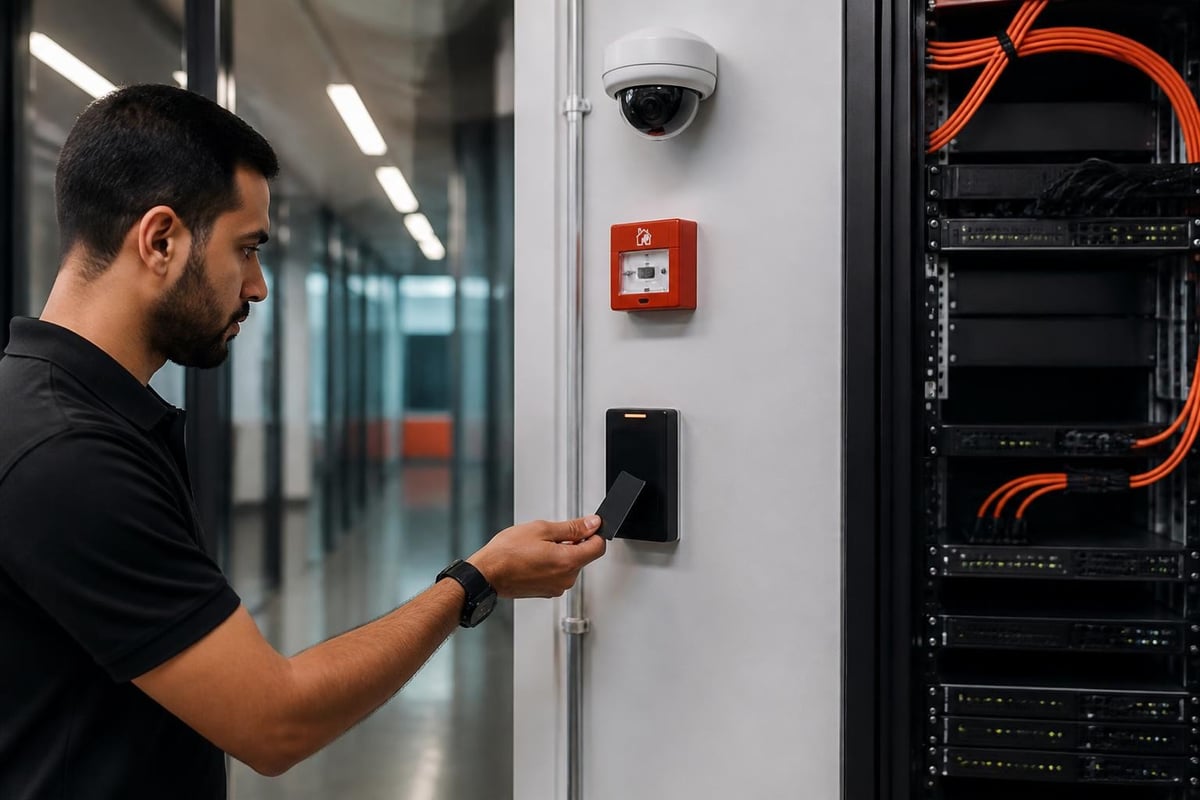
A comprehensive building access control system comprises several interconnected components that work together to manage entry and movement throughout a facility. The foundation begins with credential readers installed at entry points, which authenticate users through various technologies including proximity cards, biometric scanners, keypads, or mobile credentials. These readers connect to control panels that process authentication requests and make instant decisions about granting or denying access.
Core system components include:
- Credential readers and authentication devices
- Electronic door locks and electromagnetic holding devices
- Control panels and processing units
- Management software and user interfaces
- Power supplies and backup systems
The intelligence layer consists of software platforms that define access rules, monitor activity, and generate detailed audit trails. Modern systems store credentials centrally whilst distributing decision-making across local controllers, ensuring doors continue to function even during network disruptions.
Integration capabilities represent a critical consideration for any building access control system deployment. Today's solutions must communicate seamlessly with fire alarm systems, CCTV networks, intrusion detection, and building management platforms. The ASHRAE BACnet protocol provides standardised integration for building automation systems, enabling access control to coordinate with HVAC, lighting, and other infrastructure.
Credential Technologies and Authentication Methods
Selecting appropriate credential technology directly impacts both security effectiveness and user experience. Traditional proximity cards remain popular due to their low cost and ease of deployment, though they offer limited security against cloning and unauthorised sharing. Smart cards with embedded chips provide enhanced encryption and can store multiple applications, from access control to cashless payment systems.
Biometric authentication eliminates credential sharing entirely by verifying unique physical characteristics. Fingerprint readers offer familiar, cost-effective biometric security, whilst facial recognition systems enable contactless authentication that gained significant traction during the pandemic. Iris scanning delivers the highest security level for sensitive areas requiring absolute verification.
| Credential Type | Security Level | Cost | User Convenience | Hygiene Considerations |
|---|---|---|---|---|
| Proximity Card | Medium | Low | High | Shared cards possible |
| Smart Card | High | Medium | High | Shared cards possible |
| Fingerprint | High | Medium | Medium | Contact required |
| Facial Recognition | High | High | Very High | Contactless |
| Mobile Credential | High | Low-Medium | Very High | Personal device |
Mobile credentials represent the fastest-growing authentication method, transforming smartphones into secure access devices through Bluetooth Low Energy or Near Field Communication. This approach eliminates physical card management, enables remote provisioning, and provides enhanced security through device-specific encryption. Organisations implementing access control entry systems increasingly favour mobile-first strategies that align with broader digital transformation initiatives.
Multi-factor authentication combines two or more credential types to significantly strengthen security for high-risk areas. A common implementation requires both a card credential and PIN code, whilst maximum-security environments might demand card, biometric, and PIN verification before granting access.
Life Safety Compliance and Emergency Egress
The intersection between security and life safety represents perhaps the most critical consideration when implementing a building access control system. UK regulations and international standards mandate that electronic security systems never compromise emergency egress, regardless of system status or power availability.
Fire alarm integration stands as a fundamental requirement for any compliant access control deployment. When fire detection systems activate, access control doors equipped with electromagnetic locks must release immediately, allowing unrestricted egress whilst potentially maintaining ingress control to prevent people entering dangerous areas. This behaviour aligns with NFPA Life Safety Code guidance governing electronically locked egress doors.
Fail-Safe versus Fail-Secure Operation
Understanding lock behaviour during power loss or system failure directly impacts both security and safety outcomes. Fail-safe locks release automatically when power interrupts, prioritising life safety by ensuring people can always exit. These devices suit most egress doors where occupant safety outweighs security concerns during emergencies.
Fail-secure locks remain engaged without power, maintaining security even during outages. These locks typically protect perimeter doors, server rooms, and areas containing high-value assets where unauthorised access during power failures presents unacceptable risk. Critical spaces often combine fail-secure perimeter security with fail-safe internal doors, ensuring occupants never become trapped whilst maintaining external protection.
Request-to-exit devices installed on the secure side of doors enable occupants to leave freely without triggering alarms, whilst door position switches monitor whether doors actually close and latch properly. These components work together with delayed egress devices that permit exit after a brief countdown, allowing facilities to balance security with life safety requirements.
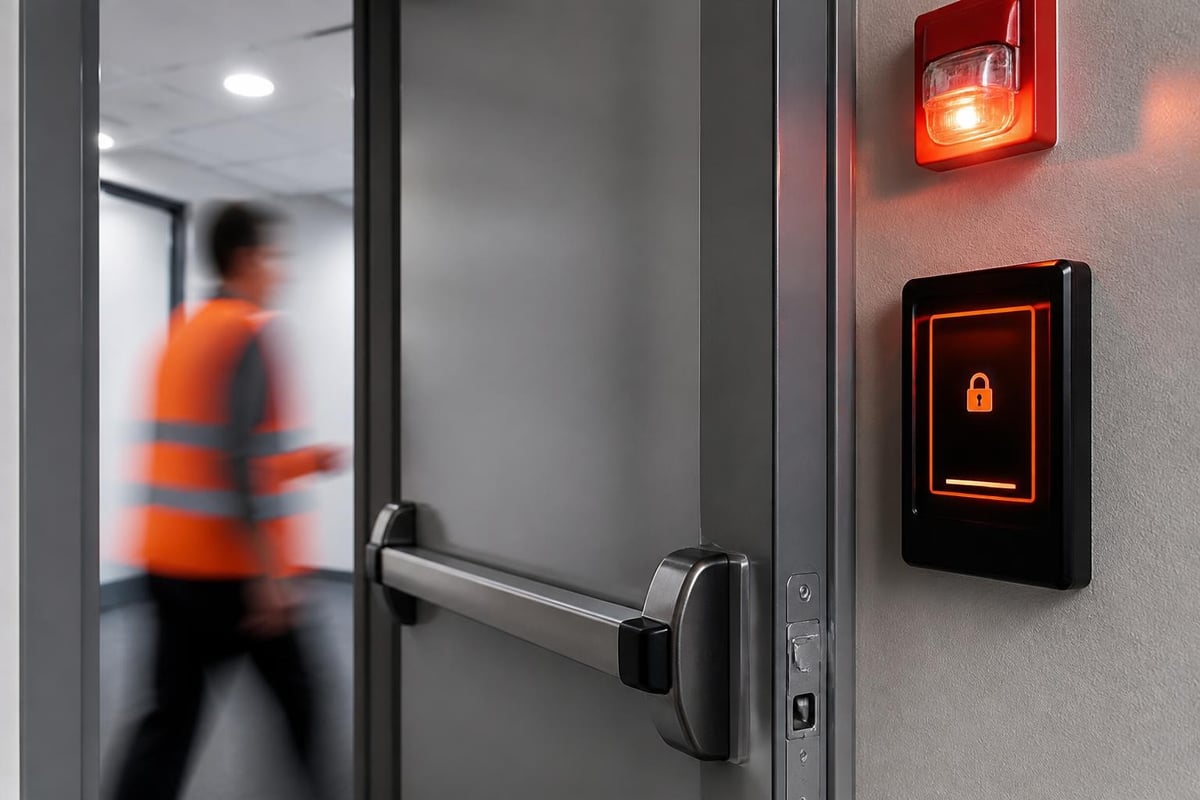
Organisations must consider how their building access control system interacts with fire alarm systems and emergency lighting to create truly integrated life safety infrastructure. Modern fire safety designs also incorporate disabled refuge systems that require coordination with access control to ensure refuge areas remain accessible whilst controlling general entry.
Cybersecurity Considerations for Connected Access Systems
As building access control systems evolve into network-connected platforms with cloud management and mobile integration, cybersecurity assumes paramount importance. Physical security systems increasingly face the same digital threats targeting IT infrastructure, from ransomware attacks to credential stuffing and network infiltration attempts.
Essential cybersecurity measures include:
- Network segmentation isolating access control systems from general IT networks
- Encrypted communication between all system components
- Regular firmware and software updates addressing known vulnerabilities
- Strong authentication for administrative access with role-based permissions
- Comprehensive logging and monitoring of system access and configuration changes
The convergence of operational technology and information technology introduces risks documented in resources like OWASP’s Operational Technology guidance, which addresses vulnerabilities specific to building systems and IoT devices. Many access control systems now incorporate Internet-connected components that require the same rigorous security practices applied to enterprise IT infrastructure.
The European Union Agency for Cybersecurity provides practical recommendations for securing smart infrastructure, emphasising the importance of secure-by-design principles when selecting building security platforms. Organisations should evaluate vendors based on their security development lifecycle, vulnerability disclosure processes, and track record responding to discovered weaknesses.
Protecting critical infrastructure extends beyond the access control system itself to encompass the broader security ecosystem. CISA’s guidance on critical infrastructure security offers frameworks for protecting physical security systems as part of comprehensive resilience strategies, particularly relevant for organisations operating essential services or high-consequence facilities.
System Design and Scalability Planning
Effective building access control system design begins with comprehensive needs assessment covering current requirements and future growth trajectories. Organisations must inventory all access points requiring control, from main entrances and vehicle gates to sensitive internal areas like server rooms, laboratories, or executive suites.
Assessing Operational Requirements
User population size directly influences system architecture decisions. Small facilities with fewer than 100 users might deploy standalone or networked controllers with basic software, whilst enterprise campuses require distributed server architectures managing thousands of users across multiple buildings. Organisations should project user growth over a five-to-seven-year horizon when sizing systems.
Access complexity varies considerably across different industries and facility types. Simple time-based access suits many commercial offices, whilst healthcare facilities require intricate rule sets governing clinical staff access based on role, department, shift patterns, and specific patient care areas. Manufacturing environments often implement zone-based access preventing unauthorised entry to production areas whilst enabling appropriate personnel movement.
Integration requirements shape both initial system selection and ongoing operational success. A building access control system rarely operates in isolation, instead forming part of broader security and building management infrastructure. Modern facilities demand integration between access control, CCTV monitoring, intrusion detection, visitor management, and increasingly with commercial CCTV analytics and building automation platforms.

Cloud-based versus on-premises deployment represents another fundamental architectural decision. Cloud platforms offer rapid deployment, automatic updates, and simplified management particularly valuable for organisations with limited IT resources or multiple geographically dispersed sites. On-premises solutions provide maximum control over data, eliminate ongoing subscription costs, and suit organisations with stringent data sovereignty requirements or facilities lacking reliable internet connectivity.
Operational Best Practices and Policy Development
Technology represents only half the equation for effective access control. Comprehensive policies and procedures governing credential management, access rights assignment, and system administration determine whether organisations realise security benefits or introduce vulnerabilities through operational gaps.
The ASIS Foundation research on access control highlights common challenges and best practices drawn from operational experience across diverse industries. Key findings emphasise the importance of regular access rights reviews, prompt credential deactivation upon employee departures, and clear ownership of access control system governance.
Establishing effective access control governance:
- Designate clear ownership spanning security, facilities, IT, and HR departments
- Document access levels aligned with job roles and operational requirements
- Implement approval workflows for access requests and modifications
- Schedule quarterly audits reviewing active credentials against current employee roster
- Define incident response procedures for access violations or system failures
Visitor management integration extends access control benefits beyond employees and contractors to temporary visitors, delivery personnel, and guests. Modern systems enable pre-registration, automated badge printing, and escort requirements whilst maintaining comprehensive audit trails documenting who accessed facilities and when.
Maintenance planning ensures ongoing system reliability and compliance. Regular testing of emergency egress functions verifies that fire alarm integration performs correctly and electronically locked doors release as designed during evacuations. Backup power systems require periodic testing, whilst card readers and biometric devices need cleaning and calibration to maintain accuracy.
Integration with Comprehensive Security Infrastructure
A building access control system achieves maximum effectiveness when integrated within broader security and life safety infrastructure rather than operating as an isolated system. This holistic approach enables sophisticated responses coordinating multiple security layers based on threats or operational requirements.
Video verification exemplifies powerful integration between access control and commercial CCTV installation. When someone presents credentials, the system automatically retrieves associated camera footage, enabling security personnel to verify the credential holder matches the authorised user. This integration helps detect credential sharing, tailgating, or coercion scenarios that credential authentication alone cannot identify.
Alarm system coordination allows access control events to trigger intrusion detection responses or vice versa. After-hours access attempts might activate additional lighting and camera recording, whilst intrusion alarms can automatically lock down specific zones. Intruder alarm monitoring combined with access control creates layered security responding dynamically to different threat levels.
Building management system integration through standardised protocols enables sophisticated scenarios like automatic lighting activation when access cards unlock doors, HVAC adjustments based on occupancy patterns derived from access data, or coordinated lockdown procedures that simultaneously control access points, activate cameras, and alert security personnel.
Organisations implementing data cabling infrastructure must plan network capacity supporting not just access control but the full complement of connected building systems. Proper infrastructure design ensures reliable communication between distributed controllers, cameras, alarm panels, and management servers whilst enabling future expansion.
Compliance Documentation and Audit Readiness
Regulatory compliance extends beyond proper system design to encompass comprehensive documentation demonstrating adherence to applicable standards and regulations. A building access control system generates valuable audit data supporting compliance across insurance requirements, industry regulations, and contractual obligations.
Access logs provide detailed records documenting entry and exit events, including timestamp, credential used, door location, and access decision (granted or denied). These records prove invaluable during security investigations, support workplace safety incident reviews, and demonstrate compliance with regulations governing access to controlled areas.
Regular compliance reporting helps organisations identify potential security gaps before they become incidents. Monthly reports highlighting unusual access patterns, repeated access denials, or doors held open beyond acceptable timeframes enable proactive intervention. Quarterly credential audits comparing active badges against current employee rosters ensure terminated personnel cannot access facilities.
Documentation should encompass system architecture diagrams, access level matrices defining which roles access which areas, integration specifications showing connections with fire and security systems, and maintenance records demonstrating ongoing system testing and updates. This documentation supports both regulatory inspections and knowledge transfer as personnel change.
Fire safety compliance requires particular attention given the life safety implications of electronically controlled egress doors. Regular fire door inspections should verify that access-controlled doors maintain proper clearances, closing mechanisms function correctly, and electromagnetic locks release appropriately during fire alarm activation.
Selecting the Right Implementation Partner
The complexity inherent in modern building access control systems demands professional expertise spanning security technology, fire safety integration, networking infrastructure, and regulatory compliance. Selecting an implementation partner with comprehensive capabilities across these disciplines directly impacts project success and long-term system performance.
Qualified partners bring essential experience in system design considering operational workflows, life safety requirements, and integration with existing infrastructure. They navigate the myriad technical decisions around controller placement, network architecture, power provisioning, and backup systems whilst ensuring compliance with UK regulations and industry standards.
Installation quality fundamentally affects system reliability and longevity. Professional installers understand proper cable routing protecting against electromagnetic interference, weatherproofing requirements for external readers, and structural considerations for magnetic locks requiring specific door and frame specifications. Substandard installation creates ongoing reliability issues, maintenance burdens, and potential compliance violations.
Commissioning and testing verify that the building access control system performs exactly as designed under all operating conditions. Comprehensive testing includes verifying every credential reader, confirming door hardware operates correctly in both normal and emergency modes, validating fire alarm integration releases locks appropriately, and documenting system performance against design specifications.
Ongoing support ensures systems remain operational and current as threats evolve and technology advances. Maintenance agreements typically include regular preventive maintenance, emergency response for system failures, software updates addressing security vulnerabilities, and technical support for administrators managing day-to-day operations.
Organisations benefit from partners offering integrated fire and security expertise rather than specialised access control vendors requiring separate coordination with fire safety providers. This integrated approach ensures seamless operation between access control and fire alarm monitoring, evacuation alert systems, and other life safety infrastructure.
Implementing a robust building access control system requires balancing security effectiveness, operational convenience, life safety compliance, and integration with broader building infrastructure. Modern solutions offer sophisticated capabilities managing access across complex facilities whilst maintaining the fundamental requirement that security never compromises emergency egress. Logic Fire and Security brings comprehensive expertise across both security and fire safety disciplines, ensuring access control deployments integrate seamlessly with fire detection, alarm systems, and emergency response infrastructure. Our experience serving Blue Chip companies and public agencies across the UK positions us to design, install, and maintain access control solutions meeting the most demanding security and compliance requirements.