

Security cameras and surveillance for a UK business means a planned system of cameras, recording equipment and monitoring that deters crime, records evidence and complies with data protection law. If your cameras capture identifiable people, the UK GDPR and Data Protection Act 2018 apply from the day you switch them on, so the legal and practical decisions need to be made together.
This guide takes you from the basics to confident use. It explains what a system contains, how to choose cameras, where to place them, how to stay compliant and how to keep the system working for years.
What does a business surveillance system actually include?
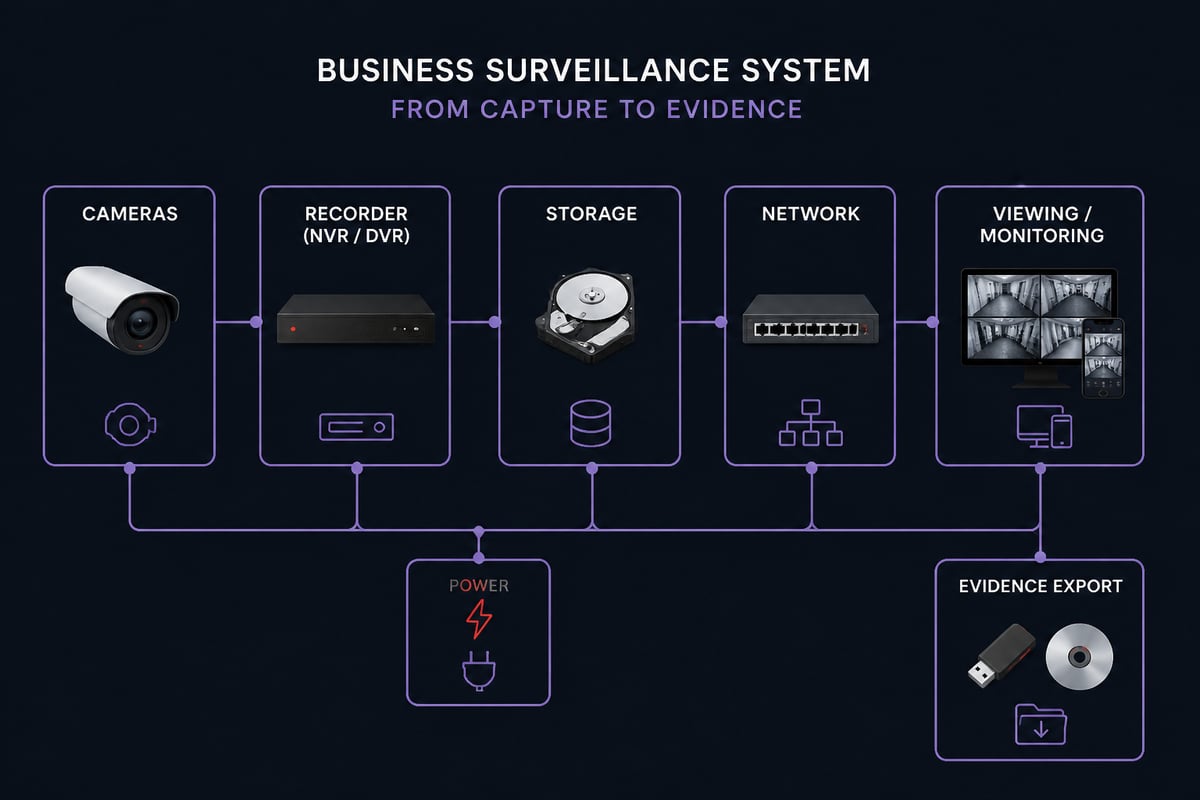
A business surveillance system combines cameras, a recorder, storage, cabling or network links, and a way to view and export footage. Each part affects the quality of the evidence you can produce later.
The core components are:
- Cameras: capture video at the points you have chosen to cover.
- Recorder: a digital video recorder (DVR) for analogue and HD-over-coax cameras, or a network video recorder (NVR) for IP cameras.
- Storage: hard drives or cloud storage sized to hold your chosen retention period.
- Network and power: cabling, switches and power supplies, often using Power over Ethernet for IP systems.
- Viewing and monitoring: on-site screens, secure remote access, or a monitoring service that responds to alerts.
Modern commercial systems are overwhelmingly IP-based, which allows higher resolution, remote access and integration with other systems such as access control and intruder alarms. Logic Fire and Security covers the broader picture of video surveillance systems for business in a separate article if you want to compare architectures in more detail.
Why do commercial and public buildings need surveillance?
Surveillance gives you three things: deterrence, evidence and situational awareness. Visible cameras discourage opportunistic theft and vandalism, recorded footage supports insurance claims and police investigations, and live viewing helps staff respond to incidents as they happen.
For a Responsible Person managing a commercial or public building, there is a fourth benefit. Cameras help you demonstrate that you have taken reasonable steps to protect people, assets and property. They can verify who entered a plant room, confirm that a fire exit was not obstructed, or show how a contractor accessed a restricted area.
Common uses in multi-occupied and high-rise buildings include:
- Monitoring entrances, lobbies and lift areas
- Covering car parks, bin stores and cycle storage
- Recording deliveries and contractor access
- Supporting concierge or security desk operations
Every use should have a defined purpose. That purpose drives camera placement, retention and your legal justification.
Which types of security camera suit which locations?
The right camera depends on the location, the lighting and what you need to see. There is no single best camera, only the best match for each coverage point.
| Camera type | Best suited to | Key consideration |
|---|---|---|
| Dome | Reception areas, corridors, retail floors | Discreet, vandal-resistant housings available |
| Bullet | Building exteriors, car parks, perimeters | Visible deterrent, suited to fixed long views |
| PTZ (pan, tilt, zoom) | Large yards, loading areas, campuses | Covers wide areas but only one view at a time |
| Fixed turret | Entrances and tight spaces | Compact, reduced glare from infrared |
| Thermal | Perimeters, sites with poor lighting | Detects heat signatures in darkness |
Resolution matters, but so do lens choice, low-light performance and frame rate. A very high-resolution camera pointed at a glare-prone doorway can produce worse evidence than a modest camera with wide dynamic range. Decide what you need to achieve at each point: general awareness, recognising a person you know, or identifying a stranger. Each requires a different image size and therefore a different lens and camera position.
Where should cameras go?
Place cameras at points where people must pass or where incidents are most likely, then check each field of view against its purpose. Start with entrances and exits, then work outwards to high-value areas and blind spots.
A sensible placement process runs as follows:
- Walk the site at the times of day when risk is highest, including after dark.
- List the areas you need to cover and the purpose of each.
- Choose positions that avoid glare, obstructions and sunlight at low angles.
- Mount cameras high enough to resist tampering but low enough to capture faces.
- Test footage in real conditions before signing off the installation.
The ICO advises that businesses should check camera angles before use and put up signs so people know they are being filmed. That check also protects you from capturing neighbouring property or public space you have no justification to record. For a deeper look at positioning, see Logic Fire and Security's guide to commercial CCTV camera placement.
What does UK law require of security cameras and surveillance?
Security cameras and surveillance in the UK must comply with data protection law whenever they capture identifiable individuals. The ICO states that organisations using CCTV in this way must comply with the UK GDPR and Data Protection Act 2018.
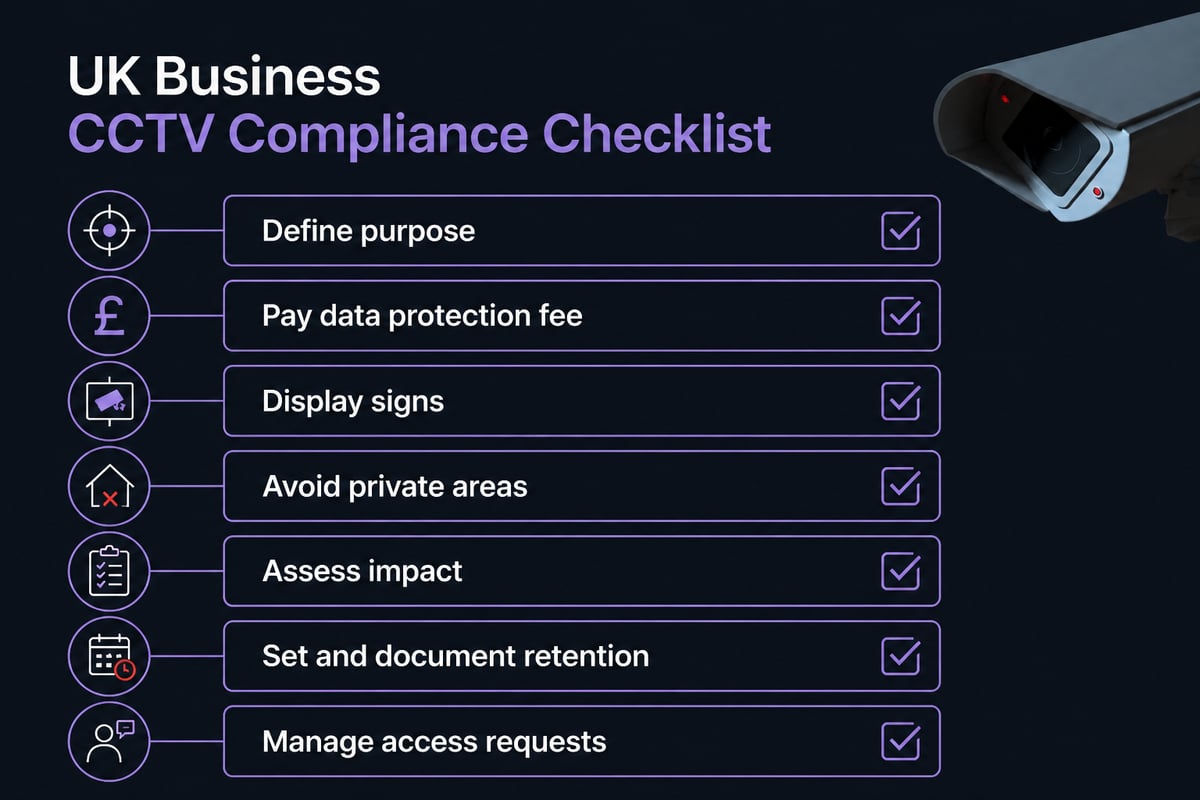
In practice, that means working through these obligations:
- Lawful purpose: document why you need cameras and why less intrusive options will not do.
- Registration and fees: most organisations processing personal data pay a data protection fee. For small and medium-sized organisations the ICO fee is £52 or £78 per year, reduced when paid by direct debit.
- Signage: clear signs at the entrance to monitored areas that state who operates the system and how to contact them.
- Private areas: the ICO advises against cameras in places such as toilets and changing rooms in ordinary circumstances, with any exception needing strong justification and clear notice.
- Impact assessment: a data protection impact assessment is required when surveillance is likely to result in a high risk to individuals, which can apply to large public-facing sites or systems with facial recognition.
The Surveillance Camera Code applies to relevant authorities in England and Wales, and the ICO says other organisations are encouraged to follow it voluntarily as good practice. Public sector bodies and housing providers working with them should treat it as a baseline. The government's guidance for CCTV owners and installers sets out how the code's principles apply to your responsibilities.
How long should you keep footage?
You should keep footage only as long as your documented purpose requires, and no longer. The ICO advises businesses to decide and document the retention period and not to retain footage longer than necessary for the stated purpose.
There is no fixed legal minimum or maximum. The UK GDPR and Data Protection Act 2018 do not set a specific period, so the purpose determines the answer.
Practical steps:
- Define the reasons you record and how quickly incidents are normally discovered.
- Set a retention period that fits, and write it into your CCTV policy.
- Configure the recorder to overwrite automatically at that point.
- Have a documented process for exporting and securing footage that is needed as evidence.
- Size your storage so the system genuinely holds the period you have chosen.
What are your responsibilities for access, security and requests?
Footage is personal data, so you must control who can see it and respond to requests from the people it shows. Restrict viewing to named, trained staff, log access and protect the recorder physically and digitally.
Cyber security matters as much as physical security. Change default passwords, keep firmware up to date, segment cameras onto their own network and disable remote access you do not use. An unsecured IP camera is a route into your wider network.
People filmed by your system can ask for a copy of their footage. Agree in advance who handles these requests, how you verify identity, and how you protect the images of other individuals appearing in the same clip. Police requests for footage should follow a documented process, with the date, officer details and reason recorded.
How do monitoring, alarms and fire systems work alongside cameras?
Cameras are most effective when connected to other systems rather than running in isolation. Linking video to intruder alarms, access control and monitoring means an event triggers a response rather than waiting to be discovered later.
Remote monitoring is a common example. When an alarm activates, a monitoring centre can view the relevant cameras, verify whether a genuine threat exists and escalate appropriately. This reduces false call-outs and shortens response times.
Fire and security also overlap. During an evacuation, camera views can help confirm that areas are clear and show how a fire or smoke event is developing. Video-based detection is also being explored in some environments, which Logic Fire and Security discusses in its article on smoke detector CCTV cameras. For a Responsible Person who owns both fire safety and security duties, a single competent contractor covering both reduces gaps between systems.
How do you choose an installer and specify a system?
Choose an installer on accreditation, experience and the quality of their design process, not on price alone. Look for third-party certification, evidence of similar projects and a willingness to survey the site before quoting.
Questions worth asking any contractor:
- Which inspectorate approvals do you hold, and can I see the certificates?
- Will you carry out a site survey and provide a written design rationale?
- How will the system be commissioned and tested before handover?
- What maintenance, support and response arrangements are available?
- How will you help us document purpose, signage and retention?
For commercial buildings, Logic Fire and Security’s commercial CCTV service provides high-definition surveillance with 24/7 monitoring and evidence for investigations. The company is an NICEIC, BAFE and NSI Gold approved contractor, with engineers who bring fire safety experience. You can review its quality and accreditations and project expertise to see how that experience applies to large and complex sites.
How do you keep a surveillance system reliable over time?
A surveillance system stays reliable only if it is inspected, maintained and reviewed on a schedule. Cameras drift out of focus, lenses collect dirt, drives fail and vegetation grows into fields of view.
A sound maintenance routine includes:
- Regular checks: confirm every camera is recording, correctly framed and time-stamped accurately.
- Servicing: clean housings and lenses, test power supplies and replace ageing storage.
- Software updates: apply firmware patches and review user accounts.
- Annual review: reassess whether each camera still serves a documented purpose, and whether the site layout or risks have changed.
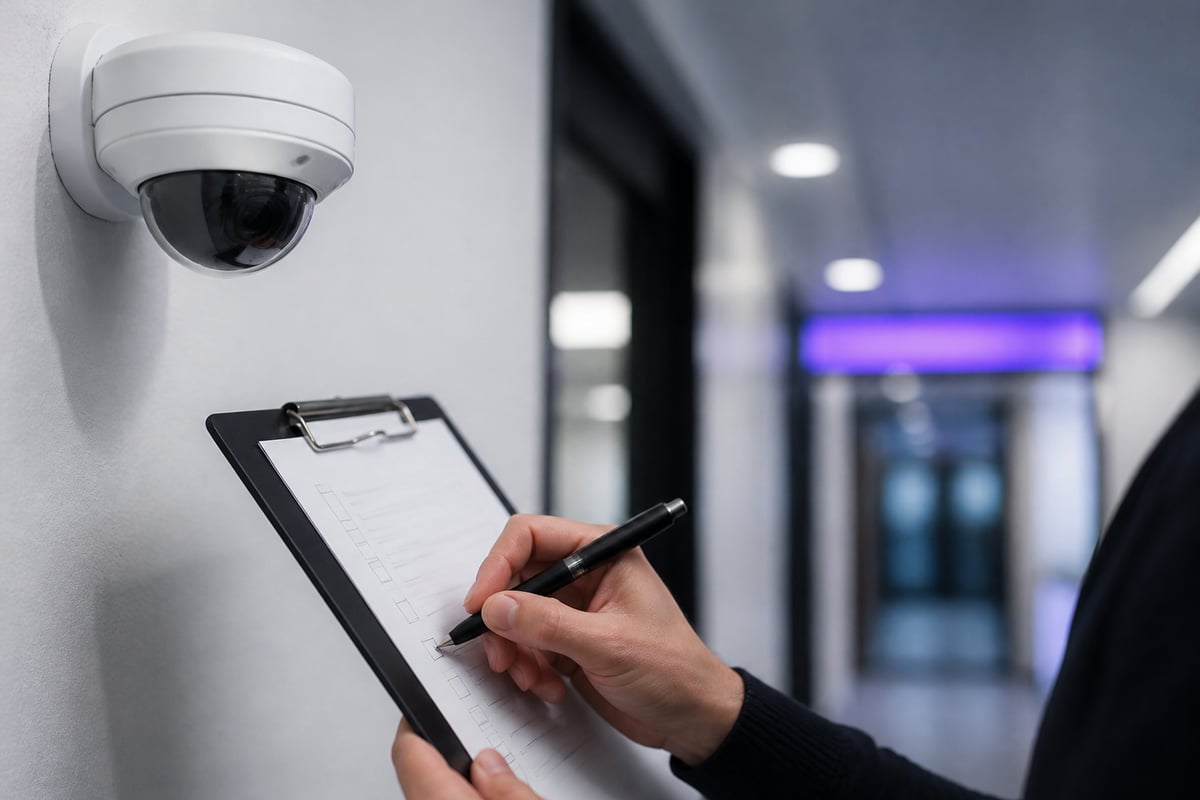
The ICO's CCTV and video surveillance hub includes a self-assessment checklist covering installation, management, operation, signage and public awareness, which makes a useful template for your annual review. Record the outcome so you can show your approach if the ICO, an insurer or a court asks.
A failed recorder discovered after an incident is a common and avoidable problem. A planned maintenance agreement, ideally with automated fault reporting, turns that risk into a routine task.
Start by walking your site with a notepad and listing every area you need to cover, the purpose of each camera and the retention period you can justify, because that single document drives design, compliance and cost. If you would like a specialist to survey your premises and design a system around it, Logic Fire and Security can design, install, commission and maintain it, and you can call 0800 8445 999 or email [email protected] to arrange a conversation about your building. Its commercial CCTV service is a sensible place to begin.