

Understanding access control installation cost begins with recognising what you're actually purchasing: not just a lock and keypad, but a networked system comprising readers, controllers, power supplies, management software, credentials, and integration with existing fire and security infrastructure. For commercial buildings in 2026, budgets typically range from £800 to £3,500 per controlled door, with the final figure determined by equipment specification, site complexity, regulatory compliance requirements, and the degree of integration needed with fire alarm systems, intruder detection systems and CCTV networks. This guide provides facility managers and responsible persons with a framework for accurate budgeting and a clear understanding of where your investment is directed.
What You're Actually Buying: The Components of Access Control Installation Cost
The access control installation cost comprises several distinct elements, each with its own price range and specification considerations. Understanding these components helps you challenge vague quotations and ensure you're comparing like with like.
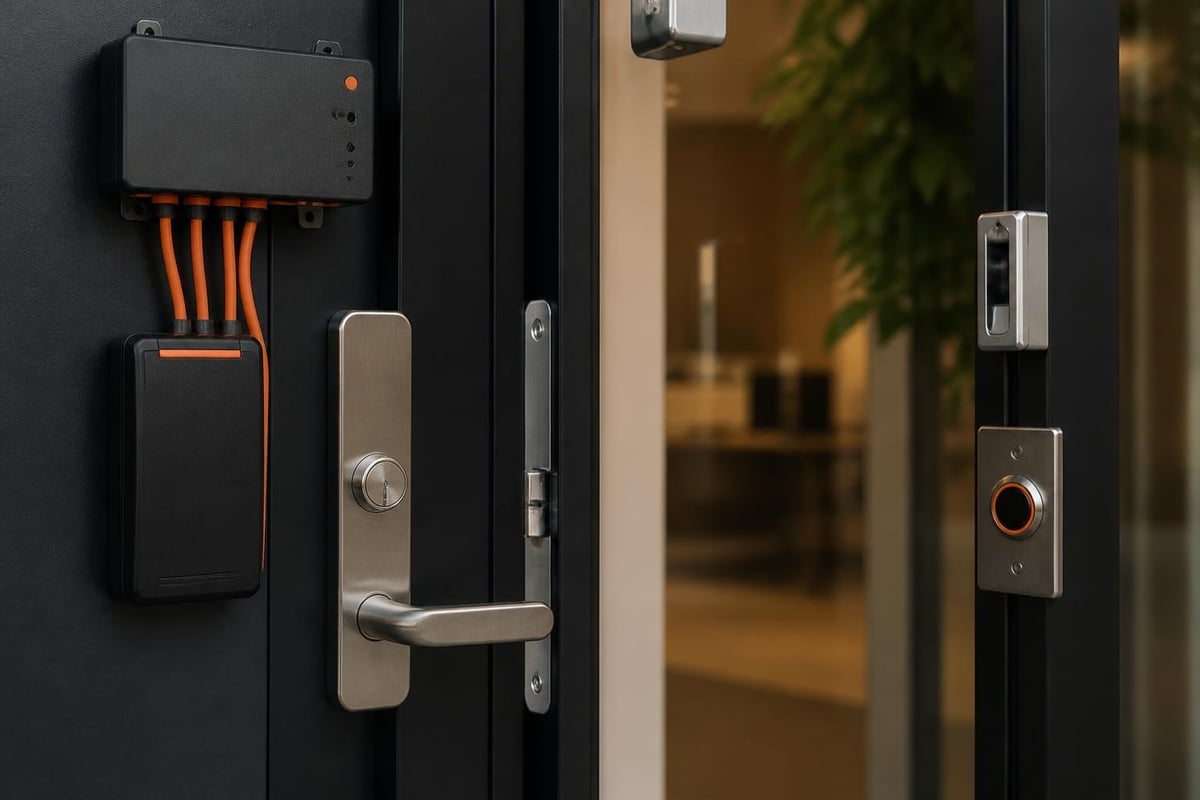
Hardware at the Door
Every controlled entry point requires:
- Card readers or biometric devices: Proximity readers (MIFARE DESFire, OSDP-compliant) cost £150–£400 each; fingerprint or facial recognition units start at £500
- Electric locks or magnetic locks: Fail-safe maglocks (releasing on fire alarm activation per BS 7273-4) cost £200–£600; motorised locks range from £300–£900
- Request-to-exit sensors: Infrared or microwave devices (£80–£200) detect legitimate exit and prevent false alarms
- Door position switches: Magnetic contacts (£15–£40) monitor door status and trigger alerts for forced or held-open conditions
Controllers and Infrastructure
Door controllers are the intelligence layer that enforces access rules:
- Single-door controllers: £180–£450 per door, typically PoE-powered for simplified cabling
- Multi-door controllers: £600–£2,000 units managing 2–8 doors, reducing per-door cost at scale
- Network switches and cabling: Cat6 structured cabling and PoE switches add £100–£300 per door depending on cable run length
- Power supplies and backup batteries: Ensuring fail-safe operation during mains failure, £150–£400 per door cluster
The Physical Access Control Systems customer ordering guide published by GSA provides detailed topology descriptions showing how these components interconnect, informing realistic cost planning for multi-door installations.
Management Software and Licences
Central management software is where access control installation cost often includes hidden surprises:
- Server software licences: £2,000–£15,000 depending on door count and feature set (visitor management, mobile credentials, API integration)
- Per-door or per-user licences: Annual fees of £40–£150 per door are common with cloud-based platforms
- Workstation clients: Additional licences for security desks or HR personnel managing credentials (£300–£800 per seat)
- Integration modules: Connecting to fire, CCTV or building management systems may require add-on licences (£500–£3,000 per integration)
Cost Per Door: Realistic Pricing Bands for 2026
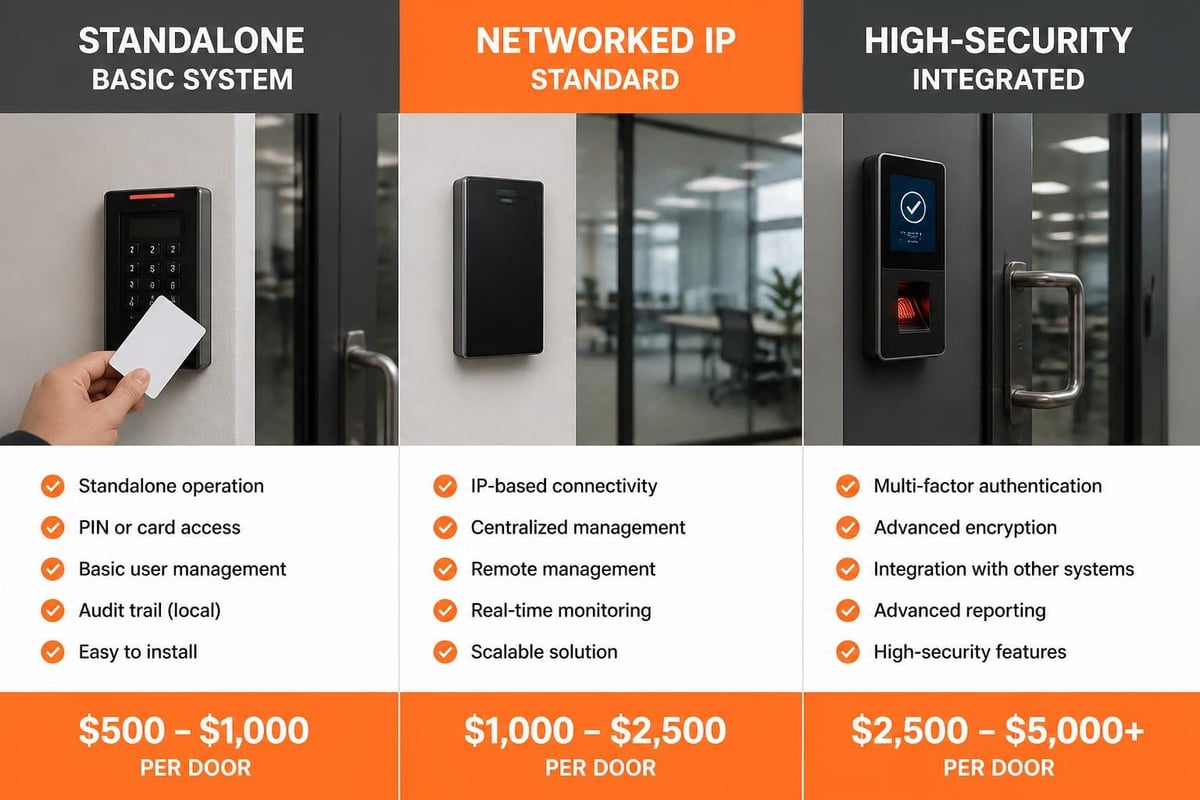
Access control installation cost expressed on a per-door basis provides the clearest benchmark for budgeting, though total project cost depends heavily on door count and system architecture.
| System Tier | Per-Door Cost | Typical Components | Best For |
|---|---|---|---|
| Entry-level standalone | £800–£1,200 | Proximity reader, electric strike, basic controller, offline operation | Low-security internal doors, small sites (under 10 doors) |
| Networked IP system | £1,400–£2,200 | OSDP reader, PoE controller, network cabling, central software, credentials | Standard commercial installations, most offices and warehouses |
| High-security integrated | £2,400–£3,500 | Biometric reader, certified components, fire/intruder integration, redundant servers | Data centres, pharmaceutical, critical infrastructure, regulated environments |
The access control market analysis published by Grand View Research in 2026 confirms these ranges align with UK commercial installations, with the mid-tier networked IP category representing approximately 65% of new projects.
Economies of Scale
Your per-door access control installation cost decreases significantly with door count:
- 1–5 doors: £2,200–£3,500 per door (proportionally higher software and server costs)
- 10–25 doors: £1,400–£2,000 per door (infrastructure costs spread across more endpoints)
- 50+ doors: £1,000–£1,600 per door (volume discounts, efficient cabling runs, shared controllers)
- 100+ doors: £850–£1,300 per door (enterprise licensing, dedicated servers justified)
These figures assume standard installation conditions; sites requiring extensive civil works, asbestos surveys, listed building consents or out-of-hours working see costs rise by 20–45%.
Wired Versus Wireless Locks: Installation Cost Trade-offs
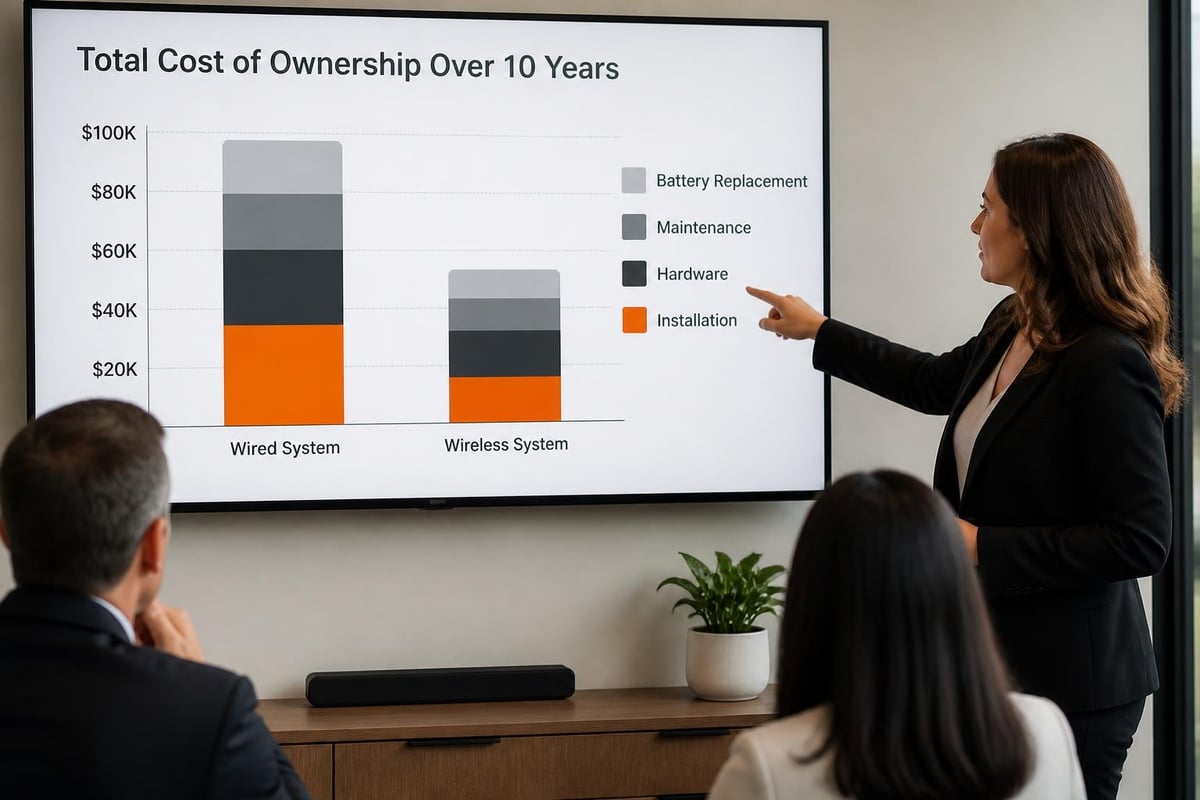
The choice between wired and wireless access control dramatically affects installation cost, though total cost of ownership tells a more complex story.
Wired Systems
Traditional hardwired installations dominate commercial projects:
Advantages affecting cost:
- Lower ongoing maintenance and battery replacement costs
- Greater reliability in high-traffic applications (no radio interference or battery failures)
- PoE delivery of power and data via single Cat6 cable reduces cabling complexity
- Compliance with BS 7273-4 for fail-safe fire door release is straightforward
- Integration with existing structured cabling and network infrastructure
Cost considerations:
- Cable installation adds £150–£400 per door depending on run length and building fabric
- Conduit and trunking for surface-mounted installations in finished buildings
- Making-good costs for concealed cabling in plasterboard or masonry walls
- Access equipment (scissor lifts, tower scaffolds) for high-level cable runs
Wireless and Battery-Powered Solutions
Wireless locks reduce installation labour but introduce different cost factors:
Where they reduce access control installation cost:
- Minimal cabling saves £200–£500 per door in labour and materials
- Faster installation (typically 2–3 hours per door versus 4–6 for wired)
- Ideal for listed buildings, glass partitions or locations where cable runs are impractical
- Retrofit scenarios where existing decorative finishes must be preserved
Hidden cost factors:
- Hardware costs are 20–40% higher (battery-powered locks cost £450–£1,200 versus £200–£600 for wired)
- Battery replacement every 2–4 years adds £40–£80 per door in parts and labour
- Radio frequency surveys may be needed in complex buildings (£800–£2,000)
- Limited integration options with fire alarm systems increase compliance complexity
The global access controls study by The Freedonia Group identifies wireless growth driven by retrofit demand, though total cost of ownership typically favours wired solutions over 10-year lifecycles.
Integrating Fire Door Release, Intruder Detection and CCTV
The access control installation cost increases substantially when systems must integrate with existing commercial security systems, but this integration delivers critical safety and operational benefits.
Fire Alarm Integration and BS 7273-4 Compliance
The Regulatory Reform (Fire Safety) Order 2005 requires that locked final exit doors release automatically upon fire alarm activation. BS 7273-4 specifies the interface arrangements:
- Fail-safe electromagnetic locks: Release when power is removed by fire alarm system relay outputs
- Interface modules: Fire panel to access control system signalling (£300–£800 per zone)
- Emergency break glass units: Manual override points adjacent to final exits (£120–£250 each)
- Battery backup: Ensures fire alarm can trigger release during mains failure (included in controller costs above)
Integration adds £400–£900 per fire exit door to access control installation cost, but is non-negotiable for regulatory compliance. The NIST guidance on PACS provides technical detail on fail-safe versus fail-secure lock selection that informs specification decisions.
Intruder Alarm System Integration
Connecting access control to intruder detection creates intelligent security zones:
Integration scenarios and costs:
- Basic door contacts to alarm panel: Existing access control door position switches wired into intruder zones (£150–£300 per door)
- Two-way communication: Access system arms/disarms alarm panels based on user credentials (£600–£1,500 integration licence plus £200–£400 labour)
- Alarm-triggered lockdown: Intrusion detection triggers automatic door locking and CCTV recording (£800–£2,000 system integration)
This integration is particularly valuable in warehouse security alarm systems and distribution centres where goods-in/goods-out areas require coordinated security responses.
CCTV and Video Management Integration
Linking access events to video footage provides audit trails and incident investigation capability:
- Event-triggered recording: Card swipes trigger CCTV bookmarks or recording sequences (£400–£1,200 integration module)
- Video verification at entry: Security personnel see live video when access is requested (requires additional monitors and interface licensing, £1,500–£3,500)
- Facial recognition verification: Biometric comparison of card holder to CCTV image (£2,000–£5,000 per door for high-security applications)
The comprehensive approach to security and access control integration ensures that multiple protective layers work cohesively rather than as isolated systems.
Hidden Costs: Licences, Credentials and Maintenance
Quoted access control installation cost often excludes ongoing operational expenses that significantly affect total cost of ownership.
Software Licences and Annual Fees
- Annual support contracts: 15–22% of software licence value per year (£300–£3,300 annually for typical 20-door systems)
- Cloud service subscriptions: £8–£25 per door per month for hosted platforms (£96–£300 per door annually)
- Mobile credential platforms: £3–£8 per user per month for smartphone-based access
- Software version upgrades: Major releases may require additional licensing (£500–£2,000 every 3–5 years)
Credentials and Consumables
Every authorised person requires a physical or digital credential:
- Proximity cards: £1.50–£4 each (MIFARE Classic); £3–£8 for secure MIFARE DESFire EV2
- Key fobs: £2–£6 each for durable ABS enclosures
- Printed card customisation: Photo ID printing adds £0.80–£2 per card in materials and labour
- Card printer hardware: £800–£3,500 for direct-to-card or retransfer printers (amortised across credentials)
- Biometric enrolment: 10–15 minutes per user at typical £45/hour labour rates
A 100-employee site issuing secure photo ID cards incurs £500–£1,200 in initial credential costs, with replacement cards for losses running at approximately 8–12% of headcount annually.
Maintenance and Callout Costs
The PACS selection guide published in peer-reviewed literature emphasises lifecycle planning:
- Preventive maintenance visits: £180–£350 per visit (recommended quarterly for critical sites)
- Reactive callout charges: £120–£200 for first hour, then £60–£90 per subsequent hour
- Parts replacement: Readers, locks and controllers have 7–12 year service lives; budget 5–8% of hardware value annually
- Database administration: 2–6 hours monthly for user management, audit reviews and credential updates
Budget Bands: What Different Price Points Deliver
Understanding how access control installation cost correlates with capability helps you specify appropriately for your risk profile and operational needs.
£800–£1,200 Per Door: Basic Standalone
What you get:
- Individual door controllers with offline operation
- Proximity card readers (125kHz or basic MIFARE)
- Electric strikes or surface-mounted maglocks
- Manual programming via controller keypad
- No central software or reporting
- Limited user capacity (100–500 credentials per controller)
Appropriate for:
- Internal office doors with low security requirements
- Server rooms or storage areas in small businesses
- Temporary or trial installations
- Sites with minimal audit or compliance obligations
Red flags: No audit trail, no remote management, difficult to revoke credentials urgently, poor scalability.
£1,400–£2,200 Per Door: Networked IP Standard
What you get:
- Network-connected controllers with central management software
- OSDP-compliant readers with secure credential authentication
- Fail-safe locks with fire alarm integration capability
- Real-time monitoring and event logging
- Time-based access rules (access granted only during working hours)
- Integration with HR systems for automated user provisioning
- Capacity for 10,000+ users system-wide
Appropriate for:
- Typical commercial offices, warehouses and retail back-of-house
- Multi-tenant buildings requiring separated access rights
- Sites requiring audit trails for insurance or client requirements
- Businesses with 20+ employees and moderate security risk
This tier represents best value for most commercial installations and aligns with industry standard implementations.
£2,400–£3,500 Per Door: High-Security Integrated
What you get:
- Biometric verification (fingerprint, facial recognition or iris scanning)
- FIPS 201-compliant components certified through the FIPS 201 Evaluation Program
- Redundant servers and failover networking
- Anti-passback and anti-tailgating enforcement
- Multi-factor authentication (card plus PIN plus biometric)
- Full integration with fire, CCTV, building management and alarm monitoring systems
- Encrypted credential data and secure communications
- Comprehensive audit logging with tamper-evident storage
Appropriate for:
- Data centres, research facilities and pharmaceutical manufacturing
- Sites holding valuable assets or sensitive information
- Regulated industries (defence, finance, healthcare)
- Critical national infrastructure
Compliance driver: Many sectors mandate specific security standards that necessitate this investment regardless of door count.
Cheap-Quote Red Flags: When Low Prices Signal Problems
Unusually low access control installation cost quotations often hide deficiencies that compromise security, compliance or total cost of ownership.
Specification Warning Signs
Non-compliant components: Electromagnetic locks that are fail-secure (remaining locked during fire alarm activation) violate BS 7273-4 and the Regulatory Reform (Fire Safety) Order 2005. Ensure specifications explicitly state fail-safe operation for all final exit doors.
Proprietary readers: Systems using manufacturer-specific credential formats lock you into single-source purchasing. Insist on open standards (MIFARE DESFire, OSDP) that allow credential and reader portability.
Inadequate power backup: Battery backup must maintain fail-safe operation for minimum four hours. Cheap installations omit batteries or use undersized units that fail during extended power cuts.
Missing documentation: Professional installations include as-built drawings, programming documentation, and operation manuals. Absence of these documents indicates poor project management and creates long-term support difficulties.
Commercial Practice Concerns
Be cautious of:
- Verbal-only quotations: Legitimate contractors provide detailed written specifications and breakdowns
- Pressure to sign quickly: Professional firms allow time for tender comparison and technical review
- No site survey: Accurate pricing requires physical assessment of cable routes, door types, network infrastructure and power availability
- Unlicensed software: Pirated management software exposes you to legal liability and lacks vendor support
- No ongoing support: Installation-only contracts with no maintenance provision leave you stranded after handover
The Secure Technology Alliance physical access publications provide implementation guidance that helps you evaluate whether contractors understand current standards and best practices.
Labour and Experience Factors
Access control installation requires specific competencies:
- Network cabling certification: Cat6 data cabling should be installed by certified technicians and tested to TIA-568 standards
- Fire alarm competence: BS 7273-4 integration must be designed and commissioned by engineers with fire alarm qualifications
- Software configuration expertise: Complex access rules, integration logic and database management require trained specialists
Quotations significantly below market rates often reflect use of unskilled labour, leading to commissioning delays, poor reliability and safety non-compliance. The investment in experienced contractors typically repays itself within months through reduced fault callouts and faster system optimisation.
Long-term Cost Implications
The cheapest access control installation cost often becomes the most expensive over time:
Comparison over 10 years:
| Factor | Budget Installation | Professional Installation |
|---|---|---|
| Initial cost (20 doors) | £16,000 | £28,000 |
| Callout costs (10 years) | £8,000–£15,000 | £2,000–£4,000 |
| Parts replacement | £6,000–£9,000 | £3,000–£5,000 |
| System replacement (year 5–7) | £18,000–£22,000 | Not required |
| Total 10-year cost | £48,000–£62,000 | £33,000–£37,000 |
Quality installations from experienced contractors deliver lower total cost of ownership, better uptime, and simpler compliance demonstration during audits or insurance renewals.
Access control installation cost varies widely based on specification, integration requirements and site complexity, but understanding the components, budget tiers and hidden costs enables informed decision-making that balances initial expenditure against long-term value and compliance obligations. Whether you need basic door control or fully integrated security solutions, Logic Fire and Security brings decades of experience designing and installing access control systems for Blue Chip companies and public agencies across the UK, ensuring your investment delivers robust security, regulatory compliance and operational efficiency tailored to your specific requirements.