

When searching for fire and security companies near me, businesses face a critical decision that directly impacts their operational safety, regulatory compliance, and asset protection. The landscape of fire and security services has evolved significantly, with technological advancements reshaping how organisations approach building safety. Selecting the right partner requires understanding not only the immediate installation needs but also the long-term support infrastructure that ensures your systems remain effective. This comprehensive guide explores the essential considerations for choosing fire and security companies near me whilst examining industry developments that influence service delivery in 2026.
Understanding the Modern Fire and Security Landscape
The fire and security sector has undergone substantial transformation over recent years. Traditional alarm systems have given way to sophisticated integrated platforms that combine fire detection, access control, and surveillance capabilities within unified management systems.
Technological Integration and Intelligence
Modern fire and security companies near me now offer solutions that leverage artificial intelligence and advanced analytics to enhance threat detection and reduce false alarms. These intelligent systems can differentiate between genuine emergencies and environmental anomalies, significantly improving response accuracy.
Key technological capabilities to expect include:
- Cloud-based monitoring platforms with remote access
- AI-enhanced video analytics for perimeter protection
- Integrated building management system connectivity
- Mobile application control for authorised personnel
- Predictive maintenance alerts using sensor data
The integration extends beyond individual components. Commercial fire detection systems now communicate seamlessly with ventilation controls, emergency lighting, and evacuation alert systems to orchestrate coordinated responses during incidents.
Industry Standards and Certifications
When evaluating fire and security companies near me, certifications serve as critical indicators of competence and reliability. British Standards such as BS 5839 for fire detection and BS 8418 for installation and remote monitoring form the foundation of quality assurance.
| Certification | Purpose | Relevance |
|---|---|---|
| NSI Gold | Third-party certification for security systems | Indicates adherence to highest industry standards |
| BAFE SP203-1 | Fire alarm design and installation | Essential for compliant fire detection systems |
| SafeContractor | Health and safety pre-qualification | Demonstrates commitment to site safety |
| ISO 9001 | Quality management systems | Ensures consistent service delivery |
The importance of these credentials cannot be overstated. They provide assurance that fire and security companies near me possess the technical knowledge, operational procedures, and insurance coverage necessary for professional service delivery.
Essential Services Portfolio
A comprehensive service provider should offer end-to-end capabilities spanning design, installation, monitoring, and maintenance.
Fire Safety Systems
Fire alarm systems represent the cornerstone of building protection. However, fire safety extends far beyond basic smoke detection to encompass multiple interconnected elements.
Complete fire safety portfolios include:
- Addressable fire detection networks – Pinpoint identification of alarm activation points
- Aspirating smoke detection – Early warning systems for high-value environments
- Gas suppression systems – Protection for server rooms and critical equipment
- Emergency lighting and signage – Guidance during evacuation scenarios
- Disabled refuge systems – Communication points for mobility-impaired occupants
- Fire extinguisher provision and servicing – First-line response equipment
The state of the fire and life safety market indicates that cloud computing and intelligent analytics are increasingly influencing system capabilities, enabling more sophisticated threat assessment and faster emergency response coordination.
Security System Integration
Electronic security solutions from fire and security companies near me should address multiple threat vectors through layered protection strategies.
Modern access control entry systems utilise biometric authentication, mobile credentials, and time-based permissions to regulate facility access. These platforms integrate with commercial CCTV installations to provide visual verification of access events and maintain comprehensive audit trails.
Perimeter protection combines intrusion detection sensors with video analytics to identify unauthorized access attempts before breaches occur. Intruder alarm monitoring services provide immediate verification and response coordination when security events are detected.
| System Type | Primary Function | Integration Benefits |
|---|---|---|
| Access Control | Credential management and entry regulation | Links with CCTV for visual verification |
| CCTV Surveillance | Visual monitoring and evidence recording | AI analytics for behaviour detection |
| Intruder Detection | Perimeter and internal breach detection | Automated alerts to monitoring centres |
| Intercoms | Visitor communication and verification | Remote access grant capabilities |
Monitoring and Ongoing Support Infrastructure
Installation represents merely the beginning of the relationship with fire and security companies near me. Ongoing monitoring and maintenance determine long-term system effectiveness.
24/7 Monitoring Capabilities
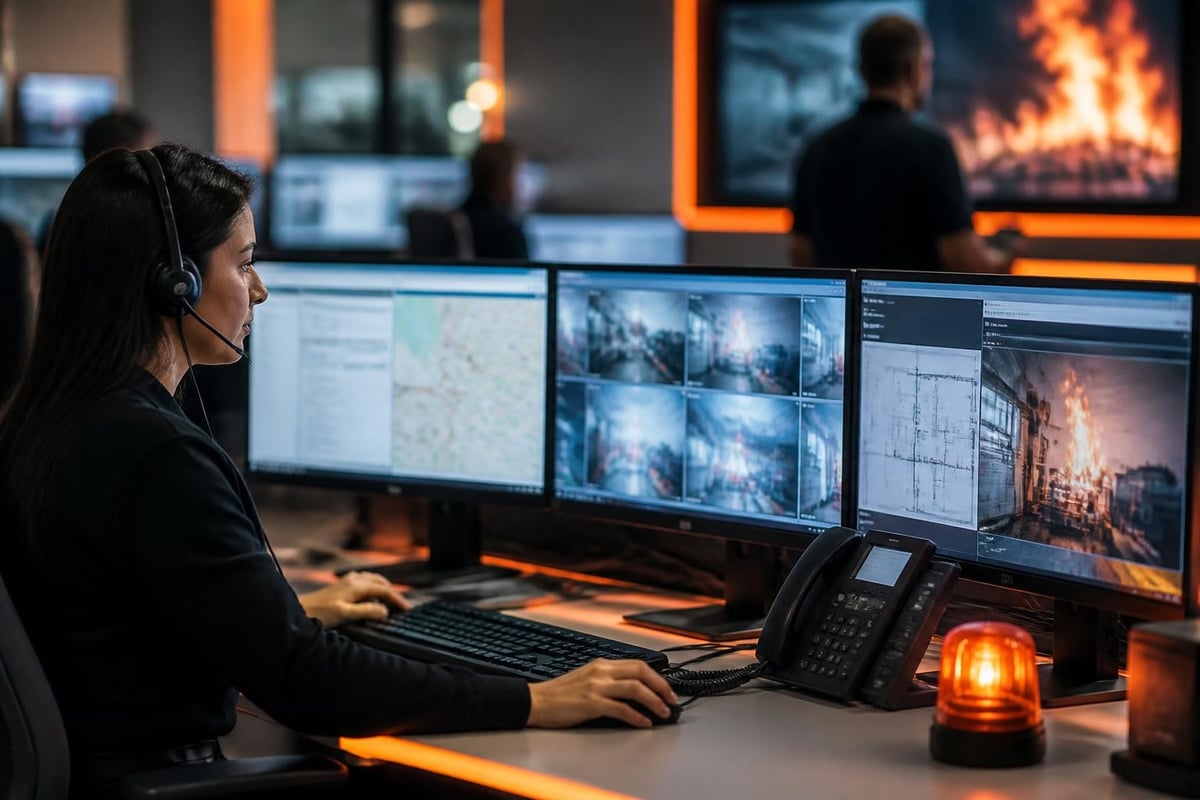
Professional monitoring centres provide continuous oversight of your fire and security infrastructure. Fire alarm monitoring services ensure immediate notification of emergency services when detection systems activate, whilst trained operators verify alarm conditions before dispatching responders.
The sophistication of monitoring extends beyond basic alert forwarding. Modern platforms track system health metrics, identifying potential failures before they compromise protection. This proactive approach minimizes downtime and maintains compliance with regulatory requirements.
Maintenance Schedules and Compliance
Regular servicing maintains system reliability whilst fulfilling statutory obligations. Fire and security companies near me should provide structured maintenance programmes tailored to your specific installation.
Typical maintenance frequencies include:
- Fire detection systems – Quarterly inspections with annual comprehensive testing
- Emergency lighting – Monthly functional tests and annual duration tests
- Gas suppression systems – Six-monthly inspections with cylinder weighing
- CCTV equipment – Quarterly health checks and lens cleaning
- Access control hardware – Annual comprehensive testing and credential audits
Maintenance visits should encompass functional testing, component replacement where necessary, and detailed reporting that evidences compliance. This documentation proves invaluable during regulatory inspections and insurance assessments.
Evaluating Service Providers in Your Area
The process of selecting fire and security companies near me requires methodical assessment across multiple criteria.
Geographic Coverage and Response Times
Proximity influences service quality, particularly for emergency callouts and routine maintenance visits. Local providers understand regional building regulations and maintain established relationships with authorities having jurisdiction.
Response time commitments vary significantly between providers. Standard service level agreements typically guarantee attendance within four to eight hours for urgent issues, whilst routine maintenance operates on scheduled appointments. However, premium service tiers may offer prioritised response with engineer deployment within two hours.
Technical Expertise and Specialisation
Different sectors present unique challenges requiring specialised knowledge. Healthcare facilities demand compliance with HTM 05-03 guidance, whilst industrial environments require explosion-proof equipment rated for hazardous areas.
When researching fire and security companies near me, assess their experience with your specific building type. Portfolio evidence and client references from similar environments indicate relevant expertise.
Sector-specific considerations include:
- Data centres – Requiring gas suppression and environmental monitoring
- Retail environments – Needing integrated theft prevention and customer safety
- Educational facilities – Demanding safeguarding-compliant access control
- Manufacturing sites – Requiring industrial-grade detection and zone isolation
Financial Stability and Business Continuity
The longevity of your chosen provider matters significantly. Fire and security companies near me should demonstrate financial stability that ensures they'll remain operational throughout your system's lifecycle, which may span 10-15 years.
Merger and acquisition activity within the sector has intensified, driven by technological advancement and regulatory pressures. Whilst consolidation can bring benefits through increased resources, it may also introduce service disruption during transition periods.
| Stability Indicator | What to Assess | Why It Matters |
|---|---|---|
| Trading History | Years in operation and client retention | Indicates reliability and reputation |
| Accreditations | Maintenance of industry certifications | Demonstrates ongoing investment in quality |
| Employee Tenure | Experience levels of engineering staff | Reflects technical capability and continuity |
| Insurance Coverage | Professional indemnity and public liability levels | Protects against negligence claims |
Technology Trends Shaping Service Delivery
Understanding emerging developments helps future-proof your investment when selecting fire and security companies near me.
Artificial Intelligence and Predictive Analytics
Fire service technology trends for 2026 highlight AI integration as transformational. Machine learning algorithms now analyse historical alarm data to identify patterns indicating impending equipment failure, enabling preventative intervention.
Video analytics have progressed beyond simple motion detection to recognise specific behaviours, objects, and situations. These capabilities reduce security officer workload by filtering irrelevant events whilst highlighting genuine threats requiring investigation.
Cloud-Based Management Platforms
Traditional on-premise management systems are giving way to cloud-hosted platforms offering enhanced accessibility and scalability. Authorised personnel can monitor system status, review alarm history, and manage user credentials from any internet-connected device.
Cloud architecture facilitates seamless software updates without site visits, ensuring your installation benefits from the latest security patches and feature enhancements. This approach also supports business continuity by eliminating single points of failure inherent in server-dependent configurations.

Cybersecurity Considerations
As fire and security systems become increasingly networked, cybersecurity assumes critical importance. Fire and security companies near me should implement robust measures protecting against unauthorised access and system compromise.
Essential cybersecurity features include:
- Encrypted communications between devices and monitoring centres
- Multi-factor authentication for administrative access
- Network segmentation isolating security systems from general IT infrastructure
- Regular firmware updates addressing discovered vulnerabilities
- Penetration testing validating system resilience
The convergence of physical and cyber security demands providers possess both domains' expertise, particularly for organisations handling sensitive data or operating within critical national infrastructure.
Cost Structures and Value Assessment
Understanding pricing models helps evaluate quotations from fire and security companies near me effectively.
Initial Investment Components
Capital expenditure encompasses equipment supply, installation labour, system commissioning, and user training. Pricing varies substantially based on building complexity, chosen technology, and integration requirements.
Transparent quotations should itemize:
- Equipment costs – Detectors, panels, cameras, access readers, and cabling
- Labour charges – Installation, programming, and commissioning activities
- Project management – Design, coordination, and compliance documentation
- Commissioning and testing – Functional verification and authority notifications
Beware of quotations lacking detailed breakdowns, as these may conceal substandard components or omit essential elements requiring subsequent additional charges.
Ongoing Service Costs
Operational expenditure includes monitoring fees, maintenance contracts, and callout charges. Monthly monitoring typically ranges from £20-£100 per site depending on system complexity and service level commitments.
Maintenance contracts operate on fixed annual fees or per-visit charging. Fixed-price agreements provide budget certainty and typically include all routine servicing, component replacement (excluding vandalism), and documentation. Per-visit arrangements suit smaller installations with minimal equipment but may become expensive as estates grow.
| Cost Model | Structure | Best Suited For |
|---|---|---|
| Fixed Annual | Single annual payment covering all planned maintenance | Multi-site estates requiring budget certainty |
| Quarterly Billing | Spread payments with scheduled service visits | Medium-sized installations |
| Per-Visit Charging | Payment only when services rendered | Small, simple systems with minimal equipment |
| Comprehensive Cover | All-inclusive monitoring and maintenance | Risk-averse organisations prioritising uptime |
Compliance and Regulatory Obligations
Fire and security companies near me must navigate complex regulatory frameworks ensuring installations meet statutory requirements.
Building Regulations and Fire Safety Legislation
The Regulatory Reform (Fire Safety) Order 2005 places duty on responsible persons to ensure adequate fire safety measures. This encompasses appropriate detection systems, emergency lighting, and evacuation procedures tailored to building occupancy and use.
Fire risk assessment companies identify specific threats and recommend proportionate mitigation measures. These assessments inform system specifications, ensuring installations address identified risks comprehensively.
British Standard BS 5839-1 establishes fire detection system design, installation, and maintenance requirements. Compliance demonstrates due diligence and forms a defence against corporate manslaughter prosecution should incidents occur.
Data Protection and Privacy
CCTV installations must comply with UK GDPR and Data Protection Act 2018 requirements. This necessitates legitimate processing grounds, proportionate surveillance, clear signage, and defined retention periods.
Building access control systems collecting biometric data trigger additional obligations regarding explicit consent and heightened security measures protecting this sensitive information.
Fire and security companies near me should provide guidance ensuring installations remain compliant, including privacy impact assessments for extensive surveillance deployments.
Making the Final Selection Decision
Consolidating research into a selection decision requires structured evaluation of shortlisted fire and security companies near me.
Requesting Detailed Proposals
Comprehensive briefs elicit comparable quotations. Specify building details, existing infrastructure, functional requirements, and constraints influencing design approaches.
Request proposals addressing:
- Detailed system design with equipment schedules
- Installation methodology and programme duration
- Commissioning procedures and handover documentation
- Maintenance requirements and service level commitments
- Warranty terms and support availability
- Migration strategies for existing system replacement
Conducting Due Diligence
Verify credentials through certifying bodies' public registers. NSI and BAFE maintain online directories confirming member status and scope of certification.
Request client references from comparable installations, focusing on:
- Reliability of equipment and false alarm frequency
- Responsiveness during emergencies and routine maintenance
- Quality of documentation and compliance support
- Professionalism of engineering staff
- Value for money across the contract term
Site visits to existing installations provide firsthand insights into equipment quality and workmanship standards fire and security companies near me deliver.
Contract Terms and Performance Metrics
Formal agreements should establish clear performance expectations with remedies for non-compliance. Essential clauses include response time guarantees, preventative maintenance frequencies, parts availability commitments, and contract termination provisions.
Service level agreements quantify acceptable performance through measurable metrics:
- System availability – Percentage of time fully operational (typically 99%+)
- Response times – Maximum periods for attendance following callout requests
- False alarm rates – Target reductions through ongoing optimization
- Compliance maintenance – Guarantee of meeting regulatory testing schedules
Selecting the right provider requires careful evaluation of technical capability, service infrastructure, and long-term reliability. As fire and security systems grow increasingly sophisticated, partnering with experienced professionals ensures your investment delivers comprehensive protection whilst maintaining regulatory compliance. Logic Fire and Security brings decades of expertise serving Blue Chip companies and public agencies across the UK, offering complete design, installation, monitoring and maintenance solutions tailored to your specific requirements.