

In today’s rapidly evolving security landscape, protecting commercial premises requires more than just installing an alarm system and hoping for the best. Businesses across the UK face increasing threats from unauthorised access, theft, and vandalism, making robust security measures essential. Intruder alarm monitoring represents a critical component of comprehensive security strategies, providing round-the-clock surveillance and immediate response capabilities that standalone systems simply cannot match. For organisations ranging from small enterprises to large corporate facilities, understanding the nuances of professional monitoring services can mean the difference between a minor security incident and a catastrophic breach.
What Is Intruder Alarm Monitoring
Intruder alarm monitoring is a professional security service that connects your business premises to a dedicated Alarm Receiving Centre (ARC), where trained operators monitor your alarm system continuously. When your intruder alarm is triggered, the signal is immediately transmitted to the ARC, where security professionals assess the situation and initiate appropriate responses.
Unlike basic alarm systems that rely solely on audible sirens to deter intruders, monitored systems create a direct link between your property and emergency services. This connection ensures that every activation receives immediate attention, regardless of whether staff members are present on site.
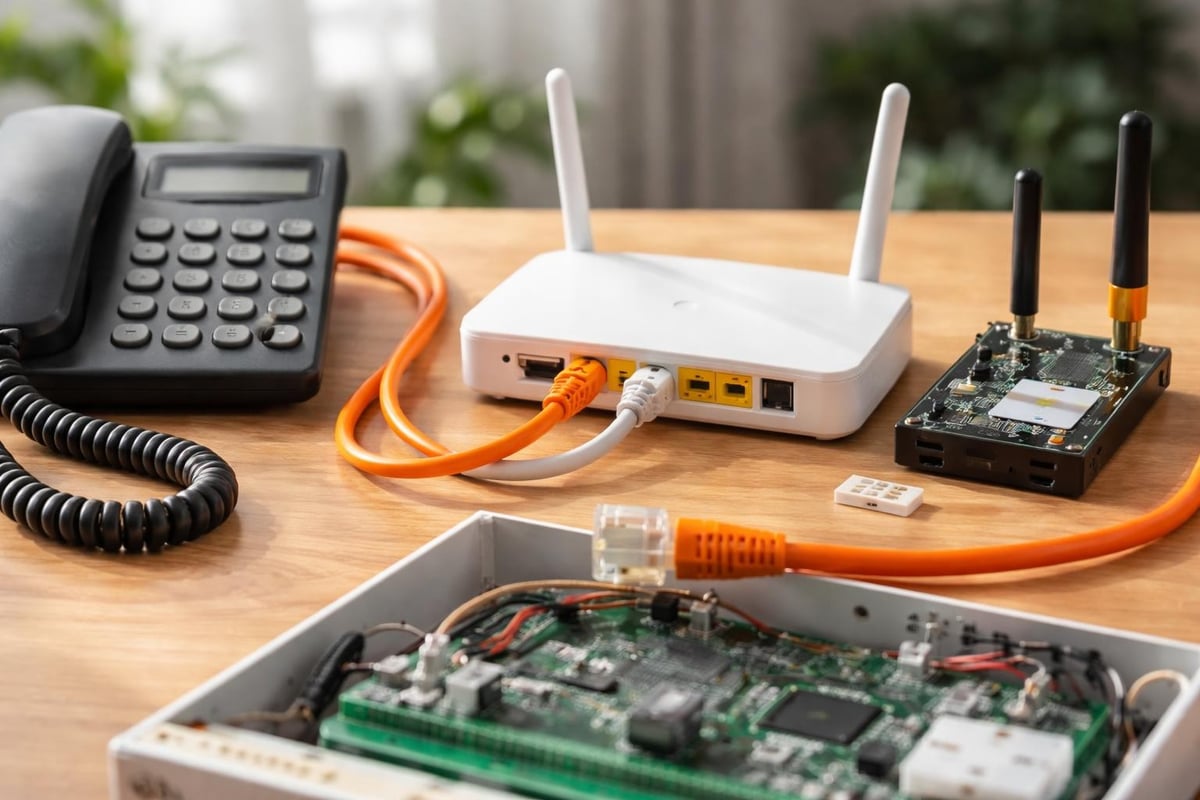
The technology behind intruder alarm monitoring has evolved significantly in recent years. Modern systems utilise multiple communication pathways, including telephone lines, broadband connections, and cellular networks, to ensure signal redundancy. Should one pathway fail, the system automatically switches to an alternative route, maintaining constant connectivity with the monitoring station.
How Professional Monitoring Works
When an intruder alarm detects unauthorised access through sensors, motion detectors, or door contacts, it immediately sends a coded signal to the ARC. The concept of alarm monitoring involves sophisticated protocols that distinguish between genuine threats and false alarms.
Monitoring centre operators receive detailed information about the activation, including:
- Zone identification showing precisely where the breach occurred
- Alarm type indicating whether motion, door contact, or glass break sensors triggered
- Time stamp recording the exact moment of activation
- Customer verification details enabling quick authentication
Within seconds, operators follow established protocols to verify the alarm. This typically involves attempting to contact designated keyholders using a cascade system, checking CCTV feeds if integrated, and assessing whether the activation pattern suggests genuine intrusion or user error.
Types of Monitoring Services for Commercial Properties
Businesses can choose from several monitoring configurations, each offering different levels of protection and response capabilities. Understanding these options helps organisations select the most appropriate solution for their specific security requirements and operational needs.
| Monitoring Type | Response Time | Coverage | Best For |
|---|---|---|---|
| Full Monitoring | Immediate | 24/7/365 | High-security facilities, retail, warehouses |
| Remote Monitoring | 1-5 minutes | Business hours or 24/7 | Offices, commercial buildings |
| Dual Signalling | Immediate | 24/7/365 | Critical infrastructure, data centres |
| Video Verification | 30-90 seconds | 24/7/365 | Properties with integrated CCTV |
Police Response Monitoring
One of the most significant advantages of professional intruder alarm monitoring is eligibility for police response. In the UK, police forces typically only respond to confirmed activations from professionally monitored systems that comply with ACPO (Association of Chief Police Officers) Security Systems Policy.
To qualify for police response, your system must meet specific criteria. The installation must be completed by an NSI or SSAIB-approved company, the system must connect to a recognised ARC, and you must maintain proper keyholder arrangements. These requirements ensure that police resources are deployed efficiently and false alarm rates remain minimal.
Commercial security alarm companies play a vital role in ensuring systems meet these stringent standards, providing both installation expertise and ongoing compliance support.
Remote Video Verification
Integrating CCTV systems with intruder alarm monitoring creates a powerful security solution that enables visual verification of alarm activations. When an alarm triggers, monitoring centre operators can immediately access live camera feeds to assess the situation visually before dispatching emergency services.
This capability significantly reduces false alarm rates whilst accelerating genuine emergency responses. Operators can confirm whether an intruder is present, identify the number of suspects, observe their behaviour, and provide real-time intelligence to responding police officers.
The advanced intruder alarm capabilities available through modern systems enable seamless integration between detection devices and surveillance equipment, creating comprehensive security ecosystems.
Benefits of Professional Monitoring for Businesses
The decision to implement intruder alarm monitoring delivers measurable advantages that extend beyond basic intrusion detection. These benefits impact operational efficiency, financial performance, and regulatory compliance across multiple business sectors.
Immediate Response to Security Threats
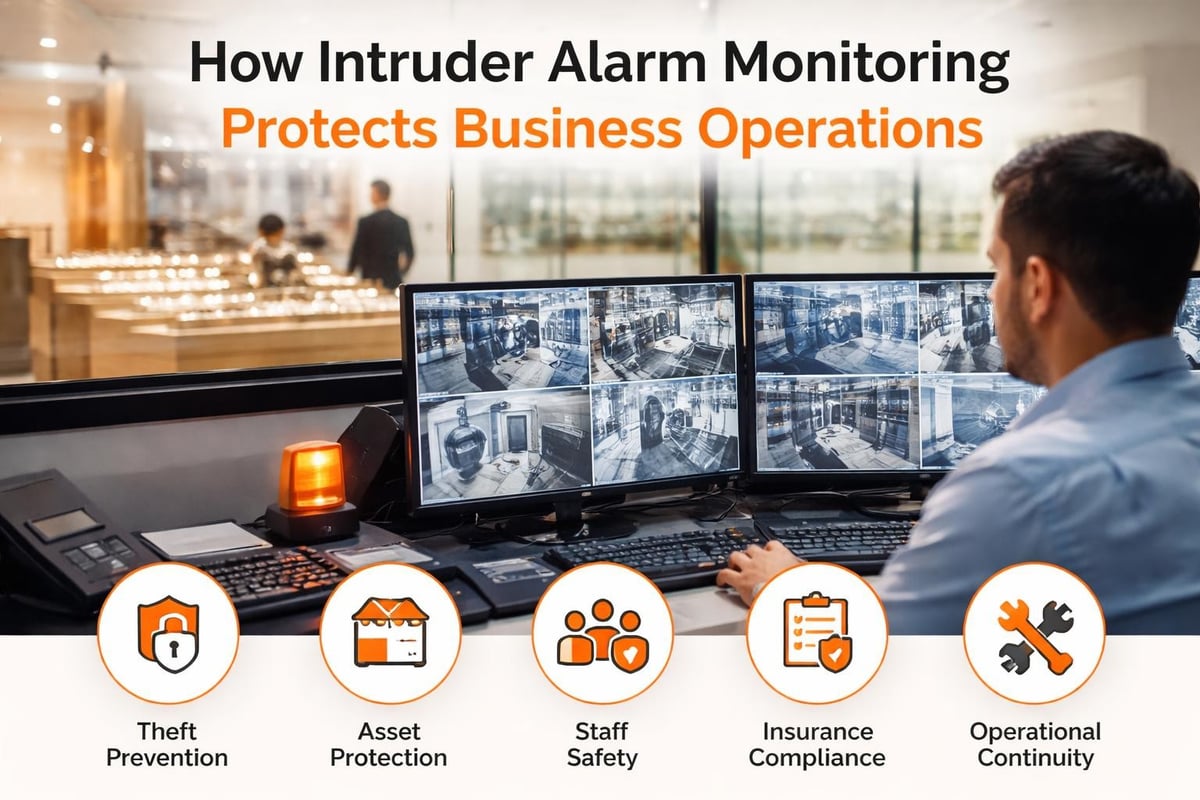
Speed matters critically during security incidents. Professional monitoring ensures that trained operators identify and respond to threats within seconds of activation, dramatically reducing the window of opportunity for intruders to cause damage or steal valuable assets.
- Reduced response times compared to relying on staff notification
- 24/7 coverage including weekends, holidays, and overnight periods
- Multiple contact attempts ensuring keyholders receive alerts promptly
- Coordinated emergency response with police, security guards, or fire services
Consider a warehouse facility storing high-value electronics. Without monitoring, an overnight break-in might go undetected for hours until staff arrive the following morning. With professional monitoring, operators detect the intrusion immediately, verify the threat, and dispatch both police and security personnel within minutes, potentially preventing significant losses.
Insurance Premium Reductions
Insurance providers recognise that professionally monitored alarm systems substantially reduce risk exposure. Many commercial insurance policies offer premium discounts ranging from 10% to 30% for businesses with approved monitoring services.
These savings can offset the cost of monitoring services significantly. For larger commercial properties, annual premium reductions may exceed the monitoring fees entirely, making professional monitoring financially advantageous beyond the security benefits.
Business security monitoring demonstrates to insurers that your organisation takes proactive measures to protect assets, making you a more attractive client and potentially improving your negotiating position when renewing policies.
Integration With Comprehensive Security Systems
Modern intruder alarm monitoring rarely operates in isolation. The most effective security strategies integrate multiple protective layers, creating sophisticated ecosystems that address diverse threats whilst simplifying management and reporting.
Access Control System Integration
Linking intruder alarms with commercial access control systems creates intelligent security environments that adapt to operational requirements. These integrated systems can automatically arm alarm zones when the last authorised person leaves a building, preventing gaps in protection caused by human error.
Integration enables sophisticated scheduling where different areas activate at different times based on actual usage patterns. A retail facility might maintain armed perimeters overnight whilst keeping back-office areas accessible for cleaning staff, then reverse the configuration during business hours.
When unauthorised access occurs, integrated systems provide comprehensive audit trails showing exactly who was on site, which doors were accessed, and the precise sequence of events leading to the alarm activation. This information proves invaluable for investigations and improving security protocols.
Fire and Security System Coordination
For businesses investing in comprehensive protection, coordinating fire detection and intruder alarm monitoring through a single ARC streamlines emergency response and reduces system complexity. Commercial fire alarm monitoring company services can be combined with intrusion detection, enabling operators to assess multiple threat types simultaneously.
This coordination proves particularly valuable during genuine emergencies where multiple systems activate. Monitoring operators can prioritise fire response whilst noting intrusion activations that may result from staff evacuating buildings hastily, preventing unnecessary police deployment during fire incidents.
Selecting the Right Monitoring Service
Choosing an appropriate monitoring provider requires careful evaluation of technical capabilities, compliance standards, and service quality. Not all monitoring services offer equivalent protection levels, and selecting the wrong provider can compromise your entire security investment.
Essential Criteria for Monitoring Centres
When evaluating potential monitoring partners, consider these critical factors:
- Certification and accreditation – Verify NSI Gold or SSAIB approval
- Redundancy and resilience – Confirm dual or triple redundancy for all systems
- Operating procedures – Review response protocols and escalation processes
- Communication capabilities – Assess signal handling for multiple transmission paths
- Geographic coverage – Ensure appropriate keyholder and guard response availability
The most reputable ARCs maintain BS 5979 certification, demonstrating compliance with British Standards for remote centres receiving signals from security systems. This certification requires independent auditing of operational procedures, staff training, and technical infrastructure.
Service Level Agreements
Professional monitoring relationships depend on clearly defined service level agreements (SLA) that specify performance expectations and response obligations. Your SLA should detail:
| SLA Component | Specification | Importance |
|---|---|---|
| Signal acknowledgement time | Within 10-30 seconds | Critical for rapid response |
| Keyholder contact attempts | Minimum 2-3 attempts | Ensures notification success |
| Police notification timeframe | Within 2-5 minutes of confirmation | Meets ACPO requirements |
| System uptime guarantee | 99.9% or higher | Ensures continuous protection |
| False alarm handling | Verification procedures documented | Maintains police response eligibility |
Review SLAs carefully and ensure they align with your operational requirements and risk profile. Businesses handling sensitive information or high-value assets may require more stringent performance guarantees than standard commercial properties.
Cost Considerations and Value Assessment
Monitoring costs vary significantly based on system complexity, property size, and service levels. Typical commercial monitoring services range from £15 to £50 monthly for basic packages, whilst comprehensive solutions with video verification and integrated systems may cost £100 to £300 monthly.
When assessing value, consider total cost of ownership rather than monitoring fees alone. Factor in insurance premium reductions, potential loss prevention, compliance benefits, and operational efficiencies gained through automated monitoring.
Understanding the features of intruder alarm monitoring services helps businesses evaluate whether premium services justify additional costs or whether standard monitoring meets their security objectives adequately.
Compliance and Regulatory Considerations
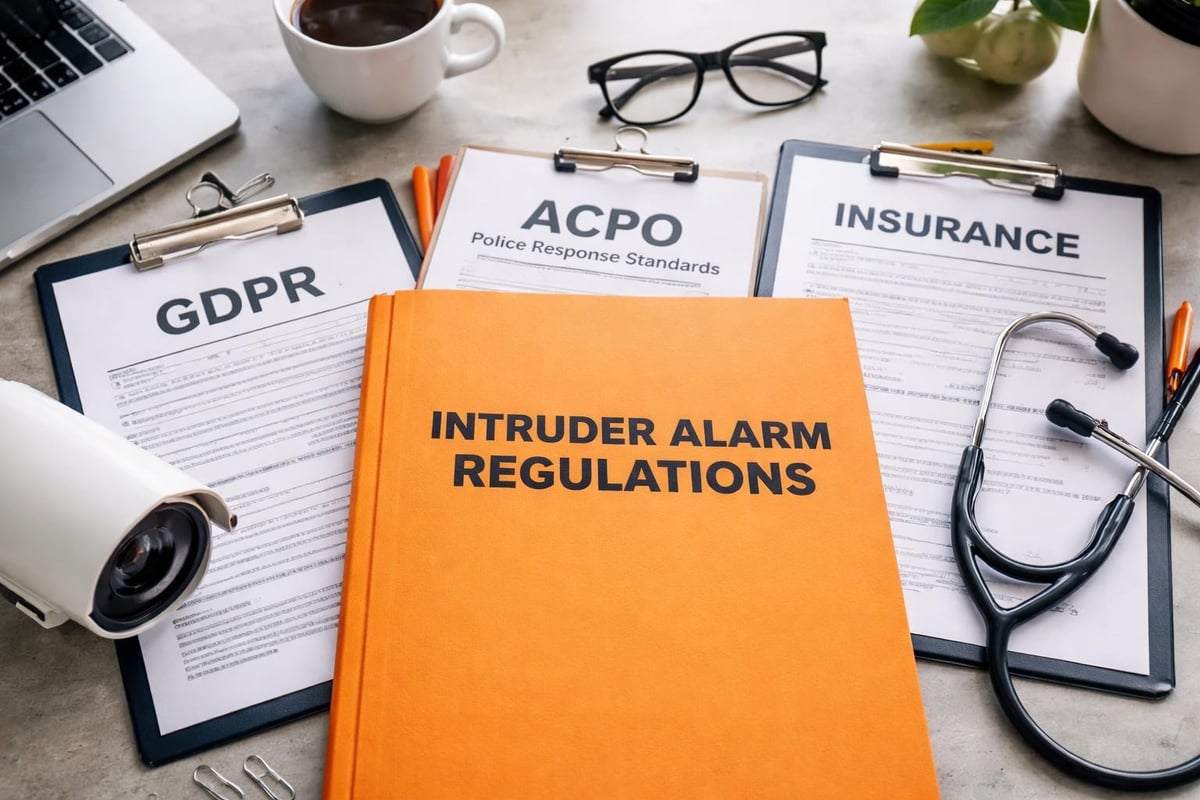
Commercial intruder alarm monitoring intersects with numerous regulatory frameworks that govern data protection, health and safety, and industry-specific security requirements. Organisations must ensure their monitoring arrangements comply with applicable regulations whilst protecting stakeholder interests.
GDPR and Data Protection
Monitoring services process personal data including keyholder contact information, access logs, and potentially video footage containing identifiable individuals. Your monitoring provider must demonstrate GDPR compliance through appropriate data processing agreements, security measures, and retention policies.
Ensure contracts clearly define data controller and processor responsibilities, specify data storage locations and durations, and establish protocols for data breach notification. Video verification services require particular attention to privacy considerations, especially where cameras may capture public spaces or neighbouring properties.
Industry-Specific Requirements
Certain sectors face additional security monitoring requirements. Financial institutions, healthcare facilities, and critical infrastructure operators often must comply with sector-specific regulations mandating particular security standards.
The differences between monitored and unmonitored systems become especially important in regulated industries where demonstrating adequate security controls affects operational licensing and customer trust.
Maintenance and System Reliability
Even the most sophisticated monitoring infrastructure fails to provide protection if the alarm system itself malfunctions or operates unreliably. Ongoing maintenance represents a critical component of effective intruder alarm monitoring, ensuring consistent performance and compliance with evolving standards.
Preventative Maintenance Programmes
Professional maintenance schedules typically include quarterly or bi-annual inspections covering all system components. Qualified engineers test detection devices, verify communication pathways, confirm backup power systems function correctly, and update software to address security vulnerabilities.
Regular maintenance identifies potential failures before they compromise security. Corroded connections, degraded sensors, and outdated firmware can prevent alarm signals from reaching monitoring centres, creating dangerous protection gaps. Alarm monitoring systems require consistent attention to maintain optimal performance.
Communication Path Testing
Monitoring effectiveness depends entirely on reliable signal transmission. Engineers should test all communication pathways during each maintenance visit, simulating alarm activations to verify signals reach the ARC successfully through primary and backup routes.
Many modern systems include automatic path testing features that periodically transmit test signals to monitoring centres without generating alarm activations. These automated tests provide continuous assurance that communication remains intact between scheduled maintenance visits.
False Alarm Management
False alarms represent one of the most significant challenges in intruder alarm monitoring, potentially leading to police response suspension, wasted resources, and reduced confidence in security systems. Effective false alarm management protects your police response privileges whilst maintaining operational efficiency.
Common False Alarm Causes
Understanding typical false alarm triggers enables businesses to implement preventative measures:
- User error – Staff forgetting codes or improper arming procedures
- Environmental factors – Balloons, moving banners, or temperature fluctuations triggering motion sensors
- Equipment malfunction – Failing sensors generating spurious activations
- Inadequate training – New employees unfamiliar with system operation
- Poor system design – Incorrectly positioned sensors or inappropriate detection devices
Professional monitoring centres track false alarm patterns and work with customers to identify underlying causes. Persistent false alarms may indicate the need for system reconfiguration, additional staff training, or equipment upgrades.
Verification Procedures
ARCs employ multiple verification techniques to distinguish genuine intrusions from false activations before requesting police response. Sequential alarm verification requires sensors in multiple zones to activate within a specified timeframe, reducing single-sensor false alarms significantly.
Audio verification uses two-way communication devices installed on premises, allowing operators to listen for intrusion sounds and potentially communicate with intruders. Video verification provides visual confirmation, enabling operators to observe actual intrusion attempts rather than relying solely on sensor activations.
The advantages of a monitored intruder alarm system include sophisticated verification that balances rapid emergency response with false alarm reduction, maintaining police cooperation whilst ensuring genuine threats receive immediate attention.
Emerging Technologies in Alarm Monitoring
The intruder alarm monitoring sector continues evolving rapidly, with emerging technologies enhancing detection capabilities, reducing false alarms, and providing richer intelligence during security incidents. Forward-thinking businesses should understand these developments to future-proof their security investments.
Artificial Intelligence and Machine Learning
AI-powered analytics transform traditional motion detection by learning normal activity patterns and identifying genuinely suspicious behaviour. These systems distinguish between staff working late, cleaning crews following expected routes, and unauthorised intruders moving through restricted areas.
Machine learning algorithms analyse historical alarm data to predict equipment failures, recommend system optimisations, and identify security vulnerabilities based on activation patterns. This predictive capability enables proactive security management rather than reactive incident response.
Cloud-Based Monitoring Platforms
Cloud infrastructure enables real-time system management, remote configuration updates, and comprehensive reporting accessible from anywhere. Businesses can review alarm history, manage user permissions, and analyse security trends through intuitive web interfaces without requiring on-site technical expertise.
Cloud platforms facilitate seamless integration with other business systems, enabling security data to flow into building management systems, health and safety reporting tools, and operational dashboards. This integration provides holistic visibility into how security events impact broader business operations.
Mobile Technology Integration
Modern monitoring services extend beyond traditional ARC operations to include mobile applications that keep stakeholders informed during security incidents. Designated personnel receive push notifications immediately when alarms activate, view live camera feeds, and communicate directly with monitoring operators through smartphone apps.
Mobile integration proves particularly valuable for businesses with multiple locations, enabling security managers to oversee entire property portfolios from single interfaces. Regional managers can respond to incidents at any site without physical presence, coordinating with local teams and monitoring operators efficiently.
Keyholder Management and Response Protocols
Effective intruder alarm monitoring depends critically on well-organised keyholder arrangements and clearly documented response protocols. Poor keyholder management represents a common failure point that undermines otherwise excellent monitoring services.
Keyholder Requirements and Responsibilities
Police response eligibility requires nominating approved keyholders who can attend premises within 20 minutes of notification. Most monitoring contracts require minimum two keyholders with at least one available outside normal business hours.
Keyholders accept specific responsibilities:
- Maintaining accessibility – Ensuring monitoring centres can contact them via multiple methods
- Timely attendance – Responding to callouts within specified timeframes
- System knowledge – Understanding alarm operation sufficiently to assess situations
- Security awareness – Following proper procedures when attending activated alarms
- Communication – Liaising effectively with monitoring operators and emergency services
Commercial security systems function optimally when supported by competent, well-trained keyholders who understand their critical role in the security ecosystem.
Response Procedure Documentation
Comprehensive response procedures document exactly how monitoring centres should handle various activation scenarios. Well-documented procedures specify:
- Contact cascade sequences defining who receives notifications in what order
- Verification questions keyholders must answer correctly
- Specific actions required for different alarm types or zones
- Escalation protocols when primary keyholders prove unavailable
- Special instructions for high-security areas or sensitive operations
Regular reviews ensure procedures remain current as personnel change, business operations evolve, and security requirements develop. Annual procedure audits identify gaps, update contact information, and reinforce keyholder responsibilities.
Multi-Site Monitoring Solutions
Organisations operating across multiple locations face unique challenges coordinating security monitoring whilst maintaining consistent protection standards and centralised oversight. Purpose-designed multi-site solutions address these complexities through unified platforms and standardised protocols.
Centralised Monitoring Dashboards
Multi-site monitoring platforms aggregate data from all locations into single dashboards, providing security managers with comprehensive visibility across entire property portfolios. These systems highlight locations experiencing unusual alarm activity, identify sites with maintenance requirements, and compare security performance metrics between facilities.
Centralised management enables consistent security policies applied uniformly across all sites whilst accommodating location-specific requirements. National retailers might enforce standard opening and closing procedures whilst allowing individual stores to customise zone configurations based on unique layouts.
Standardisation Benefits
Implementing consistent monitoring arrangements across multiple sites delivers significant operational advantages. Staff transferring between locations encounter familiar systems and procedures, reducing training requirements and minimising user errors that generate false alarms.
Standardised equipment simplifies maintenance planning, spare parts inventory management, and technician training. When monitoring centres handle multiple sites with identical systems, operators develop deep familiarity with configurations, accelerating incident response and improving verification accuracy.
Professional intruder alarm monitoring transforms basic detection systems into comprehensive security solutions that protect commercial premises around the clock, reduce operational risks, and ensure rapid response to genuine threats. By understanding available monitoring options, integration opportunities, and compliance requirements, businesses can implement security arrangements that deliver measurable protection whilst supporting broader operational objectives. Logic Fire and Security provides comprehensive monitoring solutions tailored to commercial requirements, combining advanced detection technology with professional monitoring services that keep UK businesses secure and compliant. Our expert team designs, installs, and maintains integrated security systems backed by accredited monitoring centres, ensuring your premises receive the protection they deserve.