

Fire alarm commissioning is the structured test regime that verifies every device, circuit, and fault condition in your fire detection system works exactly as designed-before you accept handover and responsibility. It is not a courtesy visit or a quick demonstration; it is a documented process governed by BS 5839-1 clauses 39 and 40, producing a certificate that proves the system met acceptance criteria on a specific date. For facilities managers and responsible persons, understanding what commissioning delivers-and what it does not-is essential before signing off on a new or modified installation.
Fire Alarm Commissioning Is a Test Regime, Not a Visit
Many organisations treat commissioning as a formality: the contractor arrives, demonstrates a few devices, and hands over a certificate. In reality, fire alarm commissioning is a methodical validation of every component, zone, and operational scenario defined in the system design.
What Commissioning Actually Covers
Under BS 5839-1, commissioning includes:
- Device activation testing: Every detector, manual call point, and input device is triggered individually to confirm correct zone indication at the panel and central monitoring station.
- Output verification: All sounders, visual indicators, door releases, damper controls, and ancillary outputs activate on cue and meet specification.
- Fault simulation: Power interruptions, open circuits, short circuits, and device removals are simulated to verify fault indication and system resilience.
- Standby supply testing: Battery autonomy is measured under alarm load; recharge performance is documented.
This regime applies equally to commercial fire alarm monitoring installations and standalone systems. No device is left untested; no assumption is accepted without evidence.
Duration and Resource Requirements
A thorough commissioning session for a medium-sized commercial building typically spans several days. Larger sites or phased handovers may require weeks of scheduled testing outside operational hours. The contractor must provide:
- Qualified commissioning engineers (often third-party witnesses for sensitive sites)
- Calibrated test equipment (sound meters, current measurement, battery load testers)
- Detailed test scripts cross-referenced to the design drawings
- Documented results for every test point
Rushing commissioning to meet an arbitrary handover date invariably leads to defects discovered during the first fire alarm servicing visit or, worse, a failed AHJ inspection.
Documents Due at Handover
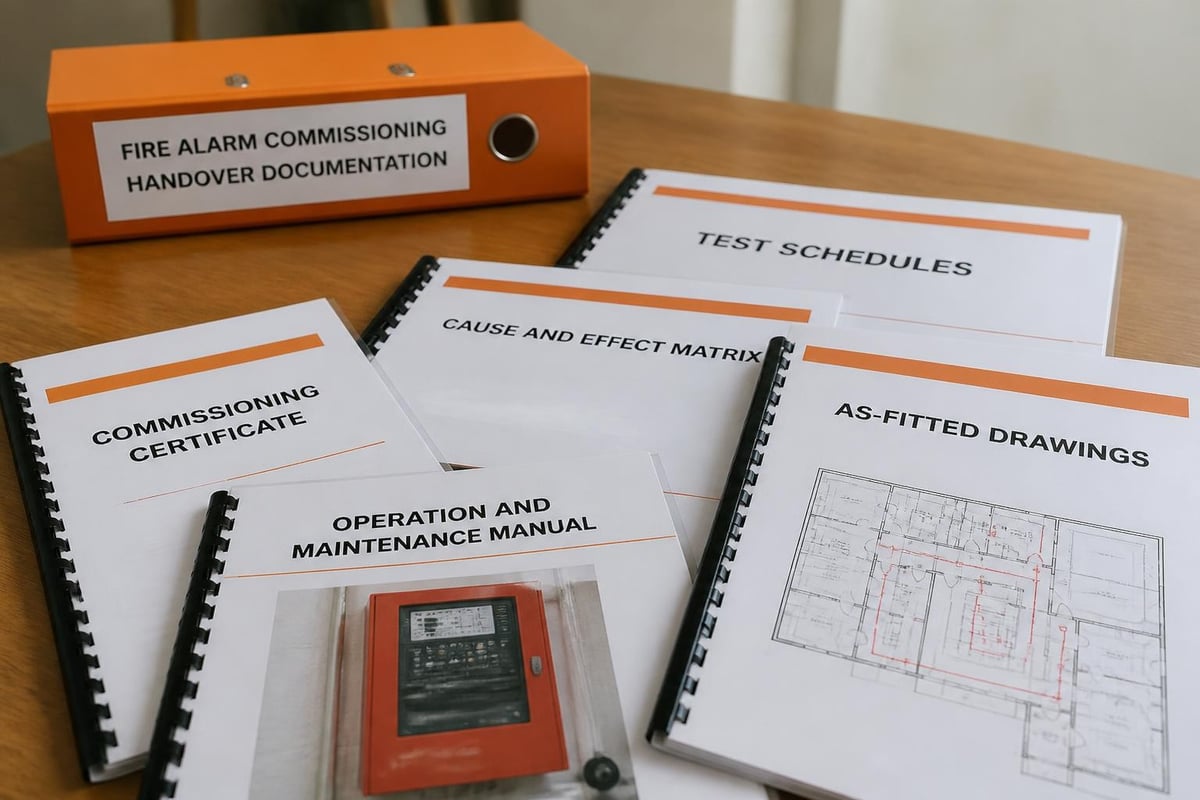
The commissioning process culminates in a handover pack. This is not a single certificate; it is a comprehensive dossier that enables you to operate, maintain, and audit the system throughout its life.
Essential Documentation
| Document | Purpose | Retention Requirement |
|---|---|---|
| Commissioning certificate (BAFE SP203-1 or equivalent) | Confirms acceptance tests passed; dated and signed by competent person | Permanent (building file) |
| Test results schedule | Itemises every device tested, pass/fail status, and readings (sound pressure, current draw) | Permanent |
| Cause and effect matrix | Maps each input to its intended outputs (zone logic, ancillary controls) | Permanent (referenced during every service visit) |
| As-fitted drawings | Floor plans showing final device locations, cable routes, zone boundaries | Permanent (updated after alterations) |
| Operation and maintenance (O&M) manual | System-specific procedures, manufacturer data sheets, recommended service intervals | Permanent |
| Design compliance statement | Declaration that the installation meets BS 5839-1, building regulations, and risk assessment | Permanent |
The Guide to the changes in BS 5839‑1:2025 introduces stricter requirements for O&M manuals, including mandatory system-specific content and clearer documentation of design deviations.
What to Check Before Accepting the Pack
- Completeness: Do the test schedules account for every device shown on the as-fitted drawings?
- Signatures and dates: Are all certificates signed by named individuals with stated competencies (e.g., BAFE-registered engineers)?
- Traceability: Can you cross-reference a failed test result to a remediation entry and retest confirmation?
- Digital formats: For larger systems, are test results provided in searchable, editable formats (not scanned PDFs of handwritten notes)?
Missing or incomplete documentation complicates future compliance audits, insurance renewals, and fault diagnosis.
Cause and Effect Testing
Cause and effect (C&E) testing validates the system's programmed logic: when detector A activates, outputs X, Y, and Z must respond within defined timescales. This is where design intent meets real-world performance.
Matrix Structure and Complexity
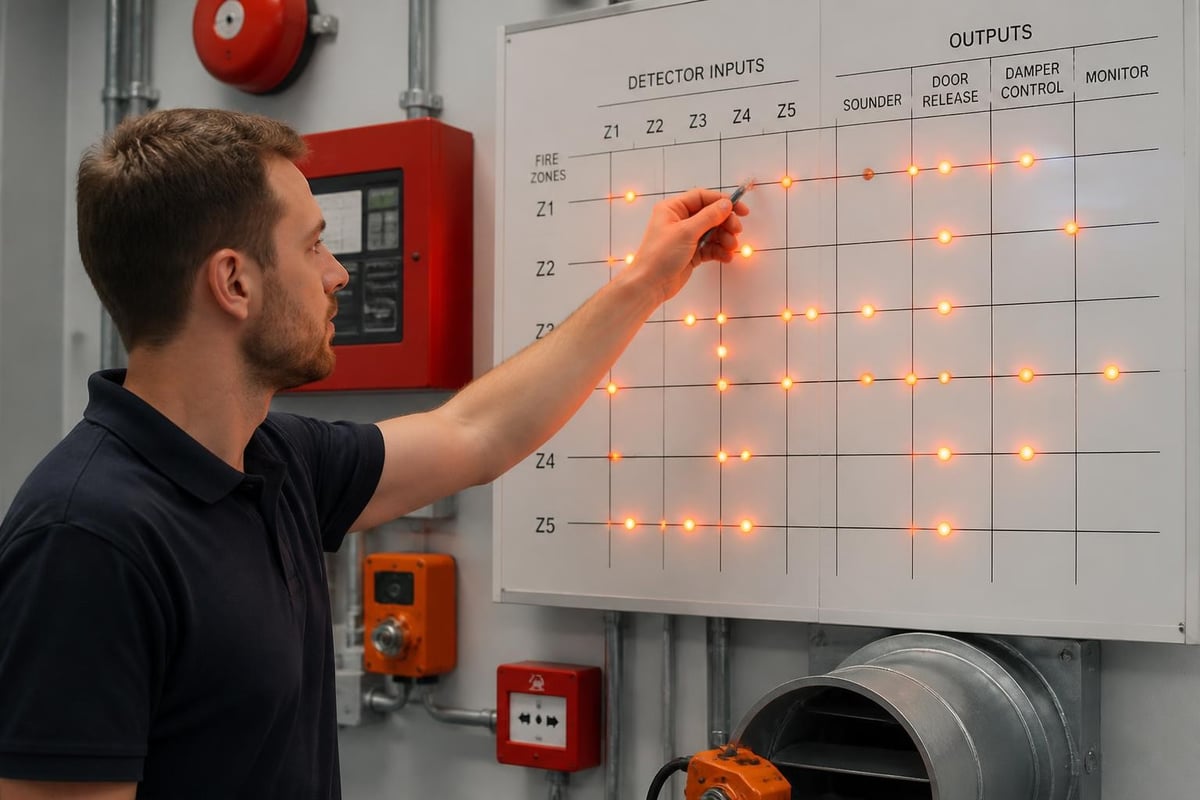
A C&E matrix lists every input device (detectors, call points, beam detectors, interface modules) down the left column and every output (sounders, relays, door releases, HVAC controls, monitoring signals) across the top. Each cell defines the expected response:
- Immediate alarm: Sounders activate within 3 seconds; visual indicators flash.
- Delayed alarm: First-stage alert for investigation areas; full evacuation after confirmation or timeout.
- Ancillary actions: Fire doors release, dampers close, air-handling units shut down, lifts recall to ground floor.
- No action: Detectors in non-critical zones may trigger local indication only, pending operator confirmation.
Testing involves isolating each input, activating it, and confirming every specified output operates correctly. For a 200-device system, this means 200 individual tests, each with multiple checkpoint verifications.
Common Errors Found During C&E Testing
- Cross-zone activation: Detector in Zone 3 triggers outputs assigned to Zone 5 (programming error).
- Missing outputs: Door release or damper control specified in design but not wired or programmed.
- Timing violations: Delayed alarms activate immediately, or immediate alarms suffer unexplained lag.
- Monitoring signal failures: Alarm transmission to the commercial alarm monitoring centre omits critical fault or supervisory signals.
Each error must be rectified and the affected tests repeated. The final C&E matrix, signed off by the commissioning engineer, becomes the reference for all future testing and alterations.
Sound Pressure, Audibility, and Voice Intelligibility
BS 5839-1 mandates minimum sound levels to ensure occupants hear the alarm wherever they are. Commissioning must prove compliance through measurement, not assumption.
The 65dB Requirement
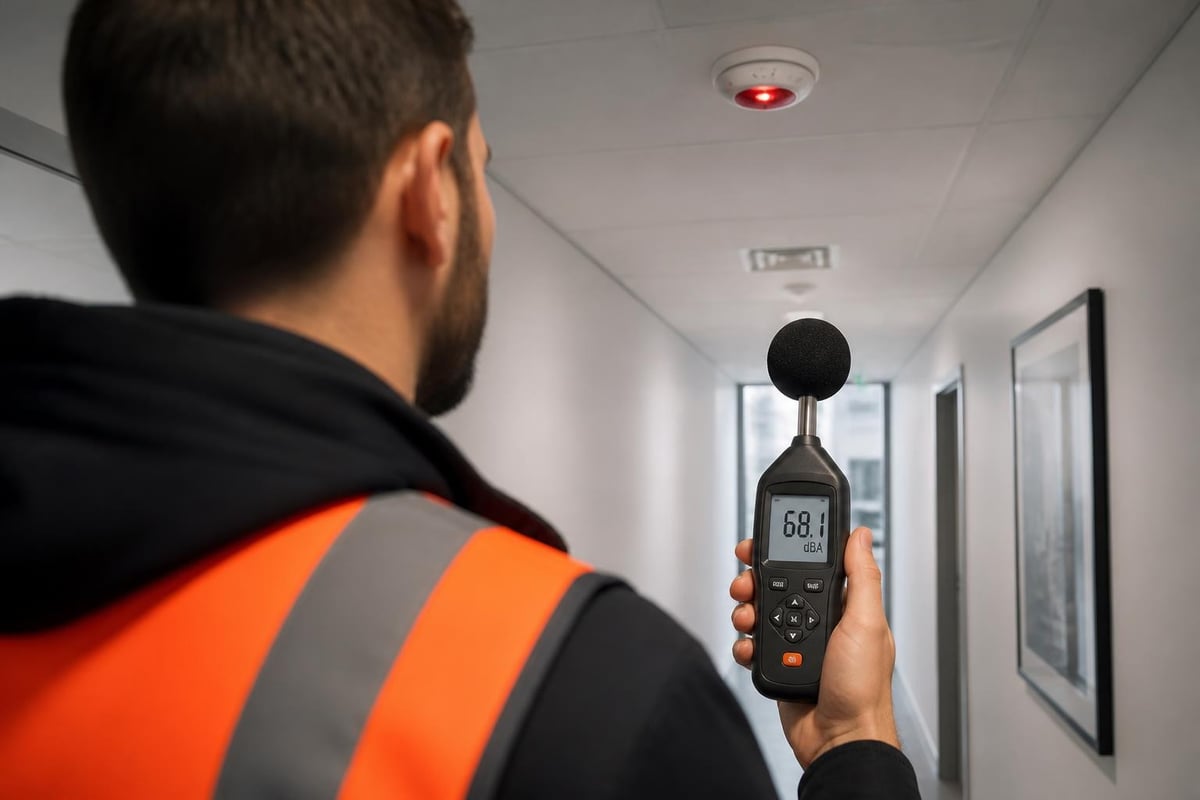
Fire alarm sounders must achieve 65 dB(A) at every point where people may be present, measured 1.5 metres above floor level. In areas of high ambient noise (plant rooms, workshops, kitchens), the alarm must exceed background noise by at least 5 dB(A). For sleeping accommodation, 75 dB(A) at the bedhead is required.
Commissioning engineers measure sound pressure using calibrated Class 1 sound-level meters at prescribed grid points across each room and corridor. The test schedule records:
- Location of each measurement point
- Background noise level (dB(A))
- Alarm sound level (dB(A))
- Pass/fail status against the applicable criterion
Voice Alarm Systems
For voice evacuation systems (VA), intelligibility is critical. The Common Intelligibility Scale (CIS) or Speech Transmission Index (STI) must be measured to confirm that pre-recorded or live messages are understandable above background noise and reverberation. Targets vary by building type:
- 0.5 CIS minimum for general commercial premises
- 0.6 CIS for large public assembly venues
- 0.7 CIS for high-risk or complex evacuation scenarios
Testing uses acoustic test signals and specialist meters. Poor intelligibility-caused by incorrect speaker placement, inadequate power, or excessive reverberation-requires additional speakers or acoustic treatment.
What Happens If Sound Levels Fail
Failures typically arise from:
- Insufficient sounder coverage (gaps in the design)
- Faulty or misprogrammed sounders
- Unexpected attenuation (heavy curtains, acoustic tiles, open-plan reconfiguration)
Remediation may involve adding devices, repositioning existing sounders, or increasing output levels. All new or relocated devices must be retested and the updated layout recorded on the as-fitted drawings.
What the Certificate Does and Does Not Certify
The commissioning certificate is a snapshot, not a perpetual guarantee. Understanding its limitations prevents false confidence.
What the Certificate Confirms
- On the stated date, the system passed acceptance tests as witnessed by the named engineer.
- All devices responded correctly to test stimuli.
- Sound levels, battery autonomy, and fault responses met BS 5839-1 criteria.
- Documentation was complete and accurate at handover.
The certificate does not confirm:
- Ongoing reliability (systems degrade; detectors drift; batteries age).
- Suitability for future changes in building use or layout.
- Compliance with other standards (building regulations, insurance conditions, DSEAR, COMAH).
- That the original design was optimal for the assessed risk.
Certification Bodies and Third-Party Validation
BAFE SP203-1 is the recognised third-party certification scheme for fire alarm installers in the UK. A BAFE-registered contractor commits to independent audits, competency verification, and standardised documentation. Certificates issued by BAFE-registered firms carry greater weight with insurers, building control, and fire authorities.
For high-risk sites (hospitals, high-rise residential, heritage buildings), specifying third-party witness testing-where an independent engineer observes and countersigns commissioning-adds an additional layer of assurance.
| Aspect | Self-Certified Installation | BAFE-Registered Contractor | Third-Party Witnessed |
|---|---|---|---|
| Design review | Contractor self-assessment | Independent audit of design | Independent design review pre-installation |
| Competency verification | Contractor's own records | Annual BAFE audit | Named CxA with documented qualifications |
| Documentation standards | Variable | BAFE SP203-1 templates | Aligned with ICC G4 commissioning guidance |
| Insurer acceptance | May require additional evidence | Widely accepted | Preferred for complex risks |
Common Failures Found at First Audit
The first independent audit or service visit often reveals defects missed or glossed over during commissioning. Recognising these patterns helps you challenge incomplete handovers.
Typical Defects
- Untested devices: Remote detectors (roof voids, riser shafts) marked "tested" without evidence.
- Incomplete C&E validation: Matrix provided but cross-checks reveal outputs not actually verified.
- Insufficient documentation: As-fitted drawings show original design, not post-installation changes.
- Battery issues: Standby duration passes initial test but rapid degradation suggests poor-quality cells or incorrect charger settings.
- Zoning errors: Floor plans mislabel zones; service engineer cannot correlate panel indications to physical locations.
Why Failures Occur
Time pressure, inadequate supervision, and cost-cutting all contribute. Commissioning is labour-intensive; shortcuts are tempting. However, the consequences-failed inspections, insurance disputes, delayed occupancy-dwarf the cost of thorough testing.
The NIST Building Fire Safety Evaluation programme has documented numerous case studies where inadequate commissioning led to detector failures in real fire scenarios, underscoring the life-safety stakes.
How to Minimise Risk
- Specify witness testing: Require your own representative (or independent consultant) to observe random sample tests.
- Request interim reports: For phased installations, review test schedules after each phase rather than waiting for final handover.
- Benchmark against similar projects: If a comparable building took five days to commission, question a contractor who claims two days suffices.
- Engage early: Involve your maintenance provider before handover; their input identifies practical concerns (access, labelling, spares) while remediation is easiest.
What to Ask Before Signing
Accepting commissioning transfers responsibility. These questions protect your interests and ensure the system is genuinely ready for operational life.
Pre-Handover Checklist
1. Has every device been individually tested?
Ask to see the test schedule. Count entries against the as-fitted drawing device count. Query any discrepancies.
2. Are all test results within specification?
Look for marginal passes (e.g., 65.2 dB(A) where 65 dB(A) is required). Confirm that values have headroom for future degradation.
3. Has the cause and effect matrix been fully validated?
Cross-reference matrix entries against actual test records. Ensure ancillary outputs (doors, dampers, HVAC) were physically observed, not just indicated on the panel.
4. Are sound pressure measurements representative?
Check that measurements include worst-case locations (furthest from sounders, high ambient noise). For phased occupancy, confirm tests occurred in representative conditions (not an empty shell).
5. Is the documentation complete and correct?
Verify serial numbers on certificates match panel labels. Ensure O&M manual is system-specific, not generic manufacturer literature.
6. What is the warranty and call-out arrangement?
Clarify response times for faults, warranty period, and transition to routine servicing. Ensure contact details and escalation procedures are documented.
7. Have building occupants been briefed?
Commissioning should include an operational demonstration for your team: how to silence alarms, reset the panel, interpret fault codes, and contact support.
Conditional Acceptance and Snagging
If defects are identified, consider conditional acceptance: sign off the majority of the system but retain a portion of the contract sum pending rectification of specific items within an agreed timeframe. Document the snagging list clearly and obtain confirmation when items are closed out.
For critical systems-particularly those linked to fire alarm installation and commissioning for high-occupancy or high-risk buildings-do not feel pressured to accept a substandard handover. The certificate you sign is evidence of your due diligence; a qualified acceptance is better than an uninformed one.
Regulatory and Insurance Implications
Authorities Having Jurisdiction (AHJ) such as local fire authorities and building control may conduct their own acceptance inspections, particularly for licensed premises, high-rise buildings, and places of assembly. Their requirements often align with BS 5839-1 but may include additional tests or documentation. For example, Fairfax County fire acceptance testing protocols specify pre-test submissions, witnessed inspections, and detailed reporting similar to UK practice.
Insurers rely on your commissioning certificate as proof of initial compliance. A certificate riddled with caveats or missing supporting documents may trigger premium loading or coverage exclusions. Conversely, comprehensive documentation from a BAFE-registered contractor strengthens your negotiating position.
Understanding Commissioning Scope for System Modifications
Fire alarm systems evolve. Extensions, panel replacements, and detector upgrades each require recommissioning-not just of new devices, but also verification that existing devices still interact correctly.
Partial vs. Full Recommissioning
- Minor changes (individual detector replacement, like-for-like): Test the new device and verify correct zone indication. Update test records and as-fitted drawings.
- Zone additions or cause-and-effect changes: Recommission all affected zones, retest all outputs triggered by the modified logic, and update the C&E matrix.
- Panel replacement or system integration: Full recommissioning of the entire system. The new panel's programming may not replicate the old logic perfectly; every device and output must be revalidated.
BS 5839-1 clause 40 requires that modifications are commissioned to the same standard as new installations. Cutting corners during upgrades stores up problems: the next fire alarm servicing visit reveals inconsistencies, or worse, a real incident exposes non-functional outputs.
Documentation Updates
Every modification must be reflected in the as-fitted drawings, O&M manual, and test schedule. The date and nature of the change should be recorded, creating an audit trail that future engineers can follow. This discipline is especially critical for multi-site organisations where records management is decentralised.
Fire alarm commissioning transforms a collection of devices into a proven life-safety system. It is not a rubber-stamp exercise but a rigorous validation of design, installation quality, and operational readiness. The certificate and documentation you receive at handover enable you to operate the system confidently, demonstrate compliance to regulators and insurers, and maintain performance throughout the system's lifecycle. For comprehensive fire alarm installation and commissioning services backed by third-party certification and a commitment to thorough documentation, Logic Fire and Security supports businesses across the UK in achieving and maintaining the highest standards of fire safety compliance.