

Modern commercial buildings demand sophisticated security solutions that balance protection with operational efficiency. Door entry systems have evolved from simple lock-and-key mechanisms into intelligent access control platforms that serve as the first line of defence for businesses across the UK. These systems not only regulate who enters a premises but also provide comprehensive audit trails, integrate with wider security infrastructure, and ensure compliance with current regulations. For organisations seeking to protect their assets, staff, and visitors, understanding the capabilities and considerations of contemporary door entry technology is essential.
Understanding Modern Door Entry Technology
Door entry systems comprise multiple components working in harmony to control, monitor, and record access to buildings and restricted areas. At their core, these solutions combine authentication methods, electronic locking mechanisms, control panels, and management software to create a cohesive security environment.
The fundamental architecture includes credential readers positioned at entry points, electromagnetic or electromechanical locks that secure the doors, a central controller that processes authentication requests, and power supplies that ensure continuous operation. Modern systems often incorporate access control entry systems that extend beyond basic door management to include time-and-attendance tracking, visitor management, and integration with fire alarm systems.
Authentication Methods and Technologies
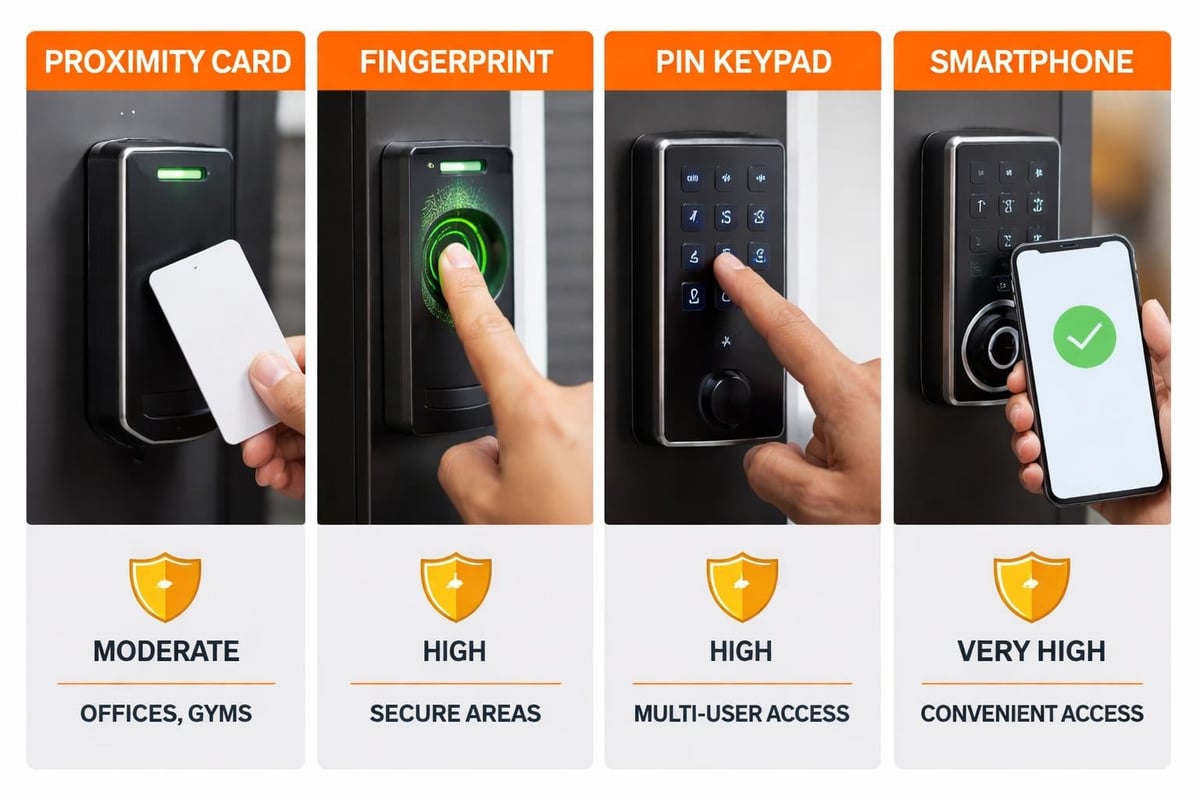
Contemporary door entry solutions support multiple authentication technologies, each offering different balances of security, convenience, and cost:
- Proximity cards and key fobs utilise RFID technology for quick, contactless access
- Biometric readers verify fingerprints, facial features, or iris patterns for enhanced security
- PIN keypads provide a code-based option that doesn't require physical credentials
- Smartphone credentials leverage Bluetooth or NFC technology through mobile applications
- Multi-factor authentication combines two or more methods for maximum protection
The selection of authentication technology depends on the security requirements, user volume, and environmental conditions of each facility. High-security areas often employ biometric verification or multi-factor approaches, whilst general office spaces may rely on proximity cards for efficiency and ease of management.
Integration With Comprehensive Security Systems
Door entry systems deliver maximum value when integrated with broader commercial security systems rather than operating in isolation. This integration creates a unified security ecosystem where different components share information and coordinate responses to events.
CCTV and Video Verification
Combining door entry with video surveillance enables visual verification of access events. When someone presents credentials at a door, the system can automatically trigger cameras to record the entry, creating visual confirmation alongside the electronic audit trail. This proves particularly valuable for investigating security incidents or verifying that the person using credentials is the authorised holder.
Video intercom functionality extends this capability by allowing security personnel or receptionists to visually verify visitors before granting access. Modern IP-based systems deliver high-definition video to central monitoring stations or even mobile devices, enabling remote access management.
| Integration Type | Primary Benefit | Typical Application |
|---|---|---|
| CCTV Linkage | Visual verification of access events | Corporate lobbies, secure facilities |
| Intruder Alarms | Coordinated arming/disarming | Office buildings, warehouses |
| Fire Systems | Automatic door release during evacuation | Multi-storey buildings, schools |
| Building Management | Centralised control and monitoring | Large campuses, commercial complexes |
Fire Safety Coordination
Integration between door entry and fire detection systems is not merely beneficial but often mandatory under UK regulations. Fire safety requirements dictate that electronically secured doors must release automatically upon fire alarm activation, ensuring clear evacuation routes. This integration must be designed carefully to maintain security whilst prioritising life safety.
Fire alarm system integration ensures that during an emergency, all access-controlled doors unlock whilst simultaneously logging this override event. Once the alarm is cleared, the system can automatically restore normal access control operation, eliminating manual intervention and potential security gaps.
Compliance and Regulatory Considerations
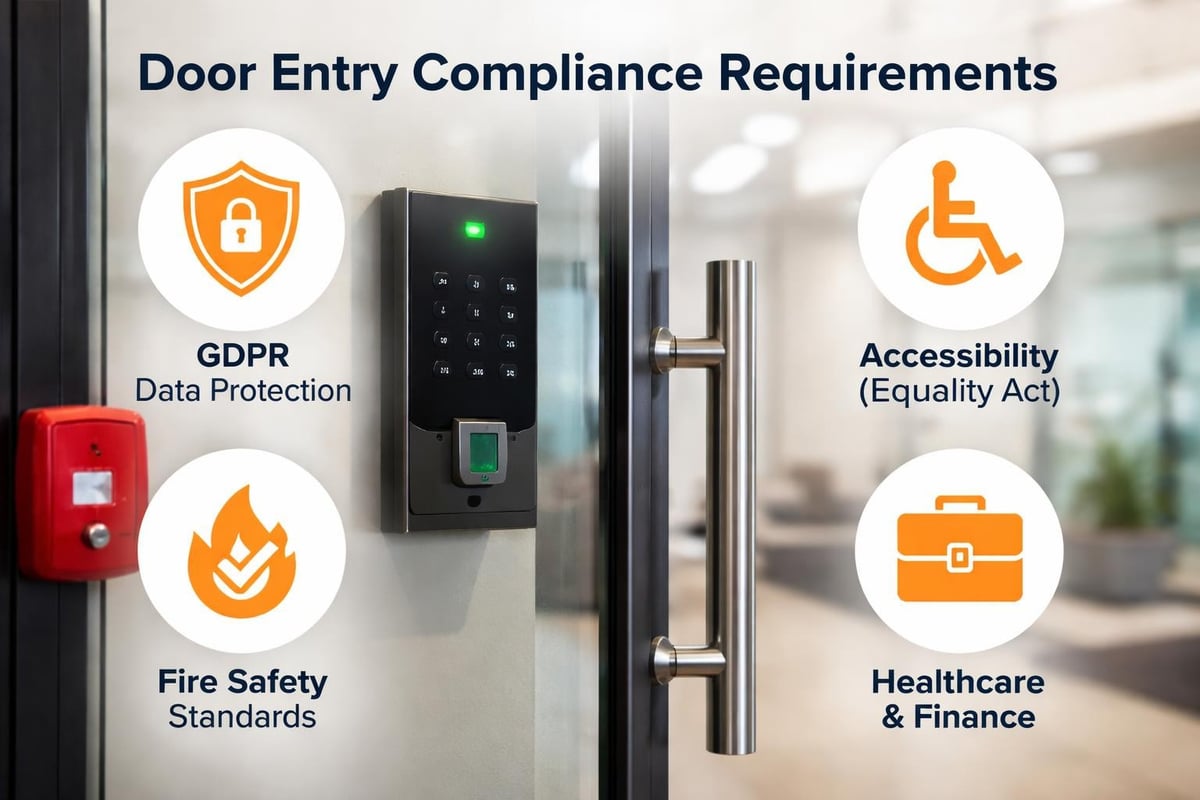
UK businesses must navigate numerous regulations and standards when implementing door entry systems. Compliance requirements span data protection, disability access, fire safety, and industry-specific mandates.
The Equality Act 2010 requires that access control systems do not discriminate against disabled individuals. This means door entry solutions must consider various accessibility needs, including:
- Accessible credential readers positioned at appropriate heights
- Audio assistance for visually impaired users
- Extended access times for those with mobility challenges
- Alternative authentication methods for individuals unable to use biometric systems
Data protection obligations under the UK GDPR significantly impact door entry system operation. Access logs constitute personal data, requiring organisations to establish lawful bases for processing, implement appropriate security measures, and define retention periods. Biometric data receives special protection as sensitive personal information, demanding enhanced justification and safeguards.
Industry-Specific Standards
Beyond general regulations, certain sectors face additional compliance requirements. Healthcare facilities must adhere to NHS standards for access control, ensuring patient confidentiality whilst enabling emergency access when needed. Financial institutions follow stricter authentication requirements and audit trail mandates. Understanding access control principles helps organisations align their door entry systems with both general and sector-specific obligations.
Educational institutions balance security with the need for rapid evacuation, requiring door entry systems that integrate seamlessly with fire safety protocols. The Standards for Alarm Systems, Installation, and Monitoring provide frameworks that ensure reliable operation across various environments.
System Design and Implementation
Effective door entry system design begins with thorough security assessment and operational requirement analysis. This process identifies which doors require access control, who needs access to specific areas, and what level of security each zone demands.
Zoning and Access Hierarchies
Well-designed systems employ zoning strategies that divide facilities into areas with different security levels. This might include:
- Public zones accessible to all visitors during business hours
- General staff areas requiring basic employee credentials
- Restricted departments limited to specific personnel groups
- High-security zones demanding enhanced authentication or multi-factor access
- Emergency-only exits that permit egress but prevent entry
Access hierarchies define which user groups can enter which zones, with permissions often tied to job roles, departments, or temporary requirements. Modern systems enable time-based access rules, automatically adjusting permissions based on schedules, ensuring that contractors or temporary staff only gain access during their assigned periods.
Network Architecture and Reliability
Contemporary door entry systems typically utilise IP-based networking, connecting controllers, readers, and management software through standard network infrastructure. This approach offers several advantages but requires careful planning to ensure reliability and security.
Network design considerations include:
- Segregated VLANs to isolate access control traffic from general business networks
- Redundant communication paths to maintain operation during network failures
- Local controller intelligence allowing continued operation if network connectivity is lost
- Encrypted communication channels protecting credential data from interception
- Regular firmware updates addressing security vulnerabilities
Power supply redundancy proves equally critical, with uninterruptible power supplies (UPS) ensuring that door entry systems remain operational during electrical failures. This becomes particularly important for life safety integration, where power loss must not compromise evacuation capabilities.
User Management and Administrative Control
The administrative capabilities of door entry systems determine how effectively organisations can manage credentials, monitor activity, and respond to security events. Modern platforms provide web-based or cloud-hosted interfaces that enable centralised management across multiple sites.
Credential Lifecycle Management
Managing user credentials throughout their lifecycle represents a significant operational consideration. The process encompasses:
Enrollment: Creating user profiles, issuing credentials, and assigning initial access permissions
Modification: Updating access rights as job roles change or temporary requirements emerge
Suspension: Temporarily disabling credentials without full deletion for leave or investigations
Revocation: Immediately removing access when employment ends or security is compromised
Audit: Regularly reviewing permissions to ensure they remain appropriate and necessary
Automated provisioning workflows can integrate with HR systems, automatically creating and revoking access based on employment status changes. This reduces administrative burden whilst eliminating security gaps caused by delayed credential management.
| User Type | Typical Access Duration | Management Approach | Security Level |
|---|---|---|---|
| Permanent Staff | Ongoing with periodic review | HR system integration | Standard authentication |
| Contractors | Project-specific timeframes | Scheduled expiration | Enhanced verification |
| Visitors | Single-day or short-term | Sponsor approval required | Escort or limited zones |
| Emergency Services | Permanent override capability | Master credentials | Highest authority |
Audit Trails and Reporting
Comprehensive logging capabilities transform door entry systems from simple access control into valuable business intelligence tools. Systems record every access attempt, whether successful or denied, creating detailed audit trails that support:
- Security investigations identifying unusual access patterns or unauthorised attempts
- Compliance reporting demonstrating adherence to regulatory requirements
- Operational insights revealing usage patterns that inform staffing or facility decisions
- Incident reconstruction providing timestamped evidence for internal or legal proceedings
Advanced systems employ analytics to identify anomalies, such as credentials used at unusual times or locations, multiple failed access attempts, or tailgating detection through integrated sensors. Alerts notify security personnel of these events in real-time, enabling prompt investigation and response.
Maintenance and Lifecycle Considerations
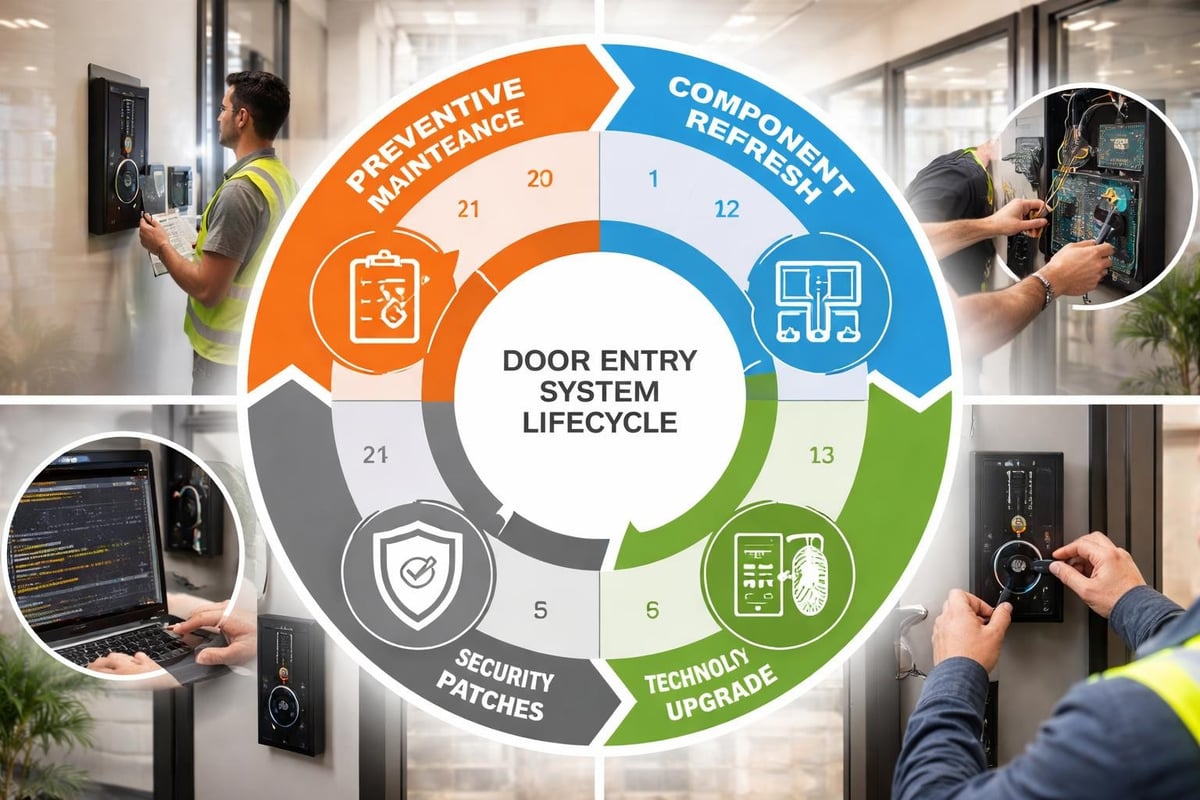
Door entry systems require ongoing maintenance to ensure reliable operation and sustained security effectiveness. Neglected systems become security vulnerabilities, with failed components creating unauthorised access opportunities or impeding legitimate users.
Preventive Maintenance Programmes
Regular maintenance schedules should address both hardware and software components:
- Monthly checks of door operation, lock engagement, and reader functionality
- Quarterly testing of battery backups and emergency release mechanisms
- Annual inspections of wiring integrity, controller operation, and system-wide testing
- Firmware updates applied promptly to address security vulnerabilities
- Software upgrades providing enhanced features and compatibility
Professional maintenance services ensure that trained technicians identify potential issues before they cause system failures. This proactive approach proves particularly important for organisations where access control failures could compromise safety or business continuity.
System Refresh and Technology Evolution
Door entry technology evolves rapidly, with new authentication methods, enhanced security features, and improved integration capabilities emerging regularly. Organisations should plan for system refresh cycles, typically spanning five to seven years for major components.
Planning considerations include:
Backwards compatibility with existing infrastructure, minimising replacement costs during phased upgrades. Door access control systems continue advancing with features like mobile credentials and cloud management platforms that offer enhanced flexibility.
Scalability to accommodate business growth without requiring complete system replacement. Migration paths that allow gradual transition to new technologies whilst maintaining operational continuity. Investment protection through vendor selection focused on long-term viability and ongoing support commitments.
Cloud-Based vs On-Premises Solutions
The decision between cloud-hosted and on-premises door entry systems significantly impacts cost structure, administrative requirements, and operational flexibility. Each approach offers distinct advantages suited to different organisational needs.
Cloud-based platforms deliver several compelling benefits. They eliminate on-site server requirements, reducing capital expenditure and IT infrastructure demands. Automatic updates ensure systems remain current with security patches and feature enhancements without manual intervention. Multi-site organisations particularly benefit from centralised management through a single interface, accessible from any location with internet connectivity.
However, cloud solutions introduce dependency on internet connectivity for management functions, though local controllers typically maintain operation during network disruptions. Data residency and privacy concerns require careful vendor evaluation to ensure compliance with UK data protection requirements.
On-premises systems provide complete data control, with all information remaining within the organisation's infrastructure. They offer independence from internet connectivity for core operation and potentially lower ongoing costs after initial capital investment. Organisations with stringent data sovereignty requirements or existing robust IT infrastructure often prefer this approach.
The hybrid model combines elements of both approaches, with local controllers ensuring continuous operation whilst cloud services provide management interfaces and advanced analytics. This architecture delivers reliability and flexibility, making it increasingly popular for medium to large organisations.
Future Developments in Door Entry Technology
The door entry sector continues evolving with emerging technologies that promise enhanced security, improved user experience, and deeper integration with smart building ecosystems. Understanding these trends helps organisations make forward-looking investment decisions.
Artificial intelligence and machine learning are transforming how systems identify threats and optimise operations. AI-powered analytics can detect sophisticated tailgating attempts, identify credential sharing, and predict maintenance requirements before failures occur. Facial recognition technology continues advancing, though deployment requires careful consideration of privacy implications and regulatory compliance.
Mobile credentials are rapidly displacing physical cards as the preferred authentication method. Smartphones offer convenient, secure access through encrypted Bluetooth or NFC communication, whilst eliminating card production and replacement costs. Users appreciate the convenience of accessing buildings with devices they already carry, and organisations benefit from remote credential management and instant revocation capabilities.
Touchless access technologies gained prominence following the COVID-19 pandemic and continue developing beyond health considerations. Gesture recognition, proximity detection, and automatic door opening enhance accessibility whilst reducing surface contact and wear on hardware components.
The convergence of door entry systems with broader building automation platforms creates opportunities for enhanced efficiency. Integration with HVAC, lighting, and occupancy monitoring systems enables buildings to respond intelligently to human presence, reducing energy consumption whilst improving user comfort. These building security compliance standards increasingly expect such integration as standard practice.
Selecting the Right Door Entry Solution
Choosing an appropriate door entry system requires balancing numerous factors including security requirements, budget constraints, operational needs, and future scalability. Organisations should approach this decision methodically, avoiding both over-engineered solutions that exceed requirements and inadequate systems that create security gaps.
Begin with comprehensive security assessment identifying specific threats, vulnerable entry points, and regulatory obligations. This foundation ensures that selected solutions address actual risks rather than perceived concerns. Consider the total cost of ownership spanning initial installation, ongoing maintenance, credential management, and eventual system replacement.
Vendor selection proves equally important as technology choice. Established providers with proven track records offer greater assurance of long-term support and product evolution. Evaluation criteria should include:
- Industry certifications demonstrating compliance with recognised security standards
- Reference sites where similar organisations successfully deployed the solutions
- Integration capabilities with existing security and building management systems
- Technical support availability and responsiveness during both installation and operation
- Training provisions ensuring staff can effectively manage and maintain systems
Professional consultation from experienced security integrators provides valuable perspective, helping organisations navigate technical complexities and avoid common implementation pitfalls. Specialists like those at Logic Fire and Security bring expertise across diverse industries and building types, ensuring solutions align with both immediate needs and long-term strategic objectives.
Door entry systems represent critical infrastructure that protects people, assets, and information whilst enabling efficient building operation. Modern solutions offer sophisticated capabilities that extend far beyond simple access control, integrating with fire safety systems, providing valuable operational insights, and adapting to evolving security threats. Whether you're upgrading existing systems or implementing access control for the first time, Logic Fire and Security brings decades of experience designing, installing, and maintaining comprehensive security solutions for businesses across the UK. Our team understands the unique challenges facing modern organisations and can help you select and deploy door entry systems that deliver lasting value and protection.