

Every day, thousands of UK businesses rely on commercial alarm monitoring services to safeguard their premises, protect valuable assets, and ensure rapid emergency response when seconds count. These services represent far more than simple alarm systems; they provide continuous oversight through professional central stations staffed around the clock, ready to verify threats and coordinate appropriate action. For organisations ranging from small enterprises to Blue Chip corporations, professional monitoring transforms passive security hardware into an active defence network capable of responding to fire, intrusion, environmental hazards, and system failures before minor incidents escalate into catastrophic events.
Understanding Commercial Alarm Monitoring Services
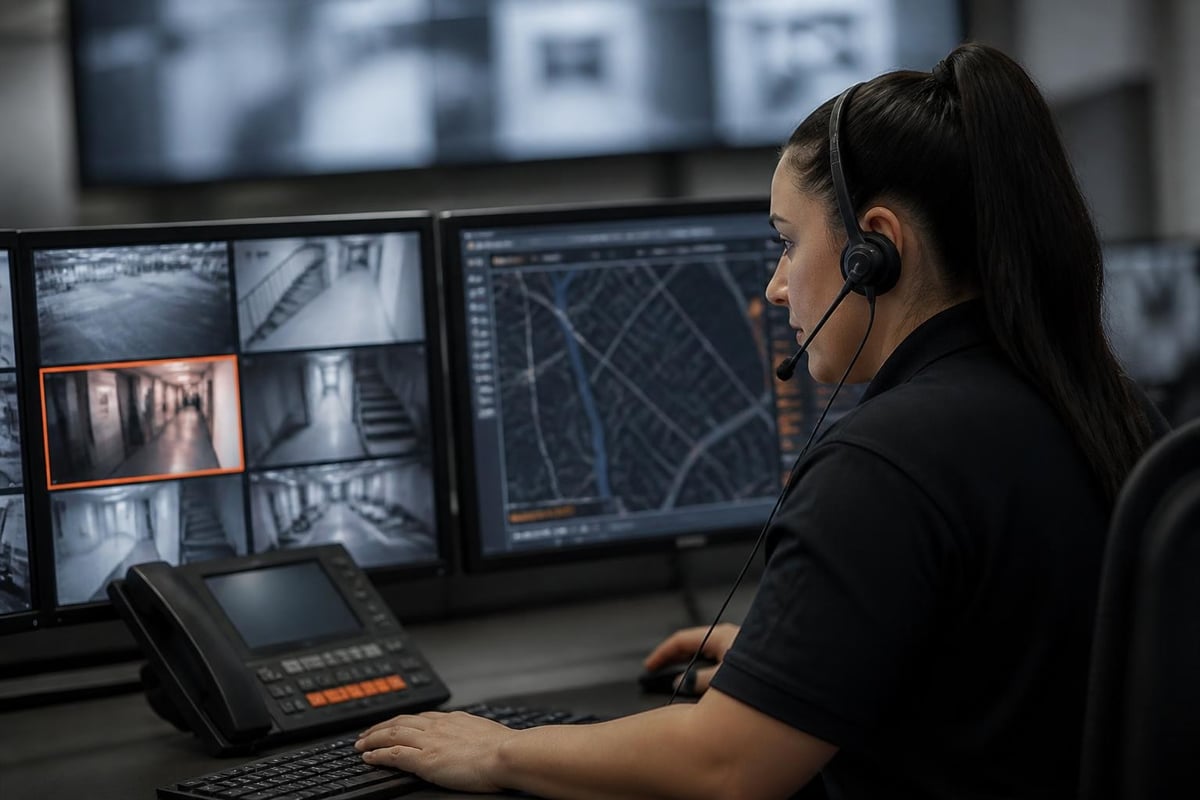
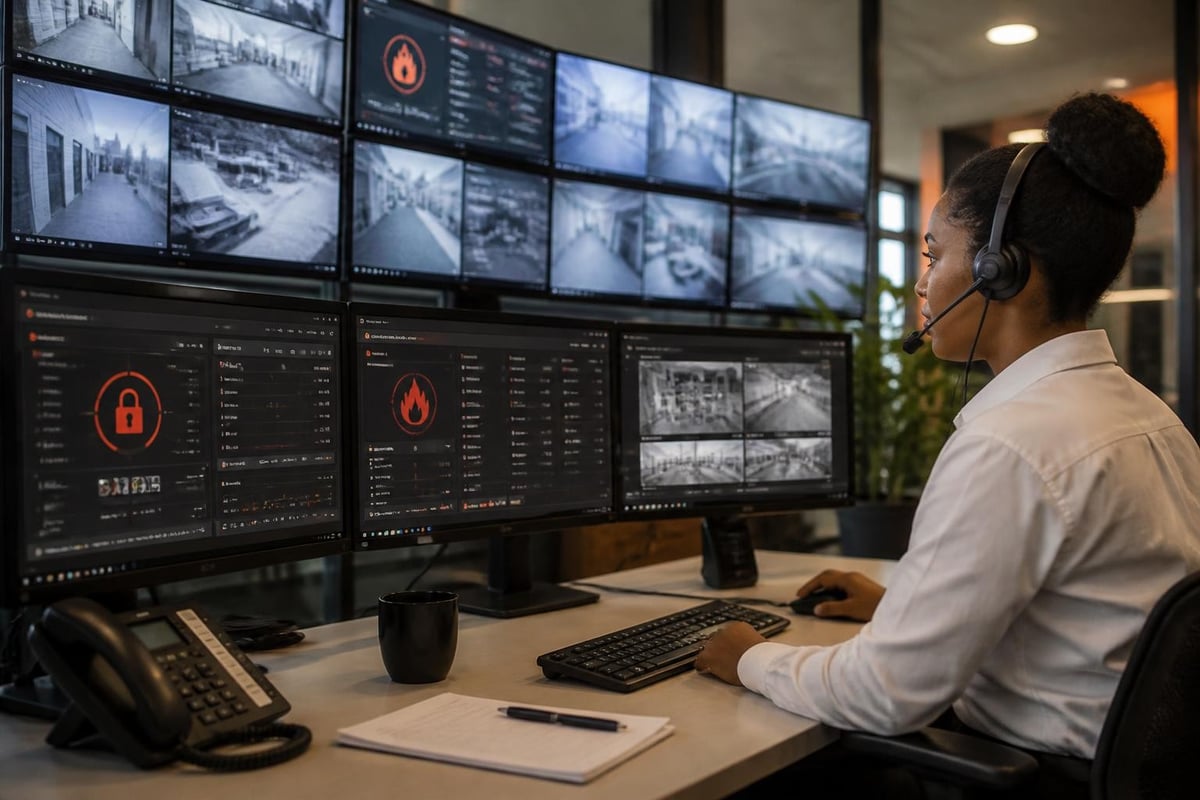
Commercial alarm monitoring services create a direct communication link between your premises and a certified monitoring centre that operates continuously. When an alarm activates, signals transmit immediately to trained operators who assess the situation, verify the threat, and initiate the appropriate response protocol. This might involve contacting designated keyholders, dispatching emergency services, or coordinating with on-site security personnel.
The distinction between commercial and residential monitoring lies primarily in complexity and consequence. Commercial environments typically feature multi-zone systems covering warehouses, offices, production facilities, and outdoor perimeters. They integrate commercial security systems with fire detection, access control, and video verification. The stakes are correspondingly higher: business continuity, employee safety, regulatory compliance, and substantial asset protection all depend on reliable monitoring.
The Central Station Model
Professional alarm monitoring centres, often called central stations, must meet rigorous certification standards. UL 827 certification establishes operational requirements for these facilities, including redundant communication paths, backup power systems, and strict operator training protocols. These standards ensure that monitoring centres remain operational even during regional emergencies or infrastructure failures.
A properly certified central station operates with multiple layers of redundancy:
- Geographic diversity: Primary and backup facilities in different regions
- Communication redundancy: Multiple signal paths (IP, cellular, radio)
- Power resilience: Battery backup and generator systems
- Staff continuity: Shift coverage ensuring 24/7/365 operation
- Procedural rigour: Documented response protocols for every alarm type
Key Components of Monitored Commercial Systems
Modern commercial alarm monitoring services integrate multiple detection technologies into a unified platform. Each component serves specific security or life-safety functions whilst feeding into the central monitoring infrastructure.
| System Type | Primary Function | Monitoring Benefit | Response Protocol |
|---|---|---|---|
| Fire detection | Life safety compliance | Immediate fire service notification | Evacuation and emergency dispatch |
| Intrusion alarms | Asset protection | Verified break-in response | Police/security response |
| Environmental sensors | Operational continuity | Flood, temperature alerts | Facilities/maintenance contact |
| Access control | Perimeter security | Unauthorised entry tracking | Security verification |
Fire and Life Safety Monitoring
Fire alarm monitoring represents the most critical element of commercial systems. When fire detection systems activate, every second matters. Monitoring operators immediately notify the fire brigade whilst simultaneously contacting designated personnel to initiate evacuation procedures and provide building access.
Advanced fire monitoring goes beyond simple alarm signals. Modern systems transmit device-specific information, indicating precisely which detector or zone triggered the alert. This granular data helps emergency responders navigate large facilities more efficiently. Some systems integrate with building automation to automatically shut down HVAC systems, activate smoke control measures, and release electromagnetic door holds on fire doors.
Intrusion and Access Monitoring
Commercial intruder alarm systems protect against unauthorised access through perimeter detection, internal motion sensors, and glass-break detectors. When monitoring operators receive an intrusion signal, they follow verification protocols before dispatching police or private security.
Video verification has transformed intrusion monitoring. Rather than relying solely on sensor signals, operators can view live or recorded footage to confirm genuine threats, dramatically reducing false alarm rates. This capability proves particularly valuable for police response, as verified alarms typically receive higher priority.
Access control monitoring tracks every entry and exit, flagging anomalies such as doors forced open, credentials used outside normal hours, or tailgating attempts. These systems create comprehensive audit trails essential for security investigations and compliance requirements.
Transmission Methods and Communication Resilience
The reliability of commercial alarm monitoring services depends fundamentally on maintaining robust communication between premises and central station. Modern systems employ multiple transmission paths to ensure signal integrity even when primary connections fail.
Primary transmission methods include:
- IP/Ethernet connectivity: High-speed, bidirectional communication supporting video and complex data
- Cellular backup: Automatic failover when hardwired connections drop
- Radio frequency: Independent path immune to internet or telecoms disruptions
- Dual-path reporting: Simultaneous transmission via two different methods
Communication redundancy addresses several vulnerability scenarios. Hardwired connections might be severed by construction accidents, weather events, or deliberate attack. Cellular networks can become saturated during regional emergencies. By maintaining multiple independent paths, systems ensure alarm signals reach monitoring operators regardless of infrastructure failures.
The CISA guidance on critical infrastructure security emphasises the importance of resilient communications for facilities that support essential services. For businesses operating critical infrastructure or holding sensitive data, communication path diversity becomes a compliance requirement as well as a security best practice.
Operational Technology Security Considerations
Commercial alarm monitoring systems increasingly fall within the operational technology (OT) domain, bridging traditional physical security and networked IT infrastructure. This convergence introduces both capabilities and vulnerabilities that organisations must address through proper security measures.
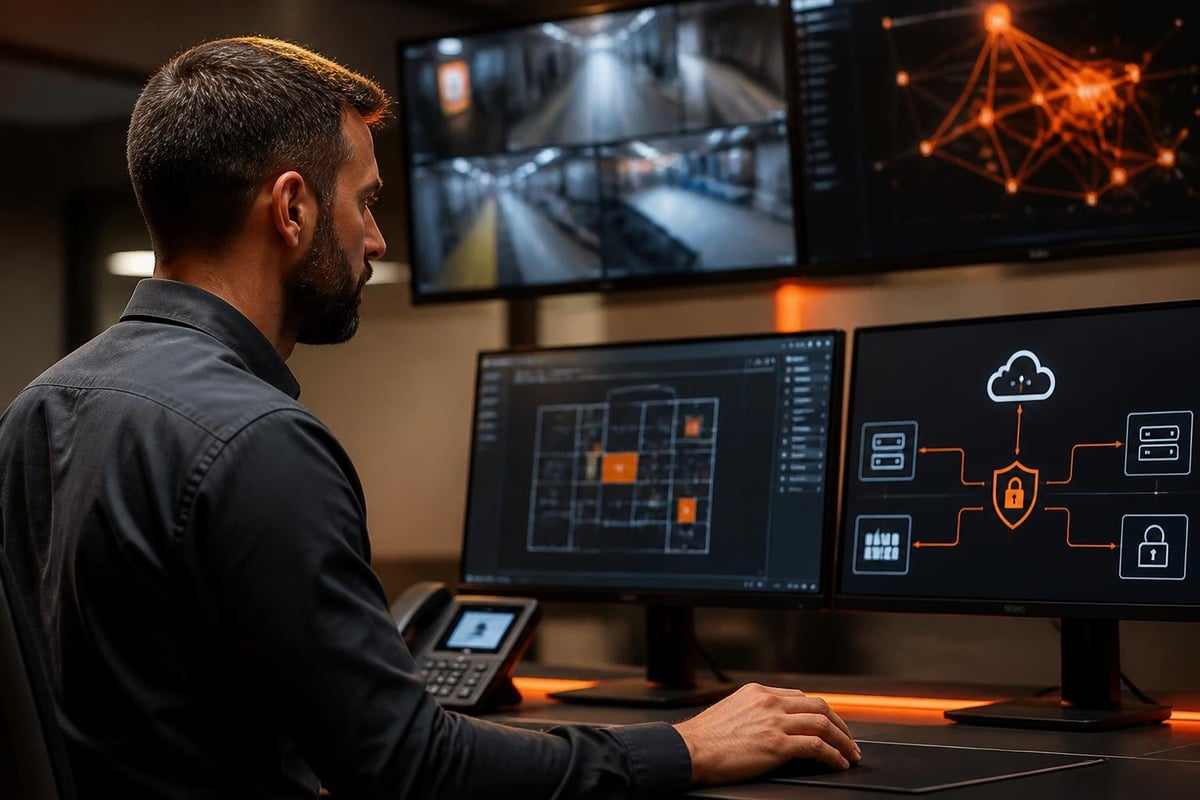
NIST guidance on operational technology security provides frameworks for protecting these hybrid environments. Key considerations include network segmentation to isolate alarm systems from general IT networks, regular firmware updates to address vulnerabilities, and access controls limiting who can modify system configurations.
The Forrester analysis of operational technology security solutions highlights emerging trends in protecting physical security infrastructure. Vendors now incorporate encryption, intrusion detection, and anomaly monitoring specifically designed for alarm and access control systems. These capabilities help organisations detect tampering attempts or unauthorised configuration changes before they compromise monitoring effectiveness.
Data Privacy and Compliance
Commercial alarm monitoring services necessarily handle sensitive information: site layouts, access patterns, video footage, and emergency contact details. The FTC Privacy and Data Security Update outlines expectations for organisations collecting and storing such data, emphasising transparency, security safeguards, and limited retention.
Monitoring providers should maintain clear data policies addressing:
- Retention schedules: How long alarm events and video footage are stored
- Access controls: Who within the monitoring organisation can view customer data
- Third-party sharing: Whether and how data is shared with emergency services or other entities
- Breach notification: Procedures for informing customers of security incidents
Response Protocols and Service Level Agreements
The value of commercial alarm monitoring services ultimately depends on how quickly and effectively operators respond to alarm signals. Service level agreements (SLAs) formalise these expectations, establishing measurable performance standards.
Critical SLA metrics include:
- Signal acknowledgement time: How quickly operators view incoming alarms (typically under 30 seconds)
- Verification completion: Time to complete verification protocols (usually 60-90 seconds)
- Dispatch initiation: How quickly emergency services are contacted for verified alarms
- Communication attempts: Number of keyholder contact attempts before escalation
The Monitoring Association’s guidance on central station operations establishes industry benchmarks for these metrics. High-performing monitoring centres consistently acknowledge signals within 15-20 seconds and complete full response protocols within two minutes of initial alarm receipt.
Escalation Procedures
Robust monitoring services maintain detailed escalation matrices tailored to each customer's operational requirements. A warehouse fire alarm might require immediate fire service dispatch plus notification to facilities managers and corporate security. An after-hours intrusion alarm might trigger verification attempts with multiple keyholders before requesting police response.
Escalation procedures should account for various scenarios:
- Primary contact unreachable
- Ambiguous or partial alarm signals
- Simultaneous multiple alarms suggesting system-wide issues
- Situations requiring specialised response (hazmat, utility emergencies)
Integration with Broader Security Infrastructure
Modern commercial alarm monitoring services extend well beyond traditional burglar and fire alarms. Integration with complementary security technologies creates comprehensive protection that addresses diverse threats whilst streamlining operational management.
| Integration Type | Business Benefit | Monitoring Enhancement |
|---|---|---|
| Video surveillance | Visual verification reduces false alarms | Operators view live footage during alarms |
| Access control | Correlate alarms with entry/exit events | Identify potential inside threats |
| Building automation | Coordinate HVAC, lighting responses | Environmental context for alarms |
| Perimeter security | Early detection before building breach | Extended response time |
Organisations with sophisticated security needs increasingly deploy security monitoring services that unify these disparate technologies under a single monitoring umbrella. This integration provides several advantages: operators develop comprehensive situational awareness, response protocols can leverage multiple data sources, and businesses benefit from simplified vendor management.
For facilities requiring physical access control, integration with gate and barrier systems proves particularly valuable. Monitoring centres can remotely control entry points during emergencies or security events. Companies like Gates On Site provide automated gate systems that integrate seamlessly with commercial alarm monitoring, enabling operators to secure perimeters remotely when needed.
Selecting a Commercial Alarm Monitoring Provider
Choosing the right monitoring partner requires evaluating capabilities beyond basic alarm response. The following criteria help organisations identify providers that align with their security requirements and operational priorities.
Certification and Compliance
Verify that monitoring centres hold current certifications from recognised authorities. UL certification for central stations demonstrates adherence to operational standards. Additional accreditations might include ISO 9001 for quality management or industry-specific certifications relevant to your sector.
Ask prospective providers:
- What certifications does your monitoring centre maintain?
- How frequently are operations audited?
- What backup and redundancy systems protect monitoring continuity?
- Do operators receive ongoing training and competency assessment?
Technical Capabilities
Modern threats demand monitoring centres equipped with current technology and protocols. Providers should support contemporary communication methods, offer mobile app interfaces for alarm management, and demonstrate expertise with integrated security platforms.
Technical evaluation should cover:
- Communication support: IP, cellular, radio paths available
- Integration capabilities: Compatible systems and manufacturers
- Video monitoring: Whether operators can access and interpret video streams
- Mobile interfaces: Apps or portals for alarm management and reporting
- Reporting tools: Historical data, trend analysis, compliance documentation
Geographic Coverage and Local Expertise
Whilst monitoring centres can technically supervise sites anywhere with network connectivity, local knowledge enhances response effectiveness. Providers familiar with UK emergency service protocols, regional infrastructure peculiarities, and local response times deliver more efficient coordination.
For organisations with multiple locations, consider whether the provider offers consistent coverage across all sites or whether regional variations might affect service quality. National providers often maintain relationships with emergency services and security responders throughout the country, streamlining dispatch procedures.
Costs and Contract Considerations
Commercial alarm monitoring services typically involve three cost components: initial system installation, ongoing monitoring fees, and maintenance or inspection charges. Understanding this structure helps organisations budget accurately and compare providers on equivalent terms.
Monthly monitoring costs vary based on:
- Number of zones and devices monitored
- Communication methods employed (dual-path costs more than single)
- Integration complexity (video verification increases fees)
- Response service levels (faster response protocols may carry premiums)
- Contract term length (longer commitments often reduce monthly rates)
Typical monthly monitoring fees for small to medium commercial premises range from £30 to £150, whilst larger facilities with comprehensive integration might invest £300 or more monthly. These figures reflect monitoring services only; physical equipment and installation represent separate costs.
Contract Terms and Flexibility
Review monitoring contracts carefully, paying particular attention to term length, automatic renewal provisions, and termination conditions. Common contract structures include:
| Contract Type | Typical Duration | Advantages | Considerations |
|---|---|---|---|
| Fixed-term | 3-5 years | Lower monthly rates, predictable costs | Limited flexibility, early termination fees |
| Rolling annual | 12 months, auto-renew | Moderate flexibility, reasonable rates | Rate increases at renewal |
| Month-to-month | 30-day notice | Maximum flexibility | Higher monthly costs |
Businesses should also clarify equipment ownership. Some providers include monitoring as part of comprehensive service packages covering installation and maintenance, whilst others monitor customer-owned equipment under separate monitoring-only agreements.
Maintenance and Testing Requirements
Commercial alarm monitoring services remain effective only when underlying detection equipment operates reliably. Regular maintenance, testing, and inspection ensure systems remain code-compliant and functionally dependable.
UK regulations mandate periodic inspection of fire detection systems, typically weekly user checks, quarterly inspections, and annual comprehensive servicing. Monitoring providers should coordinate with maintenance schedules to ensure technicians follow proper test protocols that avoid unnecessary alarm dispatches whilst confirming signal transmission.
Maintenance best practices include:
- Scheduled testing windows: Coordinate with monitoring centre to expect test signals
- Documentation: Maintain inspection records demonstrating compliance
- Software updates: Apply firmware patches addressing security or functionality issues
- Battery replacement: Replace backup batteries per manufacturer schedules
- Detector cleaning: Remove dust and contaminants affecting sensitivity
Professional monitoring providers often offer bundled service agreements combining monitoring with regular maintenance. These packages ensure consistent service delivery and simplify administrative oversight, particularly valuable for organisations managing multiple locations.
Industry-Specific Monitoring Considerations
Different sectors face unique security challenges that influence monitoring requirements. Tailoring commercial alarm monitoring services to industry-specific needs improves protection whilst supporting regulatory compliance.
Healthcare and Critical Infrastructure
Healthcare facilities require monitoring that accounts for 24/7 operations, vulnerable populations, and strict access control needs. Alarm protocols must balance security response with minimal disruption to patient care. Fire alarms in occupied medical facilities trigger immediate notification but require careful verification procedures given potential patient mobility limitations.
Critical infrastructure sites operating essential services need monitoring that integrates with operational technology systems. Power generation facilities, water treatment plants, and telecommunications hubs benefit from environmental monitoring that detects equipment failures, temperature anomalies, or utility disruptions alongside traditional security threats.
Warehousing and Logistics
Large warehouse environments present unique monitoring challenges: vast open spaces, valuable inventory, and often minimal overnight staffing. Effective monitoring combines perimeter intrusion detection with internal motion sensors and video verification to distinguish genuine threats from environmental triggers.
Warehouse security alarm systems increasingly incorporate inventory management integration, triggering alerts when high-value items move outside authorised timeframes or routes. This capability helps prevent internal theft whilst supporting operational inventory controls.
Educational Institutions
Schools and universities navigate complex security needs balancing open access during operational hours with robust protection during closures. Monitoring services for schools security systems must account for multiple buildings, diverse occupant populations, and public access requirements.
Panic alarm monitoring proves particularly valuable in educational settings, providing immediate response to threats whilst minimising false alarm disruptions. Integration with access control enables lockdown procedures coordinated through monitoring centres during active threats.
Future Trends in Commercial Alarm Monitoring
The commercial alarm monitoring landscape continues evolving as technology advances and security threats become more sophisticated. Several emerging trends are reshaping how organisations approach monitored security.
Artificial intelligence and machine learning increasingly support monitoring operations, analysing alarm patterns to predict equipment failures, identify false alarm sources, and detect anomalous behaviour suggesting emerging threats. These capabilities help monitoring centres prioritise responses and provide customers with actionable insights improving overall security posture.
Cloud-based platforms are replacing traditional on-premises control panels, enabling more flexible system management and enhanced integration capabilities. Cloud architecture supports remote configuration updates, simplified multi-site management, and improved resilience through geographic redundancy.
Mobile-first interfaces empower businesses to interact with monitoring services through smartphone apps, receiving real-time alerts, viewing verification video, and managing alarm response directly from mobile devices. This accessibility proves particularly valuable for organisations with distributed management or mobile decision-makers.
Convergence with IT security accelerates as physical security systems become network-connected. Monitoring centres increasingly coordinate responses to both physical and cyber threats, recognising that sophisticated attacks often combine elements of each.
Commercial alarm monitoring services provide the vigilance and rapid response that transform static security hardware into dynamic protection systems. From fire safety compliance to intrusion prevention and operational resilience, professional monitoring delivers measurable value through 24/7 expert oversight, verified threat response, and integration capabilities that unify diverse security technologies. If you're evaluating monitoring options for your UK business premises, Logic Fire and Security combines certified monitoring services with comprehensive fire and security system design, installation, and maintenance, ensuring cohesive protection tailored to your operational requirements.