

A smoking detector, more correctly called a smoke detector, is a device that senses the particles or heat produced by a fire and sounds an alarm so people can leave a building safely. For commercial and public buildings, choosing the right type, siting it correctly and maintaining it on a fixed schedule determines whether the device works when it is needed.
This guide takes you from the basics of how detection works through to types, placement, testing and the maintenance routines that keep a building compliant.
What does a smoke detector actually do?
A smoke detector monitors the air for the products of combustion and triggers an alarm when they reach a set threshold. In a commercial building, that signal rarely stands alone. It usually feeds into a fire alarm control panel, which activates sounders, shows which zone is affected and, where monitoring is in place, notifies a response centre.
The distinction matters for a Responsible Person. A stand-alone domestic smoke alarm sounds locally and does nothing else. A detector connected to an addressable or conventional system identifies the location of the fire, supports evacuation strategy and creates a record for audit purposes. Our guide to the relationship between a smoke detector and a fire alarm system explains how the two work together.
The value of early warning is well established. The NFPA reports that working smoke alarms reduce the risk of dying in a home fire substantially. That figure relates to homes, but the principle carries over directly to workplaces and multi-occupied residential blocks: minutes gained at the start of a fire are the minutes people use to escape.
How do the main detection technologies differ?
Smoke detectors differ mainly by the physical principle they use to sense a fire, and each principle suits different fire types and environments. Understanding these differences prevents the common mistake of fitting one type everywhere.
Optical (photoelectric) detectors
Optical detectors use a light source and a sensor inside a chamber. When smoke particles enter, they scatter the light onto the sensor and trigger the alarm. They respond well to smouldering fires, such as an overheated cable or smouldering upholstery, which produce large, visible particles. Optical detection is the standard choice for most UK commercial settings, including offices, corridors and sleeping accommodation.
Ionisation detectors
Ionisation detectors contain a small radioactive source that creates a current between two plates. Smoke particles disrupt that current and set off the alarm. They react more quickly to fast-flaming fires that produce tiny particles. The U.S. Fire Administration notes that ionisation alarms respond more readily to flaming fires, while photoelectric alarms respond more readily to smouldering fires, and it recommends both sensor types or a dual-sensor alarm in homes and sleeping places. In practice, ionisation units are now uncommon in new UK installations, largely because of false alarm sensitivity and disposal requirements.
Heat detectors
Heat detectors respond to a rise in temperature rather than to smoke. They suit places where smoke detection would trigger false alarms, such as kitchens, boiler rooms and car parks. They are slower to respond than smoke detectors, so they complement rather than replace them in areas where life safety is the priority.
Multi-sensor and specialist detectors
Multi-sensor devices combine optical and heat sensing, and sometimes carbon monoxide detection, which improves discrimination between real fires and nuisance sources. Specialist options include:
- Aspirating systems, which draw air through sampling pipes to a central, highly sensitive detector, suited to data centres and heritage buildings
- Linear beam detectors, which project a beam across large open volumes such as warehouses and atria
- Flame detectors, which respond to infrared or ultraviolet radiation in high-risk industrial areas
Which type suits which part of a building?
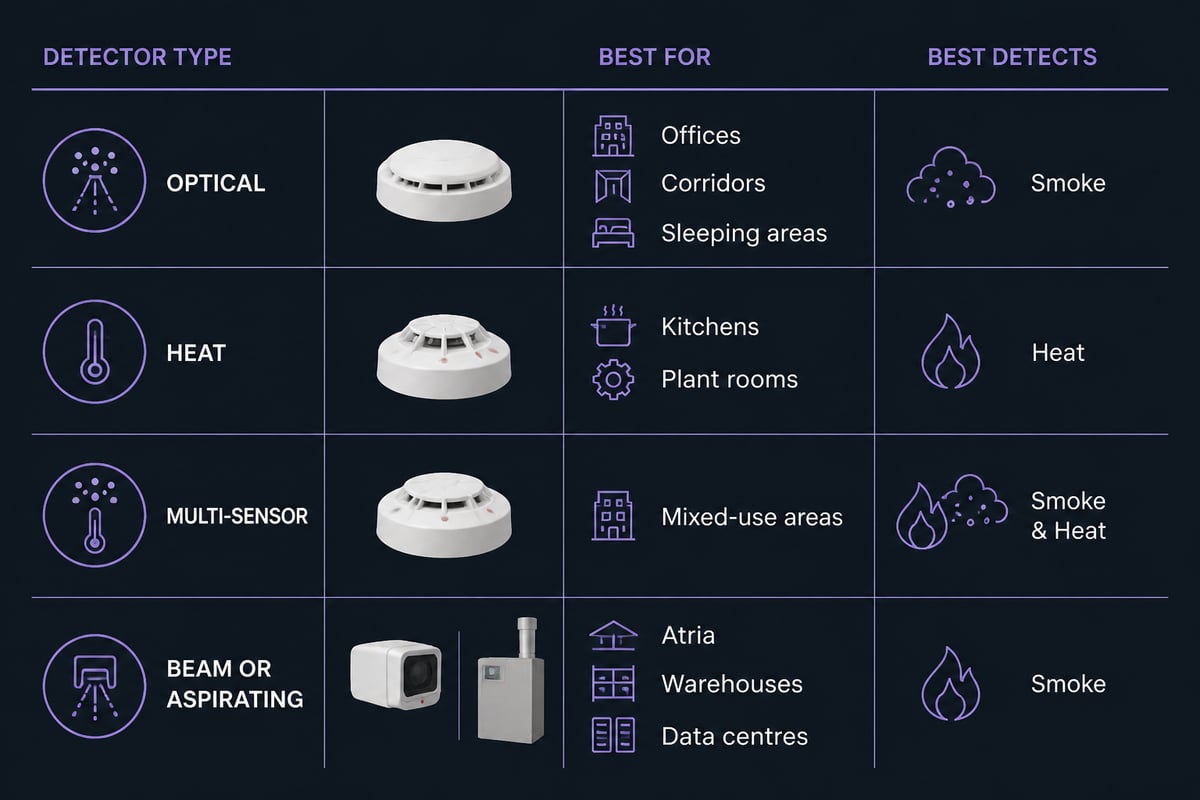
Match the detector to the environment and the likely fire, not to a single building-wide default. The table below summarises typical choices, though the final specification should come from your fire risk assessment and system designer.
| Area | Typical detector | Reason |
|---|---|---|
| Offices, corridors, stairwells | Optical | Reliable on smouldering fires, fewer nuisance alarms |
| Commercial kitchens | Heat | Cooking fumes trigger smoke detectors |
| Plant rooms, boiler rooms | Heat or multi-sensor | Dust and fumes affect optical sensors |
| Large halls, atria, warehouses | Beam or aspirating | Height and volume limit point detectors |
| Hotel rooms, residential flats | Optical, often with sounder base | Sleeping risk demands early, audible warning |
| Server rooms | Aspirating | Very early warning of overheating components |
Dust, steam, vehicle exhaust and aerosols are the usual causes of false alarms, so the environment deserves as much attention as the fire risk itself.
Where should smoke detectors be placed?
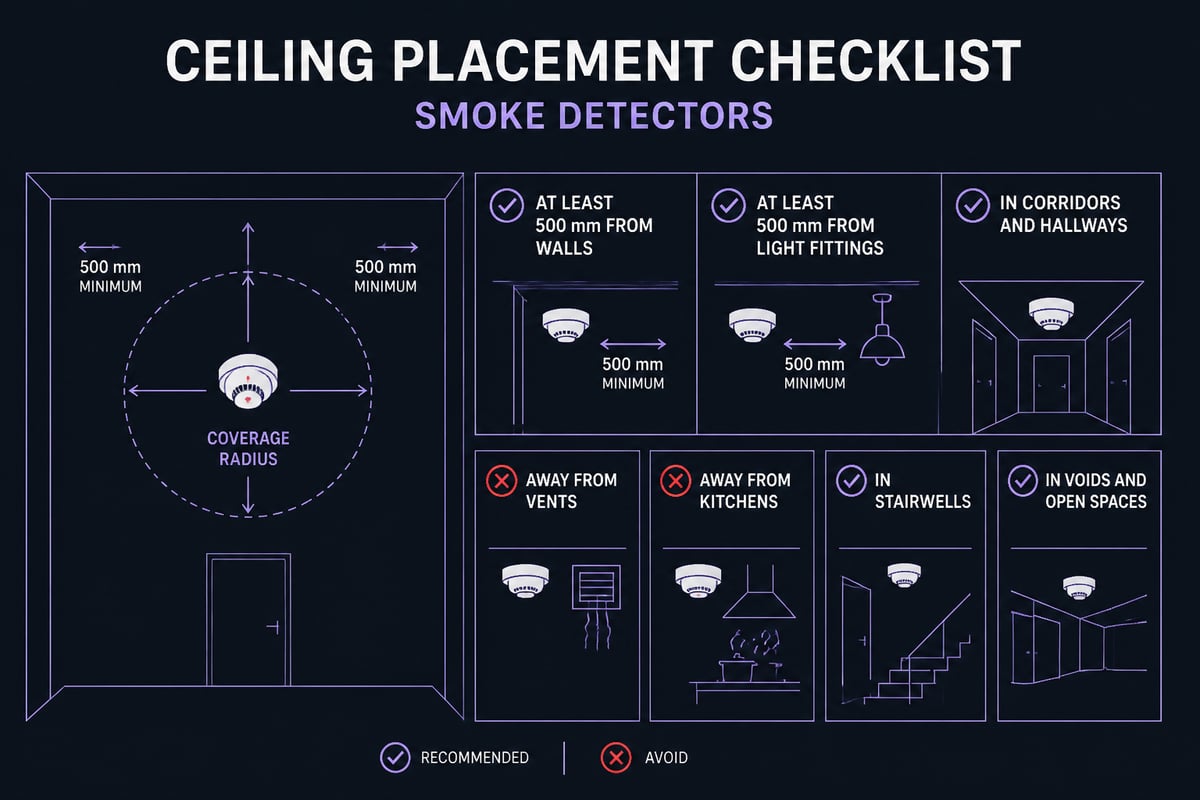
Detectors should be placed on the ceiling, in every area of a building where a fire could start or travel, with spacing governed by the design standard BS 5839-1 for non-domestic premises. Coverage rather than quantity is the goal.
Established practice for point detectors includes:
- Mount detectors on the ceiling, in the highest practical position, because smoke rises and spreads outwards.
- Keep them clear of walls and obstructions, generally at least 500 mm from a wall or light fitting.
- Cover escape routes first: corridors, stairwells, landings and lobbies must be detected so that the means of escape stays usable.
- Detect voids, such as ceiling and floor voids and lift shafts, where fire can spread unseen.
- Keep them away from air supply vents, kitchens, shower areas and any source of steam or fumes.
Guidance for homes, such as that from the U.S. Fire Administration, is to install smoke alarms inside every bedroom, outside each separate sleeping area and on every level, including the basement. The same logic applies to sleeping risk premises in the UK, including hotels, care homes and blocks of flats, where detection in each room and in shared circulation space is usual. Siting near cooking appliances also affects nuisance alarm rates, a point covered in NFPA research on smoke alarms in home fires.
For a practical walk-through of positions by room type, see our guide to smoke detector locations.
How do standalone alarms compare with a connected system?
Standalone alarms suit very small, low-risk premises, while a connected fire detection and alarm system is the appropriate choice for almost any commercial or multi-occupied residential building. The difference lies in control, evidence and response.
Standalone and interlinked alarms sound locally, and the more advanced versions link by radio or wiring so that one device triggers the rest. They have no central indication of which device has activated, no fault monitoring across the whole installation and no route to a monitoring centre.
A conventional or addressable system adds a control panel, zone or device-level location, fault reporting and integration with other safety functions such as door release, ventilation shutdown and lift recall. For a landlord or property manager with a high-rise block, addressable detection that reports the exact device in alarm speeds up the response of the fire service and the on-site team.
The design, supply, installation and commissioning of such systems fall within the fire alarm system work that Logic Fire and Security carries out for commercial and public sector buildings, from first design through to maintenance. Our overview of the fire detection system explains how the components fit together.
What are the legal duties of the Responsible Person?
Under the Regulatory Reform (Fire Safety) Order 2005 in England and Wales, and equivalent legislation in Scotland and Northern Ireland, the Responsible Person must carry out a suitable and sufficient fire risk assessment and put in place appropriate fire detection and warning measures. Detection is not optional where the assessment identifies a need for it.
In practical terms, that means:
- Completing and regularly reviewing a fire risk assessment
- Ensuring the detection and alarm system is designed to a recognised standard
- Keeping the system maintained in efficient working order
- Recording tests, faults and actions in a fire logbook
- Training staff in what to do when the alarm sounds
For multi-occupied residential buildings, the duty extends to common parts and, in higher-risk buildings, to additional requirements introduced under recent building safety legislation. If you are unsure whether your current assessment is adequate, a review by a competent assessor is the sensible starting point; our overview of fire risk assessment companies explains what to look for.
How often should detectors be tested and replaced?
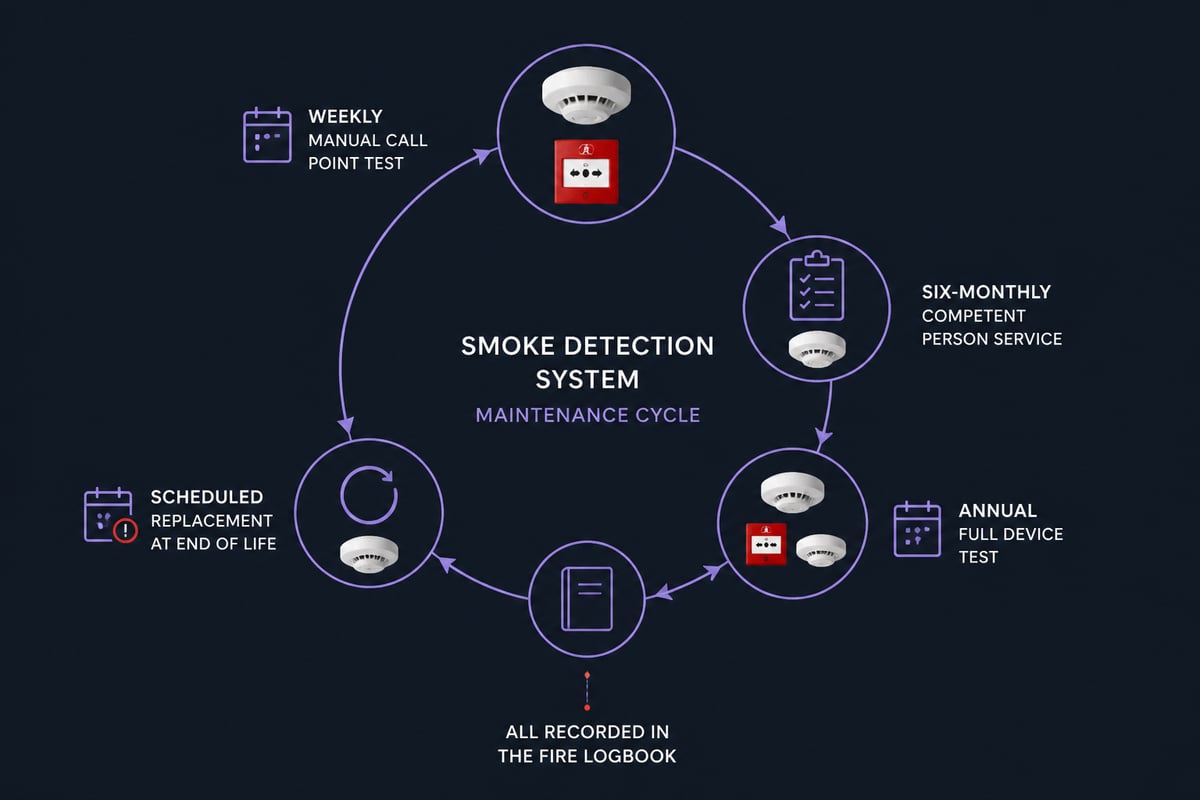
Detectors need regular testing, scheduled servicing and eventual replacement, and the intervals depend on the system and manufacturer. A reliable routine has three layers.
Weekly user test
A designated person activates a different manual call point each week and confirms that the panel and sounders respond. The result goes into the fire logbook. This tests the system as a whole, not individual detectors.
Periodic servicing
BS 5839-1 recommends that a competent person services the system regularly, with all devices tested over the course of a year. Servicing includes checking panel functions, battery condition, sounder levels and the sensitivity of detector heads. Our article on fire alarm servicing sets out what a visit should cover.
Lifespan and replacement
Detectors do not last indefinitely. Sensors drift, chambers collect dust and electronics age. As a general benchmark, the U.S. Fire Administration advises that smoke alarms be replaced 10 years after their manufacture date. Commercial detector heads follow manufacturer guidance, but the principle is the same: record installation dates and plan replacement before performance falls away.
Research by the NFPA on the usage and functionality of smoke and carbon monoxide alarms in households is a useful reminder that devices are only protective when they are present, powered and working.
How can you reduce false alarms?
Reducing false alarms starts with identifying their cause, then adjusting the detector type, position or management procedures. Repeated unwanted alarms lead to evacuation fatigue, disrupt operations and can result in delayed responses from the fire service.
Common causes and responses include:
- Cooking fumes and steam: replace smoke heads with heat detectors, or relocate them away from the source
- Dust from building works: cover or isolate detectors under a permit system, and remove covers on completion
- Aerosols and cleaning products: brief cleaning contractors on detector locations
- Contaminated or ageing heads: clean or replace at service
- Poor system design: review zoning and detector selection with a competent engineer
Isolating detectors for building work is a frequent source of risk. Covers left in place after a project finishes have caused detectors to be disabled for weeks, so a sign-off step that confirms reinstatement should be part of your contractor controls.
What does monitoring add to a detection system?
Remote monitoring ensures that an alarm is acted on even when the building is empty, which is the situation when fire does the most damage. A signal from the control panel reaches a receiving centre that can alert the fire service and nominated keyholders without relying on someone nearby hearing the sounders.
For premises that are unoccupied overnight, such as retail units, schools and offices, this closes the gap between ignition and discovery.
What should you check before specifying or upgrading detectors?
Before you buy or upgrade, confirm that the proposed system matches the building's use, risk and legal obligations. A short pre-specification checklist helps:
- Obtain a current fire risk assessment and confirm it reflects how the building is used today.
- Identify the required category of system under BS 5839-1, for example life protection or property protection.
- Choose detector types by area, not by a single default.
- Confirm that installers hold recognised third-party certification, such as BAFE, NICEIC or NSI Gold approval.
- Agree commissioning, handover documentation and a maintenance schedule before the work begins.
- Plan for monitoring and for how faults will be reported and fixed.
Third-party certification matters because it gives you independent assurance of the design, installation and commissioning work, which is helpful evidence if an enforcing authority or insurer asks questions later. Details of the standards Logic Fire and Security works to are on its quality and accreditations page.
Start by pulling out your current fire risk assessment and fire logbook and checking whether the detector types, locations and service dates still match how your building is used. If anything is out of date, or you are planning a refit, Logic Fire and Security can design, install, commission, monitor and maintain a compliant fire alarm system so call 0800 8445 999 or email [email protected] to discuss your premises.