

Modern businesses face increasingly sophisticated security challenges, from theft and vandalism to regulatory compliance and liability protection. Commercial CCTV systems have evolved far beyond simple recording devices into intelligent security platforms that integrate with access control, fire safety, and operational monitoring. For organisations across the UK, selecting and deploying the right surveillance infrastructure requires understanding not only the technology but also legal obligations, integration requirements, and long-term maintenance considerations. Whether protecting a single retail location or a multi-site enterprise, the right commercial CCTV systems deliver both security and valuable business intelligence.
Understanding Modern Commercial CCTV Technology
Today’s commercial CCTV systems bear little resemblance to the grainy, tape-based surveillance of decades past. Internet Protocol (IP) cameras now dominate the commercial sector, offering high-definition imagery, remote access, and seamless integration with other security systems.
IP Versus Analogue Systems
The fundamental choice facing any organisation begins with the decision between IP and analogue technology. IP cameras transmit digital video over standard network infrastructure, enabling resolutions up to 4K and beyond. They support Power over Ethernet (PoE), eliminating the need for separate power supplies at each camera location. Analogue systems, whilst still viable for certain applications, typically cap out at lower resolutions and require dedicated cabling infrastructure.
The interoperability of IP devices has improved dramatically through standardisation efforts. The ONVIF profiles specification ensures that cameras, recorders, and management software from different manufacturers can work together seamlessly, preventing vendor lock-in and future-proofing investments.
Most commercial installations in 2026 favour IP architecture for its flexibility and scalability. However, hybrid systems that incorporate existing analogue infrastructure whilst migrating to IP remain popular in phased upgrade scenarios.
Key Components of Commercial CCTV Systems
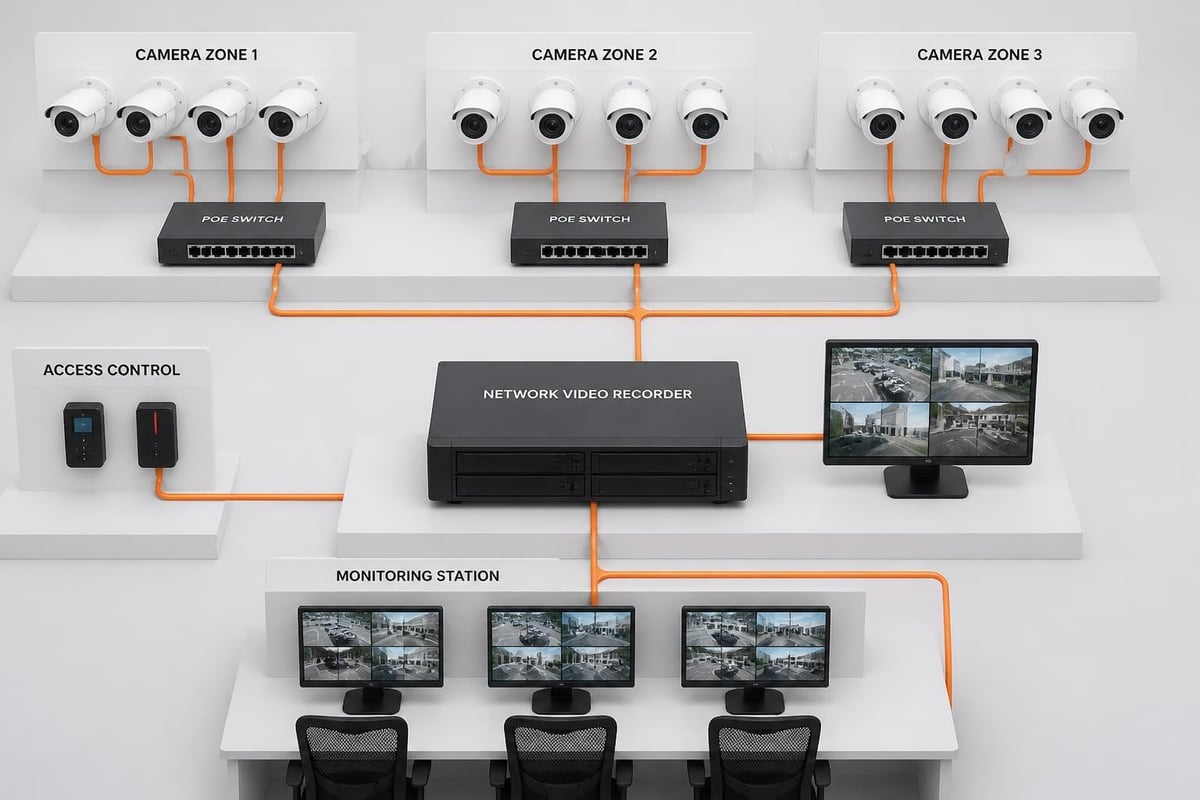
A robust surveillance solution comprises multiple interconnected elements working in concert. Understanding each component ensures optimal system design and performance.
Cameras and Lenses
Camera selection depends on specific environmental and operational requirements:
- Fixed dome cameras for general indoor surveillance in offices and retail spaces
- PTZ (Pan-Tilt-Zoom) cameras for active monitoring of large areas and perimeters
- Bullet cameras with weatherproof housings for external mounting
- Multi-sensor cameras providing 180° or 360° coverage from a single device
- Thermal imaging cameras for complete darkness or perimeter detection
Lens specifications directly impact coverage and image quality. Focal length determines the field of view, whilst varifocal lenses offer adjustment flexibility during installation and maintenance.
Recording and Storage Infrastructure
Network Video Recorders (NVRs) have replaced traditional Digital Video Recorders in most commercial environments. Storage requirements vary enormously based on:
| Factor | Impact on Storage |
|---|---|
| Resolution | 4K cameras require 4× the space of 1080p |
| Frame rate | 25fps doubles storage versus 12.5fps |
| Compression | H.265 reduces size by 50% compared to H.264 |
| Retention period | 30-day retention needs 30× single-day storage |
| Camera count | Linear scaling with device numbers |
Cloud and hybrid storage models are gaining traction, particularly for multi-site operations requiring centralised access. However, bandwidth costs and latency considerations make edge storage (local NVRs) essential for most commercial CCTV systems.
Analytics and Intelligence
Modern surveillance platforms incorporate sophisticated video analytics that transform passive recording into active security tools. Motion detection forms the baseline, whilst advanced capabilities include:
- Facial recognition and database matching
- Number plate recognition (ANPR) for vehicle tracking
- Intrusion detection with virtual tripwires and perimeter zones
- Heat mapping and people counting for operational insights
- Abandoned object detection in high-security environments
Research into real-time video analytics demonstrates the growing sophistication of these systems, particularly when processing occurs at the edge rather than requiring central server resources.
Regulatory Compliance and Data Protection
Deploying commercial CCTV systems in the UK triggers significant legal obligations under data protection legislation. The General Data Protection Regulation (GDPR) and Data Protection Act 2018 classify video footage as personal data, subjecting it to strict controls.
Privacy Impact Assessments
Organisations must conduct Data Protection Impact Assessments (DPIAs) when surveillance is likely to result in high risk to individuals’ rights and freedoms. This typically applies to extensive monitoring, facial recognition deployment, or surveillance in sensitive areas.
The ICO’s comprehensive CCTV guidance establishes clear expectations:
- Legitimate purpose – surveillance must serve a specific, defined objective
- Necessity – CCTV must be proportionate to the risk addressed
- Transparency – clear signage informing individuals of monitoring
- Security – technical and organisational measures protecting footage
- Retention – footage kept only as long as needed for its purpose
Signage and Notification Requirements
Visible signage must appear at all entry points to monitored areas. Signs should identify the data controller, the surveillance purpose, and contact details for enquiries. Covert surveillance faces even stricter limitations and typically requires specific legal authorisation.

Installation Considerations for Commercial Environments
Successful deployment of commercial CCTV systems requires careful planning that balances security objectives with practical constraints and budgetary realities.
Site Survey and Design
Professional commercial CCTV installation begins with a thorough site assessment. Security consultants evaluate:
- Critical areas requiring monitoring (entrances, cash handling, stock rooms)
- Lighting conditions affecting camera placement and specification
- Network infrastructure capacity and required upgrades
- Environmental factors such as weather exposure, vibration, and temperature
- Integration points with fire alarms, access control, and intrusion detection
Camera positioning should eliminate blind spots whilst respecting privacy zones such as toilets and changing areas. Overlapping coverage ensures redundancy if individual cameras fail or are obscured.
Cabling and Network Requirements
IP camera installations place significant demands on network infrastructure. Each 4K camera can consume 8-12 Mbps of bandwidth, whilst PoE requirements limit cable runs to 100 metres without switches or extenders.
Structured cabling using Cat6 or Cat6a ensures future-proof performance and supports emerging technologies. For commercial CCTV systems spanning multiple buildings, fibre optic backbones may prove necessary to handle aggregate bandwidth.
Many organisations integrate surveillance with existing commercial security systems, creating unified platforms that share infrastructure and simplify management.
Integration with Fire and Access Control Systems
The convergence of security technologies enables more intelligent and responsive protection. Modern commercial CCTV systems function as part of a broader ecosystem rather than isolated solutions.
Fire Safety Integration
Video verification reduces false alarm responses and accelerates emergency services deployment. When fire detection systems trigger, cameras automatically focus on affected zones, providing real-time confirmation to monitoring centres and first responders.
Integration also supports compliance documentation. Recorded footage demonstrates evacuation procedures, identifies blocked fire exits, and evidences the effectiveness of fire safety measures. Organisations with comprehensive fire safety programmes benefit from this unified approach.
Access Control Synchronisation
Linking CCTV with access control creates powerful audit trails. Every entry event triggers video recording, associating individuals with their access credentials. This proves invaluable for investigating security incidents and demonstrating compliance with visitor management protocols.
Video intercom systems at entrance points provide visual verification before granting access, particularly important for high-security facilities. Modern access control systems support this integration natively, simplifying deployment and ongoing management.
Monitoring and Response Options
Commercial CCTV systems deliver value only when footage receives appropriate attention. Organisations must choose between self-monitoring, third-party services, or hybrid approaches.
Remote Monitoring Centres
Professional security monitoring services provide 24/7 surveillance coverage without requiring internal staffing. Trained operators watch live feeds, respond to analytics alerts, and coordinate with emergency services when incidents occur.
Remote monitoring proves particularly cost-effective for:
- Multi-site organisations requiring consistent coverage
- Facilities operating outside normal business hours
- High-value assets demanding immediate response
- Businesses lacking internal security teams
False alarm filtering represents a key advantage of professional monitoring. Experienced operators distinguish genuine threats from benign triggers, reducing unnecessary emergency service callouts and associated costs.
Internal Security Teams
Larger organisations often maintain dedicated security operations centres. This approach offers greater control and familiarity with site-specific concerns but requires significant ongoing investment in personnel, training, and infrastructure.
Hybrid models are increasingly common, with internal teams handling routine monitoring during business hours whilst outsourcing overnight and weekend coverage to specialist providers.
Cyber Security and Data Protection
The network connectivity that makes modern commercial CCTV systems so capable also introduces cyber security risks. Recent enforcement actions, such as the FTC’s action against camera vendor Verkada, highlight the consequences of inadequate data security.
Securing Video Infrastructure
Robust cyber security requires multiple defensive layers:
- Network segmentation – isolating CCTV systems from general corporate networks
- Strong authentication – unique passwords, multi-factor authentication where supported
- Encryption – HTTPS/TLS for management interfaces, encrypted storage for footage
- Regular updates – timely firmware patches addressing vulnerabilities
- Access controls – limiting user permissions to necessary functions only
Default passwords represent one of the most common vulnerabilities in commercial CCTV systems. Every camera, NVR, and management platform should receive unique credentials during installation, documented securely and changed regularly.
Vendor Due Diligence
Selecting manufacturers and service providers with demonstrated security commitments reduces risk. Evaluation criteria should include:
| Criterion | Assessment Questions |
|---|---|
| Security track record | Has the vendor experienced major breaches? |
| Vulnerability disclosure | Do they have a responsible disclosure programme? |
| Update frequency | How quickly are patches released? |
| Certification | Do products carry recognised security certifications? |
| Data handling | Where is footage processed and stored? |
Cloud-based services require particular scrutiny regarding data sovereignty and sub-processor agreements.
Maintenance and Lifecycle Management
Commercial CCTV systems require ongoing attention to maintain effectiveness and compliance. Neglected surveillance infrastructure degrades rapidly, with failed cameras, outdated firmware, and insufficient storage undermining security objectives.
Preventative Maintenance Schedules
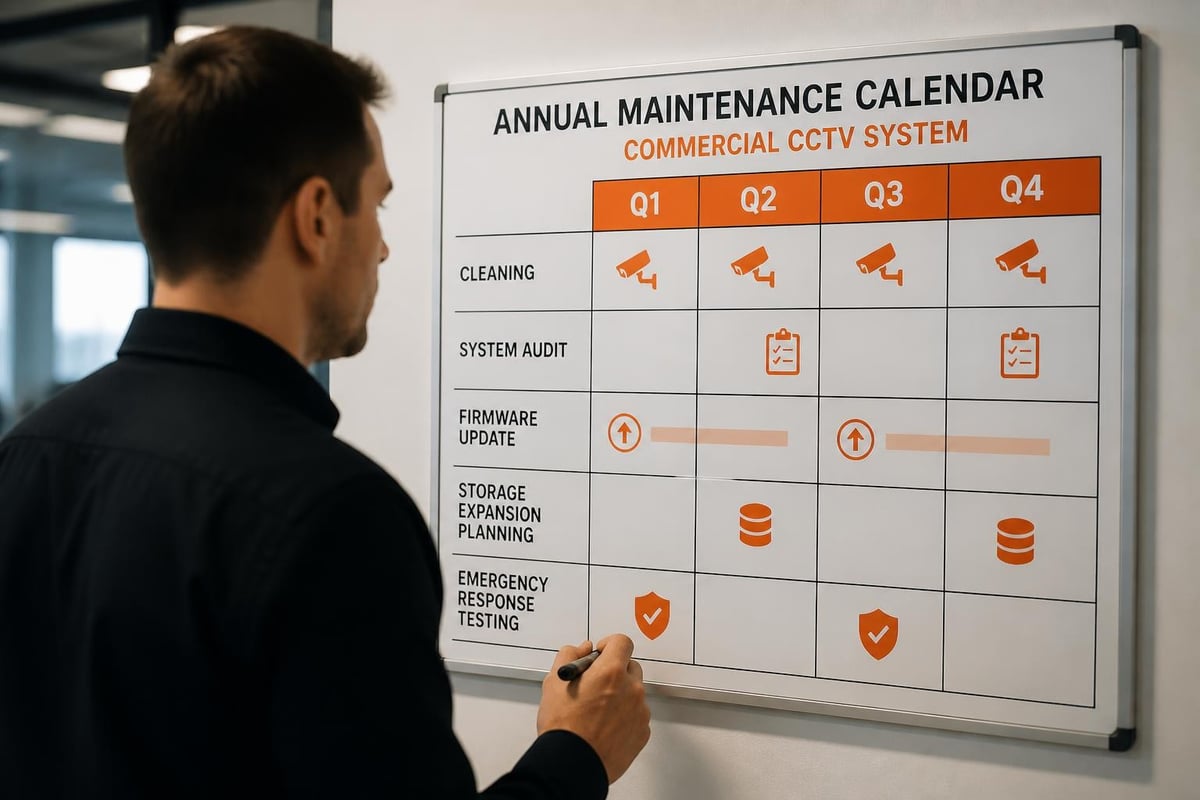
Regular servicing addresses issues before they impact operations. Professional CCTV maintenance programmes typically include:
- Quarterly camera cleaning to maintain image quality
- Lens adjustment correcting focus drift and alignment
- Storage capacity monitoring preventing footage loss
- Firmware updates patching vulnerabilities and adding features
- Cable and connection inspection identifying wear and weather damage
Environmental factors accelerate degradation. External cameras face particular challenges from condensation, temperature extremes, and UV exposure. Proactive replacement prevents the security gaps that occur when critical cameras fail during incidents.
Performance Testing and Validation
System testing should verify not only technical operation but also practical effectiveness. This includes:
- Image quality assessment under various lighting conditions
- Recording verification ensuring footage actually captures
- Analytics accuracy confirming detection zones function correctly
- Backup system testing validating redundancy measures work
- Incident response drills exercising monitoring and response procedures
Annual reviews of camera placement often reveal changes in the environment (new structures, vegetation growth, lighting changes) that compromise original design assumptions.
Sector-Specific Applications
Different industries face unique surveillance challenges requiring tailored approaches to commercial CCTV systems.
Retail and Hospitality
Loss prevention drives retail CCTV deployment. High-resolution cameras at point-of-sale terminals deter theft whilst providing evidence for prosecution. People counting and heat mapping analytics optimise staffing and store layouts based on customer behaviour patterns.
Queue management systems alert staff when checkout wait times exceed thresholds, improving customer experience whilst maintaining security coverage.
Warehousing and Logistics
Expansive facilities require strategic camera placement balancing comprehensive coverage with budget constraints. Licence plate recognition at gates automates vehicle logging, whilst warehouse interior cameras monitor high-value stock areas and loading bays.
Integration with inventory management systems can trigger alerts when goods move without corresponding transactions, identifying shrinkage sources.
Education and Healthcare
These sectors face heightened privacy concerns requiring careful policy development. Schools security systems must balance safeguarding obligations with children’s privacy rights, typically limiting monitoring to common areas and entrances.
Healthcare environments require similar sensitivity, with clear policies prohibiting cameras in clinical areas except where specific security concerns justify monitoring.
Manufacturing and Industrial
Safety compliance represents a primary driver in industrial settings. Cameras monitor hazardous processes, verify PPE usage, and provide incident reconstruction for health and safety investigations.
Environmental challenges (dust, vibration, extreme temperatures) necessitate ruggedised camera housings and specialised mounting solutions.
Total Cost of Ownership
Understanding the full financial commitment behind commercial CCTV systems extends beyond initial purchase prices. Comprehensive budgeting accounts for both capital and operational expenditure over the system’s lifespan.
Capital Expenditure Components
Initial deployment costs include:
- Camera hardware (£150-£2,000+ per camera depending on specification)
- Recording infrastructure (NVRs, servers, storage arrays)
- Network equipment (switches, cabling, wireless bridges)
- Installation labour and project management
- Integration with existing security platforms
- Initial training for operators and administrators
Small installations might start from £3,000-£5,000, whilst enterprise deployments for large facilities easily exceed £100,000.
Ongoing Operational Costs
Annual expenses accumulate from multiple sources:
- Maintenance contracts (typically 10-15% of capital cost annually)
- Monitoring services (£20-£100+ per camera monthly)
- Power consumption (modest but non-zero for large systems)
- Storage upgrades as retention requirements evolve
- Software licensing for advanced analytics platforms
- Staff training as personnel change
Total cost of ownership over a typical five-year lifespan often reaches 150-200% of the initial capital investment. Accurate forecasting prevents budget surprises and supports informed decision-making.
Emerging Technologies and Future Trends
Commercial CCTV systems continue evolving rapidly, with several technologies poised to reshape the industry in coming years.
Artificial Intelligence and Machine Learning
AI-powered analytics move beyond simple motion detection to understand context and intent. Behavioural analysis identifies suspicious loitering or unusual patterns, whilst object recognition distinguishes vehicles, people, and specific items automatically.
Edge AI, where processing occurs within cameras rather than central servers, reduces bandwidth requirements and enables faster response to time-critical events.
Enhanced Integration Capabilities
The boundaries between security systems continue blurring. Future commercial CCTV systems will integrate seamlessly with building management systems, triggering HVAC adjustments based on occupancy or coordinating with lighting for optimal image quality.
Smart city initiatives are driving standardisation, enabling private CCTV to share relevant footage with law enforcement whilst maintaining privacy controls.
Privacy-Enhancing Technologies
Responding to regulatory pressure and public concern, manufacturers are developing privacy-preserving analytics. These systems detect and track individuals whilst obscuring identifying features, extracting security value without capturing recognisable personal data.
Metadata-only recording stores analytics results (person count, direction of travel) without retaining video footage, dramatically reducing privacy impact whilst supporting legitimate security and operational objectives.
Modern commercial CCTV systems represent sophisticated security platforms that extend far beyond simple video recording, offering integration with fire safety, access control, and operational monitoring whilst navigating complex regulatory requirements. For businesses seeking to protect assets, ensure compliance, and gain operational insights, professional design, installation, and maintenance prove essential to maximising value and minimising risk. Logic Fire and Security brings decades of expertise to commercial surveillance projects across the UK, delivering integrated security solutions that protect your people, property, and business continuity with the same commitment to excellence trusted by Blue Chip companies and public agencies nationwide.