

Protecting commercial premises from fire hazards requires more than simply meeting minimum legal requirements. A properly designed and installed fire alarm system represents a critical investment in life safety, business continuity, and regulatory compliance. For businesses across the UK, understanding the complexities of commercial fire alarm installation ensures that every component works harmoniously to detect threats early, alert occupants effectively, and coordinate emergency response protocols. This comprehensive guide explores the essential considerations, regulatory frameworks, and technical best practices that underpin successful fire alarm installations in commercial environments.
Understanding Commercial Fire Alarm System Requirements
The legal landscape governing commercial fire alarm installation in the UK centres on several key pieces of legislation and recognised standards. The Regulatory Reform (Fire Safety) Order 2005 places responsibility on building owners and designated 'responsible persons' to ensure adequate fire safety measures, including appropriate detection and warning systems.
British Standard BS 5839-1 provides the code of practice for fire detection and fire alarm systems for buildings, offering detailed guidance on system design, installation, commissioning, and maintenance. Understanding when fire alarm systems are required in commercial buildings depends on multiple factors including occupancy levels, building use classification, and structural characteristics.
Building Classification and System Categories
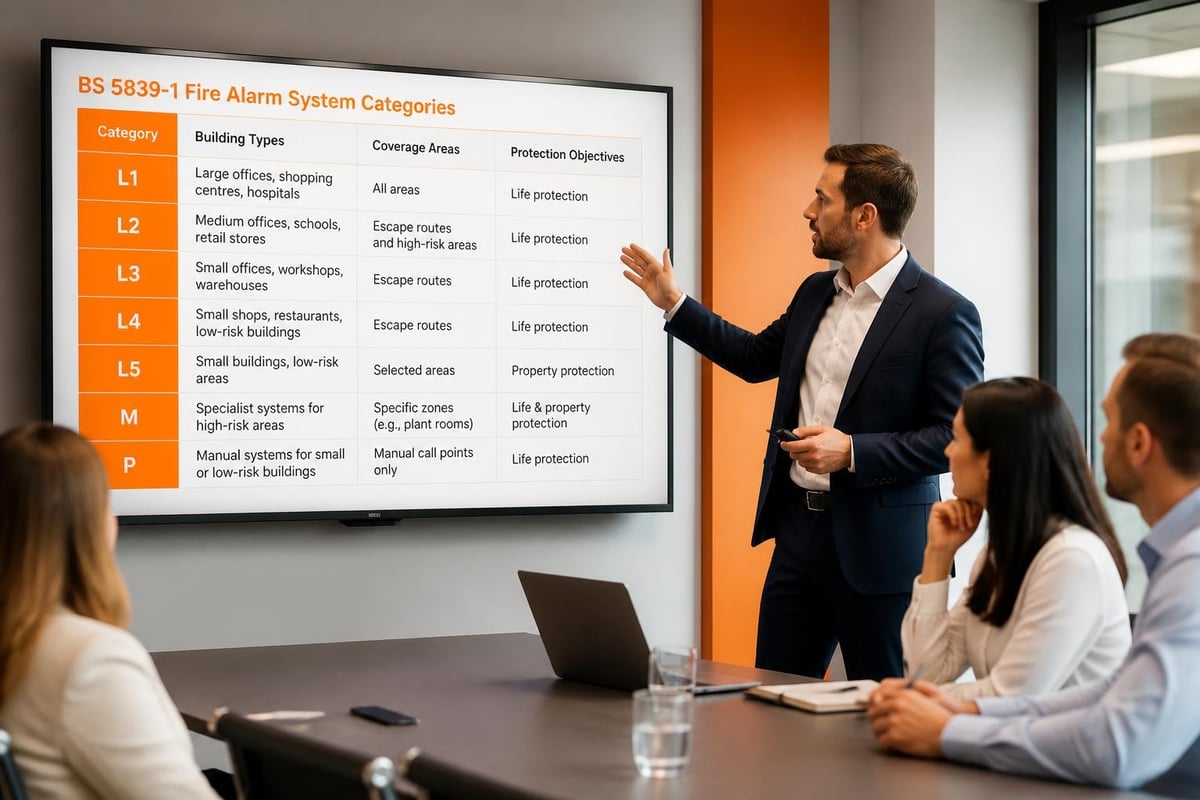
Different premises require different levels of protection. BS 5839-1 defines several system categories:
- Category L systems: Life safety systems designed to protect occupants
- Category P systems: Property protection systems focused on safeguarding assets
- Category M systems: Manual call point systems with limited automatic detection
Each category subdivides further based on coverage extent and detection capabilities. A Category L1 system provides comprehensive coverage throughout the building, whilst L2 systems protect defined escape routes and high-risk areas. Selecting the appropriate category forms the foundation of effective commercial fire alarm installation.
Occupancy type significantly influences system requirements. Educational facilities, healthcare premises, entertainment venues, and high-rise buildings each present unique challenges requiring tailored solutions. A comprehensive fire risk assessment conducted by qualified professionals identifies specific hazards and determines appropriate system specifications.
System Design Principles and Planning
Effective commercial fire alarm installation begins long before any equipment arrives on site. The design phase establishes the blueprint for a system that balances comprehensive protection with operational practicality and cost effectiveness.
A thorough site survey identifies critical factors including building layout, ceiling heights, environmental conditions, occupancy patterns, and existing infrastructure. Designers must account for physical obstacles, areas requiring specialised detectors, and integration points with other building systems such as access control or CCTV networks.
Device Placement and Spacing
Detector positioning follows strict guidelines to ensure reliable coverage without excessive false alarms. Standard spacing recommendations include:
| Detector Type | Maximum Floor Area | Maximum Spacing | Height Considerations |
|---|---|---|---|
| Smoke (Optical) | 100m² | 10m from walls | 10.5m maximum ceiling height |
| Smoke (Ionisation) | 85m² | 7.5m centres | 10.5m maximum ceiling height |
| Heat Detectors | 50m² | 5.3m centres | 9m maximum ceiling height |
| Multi-sensor | 100m² | 10m from walls | 10.5m maximum ceiling height |
These guidelines require adjustment based on ceiling configuration, ventilation systems, and environmental factors. Warehouses with high ceilings often benefit from beam detectors or aspirating smoke detection systems, whilst kitchens and dusty environments necessitate heat detectors to minimise nuisance alarms.
Manual call points must be positioned at every exit from the building and at points along escape routes, ensuring no person needs to travel more than 45 metres to raise the alarm. Sounders and visual alarm devices require careful placement to achieve adequate decibel levels and coverage throughout all occupied areas.
The fire alarm installation guide for commercial buildings provides detailed best practices for device positioning, circuit design, and system commissioning that complement British Standards requirements.
Installation Standards and Cable Infrastructure
The physical installation of commercial fire alarm systems demands precision, adherence to manufacturer specifications, and compliance with wiring regulations. Installers must hold appropriate qualifications and work under third-party certification schemes such as BAFE or NSI to demonstrate competence.
Cable Selection and Fire Resistance
Fire alarm cables must maintain circuit integrity during fire conditions to ensure the system continues operating when needed most. Standard fire-resistant cable classifications include:
- FP200: Enhanced fire performance cable suitable for most installations
- FP400: Higher performance for specific applications
- LSOH (Low Smoke Zero Halogen): Essential for enclosed spaces to minimise toxic fume generation
All cabling runs require proper segregation from power circuits, with minimum separation distances maintained to prevent electrical interference. Understanding commercial fire suppression system wiring best practices ensures cable installations meet both functional requirements and safety standards.
Cable routes should be planned to minimise the risk of mechanical damage whilst providing accessibility for future maintenance. Vertical risers in multi-storey buildings require fire-stopping at floor penetrations to prevent fire spread through service shafts.
Control Panels and System Intelligence
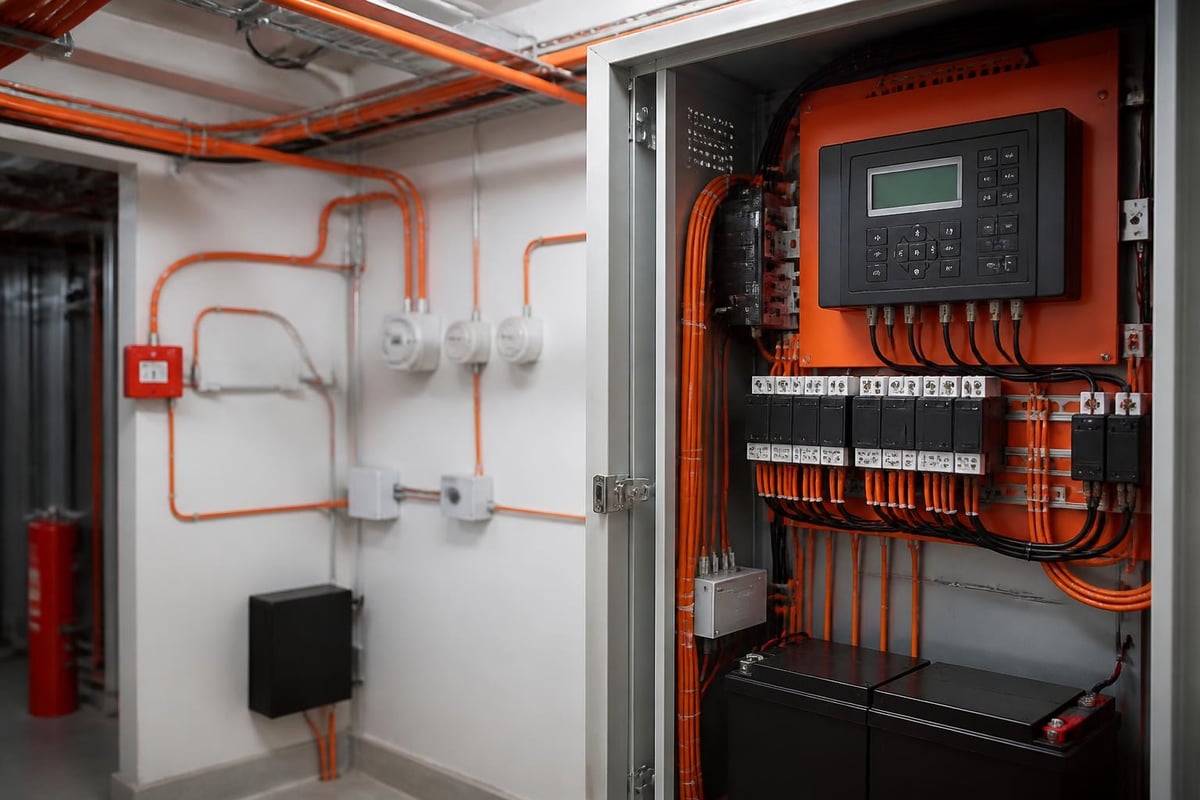
The fire alarm control panel serves as the system's central processing unit, receiving inputs from detection devices, processing alarm conditions, and coordinating output responses. Modern addressable systems offer significant advantages over conventional installations for commercial applications.
Addressable technology assigns unique identities to each device, enabling the panel to pinpoint the exact location of an activated detector or fault condition. This precision facilitates faster emergency response and simplifies troubleshooting during maintenance activities.
Panel Specification and Compliance
Selecting an appropriate control panel involves evaluating several technical parameters:
- Zone capacity: Number of detection circuits or addressable devices supported
- Loop configuration: Single or multi-loop architecture for large installations
- Integration capabilities: Compatibility with building management systems
- Network connectivity: Multi-panel networking for campus-style properties
- Power supply resilience: Battery backup duration and charging capacity
Fire alarm panel requirements and legal standards outline placement specifications, power supply mandates, and accessibility considerations that installers must observe. Panels require positioning in locations that remain accessible to authorised personnel whilst being protected from tampering or environmental damage.
The control equipment should interface seamlessly with other life safety systems, including emergency lighting and evacuation alert systems, creating a coordinated emergency response infrastructure.
Detection Technology Selection
Commercial fire alarm installation requires careful matching of detector technology to the specific risks and environmental conditions present in each area. No single detector type suits all applications, making informed selection crucial for system effectiveness.
Smoke Detection Technologies
Optical smoke detectors use light scattering principles to detect smoke particles, offering excellent sensitivity to smouldering fires that produce visible smoke. They perform well in offices, corridors, and general commercial spaces but may generate false alarms in dusty or steamy environments.
Ionisation detectors respond rapidly to fast-flaming fires with small smoke particles but have become less common due to radioactive source disposal concerns and greater susceptibility to nuisance alarms.
Multi-sensor detectors combine smoke detection with heat sensing, using sophisticated algorithms to analyse multiple parameters before triggering alarms. This intelligent approach significantly reduces false alarm incidents whilst maintaining high sensitivity to genuine fire conditions.
Aspirating smoke detection systems continuously sample air through a network of pipes, analysing it for the earliest traces of combustion products. These systems excel in sensitive environments such as data centres, clean rooms, and heritage buildings where very early warning proves essential. More information about specialised applications can be found in guidance on smoke detector fire alarm systems.
Heat and Flame Detection
Heat detectors respond to temperature increases rather than smoke, making them ideal for kitchens, garages, workshops, and other locations where smoke detectors would trigger frequently. Rate-of-rise heat detectors activate when temperature increases rapidly, whilst fixed-temperature models respond at predetermined thresholds.
Flame detectors identify the ultraviolet or infrared radiation emitted by flames, providing rapid response in high-ceiling warehouses, aircraft hangars, and industrial facilities where traditional detectors prove ineffective.
| Application Area | Recommended Detector Type | Justification |
|---|---|---|
| Offices | Optical smoke | Clean environment, smouldering fire risk |
| Kitchens | Heat detector | Steam and cooking fumes present |
| Warehouses | Beam or aspirating smoke | High ceilings, large open spaces |
| Server rooms | Aspirating smoke | Very early warning required, high value assets |
| Workshops | Multi-sensor | Dusty conditions, mixed fire risk |
Compliance with NFPA 72 and British Standards
Whilst British installations primarily follow BS 5839-1, awareness of international standards such as NFPA 72 provides valuable insights, particularly for multinational organisations or installations requiring alignment with global best practices. Understanding NFPA 72 fire alarm code requirements offers additional perspective on design principles and testing protocols.
The compliance landscape extends beyond initial installation to encompass commissioning, documentation, and ongoing maintenance responsibilities. Every commercial fire alarm installation must include:
- As-built drawings showing final device locations and circuit configurations
- Operation and maintenance manuals providing system-specific guidance
- Commissioning certificates confirming testing and verification procedures
- Log books for recording maintenance activities, faults, and modifications
Third-party certification through organisations like BAFE SP203-1 or NSI Gold demonstrates that installers operate to recognised industry standards, providing assurance to building owners, insurers, and regulatory authorities.
Monitoring and Signalling Requirements
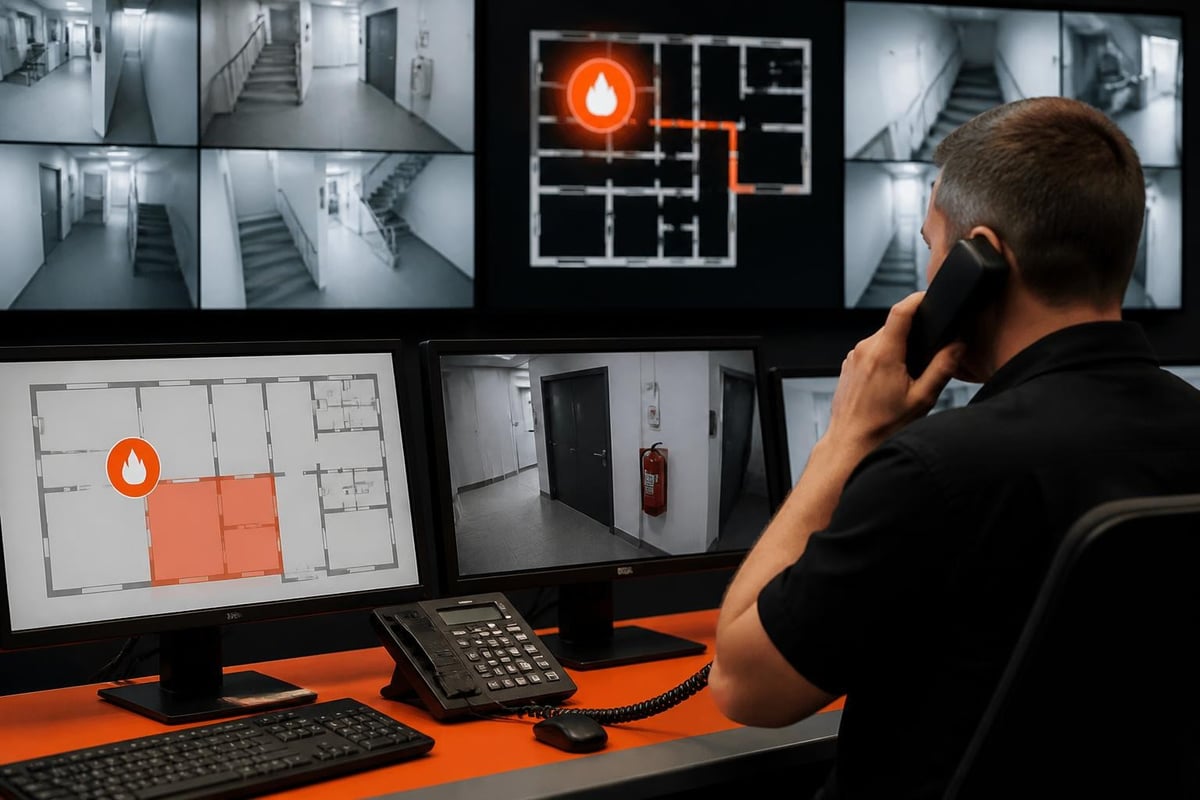
Commercial fire alarm installation typically includes connection to a certified Alarm Receiving Centre (ARC) for 24/7 monitoring. When the system activates, signals transmit automatically to trained operators who verify the alarm condition and coordinate emergency service dispatch.
Modern fire alarm monitoring best practices emphasise dual-path signalling, using both primary and secondary communication routes to ensure alarm signals reach the monitoring station even if one path fails. Common configurations include primary digital communicator with GSM backup or IP network with traditional telephone line redundancy.
Integration with Building Systems
Advanced commercial installations integrate fire alarm systems with broader building management infrastructure. Integration capabilities include:
- HVAC control: Shutting down air handling units to prevent smoke spread
- Elevator recall: Returning lifts to ground floor and preventing use
- Access control release: Unlocking exit doors to facilitate evacuation
- CCTV activation: Recording alarm zones for incident investigation
- Public address: Broadcasting voice evacuation messages
These integrations require careful design to ensure fire system integrity remains independent whilst benefiting from coordinated building-wide responses. Specialist providers like Logic Fire and Security possess the cross-disciplinary expertise necessary to implement such complex integrated solutions effectively.
Testing, Commissioning, and Handover
Comprehensive testing represents the final critical phase of commercial fire alarm installation. The commissioning process verifies that every component functions correctly individually and that the complete system performs as designed under various scenarios.
Systematic Verification Procedures
Commissioning engineers conduct methodical testing including:
- Device activation testing: Triggering each detector and manual call point
- Sounder verification: Confirming adequate sound levels throughout all areas
- Zone identification: Ensuring control panel correctly identifies device locations
- Power supply testing: Verifying mains and battery operation
- Communication testing: Confirming monitoring signals reach the ARC
- Integration testing: Checking interfaces with ancillary systems operate correctly
False alarm investigation forms part of the commissioning process, with engineers making sensitivity adjustments and verifying correct detector selection for environmental conditions. High-quality installations experience minimal false alarm incidents due to thorough design, appropriate technology selection, and careful commissioning.
Documentation provided at handover must include user training covering basic operation, alarm response procedures, and routine testing requirements. Building occupiers need to understand their responsibilities for weekly sounder tests, monthly call point tests, and prompt reporting of faults.
Advanced Technologies and Future Developments
The fire detection sector continues evolving with technological innovations that enhance detection capabilities, reduce false alarms, and provide deeper insights into building safety. Recent advancements include machine learning applications for pattern recognition and predictive maintenance.
Research into fire risk prediction using machine learning demonstrates how artificial intelligence can analyse historical data, building characteristics, and operational patterns to identify properties requiring enhanced protection or inspection prioritisation.
Deep learning models for fire and smoke recognition combined with video analytics create intelligent systems capable of visual fire detection, complementing traditional smoke and heat sensors. These technologies prove particularly valuable in challenging environments where conventional detectors struggle.
Lightweight detection models suitable for IoT applications enable distributed intelligence throughout buildings, with edge processing reducing bandwidth requirements whilst maintaining rapid response capabilities.
Cloud-based system management platforms provide building operators with real-time visibility of system status across multiple sites, predictive maintenance alerts, and comprehensive reporting tools that support compliance demonstration and operational optimisation.
Maintenance and Lifecycle Management
Commercial fire alarm installation represents the beginning of a long-term relationship between the system, building occupiers, and maintenance providers. Regular servicing ensures continued reliability whilst satisfying legal obligations and insurance requirements.
BS 5839-1 mandates routine maintenance at intervals not exceeding six months, with comprehensive testing of all detection devices, sounders, control equipment, and power supplies. Maintenance contracts should cover:
- Scheduled servicing: Bi-annual inspections and testing
- Emergency callout: 24-hour fault response
- Parts replacement: Supply of components as required
- System modifications: Updates reflecting building changes
- Compliance certification: Documentation for regulatory purposes
Organisations operating multiple sites benefit from centralised management through specialist providers offering nationwide coverage, consistent service standards, and coordinated support across their portfolio.
System Upgrades and Replacement
Fire alarm systems typically provide 15-25 years of service when properly maintained, though technological advances and changing building use may prompt earlier upgrades. Indicators suggesting system replacement include:
| Warning Sign | Implication | Recommended Action |
|---|---|---|
| Frequent false alarms | Detector aging or environmental changes | Sensitivity adjustment or replacement |
| Obsolete components | Manufacturer discontinuation | Upgrade planning |
| Integration limitations | Cannot interface with modern systems | System modernisation |
| Excessive maintenance costs | Component failures increasing | Economic replacement evaluation |
Phased upgrade strategies enable businesses to modernise systems without wholesale replacement, maintaining protection whilst managing capital expenditure. Experienced installers design migration paths that preserve useful equipment whilst introducing new capabilities incrementally.
For businesses with diverse security needs, coordinating fire alarm upgrades with enhancements to commercial alarm systems creates opportunities for shared infrastructure and integrated management platforms.
Specialist Applications and Industry-Specific Requirements
Certain commercial environments present unique challenges requiring specialist knowledge and tailored solutions beyond standard system designs. Understanding these applications ensures commercial fire alarm installation delivers appropriate protection for specific operational contexts.
Healthcare facilities demand highly sensitive detection with minimal disruption to patient care, often incorporating phased evacuation protocols and staff alert systems. Educational establishments require robust vandal-resistant equipment with scheduled testing that minimises disruption to teaching activities.
Manufacturing environments may need explosion-proof equipment, specialist detectors resistant to contamination, and integration with process control systems to initiate safe shutdown sequences. Warehouses storing hazardous materials face particular challenges requiring sophisticated detection strategies and coordination with fire suppression systems.
Heritage buildings present conservation constraints that influence equipment selection and installation methods, often requiring discreet wireless devices or carefully routed cabling that respects historical fabric. Temporary installations for construction sites or events need portable systems meeting the same safety standards as permanent infrastructure.
Data centres and telecommunications facilities prioritise very early warning detection combined with clean agent suppression, protecting critical infrastructure whilst avoiding water damage. These specialist applications benefit from providers possessing relevant sector experience and understanding of industry-specific regulatory frameworks.
Cost Considerations and Investment Planning
Commercial fire alarm installation costs vary significantly based on system complexity, building characteristics, and specification choices. Developing realistic budgets requires consideration of both initial capital expenditure and ongoing operational costs.
Initial installation expenses include:
- Design and surveying fees
- Equipment supply costs
- Installation labour
- Testing and commissioning
- Documentation and certification
Ongoing costs encompass maintenance contracts, monitoring charges, periodic component replacement, and potential system upgrades as technology evolves or buildings change use.
Value engineering during the design phase identifies opportunities to optimise costs without compromising protection levels. Addressable systems command higher initial investment than conventional alternatives but deliver operational advantages including easier fault-finding, reduced false alarms, and simplified expansion that often justify the premium over the system lifecycle.
Quality installation by accredited specialists reduces long-term costs through improved reliability, fewer false alarms, and extended equipment life. Choosing reputable providers with proven track records, appropriate certifications, and comprehensive support capabilities represents prudent risk management that extends beyond simple price comparison.
Regulatory Compliance and Documentation
Maintaining comprehensive documentation throughout the commercial fire alarm installation process supports regulatory compliance, facilitates efficient maintenance, and provides evidence of due diligence to insurers and enforcement authorities.
Essential documentation includes detailed system drawings showing device locations, zone configurations, and cable routes. These as-installed drawings must reflect any deviations from original designs and remain current as modifications occur during building occupancy.
Certification packages demonstrate that installations meet relevant standards and have undergone proper commissioning procedures. Third-party certification through schemes operated by BAFE, NSI, or similar bodies provides independent verification of installer competence and system compliance.
The fire safety log book records all maintenance activities, faults, repairs, false alarms, and system tests. This maintained history demonstrates ongoing compliance with regulatory requirements and provides valuable insights into system performance trends that inform maintenance strategies.
Building occupiers must establish clear management procedures defining responsibilities for routine testing, fault reporting, false alarm investigation, and coordination with monitoring centres. Many organisations benefit from training programmes ensuring staff understand their roles in maintaining effective fire safety systems.
Regular liaison with fire risk assessment companies ensures that fire alarm systems remain appropriate as buildings evolve, occupancy changes, or new hazards emerge from altered operational activities.
Successful commercial fire alarm installation requires expert knowledge spanning regulatory compliance, technical design principles, and practical installation skills. The complexity of modern systems demands specialist providers capable of delivering comprehensive solutions from initial survey through to long-term maintenance support. Logic Fire and Security brings decades of experience designing and installing fire detection systems for businesses across the UK, combining technical excellence with deep understanding of industry-specific requirements to deliver reliable, compliant installations that protect people, property, and business continuity for organisations of all sizes.