

Business security camera systems have evolved from simple recording devices into sophisticated, intelligent networks that protect assets, monitor operations, and provide invaluable evidence when incidents occur. For UK businesses in 2026, selecting the right surveillance infrastructure requires balancing technological capabilities, legal compliance, operational needs, and integration with broader security systems. Whether protecting a warehouse, retail space, office building, or manufacturing facility, understanding the components, placement strategies, and maintenance requirements of modern surveillance systems ensures your investment delivers long-term value and protection.
Understanding Modern Business Security Camera Systems
The landscape of commercial surveillance has transformed dramatically over recent years. Today’s business security camera systems leverage advanced technologies including artificial intelligence, cloud storage, and seamless integration with other security measures such as access control and alarm monitoring.
Contemporary systems typically comprise several key components working in harmony. Network video recorders (NVRs) serve as the central hub, processing and storing footage from multiple cameras simultaneously. Power-over-Ethernet (PoE) technology simplifies installations by transmitting both data and power through a single cable, reducing infrastructure costs and complexity. Many businesses now opt for commercial CCTV solutions that integrate with existing fire and security infrastructure for comprehensive protection.
Technology Categories and Selection Criteria
Choosing between analogue and IP-based systems represents a fundamental decision. IP cameras offer superior image quality, remote accessibility, and advanced features like motion detection zones and facial recognition. Analogue systems, whilst less feature-rich, remain cost-effective for smaller installations or businesses with budget constraints.
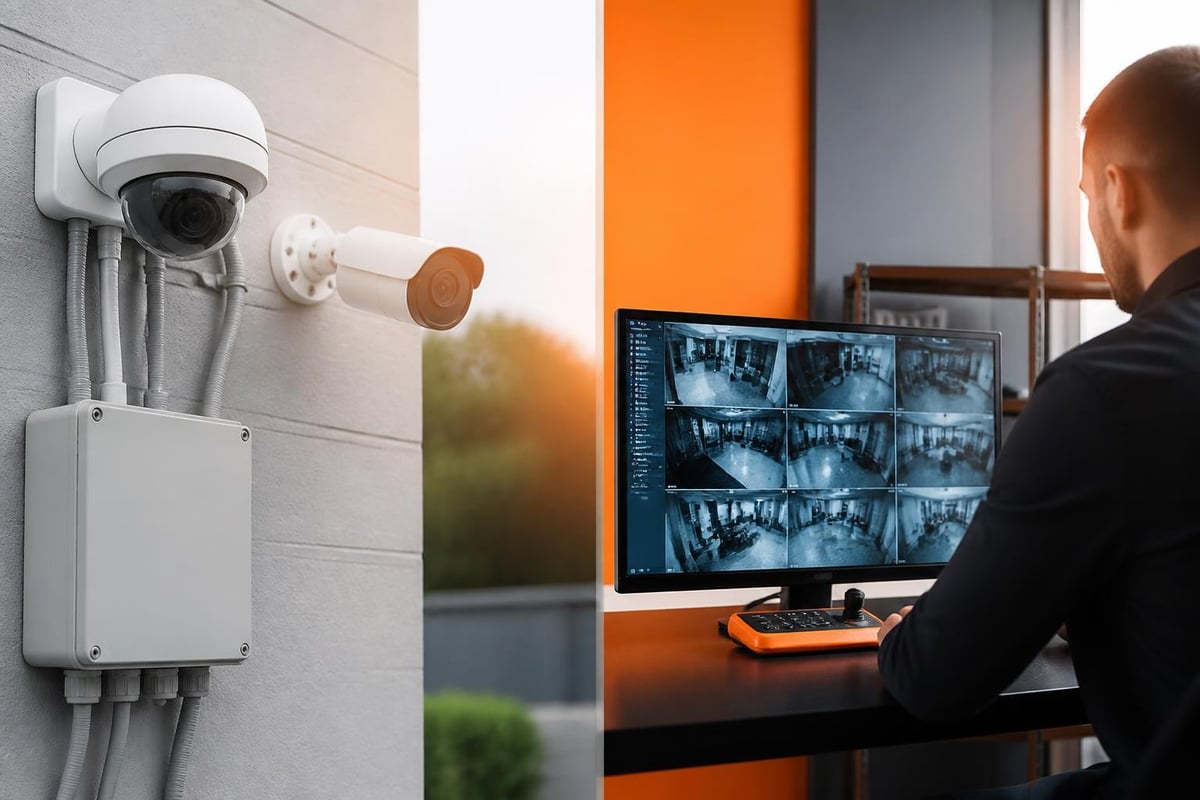
Resolution standards have progressed significantly. Whilst 1080p cameras remain common, 4K ultra-high-definition options provide exceptional detail for identifying faces, vehicle registration plates, and subtle movements across larger areas. The trade-off involves increased storage requirements and bandwidth consumption, factors that must be considered during system design.
| Camera Type | Resolution | Coverage Area | Best Application | Approximate Cost |
|---|---|---|---|---|
| Dome (Indoor) | 2MP-8MP | 20-30 metres | Reception areas, corridors | £150-£400 |
| Bullet (Outdoor) | 2MP-12MP | 30-50 metres | Perimeters, car parks | £200-£600 |
| PTZ (Pan-Tilt-Zoom) | 2MP-8MP | Variable | Large open spaces | £500-£2,000 |
| Fisheye | 5MP-12MP | 360 degrees | Warehouses, retail floors | £300-£800 |
Strategic Camera Placement and Coverage Planning
Effective surveillance begins with thoughtful placement. Understanding how to plan business security camera layout ensures comprehensive coverage whilst avoiding blind spots that criminals might exploit.
Entry and exit points demand priority attention. Every door through which people or goods pass should fall within camera view, ideally capturing facial features and identifying characteristics. Mounting cameras at 8-10 feet height provides optimal facial recognition whilst remaining out of easy reach for tampering.
Critical Monitoring Zones
High-value asset areas require multiple camera angles to eliminate blind spots completely. Stockrooms, safes, server rooms, and areas housing expensive equipment benefit from overlapping coverage that captures activity from different perspectives.
Car parks and external perimeters present unique challenges. Weather-resistant cameras with infrared night vision capabilities ensure 24-hour monitoring regardless of lighting conditions. Optimal security camera placement within business premises considers factors like lighting angles, potential obstructions, and viewing distances to maintain image quality.
- Position cameras to avoid direct sunlight in the lens
- Ensure lighting doesn’t create glare or shadows obscuring faces
- Cover loading bays and service entrances often overlooked
- Monitor staff-only areas to prevent internal theft
- Install cameras at cash handling points and tills
- Protect camera cables from tampering or disconnection
Reception areas serve dual purposes, monitoring visitors whilst deterring inappropriate behaviour. Visible cameras in these spaces communicate that security is taken seriously, often preventing incidents before they escalate.
Legal Compliance and Privacy Considerations
UK businesses must navigate complex legal frameworks when deploying surveillance systems. The Data Protection Act 2018 and UK GDPR impose strict requirements on how video footage is captured, stored, and used. Understanding business security camera legal considerations prevents costly compliance failures and protects employee rights.
Signage plays a crucial role in legal compliance. Clear, visible notices must inform people they’re entering a monitored area, explaining the surveillance purpose and identifying the data controller. These signs should appear before individuals enter camera range, giving them opportunity to understand monitoring occurs.
Privacy Impact Assessments
Before installation, businesses should conduct privacy impact assessments evaluating necessity, proportionality, and potential risks. Can the surveillance objective be achieved through less intrusive means? Does the business interest in security outweigh individual privacy rights? These questions require careful consideration and documentation.
Certain areas are typically off-limits for surveillance. Toilets, changing rooms, and private spaces where individuals have reasonable privacy expectations should never be monitored. Business surveillance privacy laws clarify these boundaries, helping organisations deploy systems that protect assets whilst respecting human rights.
Staff training becomes essential when operating business security camera systems. Employees accessing footage must understand retention policies, appropriate use cases, and restrictions on sharing recordings. Many businesses require personnel to complete compliance training covering data protection, surveillance ethics, and legal responsibilities to ensure consistent, lawful operation.
Data retention periods require clear policies. Storing footage indefinitely creates unnecessary data protection risks and storage costs. Most businesses retain recordings for 30-90 days unless specific incidents require longer preservation for investigation or legal proceedings.
Integration with Comprehensive Security Infrastructure
Business security camera systems deliver maximum value when integrated with broader protection measures. Combining surveillance with intruder alarm monitoring creates layered security that responds to threats in real-time rather than simply recording them.
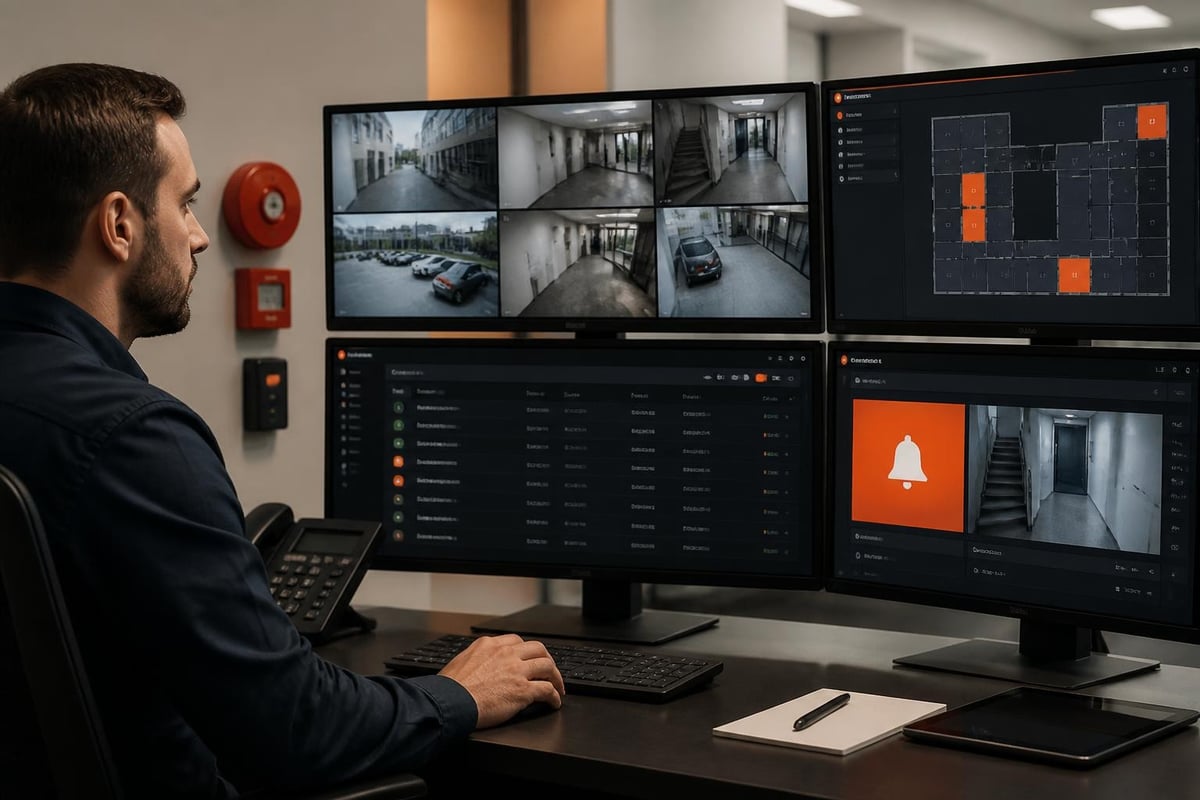
Modern systems enable automation and intelligent responses. When an access control system detects unauthorised entry attempts, integrated cameras can automatically focus on that location, begin recording at higher frame rates, and alert security personnel simultaneously. This coordination significantly reduces response times and improves incident outcomes.
Cloud-Based Management and Remote Monitoring
Cloud storage and management platforms have revolutionised how businesses operate surveillance systems. Remote access allows managers and security teams to view live feeds from any location using smartphones, tablets, or computers. Professional CCTV monitoring services provide expert oversight, with trained operators responding to alerts and coordinating with emergency services when necessary.
Video analytics represent perhaps the most significant advancement in recent years. Artificial intelligence can identify unusual behaviour patterns, count people entering premises, detect loitering, recognise number plates, and distinguish between humans, animals, and vehicles. These capabilities reduce false alarms whilst ensuring genuine security events receive immediate attention.
- Configure motion detection zones to focus on specific areas
- Set up alerts for movement during closed hours
- Integrate with access control to verify identities
- Link cameras to fire alarm systems for evacuation documentation
- Enable two-way audio for remote communication
- Schedule automatic recording based on operational hours
Integration considerations extend to data cabling infrastructure, ensuring network capacity supports high-definition video streams from multiple cameras simultaneously. Bandwidth planning prevents system slowdowns and ensures reliable operation during critical incidents.
Maintenance, Testing and System Longevity
Even the most sophisticated business security camera systems require regular maintenance to perform reliably. Environmental factors, component wear, and software updates all impact system effectiveness over time.
Quarterly physical inspections should assess camera positioning, lens cleanliness, housing condition, and mounting stability. Outdoor cameras face particular challenges from weather exposure, requiring more frequent attention to prevent deterioration affecting image quality.
Software and Firmware Updates
Cybersecurity vulnerabilities represent growing concerns for networked surveillance systems. Manufacturers regularly release firmware updates addressing security flaws and improving functionality. Establishing update schedules and testing patches before deployment prevents systems becoming targets for unauthorised access.
Storage capacity monitoring prevents unexpected recording failures. As camera resolutions increase and retention periods extend, storage requirements grow substantially. Implementing automated alerts when storage reaches capacity ensures timely expansion before recording capability is compromised.
| Maintenance Task | Frequency | Responsible Party | Estimated Time |
|---|---|---|---|
| Lens cleaning | Monthly | Internal staff | 30 minutes |
| Camera positioning check | Quarterly | Security specialist | 2 hours |
| Software updates | As released | IT department | 1-3 hours |
| Storage review | Monthly | System administrator | 30 minutes |
| Full system test | Bi-annually | Professional technician | 4-6 hours |
| Network security audit | Annually | Cybersecurity expert | Full day |
Recording quality tests ensure cameras continue capturing usable evidence. Reviewing sample footage from each camera helps identify issues like focus problems, lighting changes affecting visibility, or obstructions that have developed since installation.
Cost Considerations and Investment Planning
Understanding the true cost of business security camera systems extends beyond initial purchase prices. Installation, ongoing maintenance, storage, monitoring services, and eventual upgrades all contribute to total ownership costs. CCTV fitting costs vary significantly based on system complexity, site characteristics, and feature requirements.
Budget allocation should prioritise quality over quantity. Fewer high-quality cameras providing reliable coverage outperform numerous cheap cameras delivering poor images when needed most. Professional installation ensures optimal positioning and configuration, preventing costly repositioning or replacements.

Return on Investment Factors
Beyond preventing theft and vandalism, surveillance systems deliver value through insurance premium reductions, operational insights, and liability protection. Many insurers offer discounts for businesses with professionally installed and monitored security systems, offsetting ongoing costs.
Operational benefits emerge from reviewing footage to understand customer behaviour, monitor queue lengths, verify delivery times, and investigate accidents or disputes. These secondary uses often justify investment independently of security considerations.
Scalability planning prevents systems becoming obsolete as businesses grow. Selecting platforms that accommodate additional cameras, integrate with emerging technologies, and support expanded storage ensures investments remain viable for years rather than requiring complete replacement when needs evolve.
Advanced Features and Future Technologies
The capabilities of business security camera systems continue expanding rapidly. Thermal imaging cameras detect temperature variations, identifying potential fire risks or detecting intruders in complete darkness. License plate recognition automates vehicle tracking in car parks and entry points.
Behavioural analytics move beyond simple motion detection to identify specific activities. Systems can detect falls, recognise aggressive behaviour, identify abandoned objects, or alert when individuals enter restricted zones. These intelligent features reduce the burden on security personnel whilst improving response accuracy.
Privacy-preserving technologies address growing concerns about surveillance overreach. Privacy-preserving smart camera systems employ techniques like on-device processing, selective blurring, and encrypted storage to balance security needs with individual privacy rights. As regulations tighten, these approaches will become increasingly important for compliant operation.
Edge computing pushes processing power into cameras themselves rather than centralized servers. This architecture reduces bandwidth requirements, enables faster response times, and maintains functionality even when network connectivity is interrupted.
- Facial recognition for access control and VIP identification
- Object classification distinguishing between people, vehicles, animals
- Heat mapping showing movement patterns across premises
- Audio detection identifying breaking glass, shouting, or alarms
- Smoke and fire detection supplementing traditional alarm systems
- Queue management optimising staffing based on customer volumes
Integration with building management systems creates intelligent environments where lighting, climate control, and security work together. Cameras detecting occupancy can trigger appropriate lighting and temperature settings whilst maintaining security monitoring.
Selecting Professional Installation Partners
The expertise of installation teams significantly impacts system performance and reliability. Professional installers understand security best practices and apply them throughout deployment, from network configuration to physical mounting and system testing.
Certification and accreditation provide confidence in installer capabilities. Look for companies holding relevant industry qualifications and manufacturer certifications demonstrating technical competence and commitment to professional standards.
Comprehensive service agreements covering maintenance, updates, and technical support ensure systems remain operational throughout their lifespan. Understanding what’s included in ongoing support prevents unexpected costs and ensures responsive assistance when issues arise.
Business security camera systems represent essential infrastructure for protecting assets, monitoring operations, and ensuring safety across commercial premises. The combination of strategic placement, legal compliance, professional installation, and regular maintenance creates surveillance solutions that deliver reliable protection and operational insights for years to come. Logic Fire and Security brings decades of experience designing, installing, and maintaining integrated security systems for businesses throughout the UK, combining commercial CCTV with fire detection, access control, and professional monitoring services tailored to your specific requirements and compliance obligations.