


Protecting commercial premises requires more than simply purchasing equipment and mounting devices on walls. Professional security alarm system installation demands careful planning, technical expertise, and a thorough understanding of regulatory compliance. For UK businesses, the installation process represents a critical investment in safeguarding assets, protecting employees, and ensuring operational continuity. Whether you’re securing a retail environment, manufacturing facility, or corporate office, the quality of your installation will directly impact system effectiveness and reliability for years to come.
Understanding Your Security Requirements
Before any equipment arrives on site, businesses must conduct a comprehensive security assessment. This evaluation should identify vulnerable entry points, high-value asset locations, and potential security threats specific to your operational environment. Different industries face distinct challenges – a warehouse storing valuable inventory requires different protection compared to a financial services office handling sensitive data.
Working with experienced professionals ensures nothing gets overlooked during this crucial planning phase. Security experts analyse traffic patterns, operational hours, staffing levels, and historical incident data to design systems that address real vulnerabilities rather than generic threats. This tailored approach prevents both over-engineering and, more critically, dangerous gaps in coverage.
Site Survey and Risk Assessment
Professional installers perform detailed site surveys examining physical infrastructure, network capabilities, and environmental factors. They assess wall construction, ceiling heights, lighting conditions, and electromagnetic interference sources that might affect system performance. Understanding these practical considerations before installing a security system prevents costly modifications during implementation.
The survey also identifies existing infrastructure that can be leveraged. Many businesses already have cabling, network infrastructure, or legacy systems that, when properly integrated, reduce installation complexity and cost. This assessment feeds directly into equipment selection and system design.
Choosing the Right System Architecture
Modern security alarm system installation offers businesses two primary architectural approaches: wired systems and wireless solutions. Each presents distinct advantages depending on building characteristics, budget constraints, and operational requirements.
Wired Systems:
- Superior reliability with consistent power and communication
- Ideal for new construction or major renovations
- Lower long-term maintenance requirements
- More complex installation requiring professional expertise
Wireless Systems:
- Faster installation with minimal structural impact
- Excellent for historic buildings or listed properties
- Greater flexibility for future expansion
- Dependent on battery maintenance and signal strength
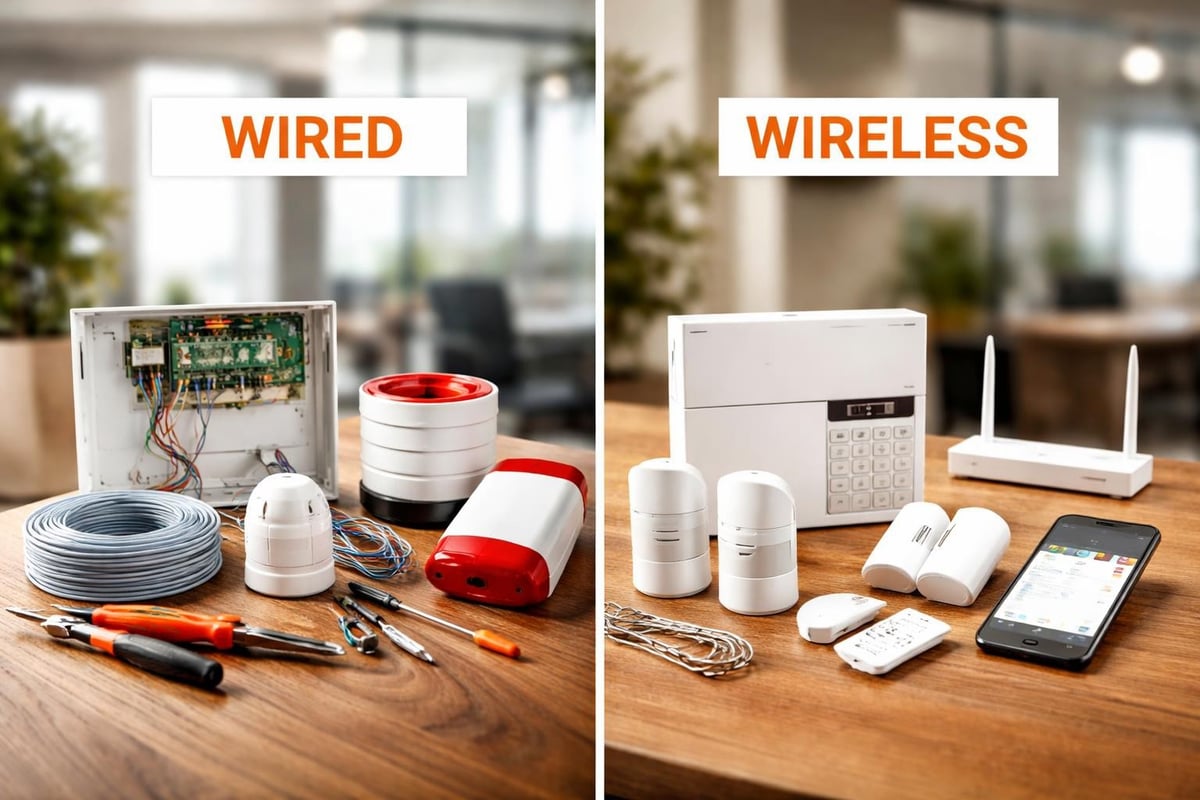
Many businesses benefit from hybrid approaches combining wired backbone infrastructure with wireless peripheral devices. This strategy delivers reliability where it matters most whilst maintaining installation flexibility. The access control and entry systems often integrate seamlessly with alarm infrastructure, creating comprehensive security ecosystems.
Equipment Selection and Specification
Selecting appropriate equipment requires balancing performance, reliability, and budget considerations. Commercial-grade components differ significantly from residential alternatives, offering enhanced durability, greater connectivity options, and compliance with stringent industry standards.
Control Panels and Central Processing
The control panel serves as your system’s brain, processing inputs from sensors and triggering appropriate responses. Modern panels offer network connectivity, remote access capabilities, and integration with building management systems. Specifications should accommodate current needs whilst providing expansion capacity for future growth.
| Feature | Basic Systems | Advanced Systems | Enterprise Solutions |
|---|---|---|---|
| Zone Capacity | 8-16 zones | 32-64 zones | 128+ zones |
| Network Integration | Limited | Full IP connectivity | Multi-site management |
| Monitoring Options | Simple dialler | Dual-path communication | Redundant pathways |
| User Management | Basic codes | Role-based access | Comprehensive audit trails |
Detection Devices and Sensors
Detection technology has advanced considerably, offering businesses sophisticated options beyond traditional door contacts and motion sensors. Glass break detectors, vibration sensors, and environmental monitors create layered security addressing multiple threat vectors. Following best practices for alarm system installation ensures devices are positioned optimally for maximum effectiveness.
Sensor placement requires technical knowledge and practical experience. Motion detectors must account for HVAC airflow, natural light patterns, and normal movement corridors. Door contacts need proper alignment and tamper protection. This precision separates professional installations from amateur attempts.
Planning the Installation Process
Effective security alarm system installation follows a structured methodology minimising business disruption whilst ensuring comprehensive coverage. Planning extends beyond the technical work to include stakeholder communication, access coordination, and contingency arrangements.
Installation Timeline and Phasing
- Pre-installation preparation – Coordinate access, prepare work areas, verify equipment delivery
- Backbone infrastructure installation – Run cabling, mount panels, establish network connections
- Device installation and mounting – Position sensors, keypads, sounders, and signalling equipment
- System programming and configuration – Set zones, configure user codes, establish monitoring protocols
- Testing and commissioning – Verify all functions, conduct walk tests, validate communication paths
- Training and handover – Educate users, document procedures, provide maintenance schedules
Larger facilities often require phased installations maintaining operational security throughout the process. This approach prevents vulnerable periods where existing systems are decommissioned before new protection becomes active.
Regulatory Compliance and Standards
UK businesses must ensure security alarm system installation meets relevant British Standards and regulatory requirements. Compliance protects not only physical assets but also validates insurance coverage and demonstrates due diligence in duty of care obligations.
Professional installers maintain current knowledge of BS 8243 (intruder and hold-up alarm systems) and related standards governing installation practices. These specifications address everything from equipment grading to signalling protocols. Installation standards cover critical elements including power supply requirements, grounding specifications, and tamper protection.
Insurance and Certification Requirements
Insurance providers increasingly specify minimum security standards as policy conditions. Systems must typically achieve specific grades corresponding to risk levels and asset values. Installation certificates from accredited providers demonstrate compliance, often resulting in premium reductions that offset installation costs over time.
The quality and accreditations held by your installation provider directly impact insurance validity and system reliability. Certifications from bodies like NSI (National Security Inspectorate) or SSAIB (Security Systems and Alarms Inspection Board) provide independent verification of professional competence.

Professional Installation Best Practices
Quality security alarm system installation separates reliable protection from systems plagued by false alarms and maintenance issues. Experienced engineers follow proven methodologies addressing common installation challenges before they compromise system performance.
Control Panel Positioning
Control panel placement significantly impacts system reliability and maintenance accessibility. Professional installers position panels in secure locations protected from unauthorized access whilst remaining accessible for servicing. Environmental factors including temperature, humidity, and electromagnetic interference influence placement decisions.
Panels require adequate ventilation, clean power supplies, and protection from physical damage. Mounting height, cable management, and expansion space all factor into long-term system viability. These considerations seem minor but dramatically affect operational reliability.
Keypad and User Interface Placement
Keypad positioning balances user convenience with security requirements. Entry and exit doors require keypads within easy reach whilst maintaining visibility to prevent covert deactivation. Best practices recommend positioning keypads where legitimate users can arm and disarm systems without exposing codes to observation.
Multiple keypads serve larger facilities, reducing the time required for arming and disarming whilst accommodating different access levels across departments or zones. Backlit displays, audible feedback, and intuitive interfaces improve usability, particularly during stressful situations.
Integration with Broader Security Ecosystems
Modern businesses rarely operate standalone alarm systems. Effective security alarm system installation considers integration with CCTV surveillance, access control, fire detection, and building management platforms. This convergence creates intelligent security ecosystems delivering enhanced protection through coordinated responses.
When alarm systems trigger, integrated CCTV monitoring automatically focuses cameras on affected zones, capturing visual verification of incidents. Access control systems can initiate lockdown procedures, whilst fire systems ensure emergency exits remain accessible. This orchestrated response provides comprehensive protection exceeding individual system capabilities.
Network Infrastructure and Connectivity
IP-based security systems leverage existing network infrastructure, reducing installation complexity whilst enabling sophisticated management capabilities. However, security systems require dedicated network segments preventing conflicts with business operations and protecting against cyber threats.
Proper network configuration includes VLAN segregation, quality of service protocols prioritising alarm signals, and redundant communication paths. The data cabling infrastructure supporting security systems demands professional installation ensuring signal integrity and future scalability.
Testing and Commissioning Procedures
No security alarm system installation is complete without comprehensive testing validating every component and function. Systematic testing identifies configuration errors, connectivity issues, and coverage gaps before systems enter operational service.
Functional Testing Protocol
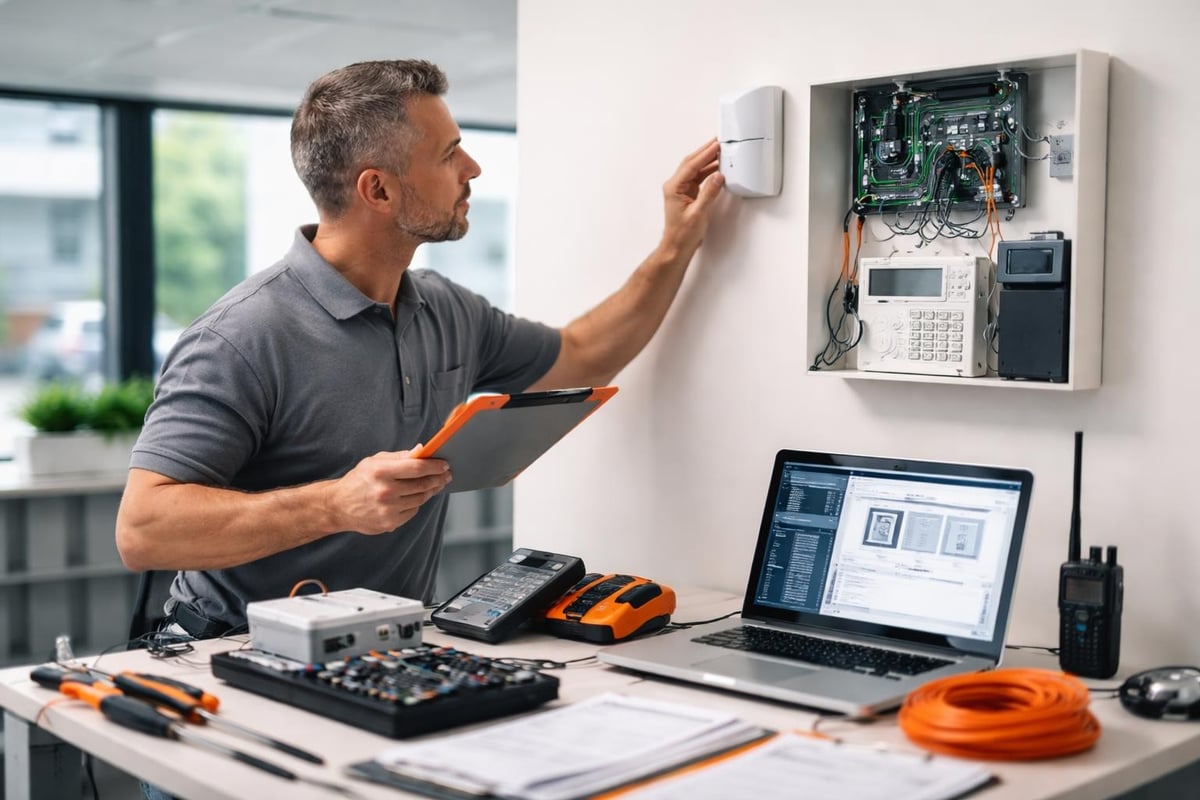
Testing begins with individual device verification – each sensor, detector, and output device must respond correctly to test stimuli. Walk tests confirm detection coverage, identifying blind spots or areas requiring sensor repositioning. Communication path testing validates signals reach monitoring centres reliably across primary and backup routes.
Key Testing Elements:
- Zone-by-zone activation verification
- Tamper detection functionality
- Power supply and battery backup operation
- Communication path redundancy
- User code and access level validation
- Integration with connected systems
Documentation during commissioning provides baseline references for future maintenance and troubleshooting. Detailed records include device locations, zone assignments, and configuration parameters essential for ongoing system management.
Training and Ongoing Management
Even perfectly installed systems fail without proper user training and ongoing management. Security alarm system installation should include comprehensive training ensuring staff understand system operation, response procedures, and basic troubleshooting.
User Training Components
Training programmes address multiple user levels from general staff requiring basic arming and disarming knowledge to security personnel managing advanced functions. Effective training reduces false alarms, improves emergency response, and maximises system value.
Coverage should include routine operations, emergency procedures, alarm verification protocols, and reporting requirements. Hands-on practice in realistic scenarios builds confidence and competence. Written procedures supplement training, providing quick references for infrequent operations.
Monitoring and Response Services
Professional monitoring transforms alarm systems from simple detection devices into comprehensive security solutions. Intruder alarm monitoring provides 24/7 oversight, ensuring rapid response to genuine security incidents whilst filtering false alarms.
Monitoring centres receive alarm signals, verify incidents through established protocols, and coordinate appropriate responses including security personnel dispatch or emergency service notification. This professional oversight proves invaluable during after-hours periods when premises remain unoccupied.
Dual signalling paths using different communication technologies ensure monitoring signals reach operators even if primary connections fail. Modern systems employ IP networking, cellular backup, and traditional telephone lines creating resilient communication architectures.
Maintenance and Lifecycle Management
Security alarm system installation represents the beginning of a long-term relationship requiring ongoing maintenance and periodic upgrades. Regular servicing ensures systems maintain peak performance, identifies developing issues before failures occur, and validates compliance with evolving standards.
Preventive Maintenance Schedules
Professional maintenance programmes include regular testing, cleaning, battery replacement, and firmware updates. Annual inspections satisfy insurance requirements whilst identifying components approaching end-of-life requiring replacement. This proactive approach prevents unexpected failures compromising security.
| Maintenance Activity | Frequency | Purpose |
|---|---|---|
| Full system test | Quarterly | Verify all functions operate correctly |
| Battery inspection | Six monthly | Prevent backup power failures |
| Sensor cleaning | Annually | Maintain detection sensitivity |
| Communication test | Monthly | Confirm monitoring connectivity |
| Software updates | As released | Address vulnerabilities, add features |
The relationship between businesses and their security providers extends beyond installation to encompass ongoing support, system evolution, and technology refresh cycles. Selecting providers offering comprehensive lifecycle services ensures long-term system effectiveness.
Successful security alarm system installation requires professional expertise, careful planning, and attention to detail at every stage. From initial risk assessment through equipment selection, installation execution, and ongoing maintenance, each element contributes to creating robust protection for your business operations. Logic Fire and Security brings decades of experience designing and installing comprehensive security solutions for businesses across the UK, ensuring your premises benefit from cutting-edge technology, regulatory compliance, and reliable protection that evolves with your operational needs.